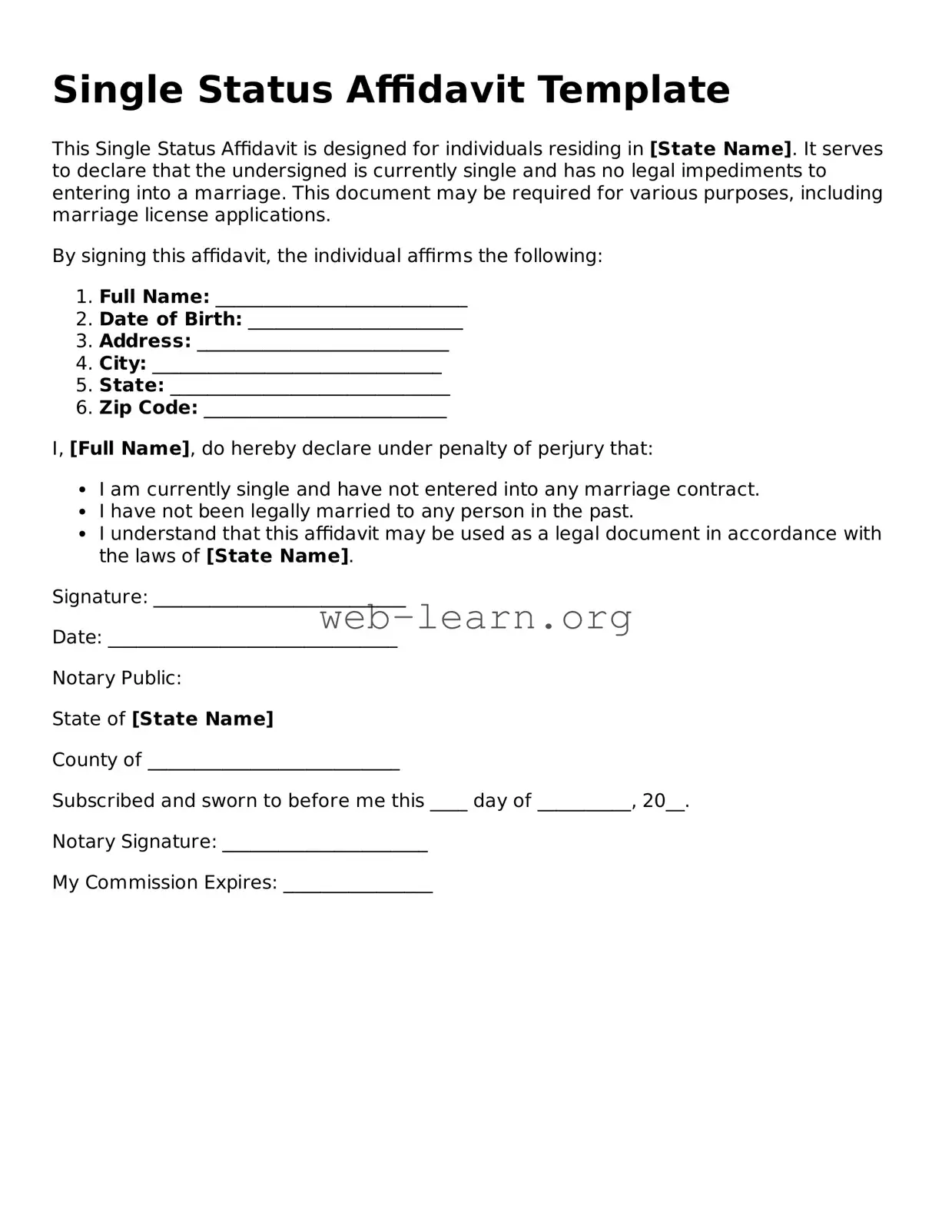
The Single Status Affidavit form serves as a crucial document for individuals who need to declare their marital status, particularly when planning to marry abroad or when required by certain legal entities. This form typically asserts that the individual is legally free to marry, affirming that they are not currently in a marriage or domestic partnership that would prevent them from entering into a new union. It is often used in various countries that require proof of single status for marriage applications. Completing the form usually involves providing personal details, such as your name, date of birth, and possibly your social security number, to verify your identity. Additionally, the form may require a notary public to witness your signature, adding an extra layer of authenticity. Understanding the requirements and implications of the Single Status Affidavit is essential, as it plays a significant role in ensuring a smooth marriage process in jurisdictions that demand it.
Single Status Affidavit Template
This Single Status Affidavit is designed for individuals residing in [State Name]. It serves to declare that the undersigned is currently single and has no legal impediments to entering into a marriage. This document may be required for various purposes, including marriage license applications.
By signing this affidavit, the individual affirms the following:
I, [Full Name], do hereby declare under penalty of perjury that:
Signature: ___________________________
Date: _______________________________
Notary Public:
State of [State Name]
County of ___________________________
Subscribed and sworn to before me this ____ day of __________, 20__.
Notary Signature: ______________________
My Commission Expires: ________________
| Fact Name | Description |
|---|---|
| Definition | A Single Status Affidavit is a legal document confirming that an individual is not currently married. |
| Purpose | This form is often used for marriage license applications in foreign countries. |
| State-Specific Forms | Each state may have its own version of the form, tailored to local requirements. |
| Governing Laws | In the U.S., the governing laws vary by state, such as Family Law or Vital Records statutes. |
| Notarization | Most states require the affidavit to be notarized to be considered valid. |
| Identification | Individuals must provide valid identification when completing the affidavit. |
| Validity Period | The affidavit is typically valid for a limited time, often ranging from 30 to 90 days. |
| Consequences of False Information | Providing false information on the affidavit can lead to legal penalties, including fines or criminal charges. |
Once you have the Single Status Affidavit form in hand, you will need to complete it accurately. This form may be required for various legal purposes, such as marriage or immigration. Follow these steps carefully to ensure all information is provided correctly.
After completing the form, review all entries for accuracy. Ensure that all required sections are filled out before submitting it to the appropriate authority.
A Single Status Affidavit is a legal document that confirms an individual’s single status. It is often required for those who wish to marry in a foreign country or for other legal purposes where proof of being unmarried is necessary. This affidavit serves as a sworn statement, affirming that the individual is not currently married or engaged in any marital relationship.
This document is typically required when applying for a marriage license in certain jurisdictions, especially abroad. Many countries require proof that you are legally free to marry. Without this affidavit, you may face delays or complications in your marriage process.
To obtain a Single Status Affidavit, you will need to visit a notary public or a legal professional who can assist you in drafting the document. You may need to provide personal information, including your full name, date of birth, and any previous marriages or divorces. Once prepared, you will sign the affidavit in front of the notary, who will then notarize it.
A Single Status Affidavit generally includes the following information:
Yes, there may be a fee for the notary's services, which can vary based on location and the complexity of the document. Additionally, if you require the affidavit to be certified or apostilled for international use, there may be additional costs involved.
Yes, when you go to sign the affidavit, you will typically need to present a valid form of identification. This could be a driver's license, passport, or any government-issued ID that verifies your identity and confirms your single status.
The validity of a Single Status Affidavit can vary depending on the requirements of the jurisdiction where you intend to use it. Some places may require that the affidavit be issued within a specific time frame prior to your marriage. It is advisable to check the local regulations where you plan to marry.
Yes, a Single Status Affidavit can be used for various legal purposes beyond marriage. For example, it may be required for certain immigration applications or legal proceedings where proof of marital status is necessary. Always confirm with the requesting authority to ensure the affidavit meets their requirements.
If your Single Status Affidavit is lost or damaged, you will need to obtain a new one. This process typically involves contacting the notary or legal professional who prepared the original document and requesting a replacement. Be prepared to provide any necessary information to verify your identity and single status.
Completing a Single Status Affidavit form can be a straightforward task, yet many individuals make common mistakes that can lead to complications. One frequent error occurs when people fail to provide accurate personal information. Names, addresses, and dates of birth must match official documents. Any discrepancies can raise questions about the validity of the affidavit.
Another mistake is neglecting to sign the affidavit in the appropriate section. A signature is not just a formality; it serves as an affirmation of the truthfulness of the information provided. Without a signature, the document may be considered incomplete or invalid.
People often overlook the requirement for notarization. A notary public must witness the signing of the affidavit to ensure its authenticity. Skipping this step can render the affidavit useless in legal contexts.
In addition, individuals sometimes fail to read the instructions thoroughly. Each jurisdiction may have specific requirements regarding the format and content of the affidavit. Ignoring these guidelines can lead to delays or rejections.
Another common error is providing insufficient proof of single status. Some forms require supporting documentation, such as a divorce decree or a death certificate. Omitting these documents can cause unnecessary complications.
Moreover, individuals may forget to update their information if there have been recent changes, such as a name change due to marriage or divorce. This oversight can create confusion and may lead to legal challenges.
People also sometimes underestimate the importance of clarity and legibility. Illegible handwriting can make it difficult for officials to process the affidavit. Typed forms are often preferred to avoid this issue.
Additionally, failing to double-check for errors in spelling or grammar can undermine the professionalism of the document. Such mistakes may not invalidate the affidavit, but they can create doubt about its credibility.
Finally, individuals may not consider the implications of submitting the affidavit in a timely manner. Delays in filing can affect personal plans, such as marriage or immigration processes. Being proactive and organized can help avoid these pitfalls.
The Single Status Affidavit is a document often required to confirm that an individual is not currently married. In various legal and personal contexts, several other forms and documents may accompany this affidavit to provide additional information or to fulfill specific requirements. Below is a list of commonly associated documents.
These documents, when used in conjunction with the Single Status Affidavit, help to establish a clear legal standing regarding an individual's marital status. Proper preparation and submission of these forms can facilitate various legal processes, including marriage licensing and other official matters.
The Single Status Affidavit form is a document that individuals often use to confirm their marital status. Several other documents serve similar purposes, each with its own specific context and requirements. Below is a list of ten documents that share similarities with the Single Status Affidavit:
Each of these documents serves to affirm an individual's marital status, whether for legal, personal, or procedural reasons. Understanding the nuances of each can be important when navigating marriage-related legal requirements.
When filling out the Single Status Affidavit form, it's important to follow certain guidelines to ensure accuracy and compliance. Here are six things to keep in mind:
The Single Status Affidavit is a document often required for individuals who want to prove their single status, typically for marriage or legal purposes. However, several misconceptions surround this form. Here are five common misunderstandings:
It is only needed for marriage abroad. Many people believe that the Single Status Affidavit is exclusively for those planning to marry in another country. In reality, it can also be required for domestic legal matters, such as certain legal proceedings or property transactions.
Anyone can create their own affidavit. Some think they can simply write their own affidavit without any formal process. However, many jurisdictions require the affidavit to be notarized and may have specific wording or content requirements to ensure its validity.
It guarantees that you are legally single. A Single Status Affidavit serves as a sworn statement but does not provide legal proof of your marital status. It is essential to check with local authorities or legal counsel to confirm what documentation is needed to establish your status officially.
There is a standard format for the affidavit. While many templates exist, the format and requirements for the Single Status Affidavit can vary significantly depending on the state or country. Always verify the specific requirements for your situation.
Once signed, it cannot be changed. Some individuals assume that once the affidavit is completed and signed, it is set in stone. In fact, if your circumstances change, you may be able to update or revoke the affidavit, but this typically involves additional steps.
Understanding these misconceptions can help individuals navigate the process more effectively and ensure they meet all necessary legal requirements.
Here are key takeaways for filling out and using the Single Status Affidavit form:
Letter to Verify Address - The affidavit may need to be submitted to various agencies or institutions.