The Indiana Affidavit of Residency form serves a crucial role for individuals who need to verify their residence for various purposes, such as enrolling in schools, obtaining government services, or fulfilling legal requirements. This form is typically used by parents or guardians to affirm that a child resides at a specific address, ensuring that the child can access educational opportunities and community resources. Completing the affidavit involves providing essential information, including the names of the individuals involved, the address in question, and a declaration of the residency status. The form must be signed in the presence of a notary public, adding an extra layer of authenticity to the claim. While it may seem straightforward, understanding the implications of this document is vital, as it can affect educational eligibility and access to local services. Whether you are a parent seeking to enroll your child in a school or an individual needing to establish residency for legal matters, familiarity with the Indiana Affidavit of Residency form can help streamline the process and ensure compliance with state requirements.
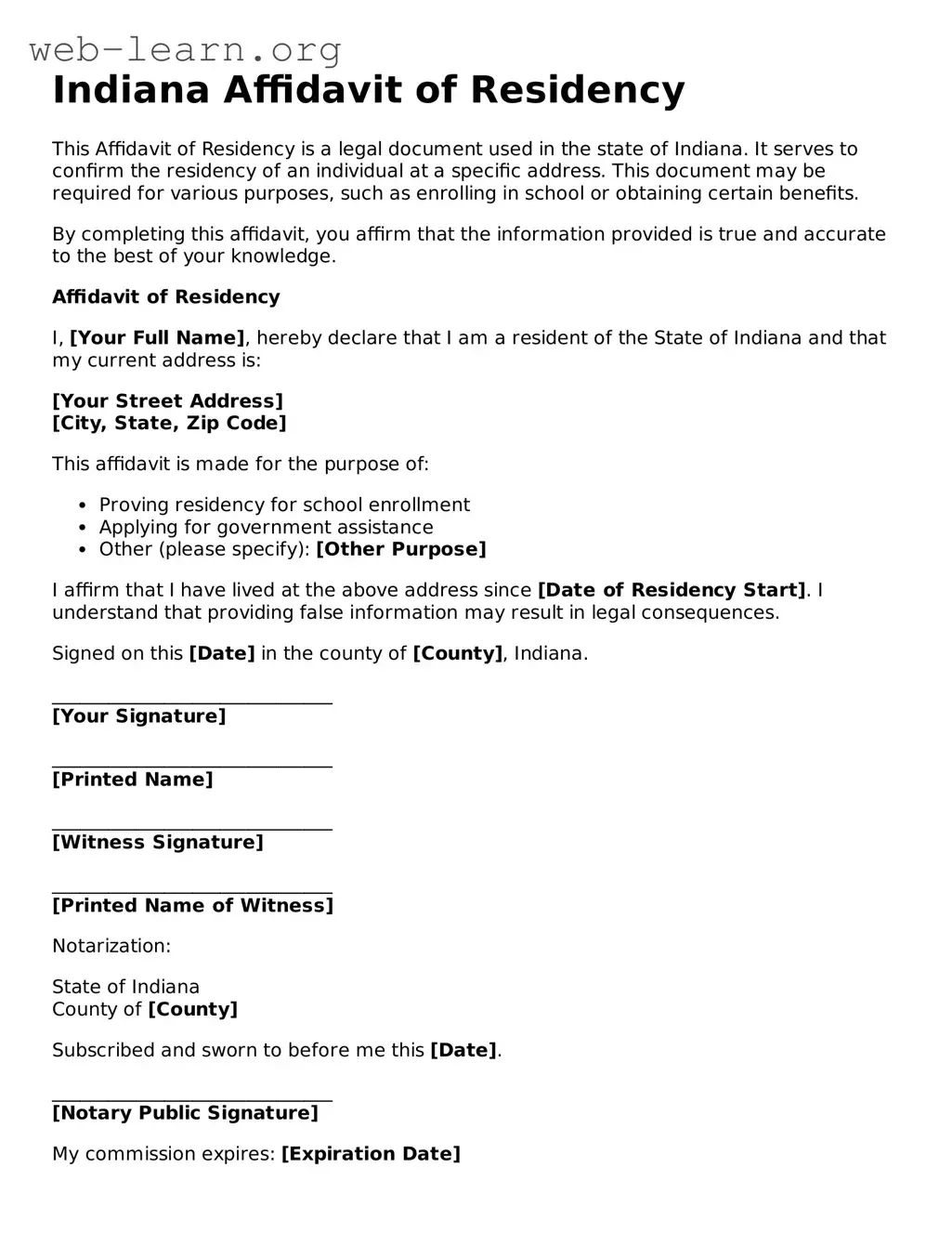
Indiana Affidavit of Residency
This Affidavit of Residency is a legal document used in the state of Indiana. It serves to confirm the residency of an individual at a specific address. This document may be required for various purposes, such as enrolling in school or obtaining certain benefits.
By completing this affidavit, you affirm that the information provided is true and accurate to the best of your knowledge.
Affidavit of Residency
I, [Your Full Name], hereby declare that I am a resident of the State of Indiana and that my current address is:
[Your Street Address]
[City, State, Zip Code]
This affidavit is made for the purpose of:
I affirm that I have lived at the above address since [Date of Residency Start]. I understand that providing false information may result in legal consequences.
Signed on this [Date] in the county of [County], Indiana.
______________________________
[Your Signature]
______________________________
[Printed Name]
______________________________
[Witness Signature]
______________________________
[Printed Name of Witness]
Notarization:
State of Indiana
County of [County]
Subscribed and sworn to before me this [Date].
______________________________
[Notary Public Signature]
My commission expires: [Expiration Date]
| Fact Name | Details |
|---|---|
| Purpose | The Indiana Affidavit of Residency form is used to verify an individual's residence for various legal and administrative purposes. |
| Governing Law | This form is governed by Indiana Code § 36-1-8-5, which outlines residency requirements for certain legal matters. |
| Who Uses It | Individuals, businesses, and organizations may use this form to confirm residency status when required by law or policy. |
| Filing Requirements | The completed affidavit must be signed in the presence of a notary public to ensure its validity. |
| Where to Obtain | The form can be obtained from local government offices, legal aid organizations, or online resources provided by the state. |
Filling out the Indiana Affidavit of Residency form is an important step in establishing your residency for various legal purposes. Once you have completed the form, you will need to submit it to the appropriate authority, which may vary depending on your specific situation.
What is the Indiana Affidavit of Residency form?
The Indiana Affidavit of Residency form is a legal document used to verify an individual's residence in Indiana. This form is often required for various purposes, such as enrolling a child in school or establishing residency for legal matters.
Who needs to complete the Affidavit of Residency?
Individuals who need to confirm their residency in Indiana may be required to complete this form. This includes parents or guardians enrolling children in schools, individuals applying for certain state benefits, or those involved in legal proceedings that necessitate proof of residence.
What information is required on the form?
The form typically asks for basic personal information, including:
How do I obtain the Affidavit of Residency form?
The form can be obtained from various sources, including:
Is the Affidavit of Residency notarized?
In many cases, the Affidavit of Residency must be notarized to be considered valid. Notarization adds an extra layer of authenticity, confirming that the information provided is true and accurate.
Where do I submit the completed form?
The completed form should be submitted to the appropriate entity requiring it. This could be a school district, a court, or another organization that requested proof of residency.
Can I use the Affidavit of Residency for multiple purposes?
Yes, the Affidavit of Residency can often be used for multiple purposes as long as it meets the requirements set by the requesting entity. However, it is important to check with the specific organization to ensure it will be accepted.
What happens if I provide false information on the form?
Providing false information on the Affidavit of Residency can lead to serious consequences, including legal penalties. It is crucial to ensure that all information is accurate and truthful before signing the document.
How long is the Affidavit of Residency valid?
The validity of the Affidavit of Residency can vary depending on the purpose for which it was created. Generally, it remains valid as long as the residency information is accurate. If your circumstances change, you may need to complete a new affidavit.
Can someone help me fill out the form?
Yes, you may seek assistance from a trusted friend, family member, or legal professional if you need help completing the form. It is important that you understand the information being provided and ensure its accuracy.
Completing the Indiana Affidavit of Residency form can be straightforward, but many individuals make common mistakes that can delay processing or lead to complications. One frequent error is failing to provide accurate personal information. This includes the name, address, and date of birth. Inaccuracies can lead to questions about residency status.
Another mistake often seen is not signing the form. A signature is essential for the affidavit to be considered valid. Without it, the form cannot be processed, and this can lead to unnecessary delays.
Some individuals overlook the requirement for a witness or notary. Depending on the specific circumstances, the affidavit may need to be signed in front of a notary public or a witness. Failing to do this can render the affidavit invalid.
In addition, people sometimes forget to include supporting documentation. When claiming residency, it is crucial to provide proof, such as utility bills or lease agreements. Omitting these documents can raise doubts about residency claims.
Another common oversight is not checking for completeness. Review the entire form to ensure that all sections are filled out. Leaving any section blank can lead to processing delays.
Many individuals also misinterpret the residency requirements. Understanding what constitutes residency in Indiana is vital. Misunderstandings can lead to incorrect information being provided.
Additionally, some people submit the form without making a copy for their records. Keeping a copy is important for future reference, especially if there are questions or issues that arise later.
People often fail to adhere to deadlines. Each situation may have specific timelines for submission. Missing these deadlines can result in complications or the need to refile.
Lastly, individuals sometimes do not seek assistance when needed. If there are uncertainties about how to complete the form, consulting with a knowledgeable source can prevent mistakes that could complicate the process.
The Indiana Affidavit of Residency form is often used in various legal and administrative situations. To support your residency claim or to fulfill requirements, you may need to provide additional documents. Here’s a list of other forms and documents that are commonly used alongside the Affidavit of Residency in Indiana.
Gathering these documents can help strengthen your case when submitting the Indiana Affidavit of Residency form. Ensure that all documents are current and accurately reflect your information to avoid complications.
When filling out the Indiana Affidavit of Residency form, it is important to follow certain guidelines to ensure accuracy and compliance. Below is a list of things you should and shouldn't do.
The Indiana Affidavit of Residency form is often misunderstood. Here are ten common misconceptions about this document:
Many believe the form is exclusively for students. In reality, anyone needing to prove residency can use it, including adults for various legal purposes.
While notarization adds credibility, it is not a strict requirement for the affidavit to be valid. The form can be signed without a notary in some situations.
This form is specific to Indiana, but individuals moving to Indiana from other states can also use it to establish residency.
The affidavit is intended for specific situations, such as school enrollment or voter registration. It may not suffice for all legal matters.
Filing the affidavit itself does not typically incur a fee. However, additional costs may arise if notarization is required.
While some agencies may require in-person submission, many allow the affidavit to be submitted online or by mail.
Only individuals who meet residency requirements should complete the form. Misrepresentation can lead to legal consequences.
While the affidavit does not expire, the information provided must be current and accurate at the time of submission.
The affidavit is a sworn statement, meaning it carries legal weight. Providing false information can result in penalties.
The affidavit is not a lease. It serves a different purpose, primarily to confirm residency rather than establish rental agreements.
When filling out and using the Indiana Affidavit of Residency form, it’s important to understand several key points to ensure proper completion and usage. Here are some essential takeaways:
Understanding these key aspects will help ensure that the Indiana Affidavit of Residency form is filled out correctly and used effectively.
How to Become an Alabama Resident - Affidavits of Residency can be part of a larger application process for various services.
How Much Does It Cost to Get a Driver's License in Idaho - Individuals can create their own affidavit if they follow legal guidelines.
Residential Affidavit - The affidavit can clarify residency status for insurance purposes, especially in claims.