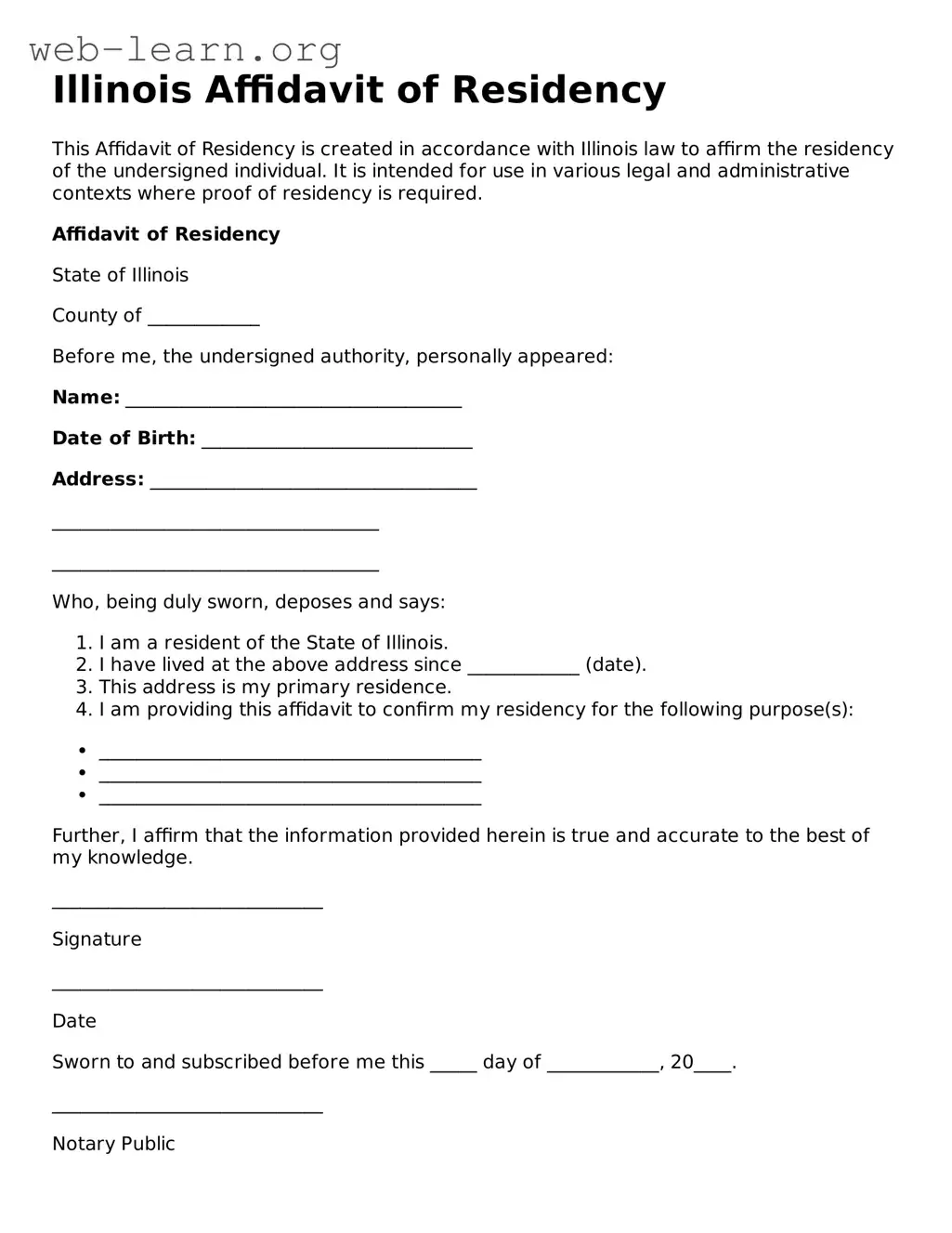
The Illinois Affidavit of Residency form plays a crucial role for individuals needing to verify their residence status in various situations. This form is often required for students seeking in-state tuition rates, individuals applying for certain government benefits, or anyone needing to confirm their residency for legal purposes. By completing this affidavit, a person declares their current address and affirms their residency status under penalty of perjury. It typically includes sections for personal information, such as the individual's name, address, and the duration of their residency. Additionally, the form may require a witness or notary signature to enhance its credibility. Understanding the nuances of this form can help residents navigate legal requirements more effectively and ensure compliance with local regulations.
Illinois Affidavit of Residency
This Affidavit of Residency is created in accordance with Illinois law to affirm the residency of the undersigned individual. It is intended for use in various legal and administrative contexts where proof of residency is required.
Affidavit of Residency
State of Illinois
County of ____________
Before me, the undersigned authority, personally appeared:
Name: ____________________________________
Date of Birth: _____________________________
Address: ___________________________________
___________________________________
___________________________________
Who, being duly sworn, deposes and says:
Further, I affirm that the information provided herein is true and accurate to the best of my knowledge.
_____________________________
Signature
_____________________________
Date
Sworn to and subscribed before me this _____ day of ____________, 20____.
_____________________________
Notary Public
My commission expires: _______________
| Fact Name | Details |
|---|---|
| Purpose | The Illinois Affidavit of Residency form is used to verify an individual's residency status. |
| Governing Law | This form is governed by the Illinois Compiled Statutes, specifically 105 ILCS 5/10-20.12. |
| Who Uses It | Schools and educational institutions often require this affidavit from parents or guardians. |
| Filing Requirements | The form must be signed in the presence of a notary public. |
| Information Required | It typically requires the name, address, and other personal details of the individual claiming residency. |
| Validity | The affidavit is usually valid for the school year in which it is submitted. |
| Consequences of False Information | Providing false information on the affidavit can lead to legal consequences, including potential criminal charges. |
Completing the Illinois Affidavit of Residency form is an important step in establishing your residency status. Follow the steps below to ensure that you fill out the form correctly and efficiently.
After completing the form, keep an eye out for any further instructions or confirmations from the agency to which you submitted it. This will ensure that your residency status is recognized without any issues.
What is the Illinois Affidavit of Residency form?
The Illinois Affidavit of Residency form is a legal document used to verify a person's residence in the state of Illinois. It is often required for various purposes, such as enrolling a child in school, obtaining a driver's license, or applying for certain government benefits.
Who needs to complete the Affidavit of Residency?
Typically, individuals who are applying for services or benefits that require proof of residency in Illinois must complete this form. This includes parents enrolling their children in public schools, individuals applying for state assistance, or those needing to establish residency for legal purposes.
What information is required on the form?
The form generally requires personal information, including:
Is the Affidavit of Residency form notarized?
Yes, in many cases, the form must be notarized. This means that you will need to sign the document in front of a notary public, who will then verify your identity and witness your signature. Notarization adds an extra layer of authenticity to the document.
Where can I obtain the Affidavit of Residency form?
You can usually find the Affidavit of Residency form on the official website of the Illinois Secretary of State or your local school district's website. Additionally, many government offices may have physical copies available for you to fill out.
How do I submit the completed form?
The submission process can vary depending on why you need the form. If it is for school enrollment, you may need to submit it directly to the school office. For other purposes, such as applying for benefits, you may need to submit it to the relevant government agency. Always check the specific instructions provided by the organization requesting the affidavit.
What if I move after submitting the form?
If you move after submitting the Affidavit of Residency, you should notify the organization or agency that requested the form. Depending on the circumstances, you may need to complete a new affidavit to reflect your new address.
Are there penalties for providing false information?
Yes, providing false information on the Affidavit of Residency can lead to serious consequences. This could include legal penalties, loss of benefits, or other repercussions. It is crucial to provide accurate and truthful information when completing the form.
Can someone else complete the form on my behalf?
In some cases, another person may assist you in completing the form, but you must personally sign it. The individual helping you must have your consent and be aware of your residency details to provide accurate information.
How long is the Affidavit of Residency valid?
The validity of the Affidavit of Residency can depend on the specific requirements of the organization requesting it. Generally, it is considered valid for as long as your residency status remains unchanged. However, if you move or if the organization requires periodic updates, you may need to submit a new affidavit.
Filling out the Illinois Affidavit of Residency form is a crucial step for individuals seeking to establish residency for various legal purposes. However, many people make common mistakes that can lead to complications or delays. Understanding these pitfalls can help ensure a smoother process.
One frequent error occurs when individuals fail to provide accurate personal information. This includes misspellings of names, incorrect addresses, or outdated contact information. Such inaccuracies can create confusion and may result in the rejection of the affidavit. It is essential to double-check all entries to ensure they reflect current and correct details.
Another mistake involves not signing the affidavit in the appropriate section. Some individuals overlook the requirement for a signature, believing that filling out the form is sufficient. Without a signature, the affidavit lacks validity. It is important to take a moment to review the form and ensure that all necessary signatures are included before submission.
Additionally, individuals often neglect to include supporting documentation. The affidavit may require proof of residency, such as utility bills or lease agreements. Failing to attach these documents can lead to delays in processing. It is advisable to gather all necessary paperwork ahead of time to avoid unnecessary setbacks.
Furthermore, individuals sometimes misinterpret the instructions regarding the residency duration. The affidavit may require a specific period of residency to be established. Misunderstanding this requirement can result in submitting an affidavit that does not meet the necessary criteria. Careful reading of the instructions is vital to ensure compliance with residency requirements.
Lastly, some people submit the affidavit without consulting with a knowledgeable party, such as an attorney or a legal aid organization. This lack of guidance can lead to errors that could have been easily avoided. Seeking assistance can provide clarity and help individuals navigate the complexities of the form more effectively.
The Illinois Affidavit of Residency form is often accompanied by several other documents that help to establish residency or support various legal claims. Each of these documents serves a specific purpose, ensuring that the information provided is accurate and reliable. Below is a list of common forms and documents that may be used alongside the Affidavit of Residency.
When gathering these documents, it is essential to ensure that all information is accurate and up-to-date. Having the necessary paperwork on hand can streamline the process and help avoid any potential complications related to residency verification.
The Affidavit of Residency form serves a specific purpose in verifying a person's residence. However, several other documents share similar functions in confirming residency or providing proof of address. Here’s a breakdown of eight such documents:
Each of these documents plays a crucial role in establishing residency, whether for legal, financial, or administrative purposes. Understanding their similarities helps in navigating situations that require proof of where you live.
When filling out the Illinois Affidavit of Residency form, it's important to follow certain guidelines to ensure accuracy and compliance. Here are some dos and don'ts to keep in mind:
The Illinois Affidavit of Residency form is often misunderstood. Below are ten common misconceptions about this form, along with clarifications.
While many students use the Affidavit of Residency to establish residency for school purposes, it is also applicable for various legal and administrative reasons, such as voting or obtaining a driver's license.
The form requires the signature of a notary public, which adds a layer of verification to the residency claims made by the individual.
This affidavit is specific to Illinois and may not hold legal weight in other states. Each state has its own residency documentation requirements.
Filling out the form does not automatically grant residency status. It serves as a declaration and may be subject to further review by relevant authorities.
There are specific deadlines for submitting the affidavit, especially for students who wish to establish residency for tuition purposes. Missing these deadlines may result in ineligibility.
Renters can also use the Affidavit of Residency. Proof of residency can come from various sources, including rental agreements.
The affidavit is not a lease. It is a sworn statement that affirms a person's residency, while a lease is a legal contract between a landlord and tenant.
If residency circumstances change, individuals can submit a new affidavit to reflect their current situation. It is important to keep residency information up to date.
Private schools and other institutions may also require proof of residency, making the affidavit relevant across various educational settings.
The Affidavit of Residency is straightforward. It typically requires basic information about the individual and their residency status, making it accessible for most people.
Filling out the Illinois Affidavit of Residency form is an important process for verifying where you live. Here are some key takeaways to keep in mind:
By following these guidelines, you can navigate the process of filling out the Illinois Affidavit of Residency form with confidence.
Id Indiana - Affidavits of Residency can help students qualify for in-state tuition rates.
How Much Does It Cost to Get a Driver's License in Idaho - Individuals may need to provide identification when submitting this form.