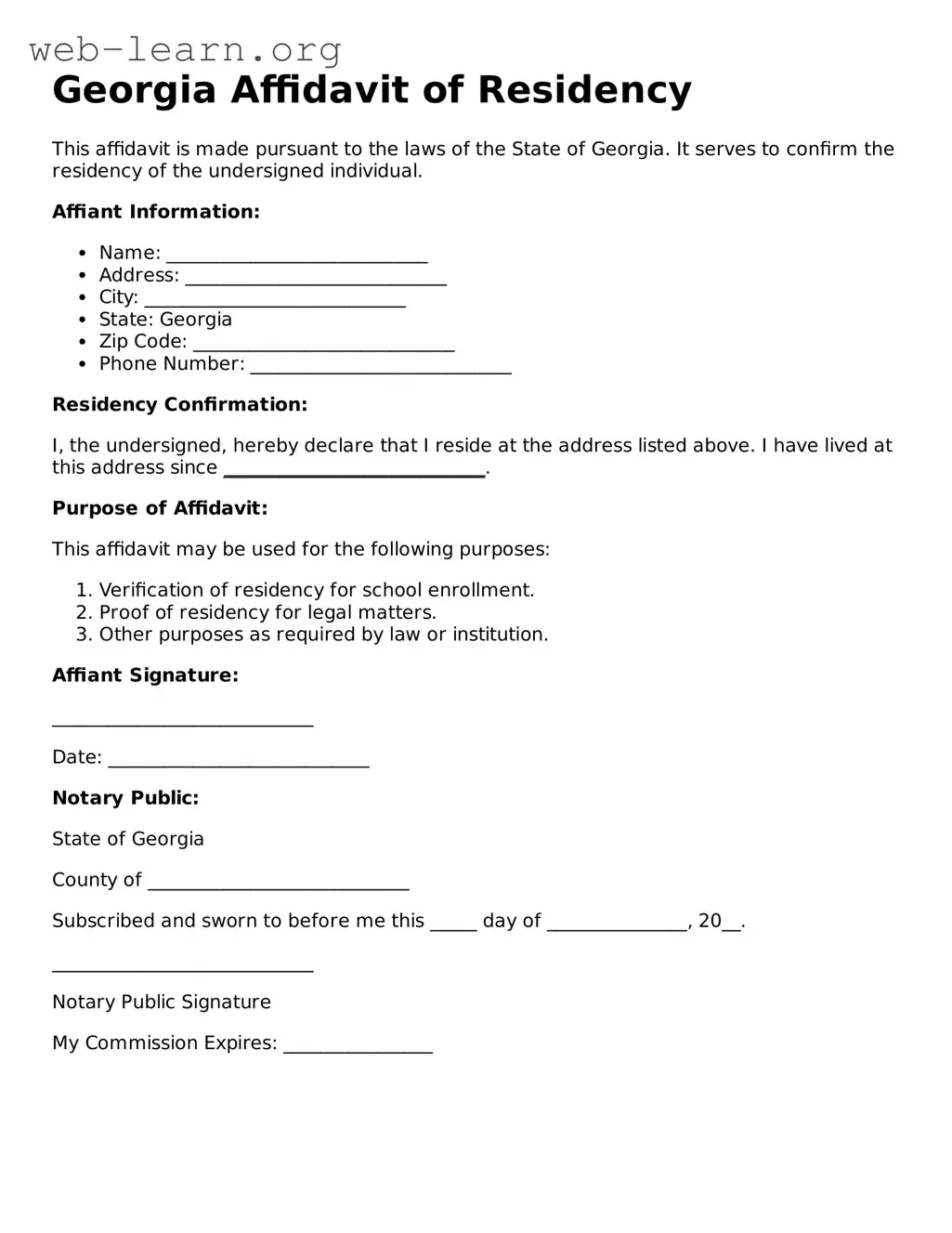
The Georgia Affidavit of Residency form plays a crucial role in establishing a person's residency status within the state. This form is often required for various purposes, such as enrolling children in public schools, obtaining certain government benefits, or applying for in-state tuition rates at colleges and universities. It serves as a sworn statement that verifies an individual's physical presence in Georgia and their intention to remain there. The form typically requires the affiant to provide personal information, including their name, address, and the duration of their residency. Additionally, it may require the signature of a witness or a notary public to ensure authenticity. Understanding the requirements and implications of this affidavit is essential for anyone navigating residency-related processes in Georgia.
Georgia Affidavit of Residency
This affidavit is made pursuant to the laws of the State of Georgia. It serves to confirm the residency of the undersigned individual.
Affiant Information:
Residency Confirmation:
I, the undersigned, hereby declare that I reside at the address listed above. I have lived at this address since ____________________________.
Purpose of Affidavit:
This affidavit may be used for the following purposes:
Affiant Signature:
____________________________
Date: ____________________________
Notary Public:
State of Georgia
County of ____________________________
Subscribed and sworn to before me this _____ day of _______________, 20__.
____________________________
Notary Public Signature
My Commission Expires: ________________
| Fact Name | Details |
|---|---|
| Purpose | The Georgia Affidavit of Residency form is used to verify an individual's residency status within the state of Georgia. |
| Governing Law | This form is governed by Georgia state law, specifically O.C.G.A. § 50-13-1. |
| Eligibility | Any individual who resides in Georgia and needs to prove their residency can complete this form. |
| Usage | The affidavit may be required for various purposes, including obtaining a driver's license, enrolling in school, or applying for government assistance. |
| Signature Requirement | The form must be signed in the presence of a notary public to ensure its validity. |
| Information Needed | Individuals must provide personal details such as their name, address, and date of birth on the form. |
| Submission | Once completed and notarized, the affidavit should be submitted to the relevant agency or institution that requires proof of residency. |
| Retention | It is advisable for individuals to keep a copy of the completed affidavit for their records. |
Completing the Georgia Affidavit of Residency form is essential for establishing your residency status in the state. After filling out the form, you will need to submit it to the appropriate authority, which may include a school or government agency, depending on your specific needs.
What is the Georgia Affidavit of Residency form?
The Georgia Affidavit of Residency form is a legal document used to verify an individual's residence in the state of Georgia. It is often required for various purposes, such as enrolling a child in school, applying for certain benefits, or proving residency for legal proceedings.
Who needs to complete this form?
This form is typically completed by individuals who need to confirm their residency status. This may include parents or guardians enrolling children in public schools, individuals applying for state assistance, or anyone needing to establish residency for legal matters.
What information is required on the form?
The form generally requires personal information such as the individual's name, address, and the duration of residency at that address. Additionally, it may ask for details about the individual’s relationship to the person verifying the residency, along with signatures from both parties.
How is the form submitted?
Once completed, the form can be submitted to the relevant authority, such as a school district or government agency. It is essential to check the specific submission guidelines for the organization requesting the affidavit, as they may have different requirements.
Is the form notarized?
In many cases, the Georgia Affidavit of Residency form must be notarized to ensure its authenticity. Notarization involves a licensed notary public witnessing the signing of the document and providing a seal to confirm that the signatures are legitimate.
Can someone else sign the form on my behalf?
Yes, in certain situations, another person may sign the form on your behalf, but this typically requires a power of attorney or explicit permission. It is important to ensure that the individual signing has the legal authority to do so.
What if my residency changes after submitting the form?
If your residency changes after you have submitted the form, it is crucial to inform the relevant authority immediately. This may involve completing a new affidavit or providing additional documentation to reflect your new residency status.
Are there any penalties for providing false information?
Yes, providing false information on the Georgia Affidavit of Residency form can lead to serious consequences, including legal penalties. It is important to be truthful and accurate when completing the form to avoid any potential issues.
Where can I obtain the Georgia Affidavit of Residency form?
The form can typically be obtained from local school districts, government offices, or online through official state websites. It is advisable to ensure you are using the most current version of the form to avoid any complications.
Is there a fee associated with submitting the form?
Generally, there is no fee for submitting the Georgia Affidavit of Residency form itself. However, some agencies may charge fees for notarization or for processing other related documents. Always check with the specific agency for their fee structure.
When filling out the Georgia Affidavit of Residency form, it's essential to be meticulous. Many individuals make common mistakes that can lead to delays or complications. One frequent error is not providing the correct address. Ensure that the address listed is the one where you currently reside, including any apartment or unit numbers. An incorrect address can cause confusion and may result in your affidavit being rejected.
Another mistake often made is failing to sign the form. After completing the affidavit, it is crucial to sign and date it. Without your signature, the document is not valid. Remember, this form is a legal declaration, and your signature confirms the information provided is true.
Many people overlook the requirement for a witness or notary. Depending on the specific use of the affidavit, you might need someone to witness your signature or have the document notarized. Ignoring this step can render the affidavit ineffective.
Additionally, some individuals forget to include all required information. The form may ask for details like your name, date of birth, and other identifying information. Omitting any of these details can delay processing and may require you to start over.
Another common oversight is using outdated forms. Always ensure you are using the most current version of the Affidavit of Residency. Using an old version can lead to rejection, as requirements may have changed.
People also sometimes fail to read the instructions carefully. Each section of the form may have specific requirements or instructions that need to be followed. Skipping over these can lead to mistakes that could have been easily avoided.
In some cases, individuals provide inaccurate information. It is vital to double-check all entries for accuracy. Providing false information, even unintentionally, can have serious legal repercussions.
Another mistake is not keeping a copy of the completed affidavit. After submission, having a copy for your records can be invaluable, especially if any issues arise later. It serves as proof of what was submitted.
Lastly, many people underestimate the importance of timing. Submitting the affidavit too close to a deadline can lead to stress and mistakes. Allow yourself ample time to complete the form accurately and submit it without rushing.
By being aware of these common mistakes, you can ensure that your Georgia Affidavit of Residency form is filled out correctly and submitted without complications. Attention to detail and careful review can save you time and effort in the long run.
When completing the Georgia Affidavit of Residency form, you may need several other documents to support your residency claim. These documents can help provide a clearer picture of your living situation and strengthen your application. Below is a list of commonly used forms and documents that often accompany the affidavit.
Gathering these documents can make the process smoother. They not only support your Georgia Affidavit of Residency but also help clarify your living situation. Make sure to keep copies of everything for your records.
When filling out the Georgia Affidavit of Residency form, it’s important to get it right. Here’s a helpful list of things you should and shouldn’t do to ensure a smooth process.
Misconceptions about the Georgia Affidavit of Residency form can lead to confusion regarding its purpose and requirements. Below are six common misconceptions, along with clarifications for each.
In reality, the form must be completed by individuals who are legal residents of Georgia. It is typically used to verify residency for specific purposes, such as enrolling a child in school.
This is not true. The affidavit often has specific deadlines, particularly in relation to school enrollment or other official processes. Missing these deadlines can result in complications.
Contrary to this belief, notarization is usually a requirement for the affidavit to be considered valid. This adds a layer of authenticity to the document.
In most cases, multiple signatures may be required. For example, both parents or guardians might need to sign the affidavit to confirm residency.
This misconception overlooks the broader applications of the affidavit. While it is commonly associated with school enrollment, it can also be used for other residency verification purposes.
This is incorrect. If there are changes to residency status or information, individuals can submit a new affidavit to reflect the updated information.
When filling out and using the Georgia Affidavit of Residency form, there are several important points to keep in mind. Understanding these key takeaways can help ensure the process goes smoothly.
Fau Residency - The affidavit typically requires the signer to affirm their residence under oath.
What Counts as Proof of Residency in Illinois - This form is often used to verify someone's address for legal or administrative purposes.
How to Become an Alabama Resident - Filling out this form can help resolve disputes regarding residency claims.