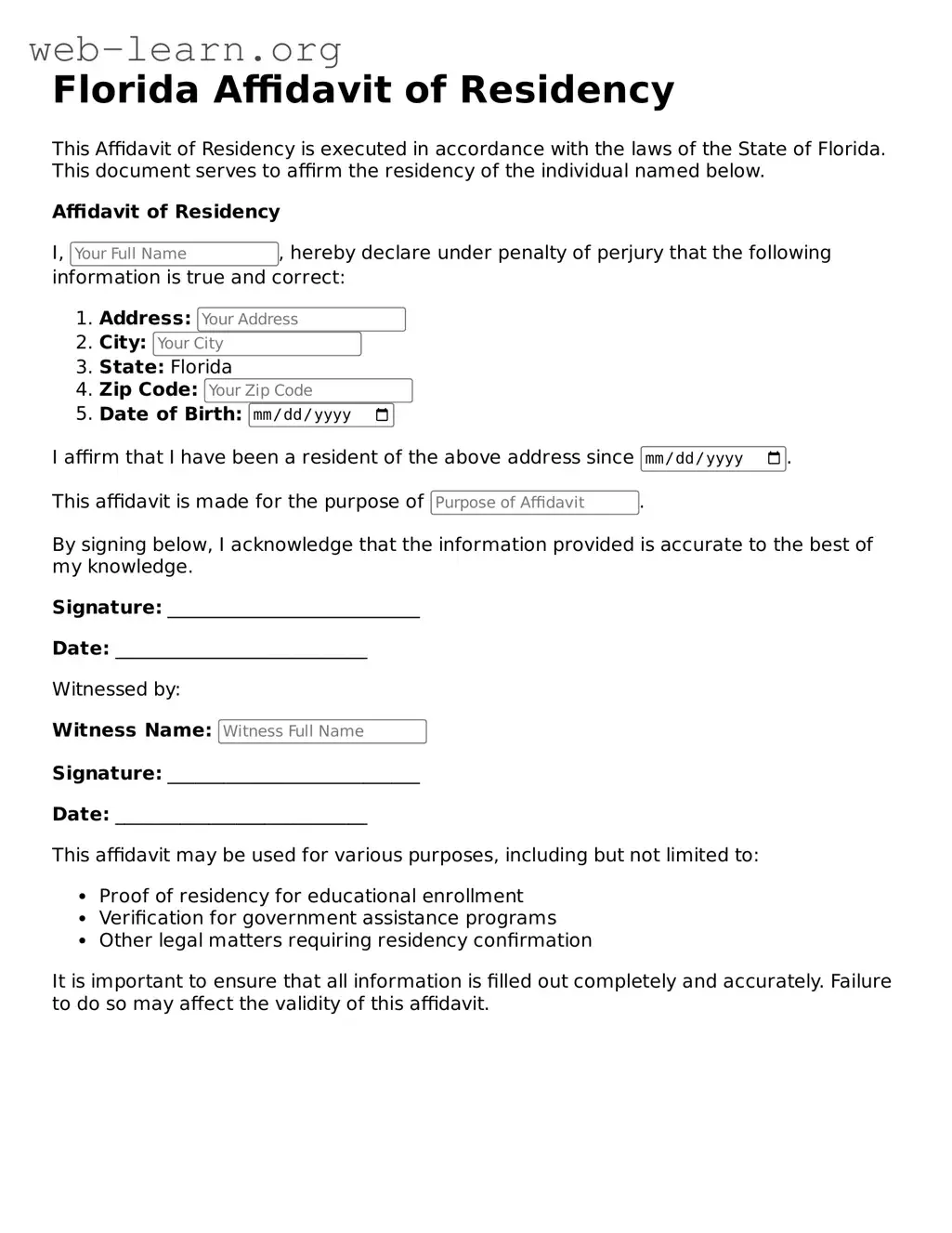
The Florida Affidavit of Residency form serves as a crucial document for individuals seeking to establish their residency within the state. This form is often utilized in various situations, such as enrolling children in public schools, obtaining certain state benefits, or securing a driver's license. It requires the individual to provide personal information, including their name, address, and the duration of their residency in Florida. Additionally, the form may need to be signed in the presence of a notary public, ensuring that the information provided is accurate and truthful. By completing this affidavit, individuals affirm their commitment to residing in Florida, which can have significant implications for their legal rights and responsibilities within the state. Understanding the requirements and implications of the Affidavit of Residency is essential for anyone navigating the complexities of residency status in Florida.
Florida Affidavit of Residency
This Affidavit of Residency is executed in accordance with the laws of the State of Florida. This document serves to affirm the residency of the individual named below.
Affidavit of Residency
I, , hereby declare under penalty of perjury that the following information is true and correct:
I affirm that I have been a resident of the above address since .
This affidavit is made for the purpose of .
By signing below, I acknowledge that the information provided is accurate to the best of my knowledge.
Signature: ___________________________
Date: ___________________________
Witnessed by:
Witness Name:
Signature: ___________________________
Date: ___________________________
This affidavit may be used for various purposes, including but not limited to:
It is important to ensure that all information is filled out completely and accurately. Failure to do so may affect the validity of this affidavit.
| Fact Name | Description |
|---|---|
| Purpose | The Florida Affidavit of Residency form is used to declare a person's residency in Florida, often required for various legal and administrative purposes. |
| Governing Law | This form is governed by Florida Statutes, specifically under Chapter 92.525, which outlines the requirements for affidavits. |
| Who Uses It | Individuals who need to prove their residency, such as students or new residents, commonly use this form. |
| Filing Requirements | The completed affidavit must be signed in the presence of a notary public to be considered valid. |
After obtaining the Florida Affidavit of Residency form, you will need to complete it accurately. This form typically requires personal information and may need to be submitted to a specific authority, depending on your situation. Follow these steps to ensure you fill it out correctly.
What is the Florida Affidavit of Residency form?
The Florida Affidavit of Residency form is a legal document used to declare an individual's residence within the state of Florida. This form is often required for various purposes, such as enrolling in schools, obtaining a driver's license, or registering to vote. It serves to confirm that the individual resides at a specified address in Florida.
Who needs to complete the Affidavit of Residency form?
Individuals who need to prove their residency in Florida may be required to complete this form. This includes students enrolling in public schools, individuals applying for state benefits, or those seeking to register to vote. Additionally, certain organizations or institutions may request this affidavit as part of their verification process.
How do I complete the Affidavit of Residency form?
To complete the Affidavit of Residency form, follow these steps:
Make sure to provide accurate information, as any discrepancies may lead to complications.
What should I do if I need assistance with the form?
If you require assistance with the Florida Affidavit of Residency form, consider reaching out to local government offices, educational institutions, or legal aid organizations. These resources can provide guidance on completing the form correctly and may help clarify any questions you have about the process.
Filling out the Florida Affidavit of Residency form can be a straightforward process, but many individuals make common mistakes that can lead to complications. One frequent error is failing to provide accurate personal information. This includes not only your name but also your address and date of birth. Inaccuracies can create confusion and delay the processing of your affidavit.
Another mistake often seen is not signing the form. Even if all the information is filled out correctly, the affidavit is not valid without a signature. Remember, your signature serves as a declaration that the information provided is true and correct to the best of your knowledge.
Some people overlook the requirement for a witness. The Florida Affidavit of Residency form typically requires the signature of a witness who can attest to your residency. Failing to include a witness can render the affidavit invalid, so it’s essential to ensure this step is not skipped.
In addition, individuals sometimes forget to date the affidavit. A date is crucial as it indicates when the affidavit was completed. Without a date, it may be difficult to establish the timeline of your residency, which could lead to further complications.
Another common mistake is not providing supporting documentation. The affidavit may require additional documents to verify your residency, such as utility bills or lease agreements. Neglecting to attach these documents can result in the form being rejected.
Some people also misinterpret the instructions regarding residency. The affidavit is meant to confirm that you reside in Florida, but individuals may mistakenly think it serves other purposes, such as proving citizenship or legal status. Understanding the specific purpose of the affidavit is crucial.
Additionally, failing to check for errors after filling out the form can lead to issues. Simple typos or incorrect information can cause delays or even denial of the affidavit. A thorough review can save time and hassle later on.
Another pitfall is not using the most current version of the form. Forms can change over time, and using an outdated version may lead to rejection. Always ensure you have the latest version from an official source.
Lastly, some individuals may not understand the importance of keeping a copy of the completed affidavit. Having a copy for your records is essential in case you need to reference it in the future. It provides a safeguard and can be useful for any follow-up actions.
By being aware of these common mistakes, individuals can ensure that their Florida Affidavit of Residency form is filled out correctly, thus avoiding unnecessary complications and delays.
When establishing residency in Florida, the Affidavit of Residency form is a crucial document. However, it is often accompanied by several other forms and documents that can help support your claim of residency. Below is a list of these additional documents, each serving a specific purpose in the residency verification process.
Having these documents ready can streamline the process of proving residency in Florida. Each piece of evidence adds credibility to your claim, making it easier to establish your status as a resident of the state.
When filling out the Florida Affidavit of Residency form, attention to detail is crucial. Here are some important dos and don'ts to consider:
When dealing with the Florida Affidavit of Residency form, it's essential to clarify some common misconceptions. Understanding these can save you time and ensure you complete the process correctly.
This form can be used by both renters and homeowners to establish residency in Florida.
You do not need legal representation to fill out this form. It is designed for individuals to complete on their own.
While notarization is often recommended, it is not a strict requirement for all uses of the affidavit.
This affidavit is specifically for establishing residency. It may not be valid for other legal matters.
There may be specific deadlines for submitting the affidavit depending on the purpose, such as for school enrollment or tax purposes.
Non-residents moving to Florida can also use this form to declare their intent to establish residency.
Minors may also need an affidavit of residency, often completed by a parent or guardian.
This affidavit may need to be updated if your residency status changes.
Most institutions prefer typed forms for clarity and professionalism.
Additional documentation, such as utility bills or lease agreements, may also be required to support your claim of residency.
Addressing these misconceptions can help ensure that your experience with the Florida Affidavit of Residency form is smooth and efficient. Take the necessary steps to gather your information and complete the form accurately.
When filling out and using the Florida Affidavit of Residency form, it is essential to keep several key points in mind to ensure the process goes smoothly. Here are some important takeaways:
What Counts as Proof of Residency in Illinois - The affidavit should be completed in full before being submitted to the relevant authority.
How to Become an Alabama Resident - This document is a formal way to assert your residency status when needed.
Id Indiana - They are often a requirement for eligibility in local scholarships or grants.