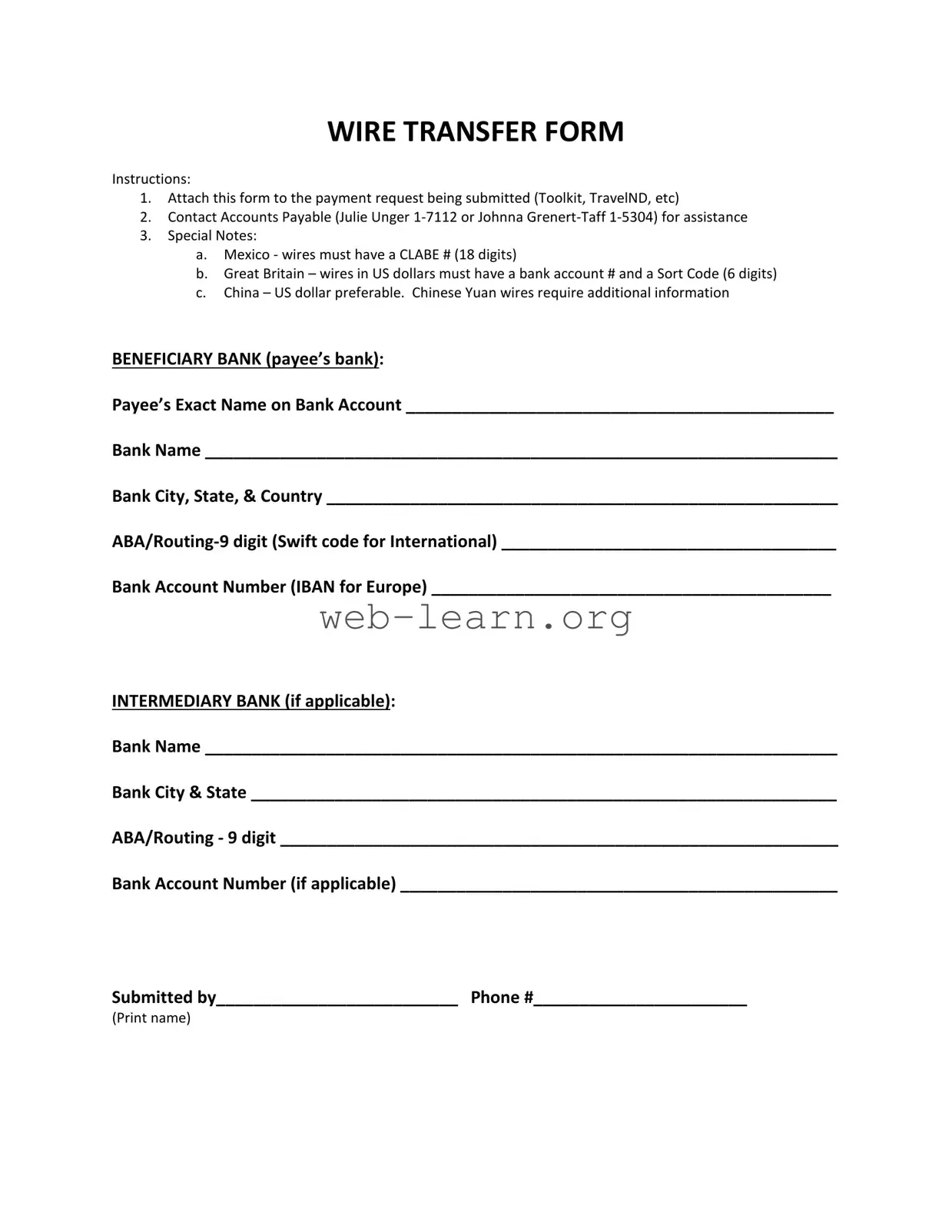
The Wire Transfer form is an essential document used to facilitate the transfer of funds between banks. It requires specific information to ensure the transaction is processed correctly and efficiently. When submitting a payment request, this form must be attached to the relevant documentation, such as Toolkit or TravelND. For assistance, individuals can reach out to Accounts Payable, with contact information provided for Julie Unger and Johnna Grenert-Taff. Special instructions apply for international transfers; for instance, wires to Mexico require a CLABE number, while transfers to Great Britain need both a bank account number and a Sort Code. Transfers to China prefer US dollars, but additional details are necessary for transactions in Chinese Yuan. The form includes sections for the beneficiary bank's details, such as the payee's exact name, bank name, and location, as well as routing information. If an intermediary bank is involved, that information must also be provided. Lastly, the form requires the submitter's name and phone number for follow-up purposes.
WIRE TRANSFER FORM
Instructions:
1.Attach this form to the payment request being submitted (Toolkit, TravelND, etc)
2.Contact Accounts Payable (Julie Unger
3.Special Notes:
a.Mexico - wires must have a CLABE # (18 digits)
b.Great Britain – wires in US dollars must have a bank account # and a Sort Code (6 digits)
c.China – US dollar preferable. Chinese Yuan wires require additional information
BENEFICIARY BANK (payee’s bank):
Payee’s Exact Name on Bank Account ______________________________________________
Bank Name ____________________________________________________________________
Bank City, State, & Country _______________________________________________________
Bank Account Number (IBAN for Europe) ___________________________________________
INTERMEDIARY BANK (if applicable):
Bank Name ____________________________________________________________________
Bank City & State _______________________________________________________________
ABA/Routing - 9 digit ____________________________________________________________
Bank Account Number (if applicable) _______________________________________________
Submitted by__________________________ Phone #_______________________
(Print name)
| Fact Name | Details |
|---|---|
| Form Purpose | This form is used to initiate a wire transfer payment. |
| Submission Process | Attach the form to the payment request being submitted. |
| Contact Information | For assistance, reach out to Julie Unger at 1-7112 or Johnna Grenert-Taff at 1-5304. |
| Special Notes for Mexico | Wires to Mexico must include a CLABE number, which is 18 digits long. |
| Special Notes for Great Britain | Wires in US dollars need a bank account number and a 6-digit Sort Code. |
| Special Notes for China | US dollars are preferable for wires; additional information is needed for Chinese Yuan transfers. |
| Beneficiary Bank Details | Include the payee’s exact name, bank name, city, state, country, ABA/routing number, and account number. |
| Intermediary Bank | If applicable, provide details for the intermediary bank, including name, city, state, ABA/routing number, and account number. |
Completing the Wire Transfer form accurately is crucial for ensuring that funds are transferred smoothly and efficiently. Once the form is filled out, it should be attached to the relevant payment request. For any questions or assistance during the process, reaching out to the Accounts Payable team is advisable.
The Wire Transfer form is designed to facilitate the process of sending money electronically from one bank account to another. This form provides all necessary details about the transaction, ensuring that funds are transferred accurately and efficiently. By completing this form, you help the Accounts Payable department process your payment request correctly.
To submit the Wire Transfer form, you need to attach it to your payment request. This could be through various platforms such as Toolkit or TravelND. After attaching the form, make sure to send it to the Accounts Payable department for processing. If you have questions during this process, you can reach out to Julie Unger at extension 1-7112 or Johnna Grenert-Taff at extension 1-5304 for assistance.
Yes, there are specific requirements for certain countries when making international wire transfers:
When filling out the Wire Transfer form, you must provide detailed information about the beneficiary bank, which is the payee’s bank. This includes:
If your wire transfer requires an intermediary bank, you will need to provide additional information on the form. This includes the intermediary bank's name, city and state, ABA/Routing number, and the bank account number if applicable. Including this information ensures that the funds are routed correctly through the intermediary bank before reaching the beneficiary.
If you have any questions or need assistance while filling out the Wire Transfer form, you can contact the Accounts Payable department. Reach out to Julie Unger at extension 1-7112 or Johnna Grenert-Taff at extension 1-5304. They are available to help you navigate any issues or clarify any requirements related to the wire transfer process.
When filling out the Wire Transfer form, individuals often make several common mistakes that can lead to delays or complications in processing. One frequent error is failing to provide the beneficiary’s exact name as it appears on the bank account. This is critical because any discrepancies can cause the transfer to be rejected or delayed.
Another common mistake involves the bank account number. Many people overlook the requirement to ensure that the number is accurate and complete. A missing digit or an incorrect number can result in the funds being sent to the wrong account, which can be difficult to rectify.
In addition, not including the ABA/Routing number can be a significant oversight. This nine-digit code is essential for domestic transfers and must be filled out correctly. Without it, the transaction may not process as intended.
People also sometimes forget to check the specific requirements for international transfers. For instance, when sending money to Mexico, the form must include a CLABE number, which consists of 18 digits. Neglecting this detail can lead to complications.
Another mistake involves the Sort Code for transfers to Great Britain. If sending funds in US dollars, the form requires both the bank account number and the Sort Code. Missing either can halt the transfer process.
Individuals may also fail to provide information about an intermediary bank when necessary. If the transfer involves multiple banks, omitting this information can lead to delays or errors in processing.
Moreover, not contacting the appropriate personnel for assistance can hinder the process. The instructions specify reaching out to Accounts Payable for help, and neglecting to do so can leave individuals uncertain about how to proceed.
Another common oversight is not attaching the Wire Transfer form to the payment request. This step is crucial, as failure to attach the form can result in the request being overlooked or processed incorrectly.
Lastly, individuals sometimes forget to include their contact information on the form. Providing a phone number ensures that the Accounts Payable team can reach out if there are any questions or issues with the transfer.
When preparing for a wire transfer, it's essential to have all the necessary forms and documents ready. Each document plays a crucial role in ensuring the transfer goes smoothly and efficiently. Below is a list of other forms often used alongside the Wire Transfer form.
Having these documents prepared can streamline the wire transfer process and minimize potential issues. Each form serves a specific purpose, contributing to a successful transaction.
The Wire Transfer form is a crucial document for facilitating electronic payments. It shares similarities with several other financial documents. Here’s a list of nine documents that resemble the Wire Transfer form in purpose or structure:
Each of these documents plays a vital role in ensuring that funds are transferred accurately and securely, just like the Wire Transfer form.
When filling out the Wire Transfer form, consider the following guidelines to ensure accuracy and efficiency.
When it comes to wire transfers, there are several misconceptions that can lead to confusion. Understanding the facts can help ensure a smooth transaction. Here’s a look at seven common misconceptions about the Wire Transfer form:
By addressing these misconceptions, you can navigate the wire transfer process with greater confidence and clarity. Always make sure to provide accurate information and seek assistance when needed.
When filling out and using the Wire Transfer form, it is essential to follow specific guidelines to ensure a smooth transaction. Here are key takeaways to keep in mind:
By keeping these points in mind, you can help ensure that your wire transfer is processed efficiently and accurately.