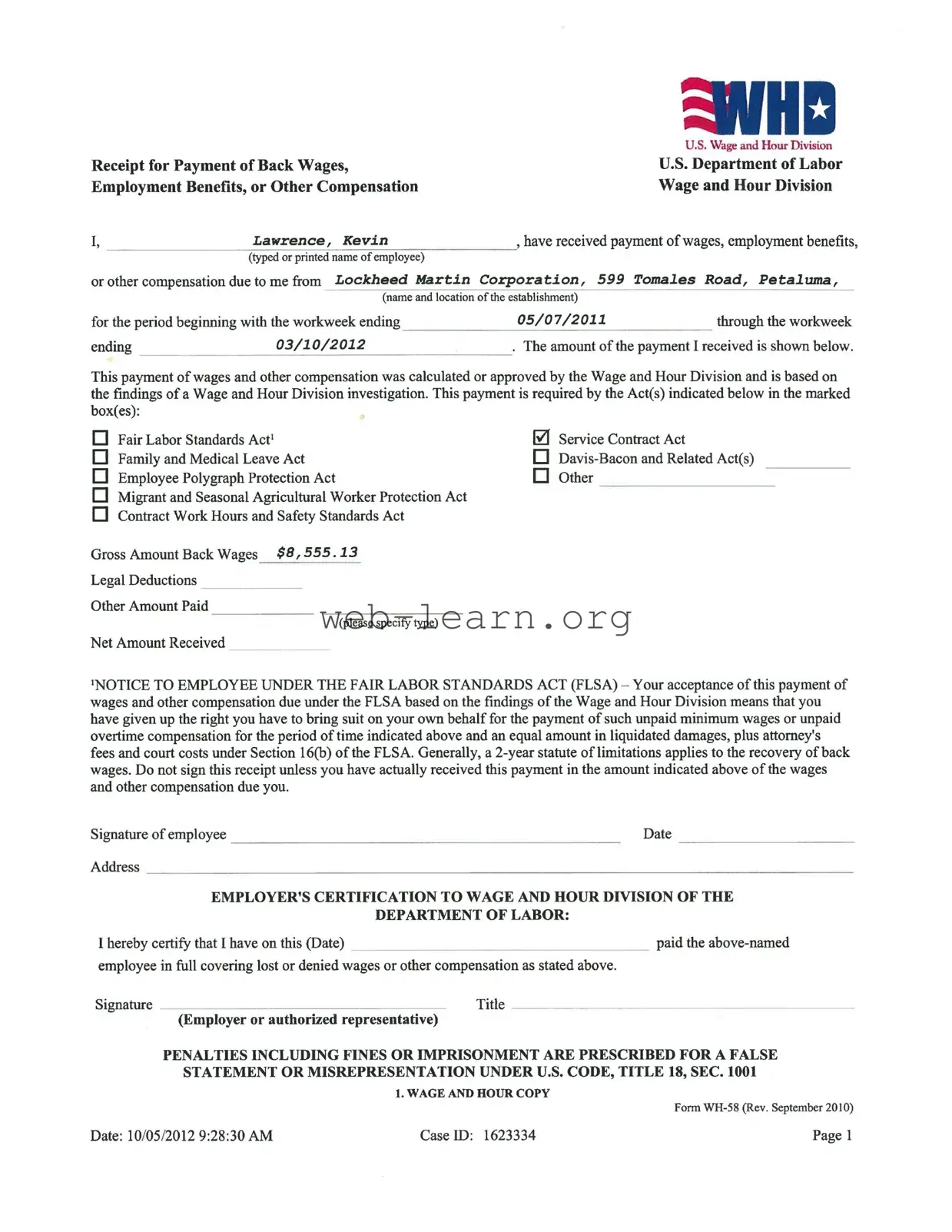
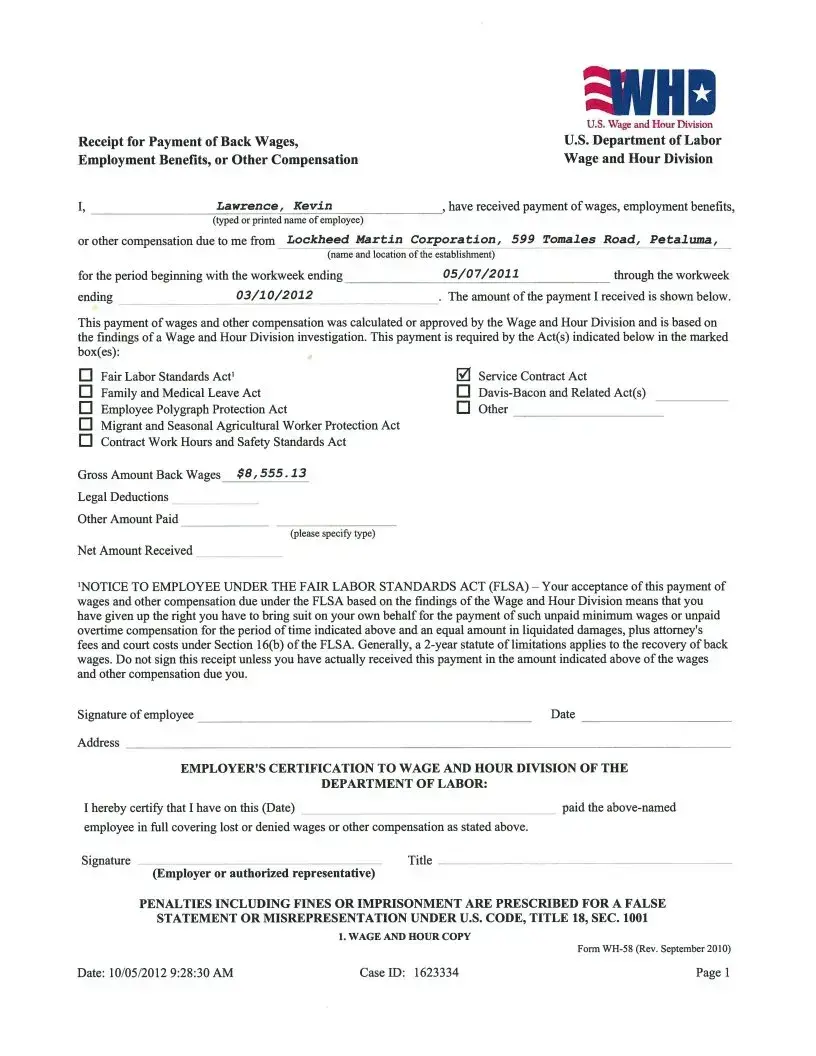
The WH-58 form is a critical document used by the U.S. Wage and Hour Division of the Department of Labor to ensure that employees receive fair compensation for their work. This form serves as a receipt for back wages, employment benefits, or other compensation owed to an employee, as determined by an investigation conducted by the Wage and Hour Division. It is essential for both employees and employers to understand the implications of this form. For instance, by signing the WH-58, an employee acknowledges receipt of the specified payment and, in doing so, waives the right to pursue legal action for unpaid wages or overtime for the indicated period. The form outlines the gross amount of back wages, any legal deductions, and the net amount received, providing a clear financial record. Additionally, it includes a certification section for the employer to confirm that the payment has been made, reinforcing accountability on both sides. Understanding the WH-58 form is vital for navigating wage disputes and ensuring compliance with various labor laws, including the Fair Labor Standards Act and the Family and Medical Leave Act.
|
3NHD |
|
U.S. Wage and Hour Division |
Receipt for Payment of Back Wages, |
U.S. Department of Labor |
Employment Benefits, or Other Compensation |
Wage and Hour Division |
I, _________________Lawrence,_ Kevin |
have received payment of wages, employment benefits, |
(typed or printed name ofemployee) |
|
or other compensation due to me from Lockheed Martin Corporation, 599 Tomales Road, Petaluma,
|
(name and location ofthe establishment) |
|
for the period beginning with the workweek ending |
05/07/2011______________ through the workweek |
|
ending |
03/10/2012 |
, The amount of the payment I received is shown below. |
This payment of wages and other compensation was calculated or approved by the Wage and Hour Division and is based on the findings of a Wage and Hour Division investigation. This payment is required by the Act(s) indicated below in the marked box(es):
П Fair Labor Standards Act1 |
0 Service Contract Act |
Family and Medical Leave Act |
О |
Employee Polygraph Protection Act |
Other |
Migrant and Seasonal Agricultural Worker Protection Act |
|
Contract Work Hours and Safety Standards Act |
|
Gross Amount Back Wages $0,555.13
Legal Deductions
Other Amount Paid
(please specify type)
Net Amount Received
‘NOTICE TO EMPLOYEE UNDER THE FAIR LABOR STANDARDS ACT (FLSA) - Your acceptance of this payment of wages and other compensation due under the FLSA based on the findings of the Wage and Hour Division means that you have given up the right you have to bring suit on your own behalf for the payment of such unpaid minimum wages or unpaid overtime compensation for the period of time indicated above and an equal amount in liquidated damages, plus attorney's fees and court costs under Section 16(b) of the FLSA. Generally, a
Signature of employee |
Date |
Address
EMPLOYER’S CERTIFICATION TO WAGE AND HOUR DIVISION OF THE
DEPARTMENT OF LABOR:
I hereby certify that I have on this (Date) |
paid the |
employee in full covering lost or denied wages or other compensation as stated above.
SignatureTitle
(Employer or authorized representative)
PENALTIES INCLUDING FINES OR IMPRISONMENT ARE PRESCRIBED FOR A FALSE
STATEMENT OR MISREPRESENTATION UNDER U.S. CODE, TITLE 18, SEC. 1001
1. WAGE AND HOUR COPY
Form
Date: 10/05/2012 9:28:30 AM |
Case ID: 1623334 |
Page 1 |
| Fact Name | Details |
|---|---|
| Form Title | WH-58 Receipt for Payment of Back Wages, Employment Benefits, or Other Compensation |
| Governing Authority | U.S. Wage and Hour Division, U.S. Department of Labor |
| Purpose | This form is used to acknowledge receipt of back wages and other compensation due to an employee. |
| Applicable Laws | Fair Labor Standards Act, Family and Medical Leave Act, Employee Polygraph Protection Act, Service Contract Act, Davis-Bacon Act, Migrant and Seasonal Agricultural Worker Protection Act, Contract Work Hours and Safety Standards Act |
| Employee Rights | By accepting the payment, the employee waives the right to sue for unpaid wages or overtime for the specified period. |
| Statute of Limitations | Generally, a 2-year statute of limitations applies for recovering back wages. |
| Net Amount | The net amount received by the employee is clearly stated on the form. |
| Employer Certification | The employer must certify that the payment has been made to the employee as indicated. |
| Penalties for False Statements | False statements or misrepresentations can lead to penalties, including fines or imprisonment. |
| Form Revision Date | The current version of the WH-58 form was revised in September 2010. |
Completing the WH-58 form is an important step in acknowledging the receipt of back wages or other compensation. Once you have filled out the form correctly, it will be submitted to the Wage and Hour Division of the U.S. Department of Labor. This process helps ensure that you are officially recognized for the payments you have received.
What is the WH-58 form?
The WH-58 form is a receipt issued by the U.S. Wage and Hour Division of the Department of Labor. It confirms that an employee has received payment for back wages, employment benefits, or other compensation. This form is typically used after an investigation by the Wage and Hour Division to ensure that employees are compensated according to federal labor laws.
Who needs to complete the WH-58 form?
The WH-58 form must be completed by employees who are receiving back wages or other compensation as a result of an investigation by the Wage and Hour Division. Employers or their authorized representatives also need to certify the payment on this form.
What information is included on the WH-58 form?
The form includes the following key details:
What does signing the WH-58 form mean for employees?
By signing the WH-58 form, employees acknowledge that they have received the payment specified. However, it also means that they give up their right to sue for unpaid minimum wages or overtime compensation for the period indicated. This includes the potential for liquidated damages, attorney's fees, and court costs under the FLSA.
Are there any legal implications for employers regarding the WH-58 form?
Yes, employers must ensure that the information provided on the WH-58 form is accurate. Any false statements or misrepresentations can lead to penalties, including fines or imprisonment, as outlined in U.S. Code, Title 18, Section 1001. Employers must also certify that they have paid the employee the amount stated on the form.
What should I do if I have questions about the WH-58 form?
If you have questions about the WH-58 form or your rights regarding wage payments, it is advisable to contact the Wage and Hour Division directly or consult with a legal professional who specializes in labor law. They can provide guidance tailored to your specific situation.
Filling out the WH-58 form can be straightforward, but mistakes can lead to delays or complications. One common error is not providing the correct name and location of the employer. It's essential to ensure that the name of the establishment is accurate and matches the records. For instance, if someone types “Lockheed Martin Corp” instead of “Lockheed Martin Corporation,” it could create issues.
Another frequent mistake is failing to include the correct dates for the work period. The form requires a specific range, and omitting or misrepresenting these dates can complicate the process. Double-checking the start and end dates of employment is crucial to avoid confusion.
Many people overlook the payment amounts. The gross amount, legal deductions, and net amount must be filled out correctly. If there is an error in any of these figures, it can lead to misunderstandings about what was paid. For example, if someone mistakenly writes $0,555.13 instead of $555.13, it could raise red flags.
Signing the form without having received the payment is another mistake that can have serious consequences. The notice clearly states that accepting the payment means giving up the right to bring a lawsuit for unpaid wages. Therefore, it’s important to ensure that the payment has actually been received before signing.
Additionally, not including a proper signature or date can invalidate the form. The employee’s signature is required to confirm acceptance of the payment, and the date should reflect when the form is signed. Skipping this step can lead to delays in processing.
Finally, some individuals may ignore the employer’s certification section. This part must be completed by the employer or an authorized representative. If this section is left blank, it can result in the form being rejected or delayed. It’s vital to ensure that all sections are filled out completely and accurately to avoid potential issues.
The WH-58 form is a critical document used in wage and hour disputes, particularly when employees are receiving back wages or other compensation. Alongside this form, several other documents may be required to ensure a comprehensive understanding of the situation and to facilitate the resolution process. Below is a list of commonly used forms and documents that often accompany the WH-58.
Understanding these forms and their purposes is essential for both employees and employers. Proper documentation can significantly affect the outcome of wage disputes and ensure that everyone’s rights are protected. If you believe you may need to use these forms, consider seeking guidance to navigate the process effectively.
When filling out the WH-58 form, it's important to follow certain guidelines to ensure accuracy and compliance. Here’s a list of things you should and shouldn't do:
Misconceptions about the WH-58 form can lead to confusion regarding employee rights and employer responsibilities. Here are five common misunderstandings:
Understanding the WH-58 form is crucial for both employees and employers. Here are key takeaways regarding its completion and use: