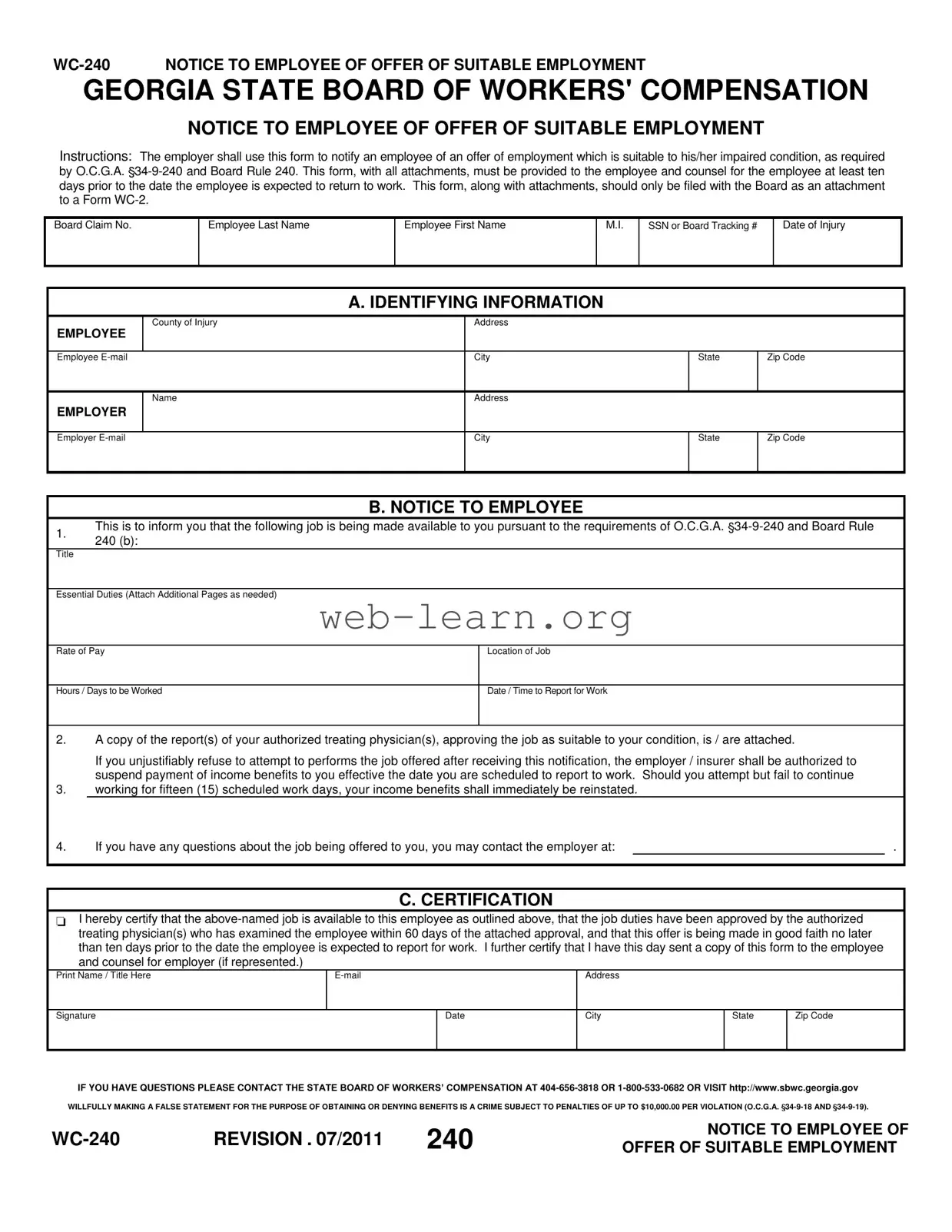
The WC-240 form is an essential document in the realm of workers' compensation in Georgia, specifically designed to inform employees about job offers that align with their medical capabilities following an injury. This form is mandated by state law and must be utilized by employers to ensure compliance with O.C.G.A. 34-9-240 and Board Rule 240. It serves a dual purpose: it not only notifies the employee of suitable employment opportunities but also protects the employer's rights regarding income benefits. The form requires detailed information, including the employee's name, date of injury, and specifics about the job being offered, such as title, essential duties, and pay rate. Employers must provide this notification to the employee and their counsel at least ten days before the expected return to work date. Additionally, the form must be accompanied by the report from the authorized treating physician, confirming that the job is suitable for the employee's condition. Failure to accept a suitable job offer without justification can lead to the suspension of income benefits, underscoring the importance of understanding this document. It is crucial for both employees and employers to familiarize themselves with the WC-240 form, as it plays a vital role in the workers' compensation process in Georgia.
GEORGIA STATE BOARD OF WORKERS' COMPENSATION
NOTICE TO EMPLOYEE OF OFFER OF SUITABLE EMPLOYMENT
Instructions: The employer shall use this form to notify an employee of an offer of employment which is suitable to his/her impaired condition, as required by O.C.G.A.
Board Claim No.
Employee Last Name
Employee First Name
M.I.
SSN or Board Tracking #
Date of Injury
A. IDENTIFYING INFORMATION
|
County of Injury |
Address |
|
|
EMPLOYEE |
|
|
|
|
|
|
|
|
|
Employee |
City |
State |
Zip Code |
|
|
|
|
|
|
|
Name |
Address |
|
|
EMPLOYER |
|
|
|
|
|
|
|
|
|
Employer |
City |
State |
Zip Code |
|
|
|
|
|
|
|
|
|
|
|
1.
B. NOTICE TO EMPLOYEE
This is to inform you that the following job is being made available to you pursuant to the requirements of O.C.G.A.
240 (b):
Title
Essential Duties (Attach Additional Pages as needed)
Rate of Pay |
Location of Job |
|
|
Hours / Days to be Worked |
Date / Time to Report for Work |
|
|
2.A copy of the report(s) of your authorized treating physician(s), approving the job as suitable to your condition, is / are attached.
If you unjustifiably refuse to attempt to performs the job offered after receiving this notification, the employer / insurer shall be authorized to suspend payment of income benefits to you effective the date you are scheduled to report to work. Should you attempt but fail to continue
3.working for fifteen (15) scheduled work days, your income benefits shall immediately be reinstated.
4. |
If you have any questions about the job being offered to you, you may contact the employer at: |
|
. |
C. CERTIFICATION
I hereby certify that the
Print Name / Title Here
Address
Signature
Date
City
State
Zip Code
IF YOU HAVE QUESTIONS PLEASE CONTACT THE STATE BOARD OF WORKERS’ COMPENSATION AT
WILLFULLY MAKING A FALSE STATEMENT FOR THE PURPOSE OF OBTAINING OR DENYING BENEFITS IS A CRIME SUBJECT TO PENALTIES OF UP TO $10,000.00 PER VIOLATION (O.C.G.A.
REVISION . 07/2011 |
240 |
NOTICE TO EMPLOYEE OF |
|
OFFER OF SUITABLE EMPLOYMENT |
| Fact Name | Description |
|---|---|
| Purpose of the Form | The WC-240 form is used by employers to notify employees of an offer of suitable employment that aligns with their impaired condition. |
| Governing Laws | This form is governed by O.C.G.A. 34-9-240 and Board Rule 240, which outline the requirements for notifying employees about suitable job offers. |
| Notification Timeline | Employers must provide the WC-240 form to the employee and their counsel at least ten days before the employee is expected to return to work. |
| Consequences of Refusal | If an employee unjustifiably refuses the job offer, the employer or insurer may suspend income benefits effective the date the employee is scheduled to report to work. |
Filling out the WC-240 form is a straightforward process. This form is essential for notifying an employee about a suitable job offer related to their condition. It is crucial to complete it accurately to comply with legal requirements and ensure that all parties are informed properly.
The WC-240 form is a notification used by employers in Georgia to inform employees about a job offer that is suitable for their impaired condition. This is in accordance with Georgia law, specifically O.C.G.A. 34-9-240 and Board Rule 240.
Both the employee and their legal counsel must receive a copy of the WC-240 form. This ensures that all parties are aware of the job offer and the conditions surrounding it.
The form must be provided at least ten days before the employee is expected to return to work. This allows the employee sufficient time to review the job offer and consult with their counsel if needed.
If an employee unjustifiably refuses to attempt the job offered after receiving the WC-240 notification, the employer or insurer may suspend the payment of income benefits. This suspension takes effect on the date the employee is scheduled to report for work.
If the employee attempts the job but fails to continue working for fifteen scheduled workdays, their income benefits will be reinstated immediately. This provision aims to protect employees who genuinely try to return to work but face challenges.
The form includes essential details such as the job title, essential duties, rate of pay, location, and hours/days to be worked. Additionally, it contains a section for the employer to certify that the job is suitable and approved by the employee's treating physician.
If an employee has any questions regarding the job being offered, they should contact their employer directly. The employer is required to provide contact information on the form for this purpose.
Willfully making a false statement to obtain or deny benefits is a serious offense. Penalties can reach up to $10,000 per violation, as outlined in O.C.G.A. 34-9-18 and 34-9-19. It is crucial to provide accurate information on the form.
For additional questions or information, individuals can contact the State Board of Workers’ Compensation at 404-656-3818 or 1-800-533-0682. More resources are also available on their website at http://www.sbwc.georgia.gov.
Completing the WC-240 form accurately is essential for both employees and employers. However, several common mistakes can lead to complications. Understanding these errors can help ensure a smoother process.
One frequent mistake is failing to provide complete identifying information. The form requires the employee's last name, first name, middle initial, and Social Security Number or Board Tracking Number. Omitting any of this information can delay the processing of the claim.
Another common error is neglecting to attach the necessary documentation from authorized treating physicians. This documentation is crucial as it verifies that the job offered is suitable for the employee's condition. Without these attachments, the employer may face challenges in justifying the job offer.
Many individuals also overlook the requirement to send the form to both the employee and their counsel. Sending it only to one party can lead to misunderstandings and disputes regarding the job offer.
Inaccurate job details, such as the title, essential duties, or rate of pay, can create confusion. Each section must be filled out correctly to ensure that the employee understands what is being offered. Misrepresentations may lead to disputes or claims of bad faith.
Another mistake is not adhering to the timeline outlined in the instructions. The form must be provided at least ten days before the employee is expected to return to work. Failing to meet this deadline can invalidate the offer.
Some people mistakenly believe that the certification section is optional. It is not. The person completing the form must certify that the job is available and that it has been approved by the treating physician. This certification is a legal requirement and should be treated with utmost seriousness.
Additionally, individuals may forget to include their contact information. Providing a phone number or email address allows the employee to ask questions or seek clarification about the job offer, fostering better communication.
It is also important to ensure that all signatures are included. A missing signature can render the form incomplete, leading to unnecessary delays in processing the claim.
Finally, some individuals may not fully understand the implications of refusing the job offer. The form clearly states that unjustified refusal can lead to suspension of income benefits. It is crucial for employees to understand their rights and responsibilities regarding the job offer.
By avoiding these common mistakes, both employees and employers can facilitate a more efficient and effective workers' compensation process.
The WC-240 form serves as a crucial document in the workers' compensation process in Georgia. When utilizing this form, several other documents may also be necessary to ensure compliance with state regulations and to provide a comprehensive understanding of the employee's situation. Below is a list of additional forms and documents commonly used in conjunction with the WC-240.
Understanding these additional forms and documents is essential for both employers and employees involved in the workers' compensation process. Proper completion and timely submission of these documents can significantly impact the outcome of a claim.
The WC-240 form in Georgia serves as a formal notification to employees regarding suitable employment opportunities after an injury. Several other documents share similarities with the WC-240 in terms of purpose and function. Here are seven such documents:
When filling out the WC-240 form in Georgia, it's essential to follow specific guidelines to ensure accuracy and compliance. Here are four things you should and shouldn't do:
Misconceptions about the WC-240 form can lead to confusion for both employees and employers. Here are ten common misunderstandings:
Understanding these misconceptions can help both employees and employers navigate the workers' compensation process more effectively.
Filling out and using the WC-240 form in Georgia is a critical step for employers when offering suitable employment to employees who have sustained injuries. Here are some key takeaways to consider:
Understanding these key points can help ensure that the process is handled correctly and that both parties are aware of their rights and responsibilities.