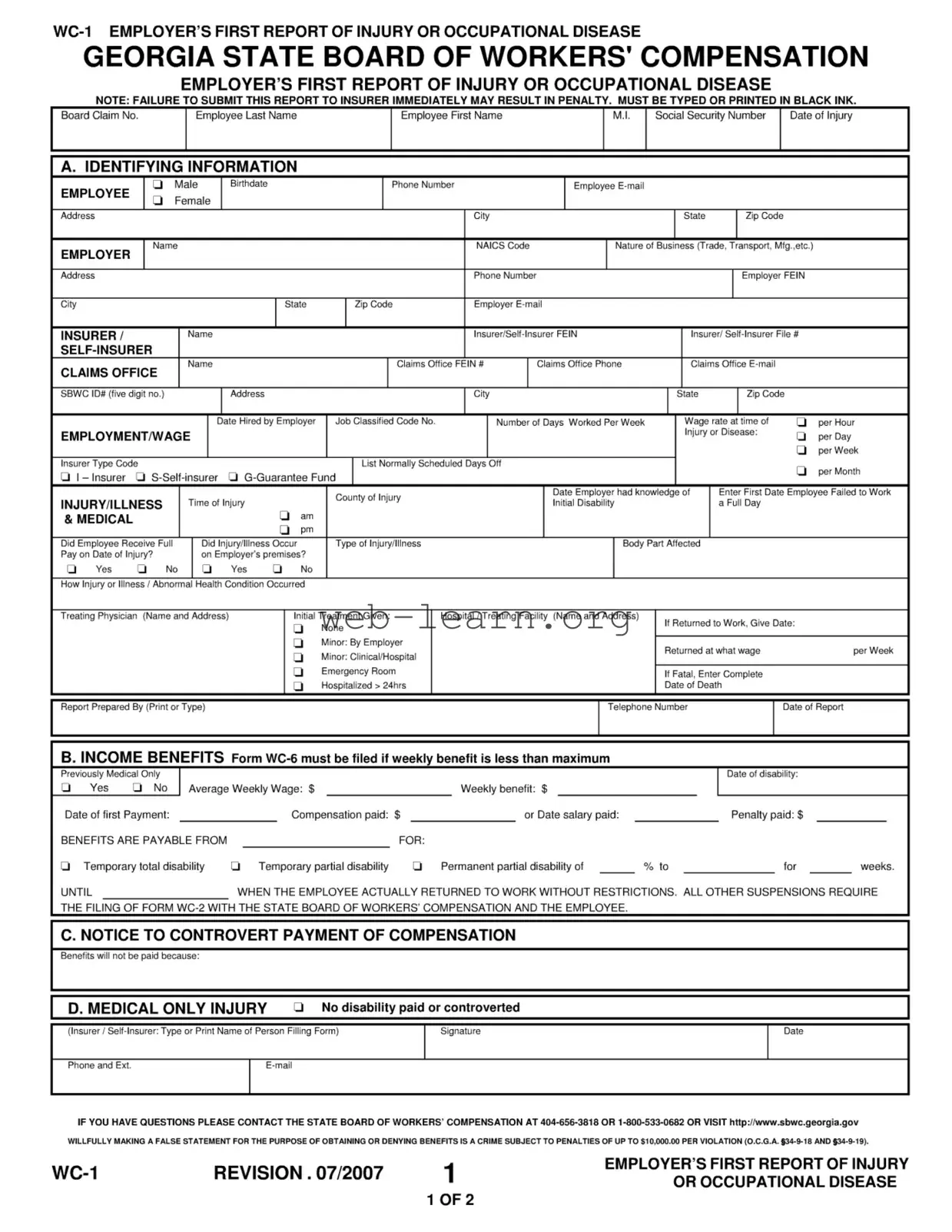
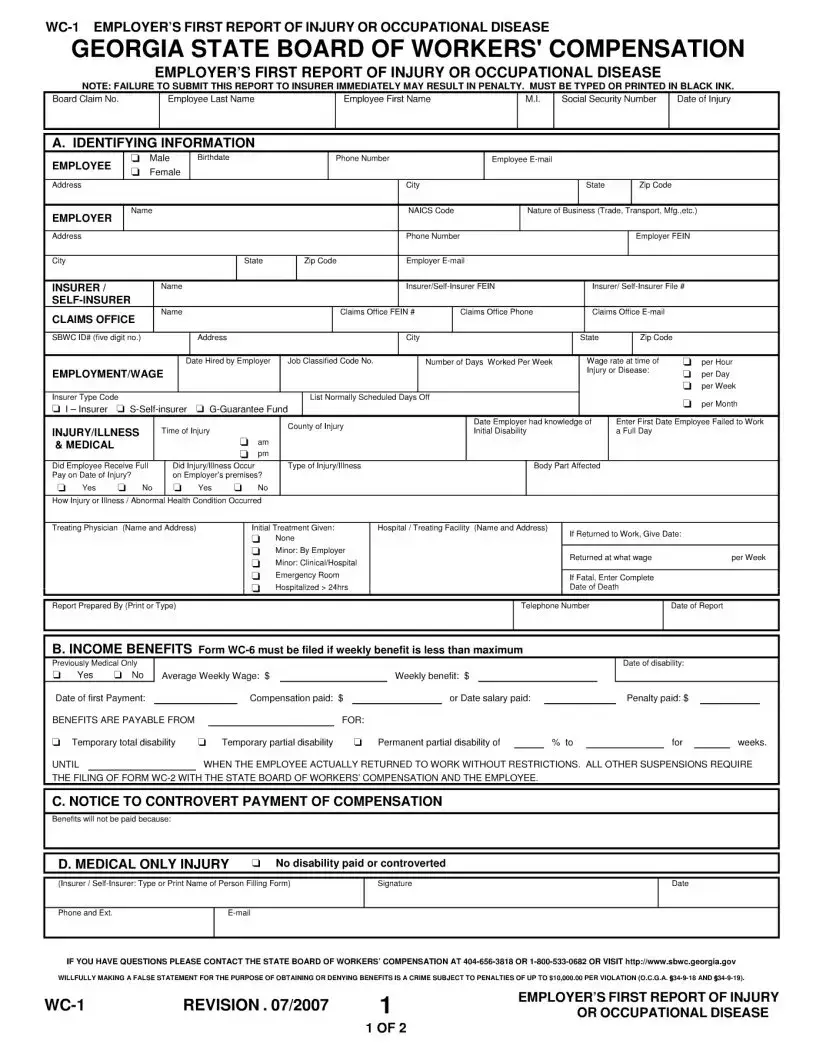
The WC-1 Georgia form, known as the Employer’s First Report of Injury or Occupational Disease, is a crucial document in the workers' compensation process. This form must be filled out promptly by employers when an employee suffers an injury or develops an occupational disease while on the job. It collects essential information, including the employee's name, Social Security number, and details about the injury or illness. Employers must provide their own identifying information and that of their insurance provider. The form also requires specifics about the nature of the injury, the circumstances surrounding it, and any medical treatment received. Timeliness is vital; failure to submit the WC-1 immediately to the insurer may lead to penalties. Additionally, the form serves as a communication tool between the employer, the insurer, and the injured employee, ensuring everyone is informed about the claim's status. Understanding the WC-1 form is essential for employers to navigate the complexities of workers' compensation effectively.
| Fact Name | Description |
|---|---|
| Form Title | WC-1 is officially titled "Employer’s First Report of Injury or Occupational Disease." |
| Governing Law | This form is governed by the Georgia Workers' Compensation Act, specifically O.C.G.A. §34-9-1 et seq. |
| Submission Requirement | Employers must submit this report to their insurer immediately upon knowledge of an injury. |
| Penalty for Non-Compliance | Failure to submit the WC-1 may result in penalties, including fines. |
| Employee Information | The form requires detailed employee information, including name, address, and social security number. |
| Employer Information | Employers must provide their name, address, and FEIN (Federal Employer Identification Number). |
| Injury Details | Information regarding the nature of the injury, date of occurrence, and treatment must be included. |
| Income Benefits | Section B outlines potential income benefits, including temporary total and partial disability payments. |
| Medical Treatment | The form requires details about the treating physician and the initial treatment provided. |
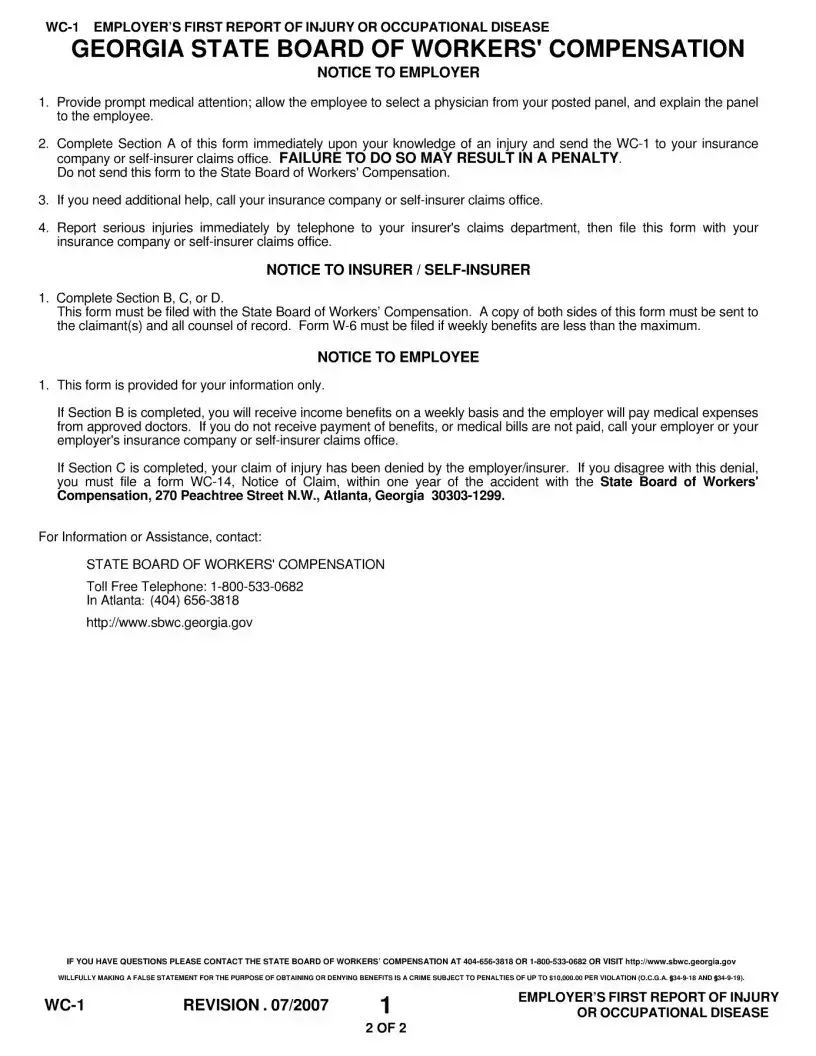
| Employee Rights | Employees are informed of their rights regarding benefits and the process for contesting a denial. |
Filling out the WC-1 form is an important step in reporting an injury or occupational disease in Georgia. Once completed, this form needs to be submitted to the appropriate insurance company or self-insurer claims office. Timeliness is crucial, as delays may result in penalties. Below are the steps to fill out the form accurately.
After completing these steps, ensure the form is submitted to the appropriate claims office promptly. This will help facilitate the claims process and ensure compliance with reporting requirements.
What is the WC-1 form?
The WC-1 form, known as the Employer’s First Report of Injury or Occupational Disease, is a document used in Georgia to report workplace injuries or occupational diseases. Employers must complete this form to notify their insurance company or self-insurer about an incident involving an employee.
Who is responsible for completing the WC-1 form?
The employer is responsible for filling out the WC-1 form. This should be done immediately upon knowledge of an injury to ensure compliance with reporting requirements.
What information is required on the WC-1 form?
The form requires various details, including:
What happens if the WC-1 form is not submitted on time?
Failure to submit the WC-1 form immediately may result in penalties. Timely reporting is crucial to avoid complications in the claims process.
Where should the completed WC-1 form be sent?
The completed form should be sent to the employer's insurance company or self-insurer claims office. It should not be sent to the State Board of Workers’ Compensation.
What should an employee do if they do not receive benefits?
If an employee does not receive payment of benefits or if medical bills are not paid, they should contact their employer or the employer's insurance company for clarification and assistance.
What if the claim is denied?
If the claim is denied, the employee will receive a notice indicating the denial. If they disagree with this decision, they must file a form WC-14, Notice of Claim, within one year of the accident.
What is the significance of the NAICS code on the form?
The NAICS code identifies the type of business the employer operates. This information helps categorize the industry and assess risk factors related to workplace injuries.
What are the penalties for making false statements on the WC-1 form?
Willfully making a false statement to obtain or deny benefits is a crime in Georgia. Penalties can reach up to $10,000 per violation, according to Georgia law.
Is there a specific format for completing the WC-1 form?
The WC-1 form must be typed or printed in black ink. This ensures clarity and legibility for all parties involved in the claims process.
Completing the WC-1 form in Georgia is a crucial step for employers reporting workplace injuries. However, many individuals make common mistakes that can delay the process or lead to penalties. One frequent error is failing to provide complete identifying information. It is essential to fill in all required fields, including the employee's full name, Social Security number, and address. Omitting any of this information can hinder the claims process.
Another common mistake involves incorrect or incomplete employer information. Employers must ensure that their name, address, and FEIN (Federal Employer Identification Number) are accurately recorded. Errors in this section can lead to complications in processing the claim. Additionally, it is vital to include the correct NAICS code, as this identifies the type of business and can affect the claim's handling.
Many people overlook the importance of documenting the date of injury accurately. The date should reflect when the injury occurred, not when it was reported. If the date is incorrect, it can create confusion and potentially affect the employee's benefits. Moreover, failing to indicate whether the employee received full pay on the date of injury is another oversight that can complicate matters.
In the section regarding the nature of the injury, individuals often provide vague descriptions. It is critical to be as specific as possible about the type of injury and the body part affected. This clarity helps in assessing the claim accurately. Furthermore, some individuals neglect to mention whether the injury occurred on the employer's premises. This information is vital for determining liability.
Another mistake is not including the treating physician's information. The form requires the name and address of the physician who provided initial treatment. Omitting this detail can delay medical payments and complicate the employee's care. Additionally, individuals sometimes forget to specify the initial treatment given. Whether it was minor or required hospitalization, this detail is necessary for accurate record-keeping.
When reporting the employee's wage rate, errors can arise if the information is not current or accurate. It is essential to report the wage rate at the time of the injury, including how many days per week the employee typically worked. Misreporting this information can lead to incorrect benefit calculations.
Some employers fail to submit the form promptly. Timeliness is critical; submitting the WC-1 form immediately upon knowledge of an injury helps avoid penalties. Delays can result in complications for both the employer and the employee, including potential fines.
Furthermore, individuals often misunderstand the requirement to report the number of days worked per week. This detail is crucial for calculating benefits and should reflect the employee's normal work schedule. Lastly, many individuals neglect to sign and date the form. A missing signature can render the report invalid and lead to further complications.
In conclusion, completing the WC-1 form accurately and promptly is essential for ensuring a smooth claims process. By avoiding these common mistakes, employers can help protect their employees' rights and ensure compliance with Georgia's workers' compensation regulations.
When dealing with workplace injuries in Georgia, the WC-1 form is just the beginning of the documentation process. Several other forms and documents may be required to ensure that the claim is processed smoothly and that all parties are informed. Below is a list of common forms that are often used alongside the WC-1 form.
Each of these forms plays a crucial role in the workers' compensation process. They help to ensure that the injured employee receives the benefits they are entitled to while also keeping the employer and insurance company informed. Proper completion and timely submission of these documents can significantly impact the outcome of a claim.
The WC-1 Georgia form, which serves as the Employer’s First Report of Injury or Occupational Disease, has several similarities with other important documents related to workers' compensation. Below are four documents that share characteristics with the WC-1 form:
When filling out the WC-1 Georgia form, it's important to follow specific guidelines to ensure accuracy and compliance. Here are some key do's and don'ts:
Misconceptions about the WC-1 Georgia form can lead to confusion and errors in reporting workplace injuries. Here are six common misconceptions:
When filling out the WC-1 Georgia form, there are several important considerations to keep in mind. Below are key takeaways that can help ensure the process is handled correctly.