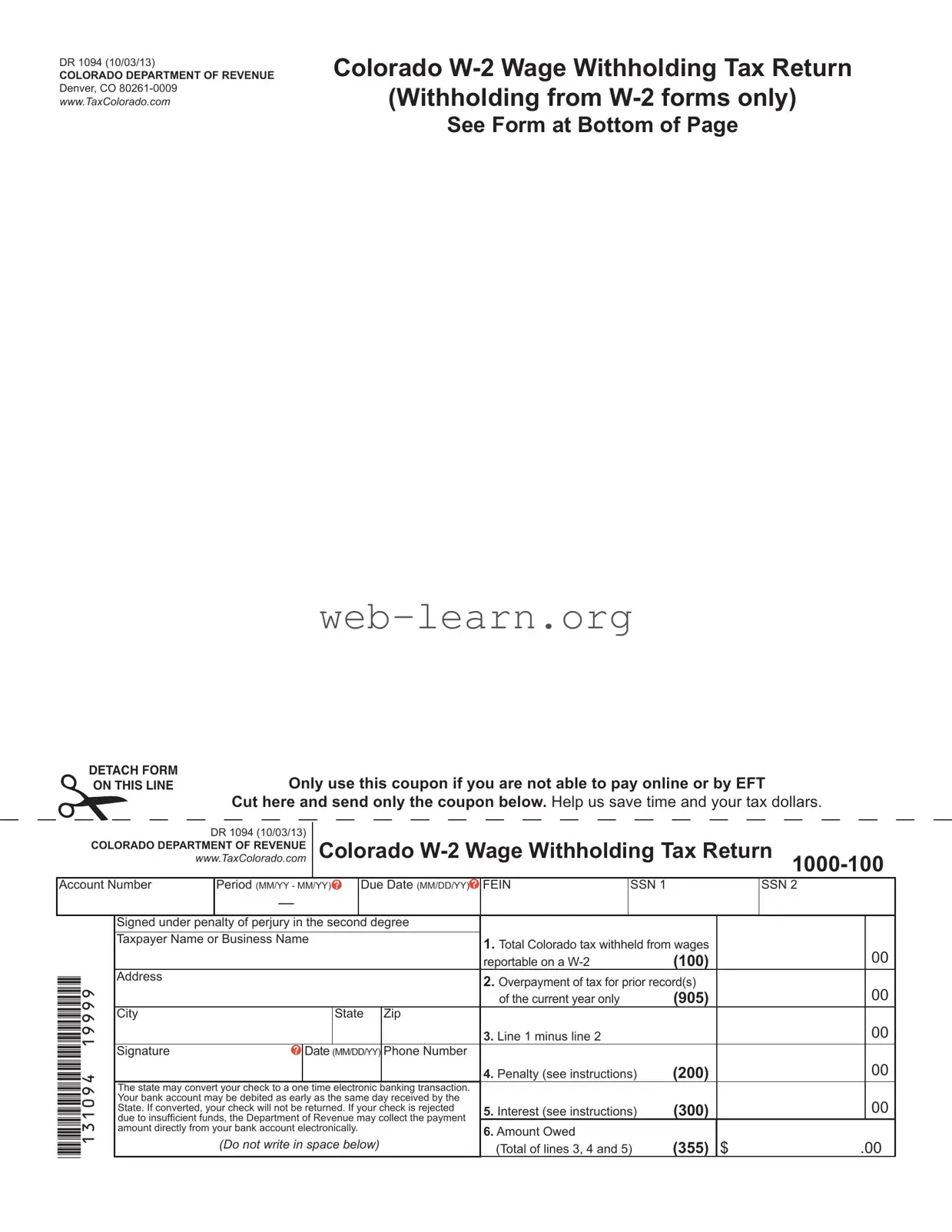
The Colorado W-2 Wage Withholding Tax Return, known as Form DR 1094, is a crucial document for employers operating within the state. This form is specifically designed for reporting the total Colorado income tax withheld from employee wages, as indicated on W-2 forms. Employers must accurately complete this form to reflect the total amount of tax withheld during the designated filing period. The form also allows for the reporting of any overpayments from previous periods, providing a mechanism for employers to adjust their tax liabilities accordingly. Additionally, it includes sections for penalties and interest that may accrue if the return is filed late. To streamline the process, employers have the option to file electronically through Revenue Online or submit a paper return, although electronic filing is encouraged for its efficiency. Understanding the requirements and deadlines associated with the DR 1094 is essential for compliance and to avoid potential penalties. Employers should ensure they keep detailed records of their withholding amounts, as this information is vital for accurate reporting and tax management.
DR 1094 (10/03/13)
COLORADO DEPARTMENT OF REVENUE
Denver, CO
www.TaxColorado.com
Colorado
(Withholding from
See Form at Bottom of Page
DETACH FORM
ON THIS LINEOnly use this coupon if you are not able to pay online or by EFT
Cut here and send only the coupon below. Help us save time and your tax dollars.
|
DR 1094 (10/03/13) |
|
|
|
|
|
|
|
COLORADO DEPARTMENT OF REVENUE |
Colorado |
|
||||||
|
www.TaxColorado.com |
|||||||
|
|
|
|
|
|
|
|
|
Account Number |
|
Period (MM/YY - MM/YY) |
Due Date (MM/DD/YY) |
FEIN |
SSN 1 |
SSN 2 |
||
|
|
— |
|
|
|
|
|
|
|
|
|
|
|
|
|
|
|
*131094==19999*
Signed under penalty of perjury in the second degree |
|
|
|
|
|||||
|
|
|
|
|
|
|
|||
Taxpayer Name or Business Name |
|
|
1. Total Colorado tax withheld from wages |
|
|||||
|
|
|
|
|
|
|
|||
|
|
|
|
|
|
reportable on a |
(100) |
|
|
Address |
|
|
|
|
|
2. Overpayment of tax for prior record(s) |
|
||
|
|
|
|
|
|
|
|||
|
|
|
|
|
|
|
of the current year only |
(905) |
|
City |
|
|
State |
Zip |
|
|
|
|
|
|
|
|
|
|
|
3. Line 1 minus line 2 |
|
|
|
Signature |
|
Date (MM/DD/YY) |
Phone Number |
|
|
|
|
||
|
|
|
|
( ) |
|
4. |
Penalty (see instructions) |
(200) |
|
|
|
|
|
|
|
|
|||
The state may convert your check to a one time electronic banking transaction. |
|
|
|
|
|||||
Your bank account may be debited as early as the same day received by the |
|
|
|
|
|||||
State. If converted, your check will not be returned. If your check is rejected |
5. |
Interest (see instructions) |
(300) |
|
|||||
due to insuficient funds, the Department of Revenue may collect the payment |
|
|
|||||||
amount directly from your bank account electronically. |
|
|
6. Amount Owed |
|
|
||||
|
(Do not write in space below) |
|
|
|
(Total of lines 3, 4 and 5) |
(355) |
$ |
||
00
00
00
00
00
.00
Instructions for Completing
Colorado
The DR 1094 is used by employers to report Colorado
publication FYI Withholding 5, Colorado Wage Withholding Tax
Requirements for detailed information about iling requirements and frequencies.
After completing payroll and withholding Colorado income taxes as deined by the Colorado Income Tax Withholding Tables for Employers (DR 1098), report here the total tax collected for the iling period. This is the Colorado withholding tax that will be
reported at the end of the year on federal form
You may pay tax through Revenue Online,
www.Colorado.gov/RevenueOnline by echeck or credit card. Or, you may sign up for Electronic Funds Transfer (EFT).
Visit www.Colorado.gov/revenue/eft for information on how to register and pay through EFT. Do not ile a paper DR 1094 if you
remitted the withholding taxes via EFT. To prevent being billed by the Department when no taxes were withheld during the iling period, ile a zero return. A paper zero return may be mailed, or for fast and simple iling of a zero return access www.Colorado.gov/RevenueOnline and ile electronically.
Instructions for Amending Withholding Taxes
If you overpaid for a period, you may take a credit on a future
return in the current calendar year. The credit may be taken on a return/payment iled at www.Colorado.gov/RevenueOnline or a subsequent paper form
your return. You may only deduct an amount bringing your return to zero (0.00) for the period you are reporting. If you are unable to claim the credit on a subsequent DR 1094 within the calendar
year, you should claim a refund on your Annual Transmittal of
State
If additional tax is owed, ile another return for the period the tax is
due reporting only the additional amount owed at www.Colorado.gov/RevenueOnline If you cannot ile electronically, ile a paper DR 1094 reporting only the additional tax due for the period.
Refunds will be issued after receipt of your DR 1093 iled at the
end of February following the end of the calendar year.
FYI publications, forms, and answers to common questions are available at www.TaxColorado.com, the oficial Taxation Web site.
Or, you may call (303)
Account Number: List the Colorado business account number from your withholding certiicate or sales tax license. This number
is 8 digits. Do not list your FEIN or EFT number here.
Filing Period: List here the iling period for this return. Be sure you are using the correct period end date for your deined iling frequency.
Line 1 Enter the amount of Colorado income tax withheld for the period. If the tax is zero, ile a zero return through Revenue
Online at www.Colorado.gov/RevenueOnline
Line 2 If a previous period in the current tax year was overstated and paid, complete the worksheet below and calculate the overpayment for the tax period. See the instructions for
amending withholding taxes.
Line 3 Calculate the net amount due by subtracting line 2 from line 1.
Line 4 Complete only if return is being iled after the due date.
Penalty is calculated by determining how far past the due date the return is being iled. If the return is iled within the irst month after the due date, calculate the penalty at 5%
(.05) of the tax due, or $5, whichever is greater. For each additional month thereafter the return is delinquent, add
Line 5 Complete only if return is being iled after the due date. Refer to publication FYI General 11, Colorado Civil Tax
Penalties and Interest to calculate late payment interest. Enter the calculated interest amount on line 5.
Line 6 Add together the amounts listed on lines 3, 4 and 5. This
is the amount that is due. Make check or money order payable to the Colorado Department of Revenue. Use the
memo to clearly list “
Mail to and make checks payable to:
Colorado Department of Revenue
Denver CO
See Below for Your Records
|
Overpayment |
Underpayment |
A. As Filed |
$ |
$ |
B. As Corrected |
$ |
$ |
C. Difference |
$ |
$ |
1.Colorado tax withheld
Original Filing Period |
Adjusted Filing Period |
|
(if overpayment) |
|
|
As Originally Filed |
As Amended |
|
|
$ |
$ |
|
|
Overpayment – You may take a credit on a future return in the
current calendar year only. See instructions above. If overpayment is claimed in a subsequent iling for the current calendar year, note
in the box Adjusted Filing Period the period date the credit was claimed.
Underpayment – Calculate the difference above. Report only the
difference for the period the additional tax is due per the instruc- tions above. Penalty and interest due will be calculated after the additional payment for the period has been received.
2.Overpayment (current year only)
3.Total 1 minus 2
4.Penalty
5.Interest
6.Total Paid
Date Paid
$
$
$
$
$
$
$
$
$
$
| Fact Name | Description |
|---|---|
| Form Purpose | The Colorado W-2 Wage Withholding Tax Return is used to report state income taxes withheld from employee wages. |
| Governing Law | This form is governed by the Colorado Revised Statutes, Title 39, Article 22. |
| Filing Frequency | Employers must file this form according to their designated filing frequency, which can be monthly, quarterly, or annually. |
| Due Date | The due date for filing is the last day of the month following the end of the reporting period. |
| Overpayment Credit | If an employer overpays, they can claim a credit on a future return within the same calendar year. |
| Zero Returns | Employers must file a zero return if no taxes were withheld during the filing period to avoid penalties. |
| Payment Methods | Employers can pay taxes online via eCheck or credit card, or through Electronic Funds Transfer (EFT). |
| Amendments | To amend a return, employers must deduct overpayments from line 1 of their next return or file a refund request using form DR 1093. |
| Penalties | Late filings incur penalties, calculated based on how far past the due date the return is submitted. |
| Contact Information | For assistance, employers can visit www.TaxColorado.com or call (303) 238-7378. |
Filling out the Colorado W-2 Wage Withholding Tax Return (Form DR 1094) is an essential task for employers who need to report the state income taxes withheld from their employees' wages. After completing this form, you will submit it along with any payment due to the Colorado Department of Revenue. This ensures that your tax obligations are met accurately and on time.
What is the purpose of the Colorado W-2 Wage Withholding Tax Return (DR 1094)?
The Colorado W-2 Wage Withholding Tax Return, also known as DR 1094, is a form used by employers to report the amount of state income tax withheld from employee wages. This form is essential for ensuring compliance with Colorado tax laws and is used to calculate the total tax that needs to be remitted to the state. Employers must report the total tax collected for each filing period, which will ultimately be reflected on employees' W-2 forms at the end of the year.
How do I file the DR 1094 form?
Filing the DR 1094 can be done in a couple of ways. Employers can file electronically through the Colorado Department of Revenue's Revenue Online portal. This method is fast and efficient, allowing for immediate processing. Alternatively, if electronic filing is not an option, a paper version of the form can be mailed to the Colorado Department of Revenue. It's important to note that if taxes were remitted via Electronic Funds Transfer (EFT), a paper DR 1094 should not be filed.
What should I do if I overpaid my withholding taxes?
If you discover that you have overpaid your withholding taxes for a specific period, you have the option to take a credit on a future return within the same calendar year. To do this, simply deduct the overpayment amount from line 1 of your next DR 1094 submission. If you are unable to claim the credit in a subsequent filing, you can request a refund by submitting the Annual Transmittal of State W-2 Forms (DR 1093) at the end of the year.
What happens if I miss the filing deadline?
Filing the DR 1094 after the due date can result in penalties and interest. The penalty is calculated based on how late the return is filed. For instance, if the return is filed within the first month after the due date, the penalty is either 5% of the tax due or $5, whichever is greater. For each additional month that the return is late, an extra charge of one-half of 1% may be added, up to a maximum of 12%. Additionally, interest may accrue on any unpaid taxes, further increasing the total amount owed.
Filling out the Colorado W-2 Wage Withholding Tax Return can be a straightforward process, but mistakes are common. Here are ten frequent errors that individuals and businesses make when completing this important form.
One of the most common mistakes is failing to include the correct account number. This number should be the Colorado business account number, which is an eight-digit identifier. Listing the Federal Employer Identification Number (FEIN) or the Electronic Funds Transfer (EFT) number instead can lead to delays or complications in processing your return.
Another mistake is not using the correct filing period. Each return must reflect the specific period for which the taxes were withheld. Misidentifying this period can result in inaccurate tax calculations and potential penalties.
Some people neglect to report the total Colorado tax withheld accurately. This figure should represent the total amount withheld from employee wages during the reporting period. Omitting this crucial information or entering an incorrect amount can lead to significant issues with the Colorado Department of Revenue.
Another frequent error is failing to account for any overpayments from previous periods. If you overpaid taxes in a prior period, you must deduct that amount from the current return. Ignoring this step can result in paying more than necessary.
Completing the penalty and interest sections can also be problematic. Many filers either leave these sections blank or fail to calculate them correctly if the return is submitted after the due date. Understanding how to calculate penalties and interest is essential for avoiding additional charges.
Additionally, some individuals forget to sign the form. A signature is required to validate the return, and submitting an unsigned form can lead to rejection or delays in processing.
Providing an incorrect or outdated contact number is another common oversight. This information is crucial for the Department of Revenue to reach you if there are questions or issues with your return.
Another mistake is not filing a zero return when no taxes were withheld during the period. Failing to file a return at all can lead to unnecessary penalties. If no taxes were withheld, it is important to file a zero return to avoid being billed by the Department.
Some filers also overlook the importance of keeping records of their submissions. It’s vital to retain copies of all submitted forms and any related documents for your records. This can be helpful if there are discrepancies in the future.
Lastly, many individuals do not utilize the online resources available. The Colorado Department of Revenue provides extensive information and guidance on their website. Not taking advantage of these resources can lead to errors that could have been easily avoided.
By being aware of these common mistakes, individuals and businesses can ensure that their Colorado W-2 Wage Withholding Tax Return is completed accurately and efficiently. Careful attention to detail can save time, money, and stress in the long run.
When filing the Colorado W-2 form, several other documents may be necessary to ensure compliance with state tax regulations. Each document serves a specific purpose in the tax filing process and helps maintain accurate records. Below is a list of these documents, along with a brief description of each.
Understanding these documents is essential for ensuring compliance with Colorado tax laws. Each form plays a role in the accurate reporting and payment of taxes, contributing to a smooth tax filing process for both employers and employees.
The Colorado W-2 Wage Withholding Tax Return (DR 1094) shares similarities with several other important tax documents. Understanding these similarities can help ensure compliance and accurate reporting. Here are four documents that are comparable to the W-2 Colorado form:
Each of these forms plays a critical role in the tax reporting process, ensuring that both employers and employees fulfill their tax obligations accurately and timely.
When filling out the W-2 Colorado form, it is essential to follow specific guidelines to ensure accuracy and compliance. Here are five key actions to take and avoid:
Here are some important points to keep in mind when filling out and using the Colorado W-2 Wage Withholding Tax Return (DR 1094):