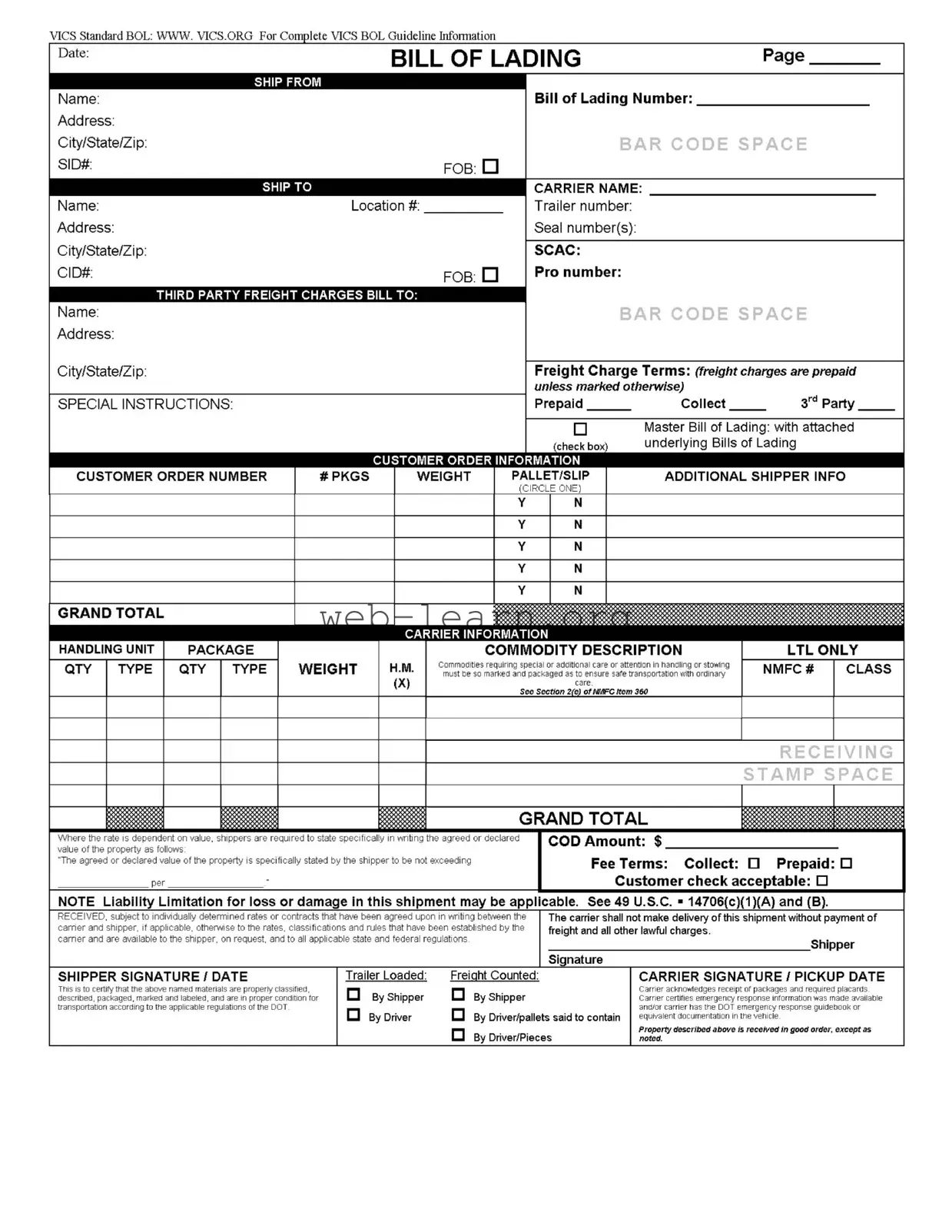
The VICS Bill of Lading (BOL) form serves as a crucial document in the transportation and shipping industry, facilitating the movement of goods between shippers and carriers. It captures essential information such as the shipper's name and address, the bill of lading number, and details about the carrier, including the carrier name and SCAC code. This form outlines freight charge terms, providing clarity on whether charges are prepaid, collected, or billed to a third party. It also includes customer order information, such as the customer order number, package count, and weight, ensuring that all parties have a clear understanding of the shipment's specifics. Special instructions for handling, as well as commodity descriptions and quantities, are prominently featured, allowing for proper care during transportation. Additionally, the VICS BOL addresses liability limitations and the need for compliance with federal regulations. This comprehensive document not only certifies the condition of the goods for transportation but also serves as a legally binding agreement between the shipper and the carrier, ensuring that all necessary protocols are followed for safe and efficient delivery.
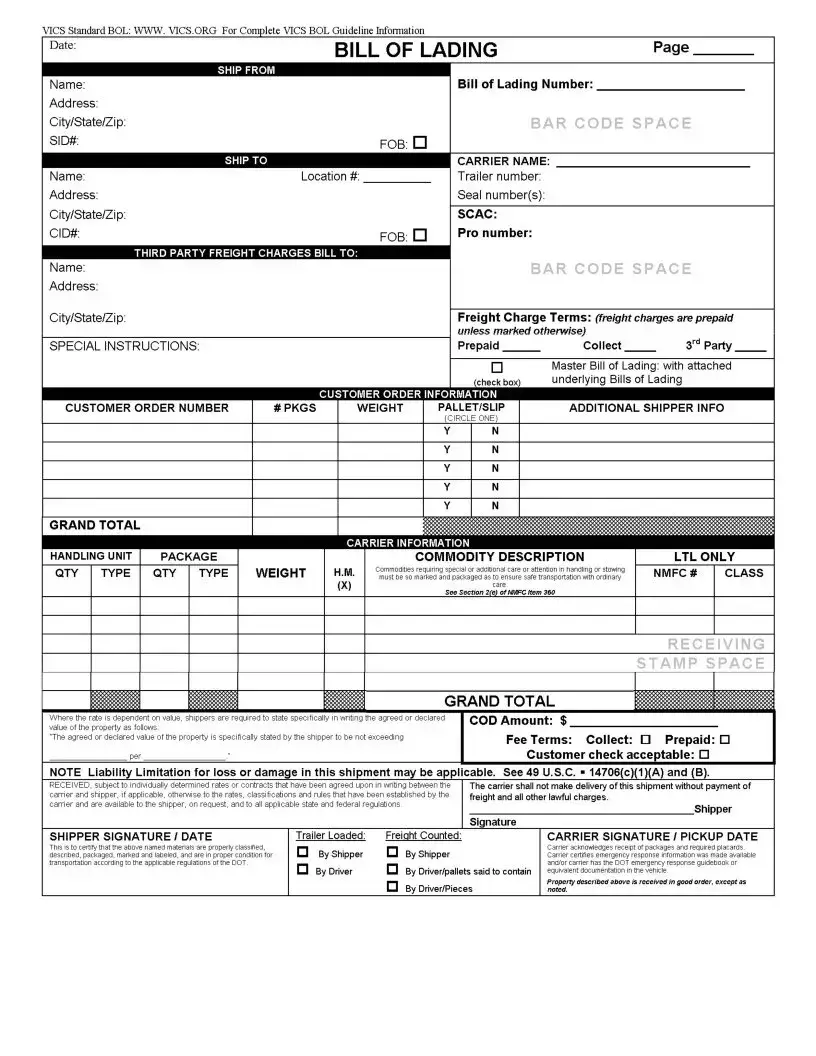
VICS Standard BQL: WWW. VICS.QRG For Complete VICS BQL Guideline Information
I Date: |
|
BILL OF LADING |
|
Page |
|
|
|
|
|||
Name: |
|
|
Bill of Lading Number: |
|
|
Address: |
|
|
|
|
|
City/State/Zip: |
|
|
BAR CODE SPACE |
||
SID#: |
|
FOB: |
|
|
|
|
|
|
CARRIER NAME: |
|
|
|
|
|
Trailer number: |
|
|
|
|
|
Seal number(s): |
|
|
|
|
|
SCAC: |
|
|
|
|
|
Pro number: |
|
|
|
|
|
BAR CODE SPACE |
||
|
|
|
Freight Charge Terms: (freight charges are prepaid |
||
|
|
|
unless marked otherwise) |
3rd Party |
|
SPECIAL INSTRUCTIONS: |
|
|
Prepaid |
Collect |
|
|
|
|
|
Master Bill of Lading: with attached |
|
|
|
|
(check box) |
underlying Bills of Lading |
|
CUSTOMER ORDER NUMBER |
# PKGS |
WEIGHT |
PALLET/SLIP |
ADDITIONAL SHIPPER INFO |
|
|
|
|
(CIRCLE ONE) |
|
|
GRAND TOTAL
HANDLING UNIT |
PACKAGE |
WEIGHT |
COMMODITY DESCRIPTION |
LTL ONLY |
|
QTY TYPE |
QTY TYPE |
Commodities requiring special or additional care or attention in handling or stowing |
NMFC# |
CLASS |
|
must be so marked and packaged as to ensure safe transportation with ordinary |
|||||
care.
See Section 2(e) ofNMFC Item 360
RECEIVING
STAMP SPACE
GRAND TOTAL
Where the rate is dependent on value, shippers are required to state specifically in writing the agreed or declared value of the property as follows:
COD Amount: $
"The agreed or declared value of the property is specifically stated by the shipper to be not exceeding |
Fee Terms: Collect: |
Prepaid: |
|
||
per |
Customer check acceptable: |
|
NOTE Liability Limitation for loss or damage in this shipment may be applicable. See 49 U.S.C. ■ 14706(c)(1)(A) and (B).
RECEIVED, subject to individually determined rates or contracts that have been agreed upon in writing between the |
The carrier shall not make delivery of this shipment without payment of |
carrier and shipper, if applicable, otherwise to the rates, classifications and rules that have been established by the |
freight and all other lawful charges. |
carrier and are available to the shipper, on request, and to all applicable state and federal regulations. |
Shipper |
|
|
|
Signature |
SHIPPER SIGNATURE / DATE |
Trailer Loaded: |
Freight Counted: |
|
This is to certify that the above named materials are properly classified, |
О |
By Shipper |
О By Shipper |
described, packaged, marked and labeled, and are in proper condition for |
|||
transportation according to the applicable regulations of the DOT. |
Q |
By Driver |
О By Driver/pallets said to contain |
|
|||
CARRIER SIGNATURE / PICKUP DATE
Carrier acknowledges receipt of packages and required placards. Carrier certifies emergency response information was made available and/or carrier has the DOT emergency response guidebook or equivalent documentation in the vehicle.
О By Driver/Pieces |
Property described above is received in good order, except as |
|
noted. |
||
|
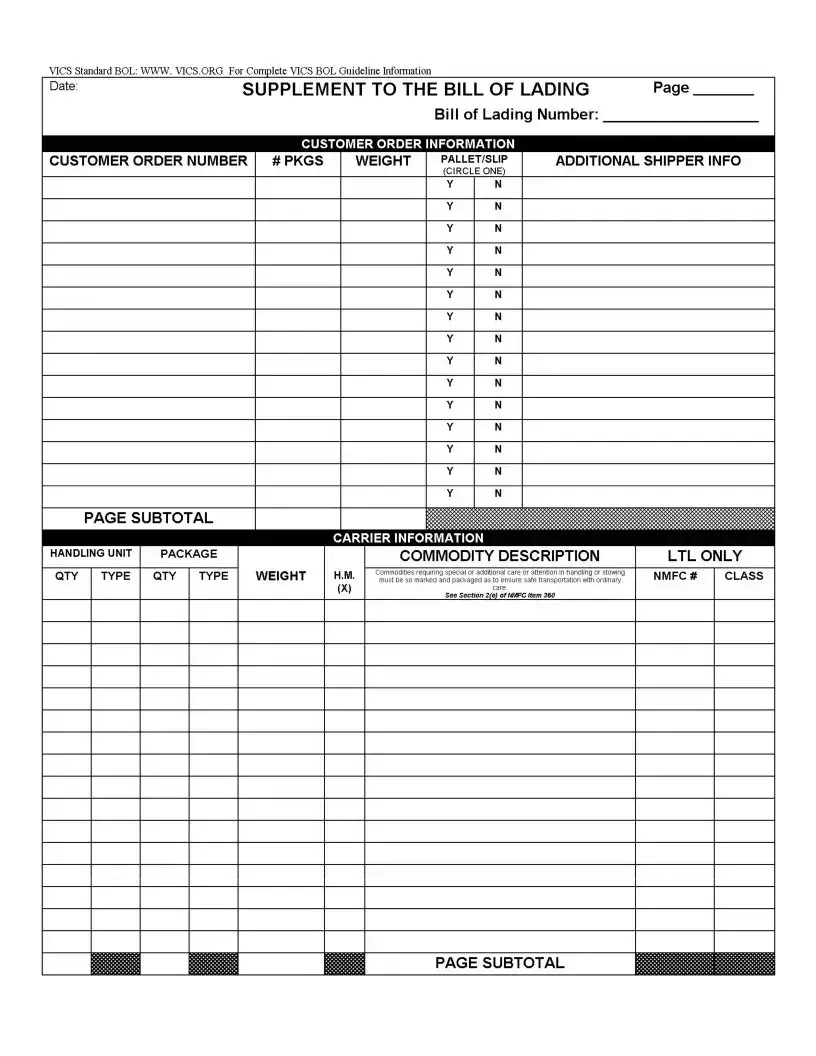
VICS Standard BQL: WWW.VICS.ORG For Complete VICS BQL Guideline Information__________________________________________________________________
Date |
SUPPLEMENT TO THE BILL OF LADING |
Page |
|
Bill of Lading Number: |
|
| Fact Name | Description |
|---|---|
| Purpose | The VICS Bill of Lading (BOL) is a document used in the transportation of goods, providing essential information about the shipment. |
| Governing Law | This form is governed by the Uniform Commercial Code (UCC) and applicable federal regulations, including 49 U.S.C. § 14706. |
| Shipping Information | Details such as shipper's name, address, and Bill of Lading number are required for accurate tracking. |
| Freight Charge Terms | Freight charges are typically prepaid unless indicated otherwise, ensuring clarity on payment responsibilities. |
| Special Instructions | Shippers can include specific handling instructions to ensure the safe transportation of sensitive goods. |
| Commodity Description | A detailed description of the commodities being shipped must be provided, including quantity and type. |
| Liability Limitation | Liability for loss or damage may be limited, requiring shippers to declare the value of the shipment. |
| Carrier Acknowledgment | The carrier must sign to confirm receipt of the shipment and acknowledge the condition of the goods. |
| Emergency Response | Carriers are required to have emergency response information available during transportation. |
| Certification | Shippers must certify that the materials are properly classified and in good condition for transport. |
Filling out the VICS Bill of Lading form requires careful attention to detail. Each section must be completed accurately to ensure proper processing and transportation of goods. Follow the steps below to fill out the form correctly.
What is the VICS Bill of Lading (BOL) form?
The VICS Bill of Lading form is a standardized document used in the shipping and logistics industry. It serves as a receipt for goods being transported, a contract between the shipper and carrier, and a document of title. This form is essential for ensuring that all parties involved in the transportation of goods have clear and concise information regarding the shipment.
What information is required on the VICS BOL form?
Several key pieces of information must be filled out on the VICS BOL form:
Completing all sections accurately helps prevent delays and ensures compliance with regulations.
What are the freight charge terms on the VICS BOL form?
Freight charge terms indicate how shipping costs will be handled. The options typically include:
It's important to select the correct option to avoid misunderstandings regarding payment responsibilities.
What should I do if my shipment contains hazardous materials?
If your shipment includes hazardous materials, it is crucial to properly classify, describe, and package these materials according to applicable regulations. The VICS BOL form requires that you mark and package hazardous items to ensure safe transportation. Additionally, emergency response information must be made available to the carrier. Failure to comply with these requirements can result in serious safety issues and legal consequences.
What is the significance of the signature section on the VICS BOL form?
The signature section of the VICS BOL form serves as a confirmation that the shipper has provided accurate information regarding the shipment. It also indicates that the carrier has received the goods in good order, except as noted. Both the shipper and carrier must sign and date the form to validate the agreement and acknowledge the terms of the shipment. This documentation is vital for resolving any disputes that may arise regarding the condition or handling of the shipment.
Filling out the VICS Bill of Lading (BOL) form accurately is essential for ensuring smooth transportation and delivery of goods. However, there are several common mistakes that individuals often make when completing this form. Recognizing these errors can help prevent delays and complications.
One frequent mistake is leaving out crucial information in the SHIP FROM section. This section requires the name, address, and other details of the sender. Omitting any part of this information can lead to confusion and misdelivery. It is vital to double-check that all fields are filled out completely and accurately.
Another common error involves the Freight Charge Terms. Many people forget to indicate whether the freight charges are prepaid, collect, or to be billed to a third party. This oversight can cause billing disputes later on. Ensure that the appropriate box is checked to clarify payment responsibilities.
In the CARRIER INFORMATION section, individuals sometimes fail to provide the correct carrier name or SCAC code. These details are essential for identifying the transportation company responsible for the shipment. Without accurate information, the carrier may not be able to process the shipment effectively.
Additionally, errors in the PACKAGE COMMODITY DESCRIPTION can lead to significant issues. It is important to provide a clear and accurate description of the goods being shipped. Mislabeling or vague descriptions can result in delays or even damage claims if the contents are not handled appropriately.
People often neglect to include the agreed or declared value of the property. This information is crucial when the rate depends on the value of the goods. Failing to state this value can limit liability coverage in case of loss or damage during transit.
Another mistake is not signing and dating the form. The SHIPPER SIGNATURE is a confirmation that the information provided is accurate and that the goods are ready for transportation. A missing signature can invalidate the document and cause issues with the carrier.
Lastly, individuals sometimes overlook the importance of special instructions. If there are specific handling requirements for the shipment, they should be clearly noted in the SPECIAL INSTRUCTIONS section. Ignoring this can lead to mishandling of sensitive items, resulting in damage or loss.
By being aware of these common mistakes, individuals can improve the accuracy of their VICS Bill of Lading forms. Taking the time to review each section thoroughly can help ensure a smoother shipping process.
The VICS Bill of Lading (BOL) form serves as a crucial document in the shipping and transportation industry, outlining the details of the shipment and the responsibilities of the involved parties. Alongside the VICS BOL form, several other documents and forms are commonly utilized to facilitate the shipping process. Each of these documents plays a distinct role, ensuring compliance with regulations and clarity in transactions.
Each of these documents complements the VICS BOL form, enhancing the efficiency and legality of the shipping process. Understanding the purpose and importance of each form can help ensure smooth transactions and compliance with applicable regulations.
When filling out the VICS Bill of Lading (BOL) form, attention to detail is crucial. Below is a list of actions to consider to ensure accurate completion.
This is not true. The VICS BOL form can be utilized for shipments of all sizes, whether small or large. Its purpose is to ensure that all necessary information is documented, regardless of the shipment's scale.
In reality, completing the VICS BOL form is essential for proper shipping. It serves as a legal document that outlines the terms of the shipment and protects both the shipper and the carrier.
This is misleading. The VICS BOL form requires comprehensive details, including shipper and carrier information, freight charges, and special instructions. Omitting details can lead to complications during transit.
The form is applicable across various industries. Any business involved in shipping goods can benefit from using the VICS BOL form to facilitate smooth transactions.
This is incorrect. Liability limitations are indeed applicable. It is crucial for shippers to understand these limitations to avoid unexpected losses during transportation.
In fact, marking commodities that require special handling is mandatory. This ensures that the carrier is aware of any specific requirements for safe transportation.
This is a common misunderstanding. The VICS BOL form can be used for both domestic and international shipments, making it a versatile tool for shipping logistics.
While it is true that changes should be avoided after signing, amendments can be made if necessary. It is important to document any changes clearly to maintain transparency.
This is misleading. While the form facilitates the shipping process, it does not guarantee delivery. Various factors, including weather and logistics, can affect delivery timelines.
This is not accurate. The form is beneficial for both shippers and carriers, providing a mutual understanding of the terms and conditions of the shipment.
When filling out and using the VICS Bill of Lading (BOL) form, it is essential to ensure accuracy and completeness. Here are key takeaways to keep in mind:
By following these guidelines, the process of filling out and using the VICS Bill of Lading form will be more efficient and effective.