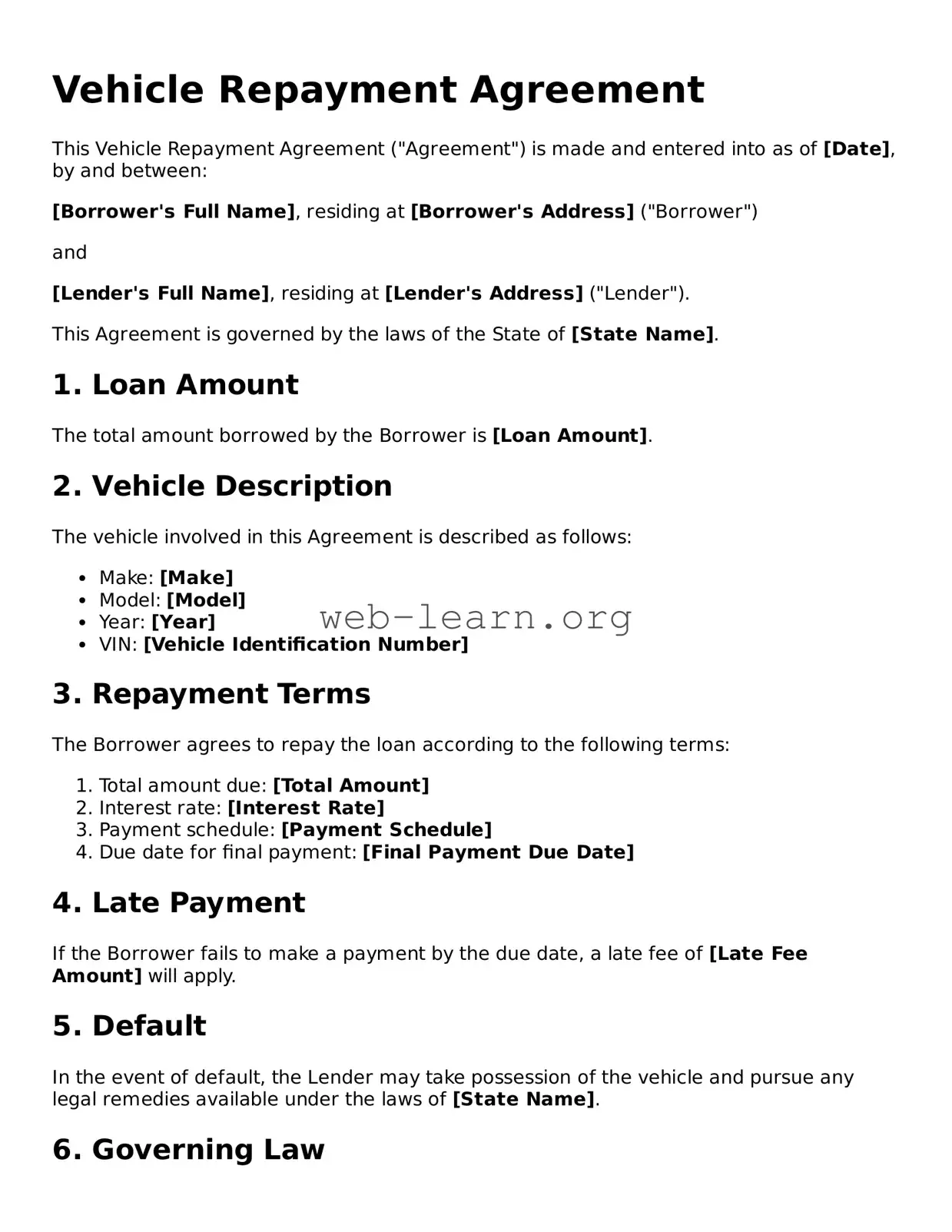
When it comes to financing a vehicle, understanding the terms of repayment is crucial for both buyers and sellers. The Vehicle Repayment Agreement form serves as a vital document that outlines the specific terms under which a vehicle is financed. This form typically includes details such as the total amount financed, the interest rate, and the payment schedule. Additionally, it may cover aspects like the consequences of late payments, any fees associated with the loan, and the rights of both parties involved. By clearly defining these elements, the agreement helps to protect the interests of both the lender and the borrower, ensuring that everyone is on the same page. Whether you're purchasing a new car or refinancing an existing loan, familiarizing yourself with this form can lead to a smoother transaction and greater peace of mind.
Vehicle Repayment Agreement
This Vehicle Repayment Agreement ("Agreement") is made and entered into as of [Date], by and between:
[Borrower's Full Name], residing at [Borrower's Address] ("Borrower")
and
[Lender's Full Name], residing at [Lender's Address] ("Lender").
This Agreement is governed by the laws of the State of [State Name].
1. Loan Amount
The total amount borrowed by the Borrower is [Loan Amount].
2. Vehicle Description
The vehicle involved in this Agreement is described as follows:
3. Repayment Terms
The Borrower agrees to repay the loan according to the following terms:
4. Late Payment
If the Borrower fails to make a payment by the due date, a late fee of [Late Fee Amount] will apply.
5. Default
In the event of default, the Lender may take possession of the vehicle and pursue any legal remedies available under the laws of [State Name].
6. Governing Law
This Agreement shall be governed by the laws of the State of [State Name].
7. Signatures
By signing below, both parties agree to the terms of this Vehicle Repayment Agreement.
__________________________
[Borrower's Full Name] (Borrower)
__________________________
[Lender's Full Name] (Lender)
Date: [Date]
| Fact Name | Details |
|---|---|
| Purpose | The Vehicle Repayment Agreement form outlines the terms for repayment of a vehicle loan. |
| Parties Involved | The form typically involves the borrower and the lender. |
| Governing Law | State-specific laws govern the agreement, such as the Uniform Commercial Code (UCC) in most states. |
| Repayment Terms | The agreement specifies the repayment schedule, including amounts and due dates. |
| Interest Rate | The form should clearly state the interest rate applicable to the loan. |
| Default Clause | It includes conditions under which the borrower may default on the loan. |
| Collateral | The vehicle itself often serves as collateral for the loan. |
| Signatures Required | Both parties must sign the form for it to be legally binding. |
| Amendments | Any changes to the agreement must be documented in writing and signed by both parties. |
| State Variations | Different states may have specific requirements for the form, such as notarization. |
After receiving the Vehicle Repayment Agreement form, you will need to complete it accurately to ensure proper processing. Follow the steps below to fill out the form correctly.
Once you have completed the form, review all entries for accuracy before submitting it. This ensures that the information provided is correct and helps avoid delays in processing your agreement.
A Vehicle Repayment Agreement is a formal document that outlines the terms and conditions under which a borrower agrees to repay a loan used to purchase a vehicle. This agreement serves to protect both the lender and the borrower by clearly defining the repayment schedule, interest rates, and other important terms.
Both the borrower and the lender must sign the Vehicle Repayment Agreement. If there are co-borrowers, they should also sign the document to ensure that all parties are legally bound to the terms of the agreement.
The form typically requires the following information:
The repayment schedule outlines when payments are due and how much each payment will be. Payments can be structured monthly, bi-weekly, or according to another agreed-upon timeline. It's essential to adhere to this schedule to avoid penalties or default.
If a payment is missed, the lender may impose late fees or penalties as specified in the agreement. Continued missed payments could lead to more severe consequences, including repossession of the vehicle. It’s important to communicate with the lender if difficulties arise.
Yes, modifications can be made to the Vehicle Repayment Agreement, but both parties must agree to the changes. It’s advisable to document any modifications in writing and have both parties sign the updated agreement to ensure clarity and legal standing.
Defaulting on the loan can lead to serious repercussions, including damage to your credit score, legal action from the lender, and potential repossession of the vehicle. It’s crucial to understand the terms of the agreement and to seek assistance if financial difficulties arise.
Yes, once signed by both parties, the Vehicle Repayment Agreement is legally binding. This means that both the borrower and the lender are obligated to adhere to the terms outlined in the document.
A Vehicle Repayment Agreement form can often be obtained from financial institutions, legal websites, or through a lawyer specializing in contracts. Ensure that the form complies with local laws and regulations.
If you have questions about the Vehicle Repayment Agreement, consider reaching out to the lender for clarification. Additionally, consulting a legal professional can provide valuable insights and ensure that you fully understand your rights and obligations.
Filling out the Vehicle Repayment Agreement form can be straightforward, but many individuals make common mistakes that can lead to complications. One frequent error is providing inaccurate personal information. This includes misspellings of names, incorrect addresses, or wrong identification numbers. Such inaccuracies can delay processing and create issues down the line.
Another mistake often seen is failing to read the terms and conditions carefully. Many people rush through the form and overlook crucial details regarding payment schedules, interest rates, or penalties for late payments. Understanding these terms is essential to avoid surprises later on.
Additionally, individuals sometimes neglect to include necessary documentation. Supporting documents, such as proof of income or insurance information, are often required. Omitting these can result in a rejected application or delays in approval.
Lastly, some individuals fail to double-check their calculations. Whether it's the total amount due or monthly payment amounts, errors in math can lead to misunderstandings about what is owed. It's important to verify all figures to ensure accuracy and prevent future disputes.
The Vehicle Repayment Agreement form is a crucial document for establishing the terms of repayment for a vehicle loan. However, several other forms and documents often accompany it to ensure clarity and legal compliance throughout the process. Below is a list of these important documents.
Each of these documents plays a vital role in the vehicle loan process. Ensuring that all necessary forms are completed accurately and submitted on time can help prevent misunderstandings and legal issues down the road.
When filling out the Vehicle Repayment Agreement form, it's essential to follow certain guidelines to ensure accuracy and compliance. Here are nine things to consider:
Following these guidelines will help you complete the Vehicle Repayment Agreement form accurately and efficiently.
When dealing with a Vehicle Repayment Agreement form, several misconceptions can arise. Understanding these can help individuals navigate the process more effectively. Here are four common misconceptions:
Understanding these misconceptions can lead to better decision-making and clearer communication between all parties involved.
When filling out and using the Vehicle Repayment Agreement form, consider these key takeaways: