Homepage Attorney-Approved Vehicle Release of Liability Template
Outline

The Vehicle Release of Liability form is an essential document for anyone involved in the transfer or sale of a vehicle. This form serves to protect the seller from future claims related to the vehicle after the sale has been completed. It outlines the responsibilities of both the buyer and the seller, ensuring that the seller is not held liable for any accidents, damages, or legal issues that may arise once the vehicle is no longer in their possession. By signing this form, the buyer acknowledges that they accept the vehicle "as is," thereby relieving the seller of any further obligations or liabilities. The form typically includes details such as the vehicle's identification number (VIN), the names and addresses of both parties, and the date of the transaction. Understanding the importance of this document can help both buyers and sellers navigate the complexities of vehicle ownership transfer smoothly and legally.

Sample - Vehicle Release of Liability Form

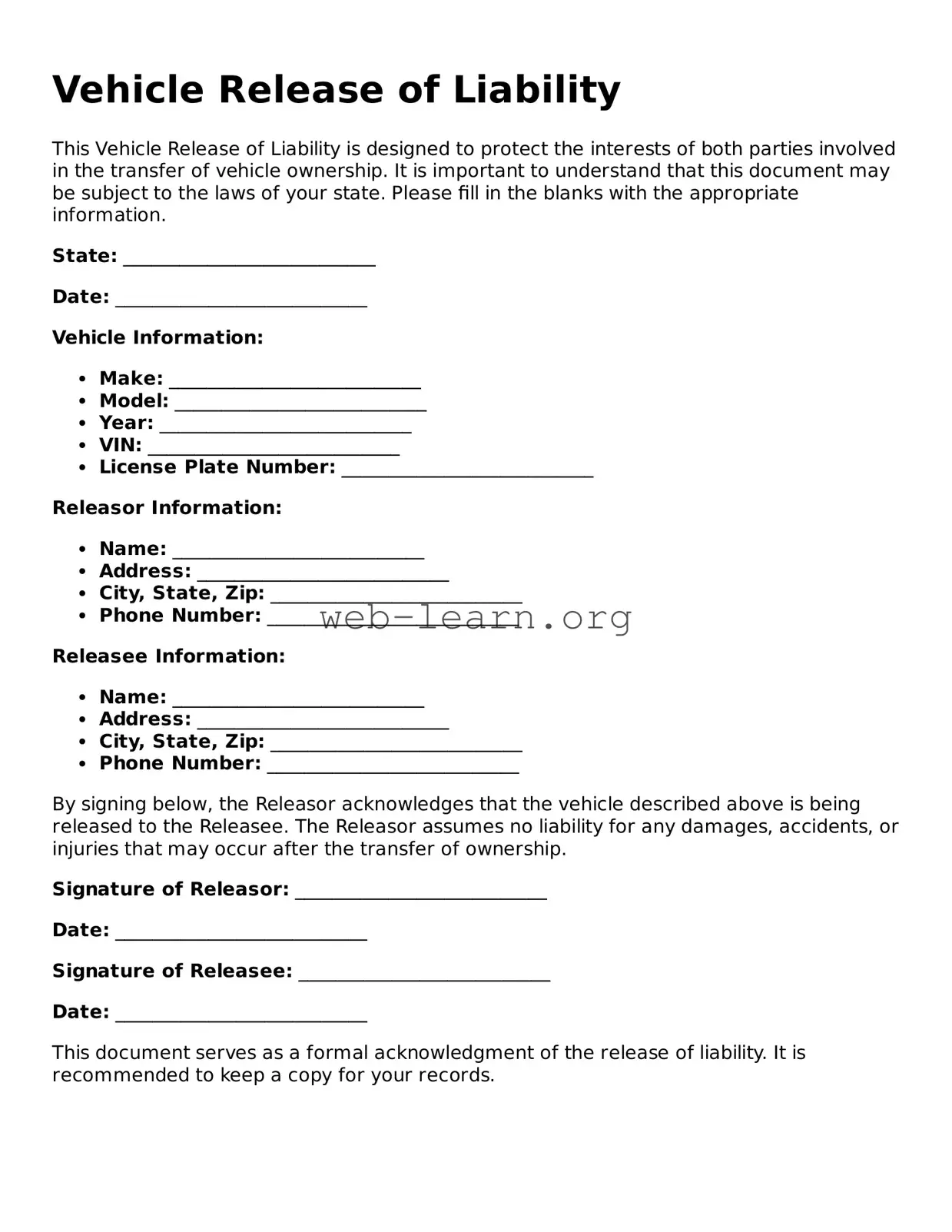
Vehicle Release of Liability

This Vehicle Release of Liability is designed to protect the interests of both parties involved in the transfer of vehicle ownership. It is important to understand that this document may be subject to the laws of your state. Please fill in the blanks with the appropriate information.

State: ___________________________

Date: ___________________________

Vehicle Information:

  • Make: ___________________________
  • Model: ___________________________
  • Year: ___________________________
  • VIN: ___________________________
  • License Plate Number: ___________________________

Releasor Information:

  • Name: ___________________________
  • Address: ___________________________
  • City, State, Zip: ___________________________
  • Phone Number: ___________________________

Releasee Information:

  • Name: ___________________________
  • Address: ___________________________
  • City, State, Zip: ___________________________
  • Phone Number: ___________________________

By signing below, the Releasor acknowledges that the vehicle described above is being released to the Releasee. The Releasor assumes no liability for any damages, accidents, or injuries that may occur after the transfer of ownership.

Signature of Releasor: ___________________________

Date: ___________________________

Signature of Releasee: ___________________________

Date: ___________________________

This document serves as a formal acknowledgment of the release of liability. It is recommended to keep a copy for your records.

File Characteristics

Fact Name Description
Purpose The Vehicle Release of Liability form is used to release a seller from future claims related to a vehicle after its sale.
Governing Law Each state has its own laws governing the use of this form. For example, California follows the California Vehicle Code Section 5602.
Parties Involved The form typically involves two parties: the seller and the buyer of the vehicle.
Signatures Required Both the seller and the buyer must sign the form to make it valid.
Notification It is recommended that the seller notifies the Department of Motor Vehicles (DMV) after the sale.
Record Keeping Both parties should keep a copy of the signed form for their records.
Liability Protection This form helps protect the seller from liability for any incidents involving the vehicle after the sale.
State Variations Different states may have specific requirements or additional forms that need to be completed.

Detailed Guide for Filling Out Vehicle Release of Liability

After completing the Vehicle Release of Liability form, you will submit it to the appropriate agency or entity. This will ensure that the necessary records are updated and that you are no longer liable for the vehicle.

  1. Obtain the Vehicle Release of Liability form from your local Department of Motor Vehicles (DMV) or their website.
  2. Fill in your name and address in the designated fields at the top of the form.
  3. Provide the vehicle's details, including the make, model, year, and vehicle identification number (VIN).
  4. Indicate the date of the sale or transfer of the vehicle.
  5. Enter the name and address of the new owner.
  6. Sign and date the form to certify the information is accurate.
  7. Make a copy of the completed form for your records.
  8. Submit the original form to the DMV or relevant agency as instructed.

Obtain Answers on Vehicle Release of Liability

  1. What is a Vehicle Release of Liability form?

    A Vehicle Release of Liability form is a legal document that protects the owner of a vehicle from being held responsible for any damages or injuries that occur after the vehicle has been sold or transferred. By signing this form, the buyer acknowledges that they assume all responsibility for the vehicle and releases the seller from any future claims related to the vehicle.

  2. Why should I use a Vehicle Release of Liability form?

    Using this form is crucial for both buyers and sellers. It provides a clear record of the transaction and ensures that the seller is not liable for any accidents or issues that arise after the sale. For the buyer, it serves as proof of ownership and helps establish a timeline of the vehicle's transfer. This form can prevent misunderstandings and potential legal disputes down the line.

  3. How do I complete a Vehicle Release of Liability form?

    Completing the form is straightforward. Follow these steps:

    • Provide the vehicle's details, including the make, model, year, and VIN.
    • Include the names and addresses of both the seller and the buyer.
    • Clearly state the date of the sale.
    • Both parties should sign and date the document to make it legally binding.

    Ensure that each party retains a copy for their records.

  4. Is a Vehicle Release of Liability form legally binding?

    Yes, when properly completed and signed, a Vehicle Release of Liability form is legally binding. It serves as a formal agreement between the buyer and seller. However, the enforceability may vary by state, so it’s wise to check local laws or consult with a legal professional if you have concerns.

Common mistakes

Filling out a Vehicle Release of Liability form is an important step when transferring ownership of a vehicle. However, many people make common mistakes that can lead to complications down the line. Understanding these pitfalls can help ensure a smooth process.

One frequent error is not providing accurate vehicle information. When filling out the form, it’s crucial to include the correct make, model, year, and Vehicle Identification Number (VIN). Missing or incorrect details can create confusion and may even result in legal issues regarding ownership.

Another mistake is failing to sign the form. A signature is essential for validating the release of liability. Without it, the document may be considered incomplete, leaving the previous owner vulnerable to future claims related to the vehicle. Always double-check that all required signatures are present before submitting the form.

People often overlook the importance of notifying the DMV after completing the form. Simply filling out the Vehicle Release of Liability does not automatically inform the Department of Motor Vehicles about the change in ownership. It’s the responsibility of the seller to ensure that the DMV is updated to avoid any potential liabilities.

Additionally, not keeping a copy of the completed form can be a significant mistake. It’s wise to retain a copy for your records. This documentation can serve as proof of the transaction and can be invaluable in case any disputes arise in the future.

Lastly, many individuals fail to understand the implications of the release. A Vehicle Release of Liability form protects the seller from future claims related to the vehicle. However, if not filled out correctly, it may not provide the intended legal protection. Take the time to read and understand the form fully to ensure it meets your needs.

Documents used along the form

When dealing with vehicle transactions, several documents often accompany the Vehicle Release of Liability form. These forms help clarify responsibilities and protect the interests of all parties involved. Below is a list of commonly used forms that may be needed in conjunction with the Vehicle Release of Liability.

  • Bill of Sale: This document serves as a record of the transaction between the buyer and seller. It includes details such as the vehicle identification number (VIN), sale price, and the names and addresses of both parties.
  • Title Transfer Form: This form is essential for officially transferring ownership of the vehicle. It typically requires signatures from both the seller and buyer, along with any necessary identification information.
  • Odometer Disclosure Statement: This document is often required by law to disclose the vehicle's mileage at the time of sale. Both parties must sign it to verify the accuracy of the reported odometer reading.
  • Insurance Certificate: Proof of insurance is crucial when transferring a vehicle. This document shows that the buyer has obtained coverage for the vehicle, ensuring compliance with state laws.
  • Power of Attorney: In some cases, a seller may grant someone else the authority to sign documents on their behalf. This form allows the designated person to handle the transaction if the seller is unavailable.

Each of these documents plays a vital role in facilitating a smooth vehicle transaction. Having them prepared and signed can help prevent misunderstandings and legal issues down the road.

Similar forms

  • Release of Liability Waiver: This document protects one party from legal claims by another. Similar to the Vehicle Release of Liability, it requires the signing party to acknowledge risks and waive their right to sue.
  • Indemnity Agreement: This form outlines the responsibility of one party to compensate another for certain damages or losses. It shares the same goal of protecting against future claims.
  • Hold Harmless Agreement: This agreement is designed to prevent one party from being held liable for injuries or damages incurred by another. It serves a similar purpose to the Vehicle Release of Liability.
  • Insurance Policy: While not a waiver, an insurance policy often includes clauses that limit liability. Both documents aim to manage risk and protect against financial loss.
  • Consent Form: Often used in medical or recreational contexts, this document ensures that individuals understand the risks involved. Like the Vehicle Release of Liability, it requires informed consent.
  • Rental Agreement: This contract outlines the terms of renting a vehicle or equipment, including liability for damages. It shares similarities in addressing responsibilities and potential risks.
  • Service Agreement: This document defines the terms under which services are provided, often including liability clauses. Both documents help clarify responsibilities and protect against claims.
  • Event Participation Waiver: Used for events or activities, this waiver protects organizers from liability for injuries. It functions similarly to the Vehicle Release of Liability in acknowledging risks.
  • Release of Medical Information: This form allows healthcare providers to share patient information. While different in context, both documents involve consent and the understanding of potential risks.
  • Construction Contract: This agreement outlines the terms of construction work, often including liability provisions. Like the Vehicle Release of Liability, it aims to protect parties from unforeseen claims.

Dos and Don'ts

When filling out the Vehicle Release of Liability form, it’s important to be careful and thorough. Here’s a list of things you should and shouldn’t do:

  • Do read the entire form carefully before starting.
  • Don’t leave any required fields blank.
  • Do provide accurate information about the vehicle.
  • Don’t use abbreviations or shorthand that may confuse the reader.
  • Do sign and date the form where indicated.
  • Don’t forget to check for any additional documents that may be required.
  • Do keep a copy of the completed form for your records.
  • Don’t submit the form without double-checking for errors.
  • Do ask for help if you’re unsure about any part of the form.
  • Don’t rush through the process; take your time to ensure accuracy.

Misconceptions

When it comes to the Vehicle Release of Liability form, there are several misconceptions that can lead to confusion. Here are five common misunderstandings:

  1. It absolves all responsibility. Many people believe that signing this form means they cannot be held responsible for any accidents or damages. However, this is not always true. The form typically limits liability for certain situations but does not eliminate it entirely.
  2. It's only necessary for private transactions. Some think that only private vehicle sales require this form. In reality, it can also be important in situations like rentals or when lending a vehicle to a friend.
  3. It’s the same as a bill of sale. While both documents are important in vehicle transactions, they serve different purposes. A bill of sale transfers ownership, while a release of liability protects the seller from future claims.
  4. It can be ignored if the vehicle is sold “as is.” Just because a vehicle is sold “as is” does not mean that a release of liability is unnecessary. The form still provides legal protection for the seller against future claims.
  5. It’s not legally binding. Some people think that these forms are just formalities and lack legal weight. In fact, when properly completed and signed, they are typically enforceable in court.

Understanding these misconceptions can help you navigate the complexities of vehicle transactions more effectively. Always consider consulting with a legal professional to ensure you have the right protections in place.

Key takeaways

When dealing with a Vehicle Release of Liability form, it’s important to understand its purpose and how to fill it out correctly. Here are some key takeaways:

  1. Purpose: This form protects the seller from future claims related to the vehicle after it has been sold or transferred.
  2. Complete Information: Ensure all sections are filled out accurately, including the vehicle identification number (VIN), make, model, and year.
  3. Signatures Required: Both the seller and the buyer must sign the form to make it valid.
  4. Date of Transfer: Clearly indicate the date when the vehicle was sold or transferred to avoid any confusion.
  5. State Requirements: Check your state’s specific regulations, as requirements may vary.
  6. Keep a Copy: Always retain a copy of the completed form for your records. This serves as proof of the transaction.
  7. Notify DMV: In many states, you must submit this form to the Department of Motor Vehicles (DMV) to officially record the transfer.
  8. Legal Advice: If unsure about any part of the process, consider seeking legal advice to ensure compliance with local laws.

Understanding these points can help ensure a smooth transaction when selling or transferring a vehicle.