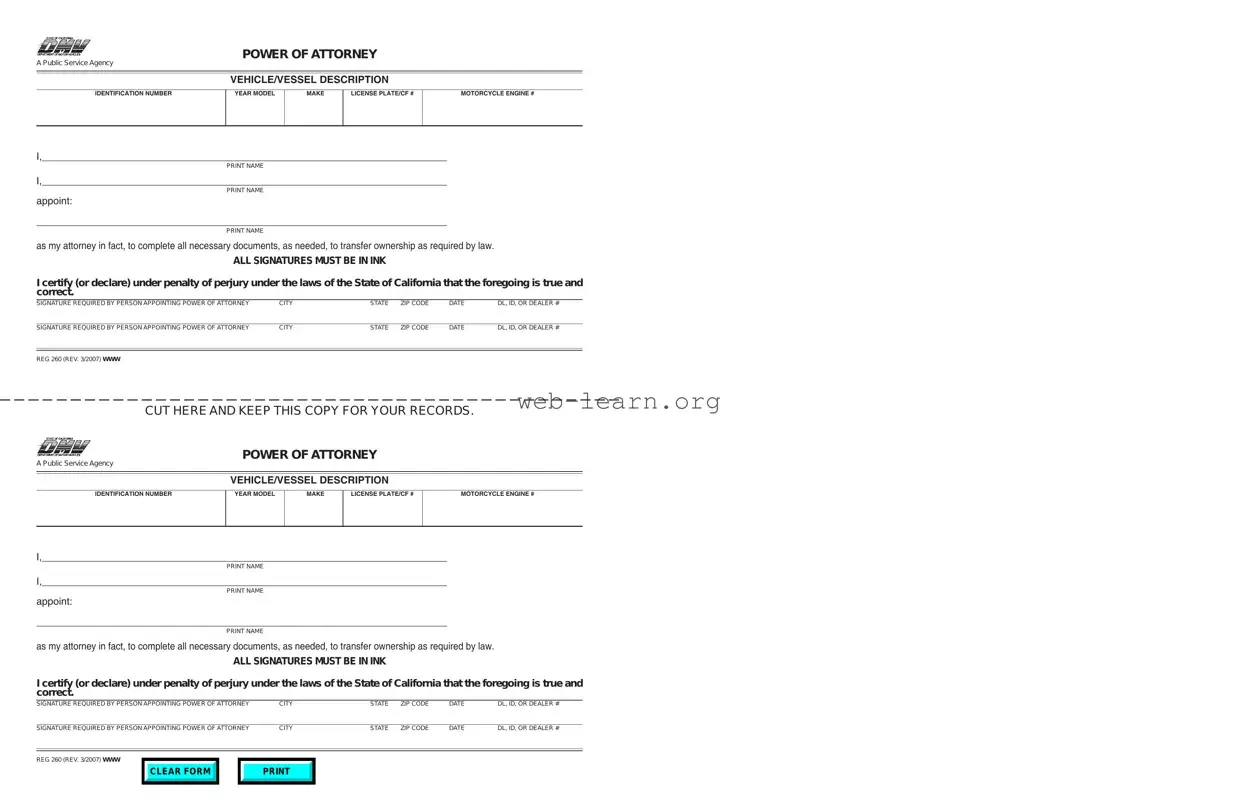
The Vehicle Power of Attorney (POA) REG 260 form serves as a vital document for individuals who need to delegate authority regarding their vehicle to another person. This form is commonly used when a vehicle owner is unable to attend to certain tasks, such as selling, transferring, or registering a vehicle, due to various reasons like being out of state or having health issues. By completing the REG 260, the vehicle owner grants specific powers to an appointed agent, allowing them to act on the owner's behalf in matters related to the vehicle. This includes signing documents, obtaining title transfers, and managing registration processes. The form requires essential information, such as the names and addresses of both the vehicle owner and the agent, as well as details about the vehicle itself, including the make, model, and VIN. Proper completion of this form ensures that the agent has the legal authority to perform the necessary actions without complications. It is crucial for vehicle owners to understand the implications of granting such authority, as it involves trust and responsibility in handling significant transactions related to their property.
POWER OF ATTORNEY
A Public Service Agency
VEHICLE/VESSEL DESCRIPTION
IDENTIFICATION NUMBER
YEAR MODEL
MAKE
LICENSE PLATE/CF #
MOTORCYCLE ENGINE #
I,________________________________________________________________________
PRINT NAME
I,________________________________________________________________________
PRINT NAME
appoint:
_________________________________________________________________________
PRINT NAME
as my attorney in fact, to complete all necessary documents, as needed, to transfer ownership as required by law.
ALL SIGNATURES MUST BE IN INK
I certify (or declare) under penalty of perjury under the laws of the State of California that the foregoing is true and correct.
SIGNATURE REQUIRED BY PERSON APPOINTING POWER OF ATTORNEY |
CITY |
STATE |
ZIP CODE |
DATE |
DL, ID, OR DEALER # |
|
|
|
|
|
|
SIGNATURE REQUIRED BY PERSON APPOINTING POWER OF ATTORNEY |
CITY |
STATE |
ZIP CODE |
DATE |
DL, ID, OR DEALER # |
|
|
|
|
|
|
|
|
|
|
|
|
REG 260 (REV. 3/2007) WWW |
|
|
|
|
|
CUT HERE AND KEEP THIS COPY FOR YOUR RECORDS.
POWER OF ATTORNEY
A Public Service Agency
VEHICLE/VESSEL DESCRIPTION
IDENTIFICATION NUMBER
YEAR MODEL
MAKE
LICENSE PLATE/CF #
MOTORCYCLE ENGINE #
I,________________________________________________________________________
PRINT NAME
I,________________________________________________________________________
PRINT NAME
appoint:
_________________________________________________________________________
PRINT NAME
as my attorney in fact, to complete all necessary documents, as needed, to transfer ownership as required by law.
ALL SIGNATURES MUST BE IN INK
I certify (or declare) under penalty of perjury under the laws of the State of California that the foregoing is true and correct.
SIGNATURE REQUIRED BY PERSON APPOINTING POWER OF ATTORNEY |
CITY |
STATE |
ZIP CODE |
DATE |
DL, ID, OR DEALER # |
|
|
|
|
|
|
SIGNATURE REQUIRED BY PERSON APPOINTING POWER OF ATTORNEY |
CITY |
STATE |
ZIP CODE |
DATE |
DL, ID, OR DEALER # |
REG 260 (REV. 3/2007) WWW
CLEAR FORM
| Fact Name | Description |
|---|---|
| Purpose | The Vehicle POA REG 260 form is used to grant power of attorney for vehicle-related transactions. |
| Governing Law | This form is governed by the laws of the state in which it is executed, typically under vehicle code regulations. |
| Authorized Actions | It allows the agent to perform tasks such as registering, transferring, or titling a vehicle. |
| Signature Requirement | The principal must sign the form to validate the power of attorney granted. |
| Agent Responsibilities | The agent must act in the best interest of the principal and follow the specified powers granted. |
| Revocation | The principal can revoke the power of attorney at any time, provided they do so in writing. |
| Notarization | Notarization may be required in some states to enhance the form's validity. |
| Expiration | The power of attorney remains in effect until revoked or until the principal's death. |
After obtaining the Vehicle POA REG 260 form, you will need to complete it accurately to ensure proper processing. Follow the steps outlined below to fill out the form correctly.
Once completed, ensure all information is accurate and legible. The form can then be submitted as required by the relevant authorities.
What is the Vehicle POA REG 260 form?
The Vehicle POA REG 260 form is a Power of Attorney document used in the United States for vehicle-related transactions. It allows one person (the agent) to act on behalf of another person (the principal) regarding the registration, sale, or transfer of a vehicle. This form is particularly useful when the principal cannot be present to handle these tasks personally.
Who can use the Vehicle POA REG 260 form?
Any vehicle owner in the U.S. can use the Vehicle POA REG 260 form. This includes individuals who may be unable to attend a DMV appointment due to health issues, travel, or other commitments. The agent must be someone the principal trusts, as they will have the authority to make decisions regarding the vehicle.
What transactions can be completed using the Vehicle POA REG 260 form?
The Vehicle POA REG 260 form can be used for various transactions, including:
These actions can be completed without the principal being present, streamlining the process for both parties.
How do I complete the Vehicle POA REG 260 form?
To complete the Vehicle POA REG 260 form, follow these steps:
Make sure to keep a copy of the completed form for your records.
Is the Vehicle POA REG 260 form valid in all states?
The Vehicle POA REG 260 form is generally recognized across the U.S., but specific requirements may vary by state. Some states may have additional rules regarding notarization or the specific language used in the form. It is advisable to check with your local DMV or legal advisor to ensure compliance with state laws.
Filling out the Vehicle Power of Attorney (POA) REG 260 form can seem straightforward, but many people make common mistakes that can delay the process or lead to complications. One frequent error is failing to provide accurate information. For instance, if the vehicle identification number (VIN) is incorrect, it can cause issues when the document is submitted. Always double-check the VIN and other details to ensure they match the vehicle's title.
Another mistake is neglecting to sign the form. A signature is essential for the form to be valid. Without it, the document cannot be processed. Additionally, some individuals forget to date their signatures. This small detail can also lead to confusion and may require resubmission.
Many people overlook the need for a witness or notarization. Depending on state requirements, the form may need to be signed in front of a notary public or witnessed by a third party. Ignoring this requirement can render the document invalid.
Misunderstanding the authority granted is another common issue. The form allows you to specify what powers you are giving to the agent. Failing to clearly outline these powers can lead to misunderstandings later. Be explicit about what the agent can and cannot do on your behalf.
In some cases, individuals may use an outdated version of the form. Always ensure that you are using the most current version of the Vehicle POA REG 260 form. Using an old version may result in rejection or delays.
People often neglect to provide contact information for both the principal and the agent. This information is crucial for any follow-up or clarification needed during the process. Ensure that all contact details are clearly stated and up to date.
Another mistake involves not reviewing the completed form before submission. Taking a moment to go over the entire document can help catch errors that may have been overlooked initially. This simple step can save time and prevent unnecessary complications.
Some individuals also forget to keep a copy of the completed form for their records. Having a copy can be beneficial if questions arise later or if there is a need to reference the document in the future.
Lastly, failing to understand the implications of granting power of attorney can lead to significant issues. It’s important to fully comprehend what it means to give someone else authority over your vehicle. Take the time to consider the responsibilities and potential consequences before signing the form.
The Vehicle Power of Attorney (POA) REG 260 form is commonly used in vehicle transactions. Several other forms and documents may accompany this form to facilitate the transfer of ownership or to authorize specific actions related to the vehicle. Below is a list of these documents, each serving a distinct purpose.
These documents work in conjunction with the Vehicle POA REG 260 form to ensure a smooth and legally compliant transaction. Understanding each document's role can help facilitate the process of buying, selling, or transferring vehicle ownership.
When filling out the Vehicle POA REG 260 form, it’s important to follow some guidelines to ensure everything goes smoothly. Here’s a list of things you should and shouldn’t do:
Following these tips will help you complete the Vehicle POA REG 260 form correctly and efficiently.
This form is actually designed for any individual who needs to authorize another person to act on their behalf regarding vehicle transactions. This includes private owners, not just dealers.
While being present can simplify the process, it is not a requirement. You can complete the form and grant power of attorney remotely, as long as the necessary signatures are obtained.
In reality, this form can be used for various vehicle-related tasks, including registration, title transfers, and even applying for permits. Its versatility is one of its key advantages.
This is not true. The principal can revoke the power of attorney at any time, as long as they provide written notice to the agent and any relevant parties.
Notarization is not a mandatory requirement for this form. However, having it notarized can add an extra layer of legitimacy and may be beneficial in certain situations.
This form has a limited duration unless otherwise specified. Typically, it remains effective until the task is completed or the principal decides to revoke it.
Actually, you can appoint multiple agents if desired. Just be sure to clearly outline their roles and responsibilities to avoid confusion.
When dealing with the Vehicle Power of Attorney (POA) REG 260 form, it's essential to understand its purpose and how to complete it correctly. Here are some key takeaways to keep in mind:
Understanding these key points can streamline the process and ensure that your vehicle transactions go smoothly.