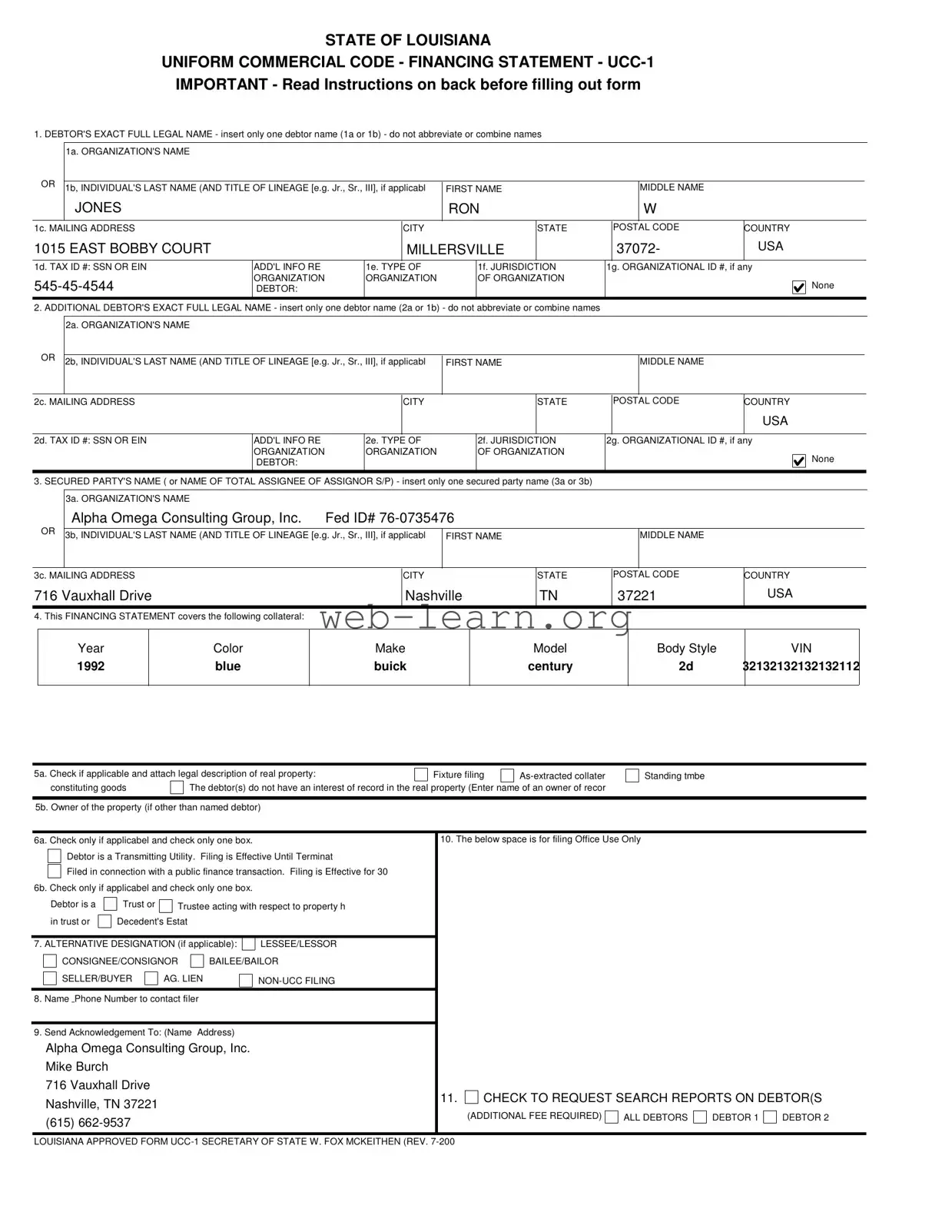
The UCC-1 form, a crucial document in the realm of secured transactions, plays an essential role in establishing a creditor's legal claim to a debtor's assets in Louisiana. This financing statement allows creditors to publicly declare their security interests in specific collateral, which can include personal property or fixtures. One of the first steps in completing the form involves accurately listing the debtor's full legal name, ensuring that it is neither abbreviated nor combined with other names. This precision is vital, as it helps prevent any confusion regarding the identity of the debtor. Additionally, the form requires detailed information about the secured party, including their name and mailing address. The UCC-1 also necessitates a description of the collateral being secured, which must be specific enough to identify the property in question. For those involved in real estate, there are options to indicate if the filing pertains to fixtures or if it is related to a public finance transaction. Moreover, the form includes sections for additional debtors, organizational details, and even alternative designations that clarify the nature of the transaction. Understanding these components is essential for anyone navigating the complexities of secured financing in Louisiana.
STATE OF LOUISIANA
UNIFORM COMMERCIAL CODE - FINANCING STATEMENT -
IMPORTANT - Read Instructions on back before filling out form
1.DEBTOR'S EXACT FULL LEGAL NAME - insert only one debtor name (1a or 1b) - do not abbreviate or combine names 1a. ORGANIZATION'S NAME
OR |
1b, INDIVIDUAL'S LAST NAME (AND TITLE OF LINEAGE [e.g. Jr., Sr., III], if applicabl |
FIRST NAME |
MIDDLE NAME |
|
|||
|
JONES |
RON |
W |
|
|
|
|
|
|
|
|
1c. MAILING ADDRESS
1015 EAST BOBBY COURT
CITY
MILLERSVILLE
STATE
POSTAL CODE
37072-
COUNTRY
USA
1d. TAX ID #: SSN OR EIN
ADD'L INFO RE ORGANIZATION DEBTOR:
1e. TYPE OF ORGANIZATION
1f. JURISDICTION OF ORGANIZATION
1g. ORGANIZATIONAL ID #, if any
None
2.ADDITIONAL DEBTOR'S EXACT FULL LEGAL NAME - insert only one debtor name (2a or 1b) - do not abbreviate or combine names 2a. ORGANIZATION'S NAME
OR
2b, INDIVIDUAL'S LAST NAME (AND TITLE OF LINEAGE [e.g. Jr., Sr., III], if applicabl
FIRST NAME
MIDDLE NAME
2c. MAILING ADDRESS
CITY
STATE
POSTAL CODE
COUNTRY
USA
2d. TAX ID #: SSN OR EIN
ADD'L INFO RE ORGANIZATION DEBTOR:
2e. TYPE OF ORGANIZATION
2f. JURISDICTION OF ORGANIZATION
2g. ORGANIZATIONAL ID #, if any
None
3.SECURED PARTY'S NAME ( or NAME OF TOTAL ASSIGNEE OF ASSIGNOR S/P) - insert only one secured party name (3a or 3b) 3a. ORGANIZATION'S NAME
|
Alpha Omega Consulting Group, Inc. |
Fed ID# |
|
|
|
|
||
OR |
|
|
|
|
|
|
|
|
3b, INDIVIDUAL'S LAST NAME (AND TITLE OF LINEAGE [e.g. Jr., Sr., III], if applicabl |
FIRST NAME |
|
|
MIDDLE NAME |
|
|||
|
|
|
|
|||||
|
|
|
|
|
|
|
|
|
3c. MAILING ADDRESS |
|
CITY |
STATE |
POSTAL CODE |
COUNTRY |
|||
716 Vauxhall Drive |
|
Nashville |
TN |
37221 |
USA |
|||
|
|
|
|
|
|
|
|
|
4. This FINANCING STATEMENT covers the following collateral:
Year
1992
Color
blue
Make
buick
Model
century
Body Style |
VIN |
2d |
32132132132132112 |
|
|
5a. Check if applicable and attach legal description of real property: |
|
Fixture filing |
|
|
Standing tmbe |
|||
|
|
|
|
|
|
|
|
|
constituting goods |
|
The debtor(s) do not have an interest of record in the real property (Enter name of an owner of recor |
|
|
||||
|
|
|
|
|
|
|
|
|
5b. Owner of the property (if other than named debtor)
6a. Check only if applicabel and check only one box.
Debtor is a Transmitting Utility. Filing is Effective Until Terminat
Filed in connection with a public finance transaction. Filing is Effective for 30
6b. Check only if applicabel and check only one box. |
|
||||
Debtor is a |
Trust or |
Trustee acting with respect to property h |
|||
|
|
||||
in trust or |
Decedent's Estat |
|
|
|
|
|
|
||||
7. ALTERNATIVE DESIGNATION (if applicable): |
|
LESSEE/LESSOR |
|||
CONSIGNEE/CONSIGNOR |
BAILEE/BAILOR |
||||
SELLER/BUYER |
AG. LIEN |
|
|
||
|
|
|
|
|
|
8.Name Phone Number to contact filer
9.Send Acknowledgement To: (Name Address)
Alpha Omega Consulting Group, Inc.
Mike Burch
716 Vauxhall Drive
Nashville, TN 37221
(615)
10. The below space is for filing Office Use Only
11. CHECK TO REQUEST SEARCH REPORTS ON DEBTOR(S
(ADDITIONAL FEE REQUIRED) |
ALL DEBTORS |
DEBTOR 1 |
DEBTOR 2 |
LOUISIANA APPROVED FORM
| Fact Name | Details |
|---|---|
| Governing Law | The UCC-1 form in Louisiana is governed by the Louisiana Uniform Commercial Code. |
| Debtor Name Requirement | Only one debtor name can be inserted, either an organization or an individual's full legal name. |
| Mailing Address | A complete mailing address for the debtor must be provided, including city, state, and postal code. |
| Tax ID Information | The form requires the debtor's Tax ID number, which can be either a Social Security Number (SSN) or Employer Identification Number (EIN). |
| Secured Party Name | Only one secured party's name can be listed, either an organization or an individual's full legal name. |
| Collateral Description | The form requires a description of the collateral being secured, including details like year, make, model, and VIN. |
| Alternative Designation | Alternative designations such as lessee, consignor, or seller can be indicated if applicable. |
| Contact Information | A contact name and phone number must be provided for inquiries related to the filing. |
Once you have gathered the necessary information, you can proceed to fill out the UCC-1 form for Louisiana. This form is crucial for establishing a secured interest in collateral. It is important to ensure that all details are accurate and complete to avoid any potential issues in the future.
What is the purpose of the UCC-1 form in Louisiana?
The UCC-1 form serves as a financing statement that establishes a secured party's interest in a debtor's collateral. This document is crucial for lenders and creditors, as it provides public notice of their security interest. By filing this form, a secured party can protect their rights in the event that the debtor defaults on their obligations. The UCC-1 form must be accurately completed and filed with the appropriate state office to ensure its effectiveness.
What information is required to complete the UCC-1 form?
To properly fill out the UCC-1 form, the following information is necessary:
Failure to provide accurate information may lead to complications in enforcing the secured party's rights.
How long is a UCC-1 filing effective in Louisiana?
A UCC-1 filing in Louisiana is generally effective for five years from the date of filing. However, the secured party may extend this period by filing a continuation statement before the original filing expires. This extension allows the secured party to maintain their interest in the collateral for an additional five years. It is important for secured parties to monitor their filings and take appropriate action to avoid lapses in their security interests.
What should I do if I need to amend or terminate a UCC-1 filing?
If changes are needed regarding the information in a UCC-1 filing, an amendment can be made by submitting a UCC-3 form. This form allows for corrections to be made to the debtor's name, secured party information, or collateral description. To terminate a UCC-1 filing, a termination statement (also a UCC-3 form) must be filed. This action officially releases the secured party's interest in the collateral, which is important for clearing the debtor's record.
Filling out the UCC-1 form in Louisiana can be a straightforward process, but many individuals make common mistakes that can lead to complications. One frequent error is the failure to provide the debtor's exact full legal name. It is crucial to use only one debtor name in either section 1a or 1b. Abbreviations or combined names can result in the form being rejected.
Another mistake involves the mailing address. Providing an incomplete or incorrect address can hinder communication and lead to issues with the filing. Ensure that the address includes all necessary components, such as the street number, city, state, and postal code.
Some filers overlook the tax identification number, which is essential for identifying the debtor. Whether it is a Social Security Number (SSN) or Employer Identification Number (EIN), omitting this information can create problems in the future.
In section 2, filers often forget to include the additional debtor's exact full legal name if applicable. Similar to the first debtor, this information must be accurate and should not include abbreviations or combined names.
When listing the secured party's name in section 3, it is important to include only one name. Many make the mistake of trying to list multiple secured parties, which can complicate the filing process. Additionally, ensure that the mailing address for the secured party is complete and accurate.
Another common error is failing to describe the collateral properly in section 4. Providing insufficient or vague descriptions can lead to misunderstandings about what is secured. Be specific and thorough in detailing the collateral involved in the transaction.
Section 5 often sees mistakes related to checking applicable boxes. Filers may check multiple options or fail to check any boxes at all. It is crucial to only check one box and to ensure that it accurately reflects the situation.
Many people also neglect to provide an alternative designation in section 7 when it applies. This designation can clarify the nature of the transaction and should be included if relevant.
Contact information for the filer is sometimes incomplete or incorrect. In section 8, provide a valid phone number to ensure that any questions or issues can be addressed promptly.
Finally, some filers forget to specify where to send the acknowledgment in section 9. This oversight can delay the process and create confusion. Always ensure that the acknowledgment is directed to the correct name and address.
The UCC-1 form is a crucial document for securing interests in personal property in Louisiana. However, it is often accompanied by several other forms and documents that provide additional information or fulfill specific legal requirements. Below is a list of commonly used documents that complement the UCC-1 form.
Understanding these forms and documents is essential for anyone involved in secured transactions. They help protect the interests of lenders and ensure that all parties are informed about their rights and obligations. Properly managing these documents can lead to smoother transactions and better outcomes in the event of disputes.
The UCC-1 form in Louisiana serves as a financing statement to secure interests in personal property. It is essential for establishing the rights of creditors over a debtor's collateral. Several other documents share similarities with the UCC-1 form, primarily in their purpose of securing interests or providing notice regarding financial transactions. Here are eight documents that are similar to the UCC-1 form:
Understanding these documents can help individuals and businesses navigate financial transactions more effectively. Each serves a specific purpose but ultimately contributes to the broader goal of securing interests and protecting the rights of creditors.
When filling out the UCC-1 form in Louisiana, it is essential to follow specific guidelines to ensure accuracy and compliance. Here are ten things to consider:
Adhering to these guidelines will help ensure that the UCC-1 form is filled out correctly and efficiently.
It is essential to include the debtor's exact full legal name on the UCC-1 form. This ensures that the financing statement is valid and can be properly indexed. Abbreviating or combining names can lead to complications in enforcing the security interest.
While the UCC-1 form is commonly used by businesses, it is also applicable to individual debtors. Individuals who secure loans or credit may need to file this form to protect their interests in collateral.
Filing a UCC-1 form does not automatically guarantee the secured party's interest. It establishes a public record of the security interest, but the validity and priority of that interest depend on various factors, including the debtor's rights in the collateral and compliance with other legal requirements.
It is important to update the UCC-1 form if there are changes in the debtor's name, the secured party's name, or the collateral. Failure to do so can lead to loss of priority or the inability to enforce the security interest.
When filling out the UCC-1 form in Louisiana, there are several important points to keep in mind. This form is essential for securing interests in personal property. Below are key takeaways to ensure proper completion and usage of the form:
Completing the UCC-1 form accurately is crucial for protecting your interests in the collateral. Always double-check the information provided to avoid any potential issues in the future.