The Transfer-on-Death Deed (TODD) is a valuable estate planning tool that allows property owners to designate beneficiaries who will receive their real estate upon their death, bypassing the often lengthy and costly probate process. This form is particularly advantageous because it enables individuals to maintain full control over their property during their lifetime while ensuring a smooth transfer to heirs without the need for court intervention. The TODD can be revoked or amended at any time, providing flexibility as circumstances change. Importantly, it is essential for the deed to be properly executed and recorded in accordance with state laws to ensure its validity. By utilizing a Transfer-on-Death Deed, property owners can simplify the transfer of assets, reduce potential disputes among heirs, and provide peace of mind knowing that their wishes will be honored after their passing.
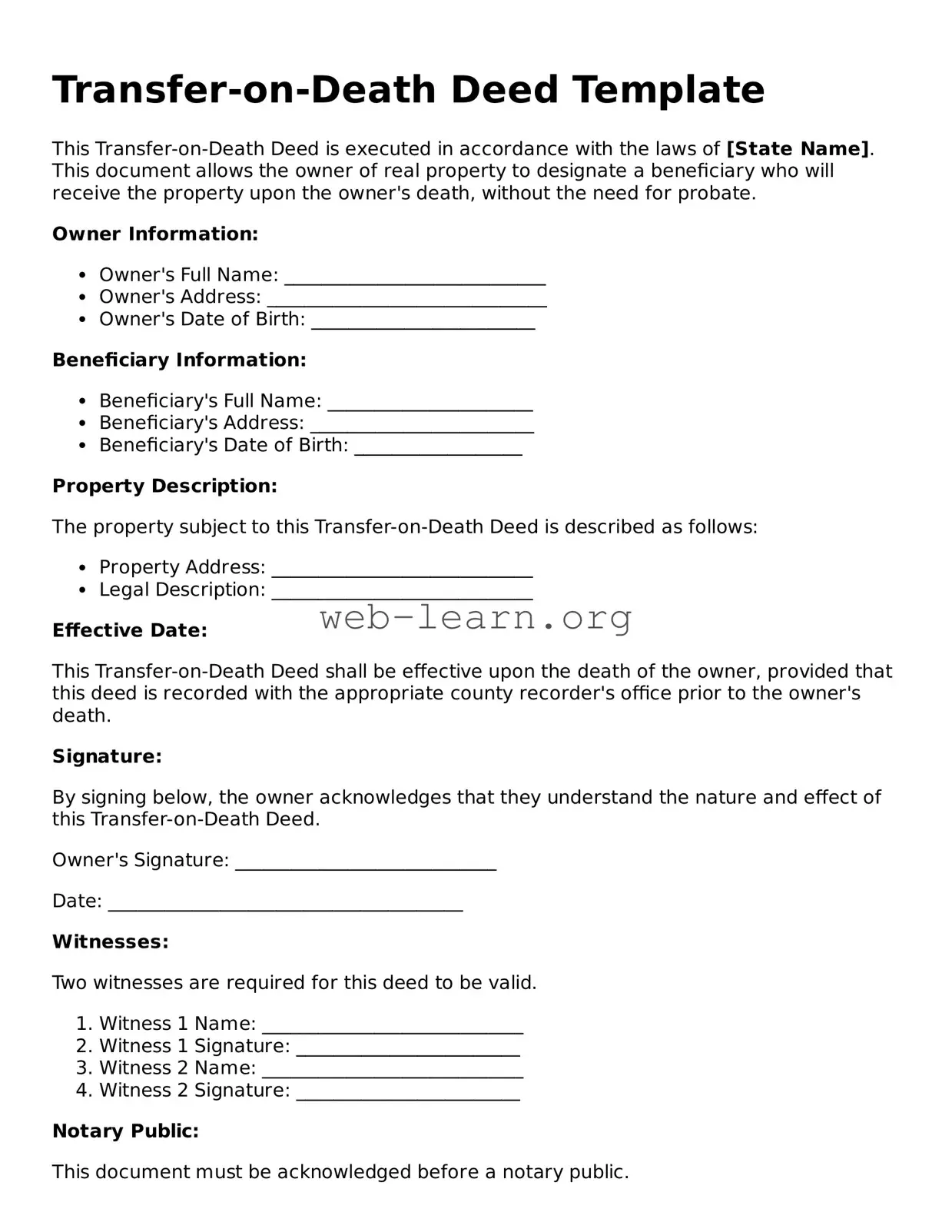
Transfer-on-Death Deed Template
This Transfer-on-Death Deed is executed in accordance with the laws of [State Name]. This document allows the owner of real property to designate a beneficiary who will receive the property upon the owner's death, without the need for probate.
Owner Information:
Beneficiary Information:
Property Description:
The property subject to this Transfer-on-Death Deed is described as follows:
Effective Date:
This Transfer-on-Death Deed shall be effective upon the death of the owner, provided that this deed is recorded with the appropriate county recorder's office prior to the owner's death.
Signature:
By signing below, the owner acknowledges that they understand the nature and effect of this Transfer-on-Death Deed.
Owner's Signature: ____________________________
Date: ______________________________________
Witnesses:
Two witnesses are required for this deed to be valid.
Notary Public:
This document must be acknowledged before a notary public.
Notary Public Name: __________________________
Notary Public Signature: _______________________
Date: ______________________________________
| Fact Name | Description | Governing Law |
|---|---|---|
| Definition | A Transfer-on-Death (TOD) deed allows property owners to transfer real estate to beneficiaries upon their death without going through probate. | Varies by state; check local laws. |
| Revocability | The deed can be revoked or changed at any time by the property owner while they are alive. | Varies by state; check local laws. |
| No Immediate Transfer | Ownership does not transfer until the death of the property owner, allowing for control during their lifetime. | Varies by state; check local laws. |
| Beneficiary Designation | Property owners can designate multiple beneficiaries or a single beneficiary in the deed. | Varies by state; check local laws. |
| State-Specific Forms | Each state may have its own specific form for the TOD deed, and it's crucial to use the correct one. | State-specific laws apply; consult state regulations. |
Once you have the Transfer-on-Death Deed form ready, you will need to fill it out carefully to ensure that all information is accurate and complete. After completing the form, you will be required to sign it in front of a notary public and then file it with the appropriate local government office. This process is essential to ensure that your intentions are legally recognized.
What is a Transfer-on-Death Deed?
A Transfer-on-Death Deed (TOD Deed) is a legal document that allows a property owner to transfer their real estate to a designated beneficiary upon their death. This deed avoids the probate process, allowing for a smoother transition of property ownership without court involvement.
How does a Transfer-on-Death Deed work?
When the property owner passes away, the beneficiary named in the TOD Deed automatically receives ownership of the property. The deed must be recorded with the appropriate local government office while the owner is still alive. It becomes effective upon the owner’s death, provided all requirements are met.
What are the benefits of using a Transfer-on-Death Deed?
Are there any limitations to a Transfer-on-Death Deed?
Yes, there are some limitations. A TOD Deed cannot be used for all types of property. For instance, it typically applies only to real estate and not to personal property or financial accounts. Additionally, it may not be valid in certain states or jurisdictions, so it’s important to check local laws.
Can I change or revoke a Transfer-on-Death Deed?
Yes, the property owner has the right to change or revoke the TOD Deed at any time while they are alive. This can be done by creating a new TOD Deed or by formally revoking the existing one. It is advisable to record any changes with the local office to ensure they are legally recognized.
Do I need a lawyer to create a Transfer-on-Death Deed?
While it is possible to create a TOD Deed without legal assistance, consulting a lawyer is recommended. A lawyer can ensure that the deed complies with state laws and accurately reflects the property owner’s intentions. This can help avoid potential disputes among beneficiaries later on.
What happens if there are multiple beneficiaries named in a Transfer-on-Death Deed?
If multiple beneficiaries are named, the property will be divided among them according to the terms specified in the deed. If the deed does not specify how to divide the property, state laws will determine the distribution. Clear communication among beneficiaries can help prevent misunderstandings.
Filling out a Transfer-on-Death Deed form can be a straightforward process, but many people make common mistakes that can lead to complications later on. One frequent error is not including all necessary information. It's crucial to provide complete details about the property and the beneficiaries. Omitting even a small piece of information can delay the transfer or cause legal issues.
Another mistake is failing to sign the deed correctly. The deed must be signed in the presence of a notary. If this step is overlooked, the deed may not be valid. Always ensure that the signature is clear and that the notary's acknowledgment is included.
People often overlook the importance of naming alternate beneficiaries. If the primary beneficiary cannot inherit the property for any reason, the transfer may not occur as intended. It’s wise to consider who would inherit if the first choice is unavailable.
Additionally, some individuals do not record the deed with the appropriate county office. A Transfer-on-Death Deed must be filed to be effective. Without this step, the transfer may not be recognized, leaving the property subject to probate.
Another common error is using outdated forms. Laws can change, and using an old version of the deed may result in issues. Always check that you are using the most current form available.
Misunderstanding the implications of the deed is also a mistake people make. A Transfer-on-Death Deed does not affect the property during the owner’s lifetime. Some may mistakenly believe that they are giving up ownership rights while they are still alive.
People sometimes fail to consider tax implications. Transferring property can have tax consequences for both the giver and the recipient. It's important to consult a tax professional to understand these potential impacts.
Lastly, some individuals neglect to communicate their intentions with family members. This can lead to confusion and conflict after the property owner passes away. Open discussions about the deed and the reasons behind it can help ensure that everyone understands the wishes of the property owner.
When preparing a Transfer-on-Death Deed, several other forms and documents may be necessary to ensure a smooth transfer of property. Understanding these documents can help streamline the process and avoid potential complications.
Being aware of these documents can help you navigate the process of transferring property effectively. Each plays a role in ensuring that your wishes are honored and that the transfer goes as smoothly as possible.
The Transfer-on-Death Deed (TOD Deed) is a unique estate planning tool that allows an individual to designate a beneficiary who will receive real property upon the individual's death, without the need for probate. Several other legal documents serve similar purposes in estate planning. Here are four documents that share similarities with the Transfer-on-Death Deed:
When filling out a Transfer-on-Death Deed form, it is important to follow certain guidelines to ensure the document is completed correctly and serves its intended purpose. Below are eight recommendations that outline what to do and what to avoid.
Transfer-on-Death Deeds (TODs) can be a valuable estate planning tool, but several misconceptions often surround them. Understanding these myths can help individuals make informed decisions about their property and beneficiaries. Here’s a look at seven common misconceptions:
By debunking these misconceptions, individuals can better navigate the complexities of estate planning and make choices that align with their goals and needs.
When considering a Transfer-on-Death Deed, it is essential to understand its implications and requirements. Here are five key takeaways:
Correction Deed California - It is important for maintaining clear property records and preventing disputes.
Ladybird Clause - This form can be a straightforward way to ensure that property ownership is transferred smoothly and efficiently.
Quit Claim Deed Form Iowa - A Quitclaim Deed can serve as a tool for clearing up title defects.