Homepage Blank Trailer Inspection Form
Outline

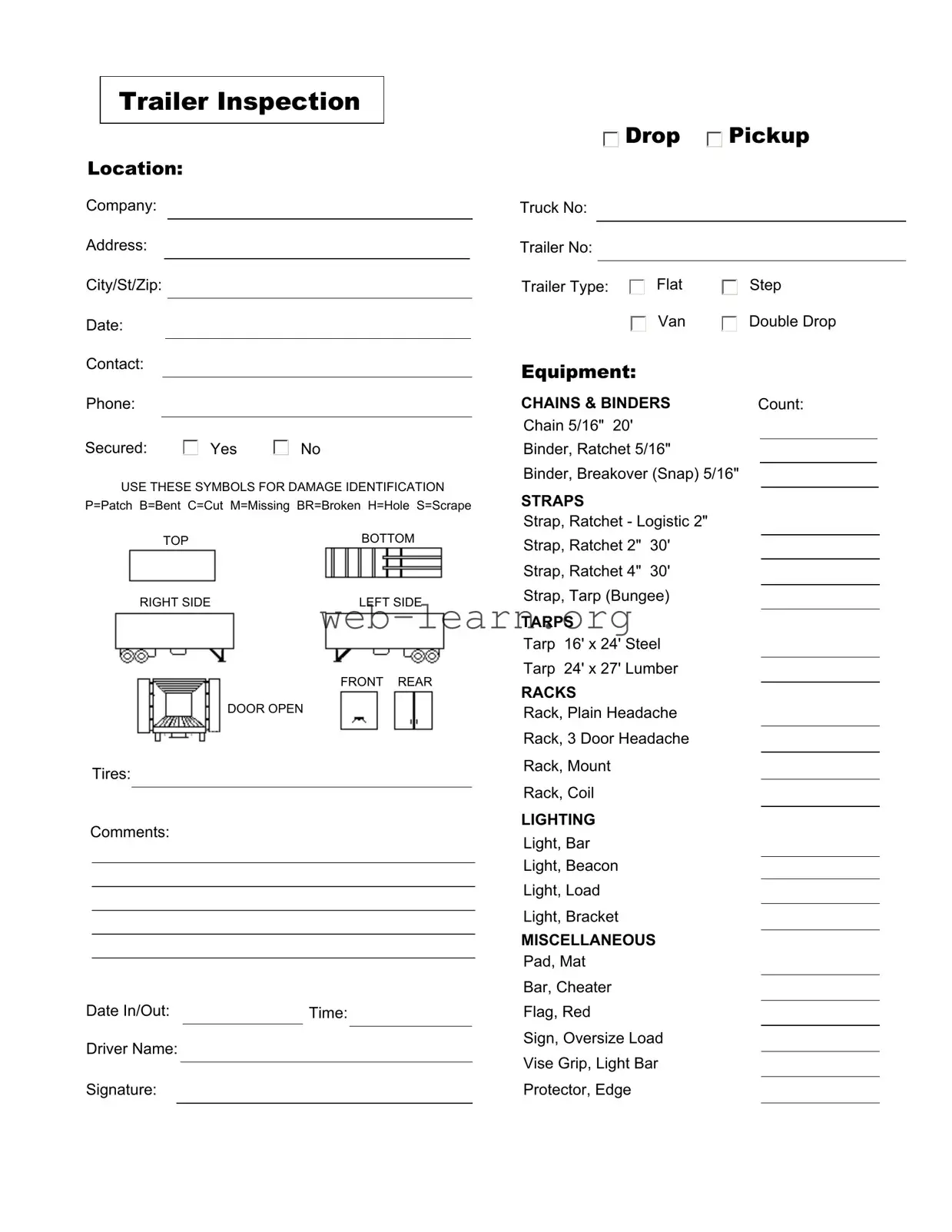
The Trailer Inspection form is an essential tool for ensuring the safety and functionality of trailers used in transportation. This form captures crucial details such as the inspection location, date, and contact information, along with specifics about the truck and trailer involved, including their respective numbers and types. It prompts the inspector to assess various equipment and features, from tires to lighting, and to indicate any damage using a clear system of symbols. Inspectors can mark issues such as patches, bends, cuts, or missing parts, providing a comprehensive overview of the trailer's condition. Additionally, the form includes sections for documenting chains, binders, straps, tarps, and racks, ensuring that all necessary equipment is accounted for. Comments can be added to elaborate on any findings, and the form requires the inspector's signature to confirm the inspection's completion. By facilitating a thorough evaluation, the Trailer Inspection form plays a vital role in maintaining safety standards in the transportation industry.
Sample - Trailer Inspection Form

Trailer Inspection

Location:

Drop

Pickup

Company:

Address:

City/St/Zip:

Date:

Contact:

Truck No:

Trailer No:

Trailer Type:

Equipment:

Flat

Van

Step

Double Drop

Phone:

Secured:

Yes

No

USE THESE SYMBOLS FOR DAMAGE IDENTIFICATION P=Patch B=Bent C=Cut M=Missing BR=Broken H=Hole S=Scrape

TOPBOTTOM

RIGHT SIDE

LEFT SIDE

FRONT REAR

DOOR OPEN

Tires:

Comments:

Date In/Out:


Time:


Driver Name:

Signature:

CHAINS & BINDERS

Count:


Chain 5/16" 20'


Binder, Ratchet 5/16"


Binder, Breakover (Snap) 5/16"


STRAPS


Strap, Ratchet - Logistic 2"


Strap, Ratchet 2"

30'


Strap, Ratchet 4"

30'


Strap, Tarp (Bungee)

TARPS

Tarp 16' x 24' Steel

Tarp 24' x 27' Lumber

RACKS

Rack, Plain Headache

Rack, 3 Door Headache

Rack, Mount

Rack, Coil

LIGHTING

Light, Bar

Light, Beacon

Light, Load

Light, Bracket

MISCELLANEOUS

Pad, Mat

Bar, Cheater

Flag, Red

Sign, Oversize Load

Vise Grip, Light Bar

Protector, Edge

Form Information

Fact Name Description
Purpose The Trailer Inspection form is designed to ensure that trailers are in safe and compliant condition before use.
Location It captures the location of the trailer inspection, which is crucial for record-keeping and accountability.
Governing Laws Specific states may have regulations governing trailer inspections. For example, California Vehicle Code Section 24008 mandates inspections for commercial vehicles.
Damage Identification The form includes symbols for identifying damage, such as P for Patch and BR for Broken, which helps in assessing the condition of the trailer.
Equipment Listing It lists various equipment types, including chains, binders, and straps, ensuring that all necessary items are accounted for during the inspection.
Contact Information The form requires the inspector’s contact details, which facilitates communication regarding any issues found during the inspection.
Signature Requirement A signature from the driver or inspector is necessary, providing a formal acknowledgment of the inspection results.

Detailed Guide for Filling Out Trailer Inspection

Completing the Trailer Inspection form is an essential step in ensuring that all necessary details about the trailer are accurately recorded. This process will help maintain safety and compliance standards. Follow the steps below to fill out the form correctly.

  1. Begin by entering the Trailer Inspection Location. Specify whether this is a drop-off or pickup location.
  2. Next, fill in the Company name associated with the trailer inspection.
  3. Provide the Address, City/St/Zip of the company location.
  4. Record the Date of the inspection.
  5. Enter the Contact person’s name for any follow-up questions.
  6. Fill in the Truck No and Trailer No for identification purposes.
  7. Specify the Trailer Type to categorize the trailer.
  8. List the Equipment being inspected, including any specific types.
  9. Provide the Phone number for the contact person.
  10. Indicate whether the trailer is Secured by selecting 'Yes' or 'No'.
  11. Use the provided symbols to identify any damage on the trailer. Record the damage in the appropriate sections: P for Patch, B for Bent, C for Cut, M for Missing, BR for Broken, H for Hole, S for Scrape.
  12. Assess the Tires and add any relevant Comments about their condition.
  13. Document the Date In/Out and Time of the inspection.
  14. Enter the Driver Name who is responsible for the trailer.
  15. Finally, obtain the Signature of the driver or inspector to validate the form.
  16. For chains and binders, count the quantity of each type listed and fill in the Count for Chain, Binder, and Straps as applicable.
  17. Record details for TARPS and RACKS as needed.
  18. Lastly, check the LIGHTING and any MISCELLANEOUS items, ensuring to list them accurately.

Obtain Answers on Trailer Inspection

  1. What is the purpose of the Trailer Inspection form?

    The Trailer Inspection form is designed to document the condition of a trailer before and after use. It helps ensure that all equipment is safe and in good working order, providing a record for both the company and the driver.

  2. What information is required on the form?

    Essential details include:

    • Trailer Inspection Location
    • Pickup Company and Address
    • Date and Contact Information
    • Truck and Trailer Numbers
    • Trailer Type and Equipment
    • Driver Name and Signature
  3. How should damages be reported on the form?

    Damages should be identified using specific symbols provided on the form. For example, "P" for Patch, "B" for Bent, and "BR" for Broken. Indicate the location of the damage using the designated areas such as Top, Bottom, Right Side, and others.

  4. What should I do if I notice damage during the inspection?

    If damage is observed, it is crucial to document it accurately on the form. Use the appropriate symbols and provide comments that describe the damage. Ensure that the information is clear so that necessary actions can be taken.

  5. Are there specific items that need to be checked during the inspection?

    Yes, the inspection should cover various components, including:

    • Tires
    • Chains and Binders
    • Straps and Tarps
    • Lighting
    • Miscellaneous items like pads and flags
  6. What should be done with the completed form?

    Once the form is filled out, it should be submitted to the appropriate department for record-keeping. This ensures that all inspections are documented and can be referenced in the future if needed.

  7. Is there a specific time frame for completing the inspection?

    The inspection should be completed before the trailer is used. It is best practice to conduct the inspection right before loading or after unloading to ensure the trailer is in good condition at all times.

  8. Who is responsible for filling out the Trailer Inspection form?

    The driver is typically responsible for completing the form. However, it is a collaborative effort, and any party involved in the loading or unloading process should ensure that the inspection is thorough and accurate.

Common mistakes

Filling out the Trailer Inspection form accurately is crucial for ensuring safety and compliance. However, many individuals make common mistakes that can lead to confusion and potential issues. One frequent error is neglecting to provide complete information in the Trailer Inspection Location and Company sections. These details are essential for tracking and accountability. Without them, it becomes challenging to identify where the inspection took place or which company is responsible for the trailer.

Another common mistake involves the damage identification symbols. Many people either forget to use these symbols or misinterpret them. For instance, if a trailer has a hole, marking it as a scrape can lead to serious misunderstandings regarding the trailer's condition. Accurate damage reporting is vital for maintenance and safety. Incorrect symbols can result in improper repairs and increased risk on the road.

Additionally, individuals often overlook the tires section of the form. This section is critical for assessing the trailer's readiness for travel. Failing to note the condition of the tires or neglecting to include comments can lead to unsafe driving conditions. A simple oversight here can have significant consequences, including accidents or breakdowns.

Finally, many people forget to sign the form. The Driver Name and Signature fields are not just formalities; they serve as a record of accountability. Without a signature, the inspection may be considered incomplete. This can create complications if issues arise later, as there would be no clear evidence of who conducted the inspection.

Documents used along the form

The Trailer Inspection form is an essential document that ensures the safety and compliance of trailers used in transportation. However, it is often accompanied by other important forms and documents that help facilitate the inspection process and maintain thorough records. Below is a list of five commonly used documents that complement the Trailer Inspection form.

  • Maintenance Log: This document records all maintenance activities performed on the trailer, including repairs, part replacements, and routine checks. It serves as a historical account of the trailer's upkeep and is crucial for understanding its condition over time.
  • Pre-Trip Inspection Checklist: Before a trailer is put into service, this checklist is used to ensure that all critical components are functioning properly. It typically includes checks for tires, brakes, lights, and other essential systems, helping to prevent accidents caused by mechanical failures.
  • Bill of Lading: This document acts as a receipt for goods being transported and outlines the details of the shipment. It includes information such as the shipper's and receiver's addresses, the nature of the cargo, and any special handling instructions, thus serving as a legal contract between the shipper and the carrier.
  • Accident Report Form: In the unfortunate event of an accident involving the trailer, this form is completed to document the incident. It includes details such as the date, time, location, parties involved, and a description of the events leading up to the accident, which can be vital for insurance claims and legal proceedings.
  • Load Securement Checklist: This form ensures that all cargo is properly secured before transport. It outlines the types of equipment used, such as straps and chains, and verifies that they meet safety standards. Proper load securement is critical to preventing cargo shifts that could lead to accidents on the road.

These documents, when used in conjunction with the Trailer Inspection form, create a comprehensive framework for ensuring safety and compliance in trailer operations. Together, they help transport companies maintain high standards of accountability and operational integrity.

Similar forms

The Trailer Inspection form serves as a crucial document in ensuring the safety and compliance of trailers. Several other documents share similar purposes and structures. Below are five documents that are comparable to the Trailer Inspection form:

  • Vehicle Inspection Report: This document outlines the condition of a vehicle, detailing any issues found during an inspection. Like the Trailer Inspection form, it includes sections for identifying damage, recording the vehicle's identification details, and noting any necessary repairs.
  • Pre-Trip Inspection Checklist: This checklist is used by drivers before embarking on a journey. It ensures that all essential components of the vehicle are functioning properly. Similar to the Trailer Inspection form, it emphasizes safety and includes a systematic approach to identifying potential issues.
  • Maintenance Log: A maintenance log records all service and repair activities performed on a vehicle. This document is similar in that it tracks the condition and upkeep of the vehicle, providing a history that can be referenced during inspections.
  • Load Securement Checklist: This checklist is used to ensure that cargo is properly secured before transportation. It shares similarities with the Trailer Inspection form by focusing on safety and compliance, detailing specific items and methods used for securing loads.
  • Accident Report Form: In the event of an accident, this form documents the details surrounding the incident. Like the Trailer Inspection form, it requires thorough information gathering and can include assessments of damage, ensuring that all aspects are accounted for in a formal manner.

Dos and Don'ts

When filling out the Trailer Inspection form, it is important to ensure accuracy and completeness. Below is a list of things to do and avoid to facilitate a smooth inspection process.

  • Do provide clear and legible information in all fields.
  • Do double-check the trailer number and truck number for accuracy.
  • Do use the correct symbols for damage identification as specified.
  • Do include detailed comments if any issues arise during the inspection.
  • Do ensure the form is signed and dated by the driver.
  • Don't leave any fields blank; incomplete forms can lead to delays.
  • Don't use abbreviations or unclear terms that may confuse the reader.
  • Don't forget to indicate whether the trailer is secured.
  • Don't skip the section on tire conditions; this is crucial for safety.
  • Don't overlook the importance of accurate contact information.

Misconceptions

Understanding the Trailer Inspection form is essential for ensuring safety and compliance. However, several misconceptions can lead to confusion. Here are eight common misunderstandings:

  1. The form is optional. Many believe that filling out the Trailer Inspection form is not necessary. In reality, it is often required for compliance with safety regulations.
  2. Only the driver needs to complete it. Some think only the driver is responsible for the form. However, both the driver and the company must ensure that the inspection is properly documented.
  3. Damage identification symbols are not important. Many overlook the symbols used for damage identification. These symbols provide clear communication about the condition of the trailer.
  4. All trailers require the same inspection. Some assume that every trailer has the same inspection requirements. In fact, different types of trailers may have specific inspection needs based on their design and use.
  5. Comments section is optional. A common misconception is that comments are not necessary. This section is crucial for noting any specific issues that may not be covered by the form.
  6. Inspection dates are irrelevant. Some people think that the date of inspection does not matter. However, keeping accurate records of when inspections occur is vital for safety audits and compliance checks.
  7. Only visible damage needs to be reported. Some believe that only obvious damage should be noted. In truth, even minor issues can lead to bigger problems if not reported and addressed.
  8. Signature is just a formality. Many view the signature as a mere formality. In reality, it signifies that the inspection was completed and that the driver acknowledges the trailer's condition.

By clearing up these misconceptions, individuals can ensure that they are using the Trailer Inspection form effectively and responsibly.

Key takeaways

When filling out and using the Trailer Inspection form, keep the following key takeaways in mind:

  • Complete all sections: Ensure that every field on the form is filled out accurately. Missing information can lead to delays or issues later.
  • Use clear identification symbols: Familiarize yourself with the damage identification symbols (P, B, C, M, BR, H, S) to clearly indicate any issues found during the inspection.
  • Document the location: Clearly state the drop pickup location, including the address, city, state, and zip code. This helps in tracking and accountability.
  • Record the date and time: Always note the date and time of the inspection. This information is critical for maintenance records and compliance.
  • Inspect tires: Pay special attention to the condition of the tires. Document any issues as they can affect safety and performance.
  • Check all equipment: Ensure that all listed equipment, such as chains, binders, and straps, are accounted for and in good condition.
  • Include comments: Use the comments section to provide additional details about the inspection. This can be vital for future reference.
  • Sign and date: The driver must sign the form after completing the inspection. This confirms that the inspection was performed and acknowledges any findings.