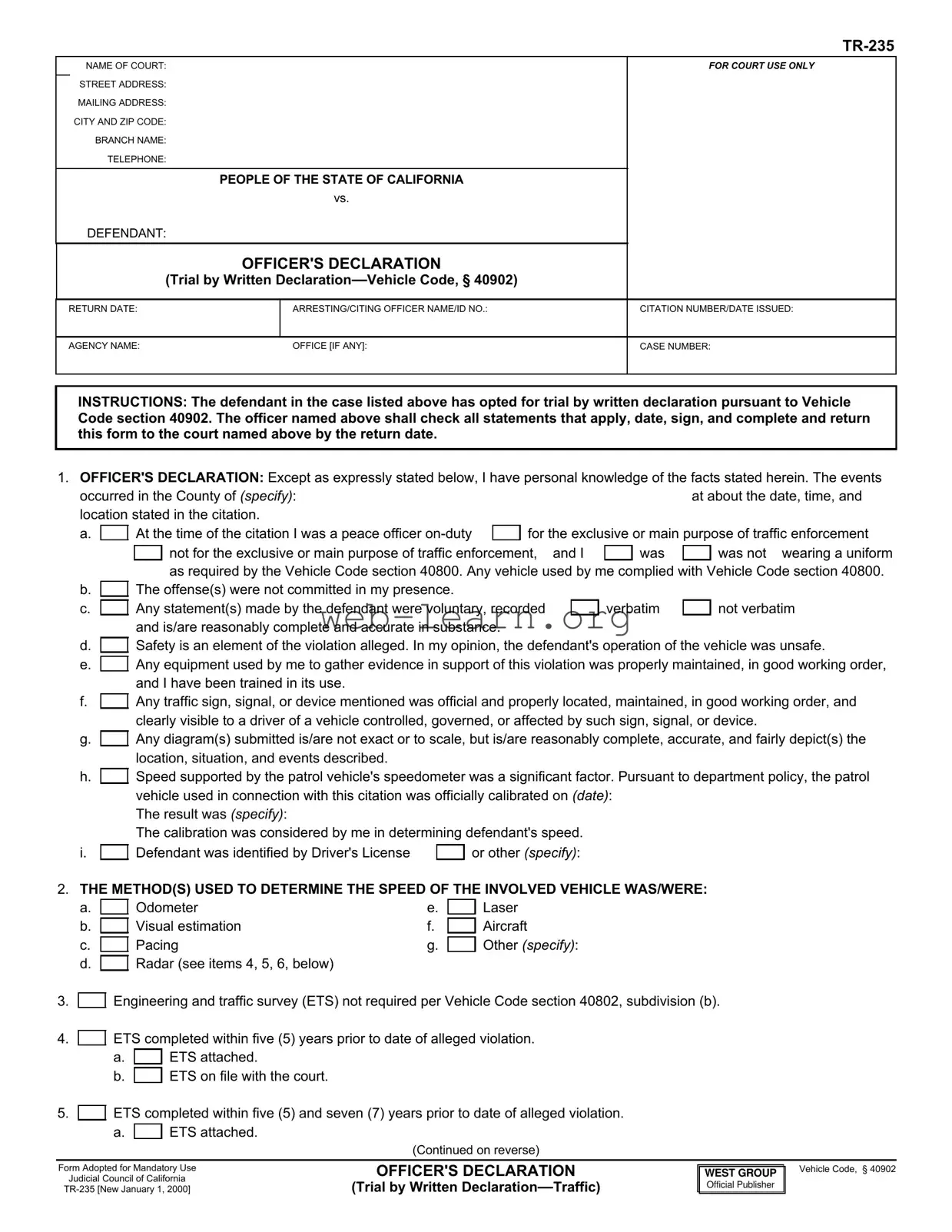
The TR-235 California form serves as a vital document in the process of contesting traffic citations through a written declaration. This form is specifically designed for situations where a defendant chooses to challenge their citation without appearing in court, as permitted under Vehicle Code section 40902. Key elements of the form include an officer's declaration, where the citing officer provides detailed information regarding the circumstances surrounding the citation. The officer must confirm their presence during the incident, the methods used to determine the defendant's speed, and the condition of any equipment utilized. Additionally, the form requires the officer to attest to the accuracy of any evidence collected, such as diagrams and engineering surveys. The TR-235 not only facilitates a streamlined process for defendants but also ensures that all pertinent information is documented and submitted to the court by a specified return date, ultimately contributing to a fair examination of the case.
|
NAME OF COURT: |
|
|
FOR COURT USE ONLY |
|
STREET ADDRESS: |
|
|
|
|
|
|
|
|
|
MAILING ADDRESS: |
|
|
|
|
CITY AND ZIP CODE: |
|
|
|
|
BRANCH NAME: |
|
|
|
|
TELEPHONE: |
|
|
|
|
|
|
|
|
|
|
PEOPLE OF THE STATE OF CALIFORNIA |
|
|
|
|
|
vs. |
|
|
DEFENDANT: |
|
|
|
|
|
|
|
|
|
|
OFFICER'S DECLARATION |
|
|
|
(Trial by Written |
|
||
|
|
|
|
|
RETURN DATE: |
|
ARRESTING/CITING OFFICER NAME/ID NO.: |
CITATION NUMBER/DATE ISSUED: |
|
|
|
|
|
|
AGENCY NAME: |
|
OFFICE [IF ANY]: |
CASE NUMBER: |
|
|
|
|
|
|
INSTRUCTIONS: The defendant in the case listed above has opted for trial by written declaration pursuant to Vehicle Code section 40902. The officer named above shall check all statements that apply, date, sign, and complete and return this form to the court named above by the return date.
1. OFFICER'S DECLARATION: Except as expressly stated below, I have personal knowledge of the facts stated herein. The events
occurred in the County of (specify): |
|
|
|
|
|
|
|
at about the date, time, and |
|||||||
location stated in the citation. |
|
|
|
|
|
|
|
|
|
||||||
a. |
|
|
At the time of the citation I was a peace officer |
|
|
for the exclusive or main purpose of traffic enforcement |
|||||||||
|
|
|
|
||||||||||||
|
|
|
|
|
|
|
|
|
|
|
|
||||
|
|
|
|
not for the exclusive or main purpose of traffic enforcement, and I |
|
|
was |
|
was not wearing a uniform |
||||||
|
|
|
|
as required by the Vehicle Code section 40800. Any vehicle used by me complied with Vehicle Code section 40800. |
|||||||||||
|
|
|
|
|
|
|
|
|
|
|
|
|
|
|
|
b. |
|
|
The offense(s) were not committed in my presence. |
|
|
|
|
|
|
|
|
|
|||
|
|
|
|
|
|
|
|
|
|
|
|
|
|
|
|
c. |
|
|
Any statement(s) made by the defendant were voluntary, recorded |
|
|
verbatim |
|
not verbatim |
|||||||
|
|
|
and is/are reasonably complete and accurate in substance. |
|
|
|
|
|
|||||||
|
|
|
|
|
|
|
|
|
|
|
|
|
|
|
|
d. |
|
|
Safety is an element of the violation alleged. In my opinion, the defendant's operation of the vehicle was unsafe. |
||||||||||||
e. |
|
|
Any equipment used by me to gather evidence in support of this violation was properly maintained, in good working order, |
||||||||||||
|
|
||||||||||||||
|
|
|
and I have been trained in its use. |
|
|
|
|
|
|
|
|
|
|||
|
|
|
|
|
|
|
|
|
|
|
|
|
|||
f. |
|
|
Any traffic sign, signal, or device mentioned was official and properly located, maintained, in good working order, and |
||||||||||||
|
|
|
clearly visible to a driver of a vehicle controlled, governed, or affected by such sign, signal, or device. |
||||||||||||
|
|
|
|
|
|
|
|
|
|
|
|||||
g. |
|
|
Any diagram(s) submitted is/are not exact or to scale, but is/are reasonably complete, accurate, and fairly depict(s) the |
||||||||||||
|
|
|
location, situation, and events described. |
|
|
|
|
|
|
|
|
|
|||
|
|
|
|
|
|
|
|
|
|
|
|||||
h. |
|
|
Speed supported by the patrol vehicle's speedometer was a significant factor. Pursuant to department policy, the patrol |
||||||||||||
|
|
|
vehicle used in connection with this citation was officially calibrated on (date): |
|
|
||||||||||
|
|
|
The result was (specify): |
|
|
|
|
|
|
|
|
|
|||
|
|
|
The calibration was considered by me in determining defendant's speed. |
|
|
|
|
|
|||||||
|
|
|
Defendant was identified by Driver's License |
|
|
or other (specify): |
|
|
|
|
|
||||
i. |
|
|
|
|
|
|
|
|
|
||||||
2.THE METHOD(S) USED TO DETERMINE THE SPEED OF THE INVOLVED VEHICLE WAS/WERE:
a.
b.
c.
d.
Odometer |
e. |
|
Laser |
Visual estimation |
|
|
Aircraft |
f. |
|
||
Pacing |
|
|
Other (specify): |
g. |
|
||
Radar (see items 4, 5, 6, below) |
|
|
|
3. |
|
Engineering and traffic survey (ETS) not required per Vehicle Code section 40802, subdivision (b). |
||
4. |
|
ETS completed within five (5) years prior to date of alleged violation. |
||
|
||||
|
|
a. |
|
ETS attached. |
|
|
|
||
|
|
|
|
|
|
|
b. |
|
ETS on file with the court. |
5. |
|
ETS completed within five (5) and seven (7) years prior to date of alleged violation. |
||
|
||||
|
|
|
|
|
|
|
a. |
|
ETS attached. |
|
|
|
|
(Continued on reverse) |
Form Adopted for Mandatory Use
Judicial Council of California
OFFICER'S DECLARATION
(Trial by Written
WEST GROUP
OFFICIAL PUBLISHER
Vehicle Code, § 40902
PEOPLE v. DEFENDANT (Name):
CASE NUMBER:
5.b.
c.
d.
e.
f.
6.
ETS on file with the court. |
|
Arresting/citing officer has successfully completed a radar operator course of not less than 24 hours approved and |
|
certified by the Commission on Peace Officer Standards and Training (POST). |
|
Laser or other electronic device was used to measure speed. Arresting/citing officer successfully completed an |
|
additional training course of not less than two hours approved and certified by POST. |
|
The speed measuring device used to measure the speed of defendant (Serial No: |
) |
meets or exceeds the minimum operational standards of the National Highway Traffic Safety Administration (NHTSA)
and was last calibrated on (date): |
by an independent certified laser/radar repair |
and testing/calibration facility. |
|
Equipment accuracy check conducted on (date): |
at (time): |
and again on (date): |
at (time): |
ETS completed within seven (7) and ten (10) years prior to the date of the alleged violation.
a. |
|
A registered engineer has evaluated the section of the highway in question and has determined that no significant |
|
|
changes in roadway or traffic conditions have occurred. |
|
|
All of the elements marked under item 5, above, which are applicable. |
b. |
|
7.FACTS AND CIRCUMSTANCES (Type or print only. State what happened):
Continued on attachment.
8.OTHER EVIDENCE AND STATEMENTS (Explain any other evidence and statements):
Continued on attachment.
9.DIAGRAM(S) (specify):
Attached.
10. Number of pages attached: _____
I declare under penalty of perjury under the laws of the State of California that the foregoing is true and correct. Date:
. . . . . . . . . . . . . . . . . . . . . . . . . . . . . . . . . . . . . . . . . . . . .
(TYPE OR PRINT NAME) |
(SIGNATURE OF OFFICER) |
ID Number:
Agency NCIC Number:
OFFICER'S DECLARATION
(Trial by Written
WEST GROUP
OFFICIAL PUBLISHER
Page two
| Fact Name | Description |
|---|---|
| Form Purpose | The TR-235 form is used for a trial by written declaration in traffic cases in California. |
| Governing Law | This form is governed by California Vehicle Code section 40902. |
| Officer's Declaration | The form requires the arresting officer to declare facts related to the traffic violation. |
| Return Date | Officers must return the completed form to the court by a specified return date. |
| Evidence Requirements | Officers must provide evidence, including diagrams and calibration details, to support the citation. |
| Speed Measurement Methods | The form allows various methods for determining vehicle speed, such as radar and pacing. |
| ETS Requirements | An Engineering and Traffic Survey (ETS) may be required, depending on the age of the survey. |
| Officer Training | Officers must complete specific training courses related to speed measurement devices. |
| Signature Requirement | The officer must sign the form, declaring the information to be true under penalty of perjury. |
| Form Adoption | The TR-235 form was adopted for mandatory use by the Judicial Council of California on January 1, 2000. |
Filling out the TR-235 form is a crucial step in the process of a trial by written declaration in California. This form must be completed accurately and returned to the court by the specified return date. Below are the detailed steps to guide you through the process of filling out the TR-235 form.
Once completed, review the form for accuracy and ensure all necessary attachments are included. Timely submission of the TR-235 form is essential to ensure your case is heard appropriately.
The TR-235 form is used in California for a trial by written declaration in traffic cases. It allows a defendant to contest a traffic citation without appearing in court. Instead, the defendant submits a written statement, and the arresting officer provides their declaration regarding the circumstances of the citation.
The form is completed by the arresting or citing officer. This officer must provide information about the traffic violation, including details about the event, the methods used to determine the speed of the vehicle, and any relevant evidence or statements.
The officer must include several details, such as:
The form allows officers to check multiple methods used to determine the vehicle's speed, including:
The ETS is a study that assesses the traffic conditions and safety of the area where the violation occurred. The TR-235 form requires that an ETS be completed within a specific timeframe to support the citation. The officer must indicate if an ETS is attached or on file with the court, and whether it meets the necessary criteria.
The officer must confirm that any speed measurement device used, such as radar or laser, meets the operational standards set by the National Highway Traffic Safety Administration (NHTSA). Additionally, the officer must provide details about the calibration of the device, including the date of the last calibration and any accuracy checks performed.
Once the officer completes the TR-235 form, they must sign and date it, declaring that the information provided is true and correct. The completed form must then be returned to the court by the specified return date.
Yes, the defendant may include additional evidence or statements to support their case. This could include photographs, diagrams, or witness statements that contest the officer's declaration or provide context for the incident.
Submitting false information on the TR-235 form can lead to serious legal consequences. The officer declares under penalty of perjury that the information is accurate. If it is found to be false, the officer could face disciplinary actions, including potential criminal charges.
When filling out the TR-235 California form, individuals often encounter various challenges that can lead to mistakes. One common error is not providing complete information in the designated fields. For example, failing to include the name of the court or the case number can result in significant delays in processing the form. Each section is designed to gather specific details, and omitting any of these can lead to confusion and complications in the legal process.
Another frequent mistake involves the officer's declaration section. It is essential for the officer to accurately check all statements that apply. Sometimes, officers may overlook certain statements or check those that do not apply to their situation. This can create inconsistencies in the declaration and may undermine the validity of the evidence presented. Ensuring that all checked statements are truthful and relevant is crucial for the integrity of the trial.
Moreover, many individuals fail to adhere to the required deadlines for submitting the form. The TR-235 form has a specific return date that must be followed. Submitting the form late can result in the case being dismissed or other negative consequences. It is vital to keep track of the timeline and ensure that all documentation is submitted promptly to avoid any issues.
In addition, errors in the method of determining speed can also occur. Officers must be precise when indicating the methods used, such as radar or pacing. Misreporting the method can lead to questions about the reliability of the evidence. It is important to provide accurate details and ensure that all equipment used was properly maintained and calibrated.
Lastly, individuals may neglect to include supporting evidence or diagrams as required. The TR-235 form allows for attachments to be submitted, and failing to include these can weaken a case. Any diagrams or additional evidence should be clearly labeled and referenced in the form. This additional information can be vital in supporting the claims made in the declaration.
The TR-235 form is a critical document used in California for traffic violations when a defendant opts for a trial by written declaration. Several other forms and documents often accompany this form to ensure proper processing and legal compliance. Below is a list of these related documents, each serving a specific purpose in the legal process.
Understanding these accompanying documents can help defendants navigate the legal process more effectively. Each form plays a vital role in building a comprehensive case, ensuring that all relevant information is presented to the court for consideration.
The TR-235 California form is a specific document used in traffic cases for a trial by written declaration. Several other documents share similarities with the TR-235 in terms of purpose, structure, or content. Here are eight such documents:
When filling out the TR-235 California form, it is essential to follow specific guidelines to ensure accuracy and compliance. Here is a list of dos and don'ts to help you through the process:
Misconceptions about the TR-235 California form can lead to confusion for those involved in traffic violations. Below are nine common misconceptions and clarifications regarding the form:
When filling out and using the TR-235 California form, keep these key takeaways in mind: