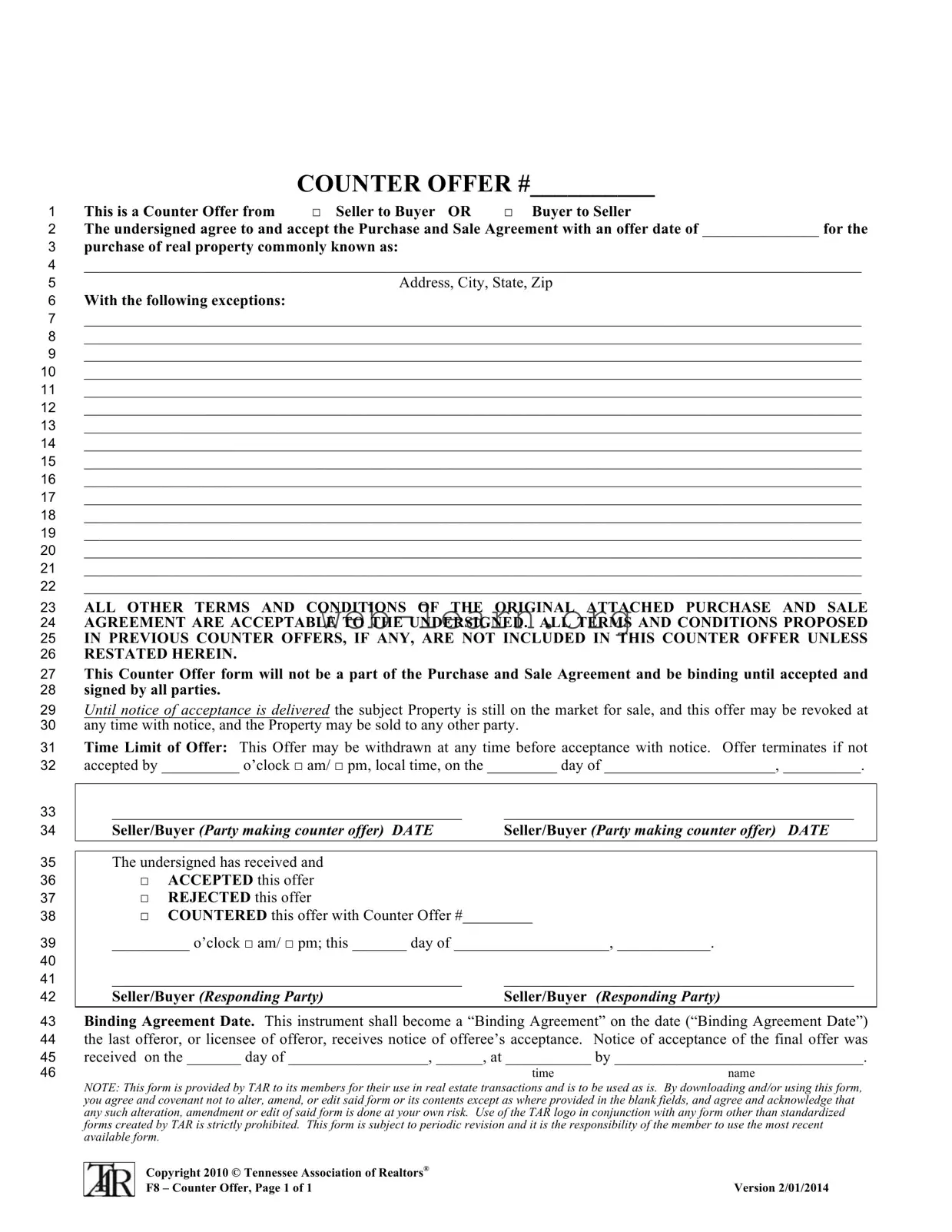
In the world of real estate transactions, effective communication between buyers and sellers is essential. The Tennessee Counter Offer form plays a crucial role in this dialogue, allowing one party to propose modifications to the original purchase agreement. This form serves as a structured way for the seller or buyer to express their acceptance of the initial offer while also highlighting specific exceptions or changes they wish to negotiate. It includes important sections that outline the property details, the terms of the original agreement, and any modifications being proposed. Moreover, the Counter Offer form emphasizes that all previous terms from earlier counter offers are void unless explicitly restated, ensuring clarity in the negotiation process. Additionally, it includes a time limit for acceptance, which is vital for maintaining momentum in the transaction. The form also stipulates that the property remains available for sale until all parties have signed and accepted the counter offer, underscoring the need for timely responses. Understanding this form is essential for anyone involved in a real estate deal in Tennessee, as it not only facilitates negotiation but also helps protect the interests of both parties.
1
2
3
4
5
6
7
8
9
10
11
12
13
14
15
16
17
18
19
20
21
22
23
24
25
26
27
28
29
30
31
32
33
34
35
36
37
38
39
40
41
42
43
44
45
46
COUNTER OFFER #__________
This is a Counter Offer from □ Seller to Buyer OR □ Buyer to Seller
The undersigned agree to and accept the Purchase and Sale Agreement with an offer date of _______________ for the
purchase of real property commonly known as:
____________________________________________________________________________________________________
Address, City, State, Zip
With the following exceptions:
____________________________________________________________________________________________________
____________________________________________________________________________________________________
____________________________________________________________________________________________________
____________________________________________________________________________________________________
____________________________________________________________________________________________________
____________________________________________________________________________________________________
____________________________________________________________________________________________________
____________________________________________________________________________________________________
____________________________________________________________________________________________________
____________________________________________________________________________________________________
____________________________________________________________________________________________________
____________________________________________________________________________________________________
____________________________________________________________________________________________________
____________________________________________________________________________________________________
____________________________________________________________________________________________________
____________________________________________________________________________________________________
ALL OTHER TERMS AND CONDITIONS OF THE ORIGINAL ATTACHED PURCHASE AND SALE AGREEMENT ARE ACCEPTABLE TO THE UNDERSIGNED. ALL TERMS AND CONDITIONS PROPOSED IN PREVIOUS COUNTER OFFERS, IF ANY, ARE NOT INCLUDED IN THIS COUNTER OFFER UNLESS RESTATED HEREIN.
This Counter Offer form will not be a part of the Purchase and Sale Agreement and be binding until accepted and signed by all parties.
Until notice of acceptance is delivered the subject Property is still on the market for sale, and this offer may be revoked at any time with notice, and the Property may be sold to any other party.
Time Limit of Offer: This Offer may be withdrawn at any time before acceptance with notice. Offer terminates if not accepted by __________ o’clock □ am/ □ pm, local time, on the _________ day of ______________________, __________.
_____________________________________________ |
_____________________________________________ |
Seller/Buyer (Party making counter offer) DATE |
Seller/Buyer (Party making counter offer) DATE |
The undersigned has received and
□ACCEPTED this offer
□REJECTED this offer
□COUNTERED this offer with Counter Offer #_________
__________ o’clock □ am/ □ pm; this _______ day of ____________________, ____________.
_____________________________________________ |
_____________________________________________ |
Seller/Buyer (Responding Party) |
Seller/Buyer (Responding Party) |
Binding Agreement Date. This instrument shall become a “Binding Agreement” on the date (“Binding Agreement Date”) the last offeror, or licensee of offeror, receives notice of offeree’s acceptance. Notice of acceptance of the final offer was received on the _______ day of __________________, ______, at ___________ by ________________________________.
time |
name |
NOTE: This form is provided by TAR to its members for their use in real estate transactions and is to be used as is. By downloading and/or using this form, you agree and covenant not to alter, amend, or edit said form or its contents except as where provided in the blank fields, and agree and acknowledge that any such alteration, amendment or edit of said form is done at your own risk. Use of the TAR logo in conjunction with any form other than standardized forms created by TAR is strictly prohibited. This form is subject to periodic revision and it is the responsibility of the member to use the most recent available form.
Copyright 2010 © Tennessee Association of Realtors® |
|
F8 – Counter Offer, Page 1 of 1 |
Version 2/01/2014 |
| Fact Name | Details |
|---|---|
| Purpose | The TN Counter Offer form is used to propose changes to an existing Purchase and Sale Agreement between a buyer and seller. |
| Parties Involved | This form can be completed by either the seller or the buyer, indicating who is making the counter offer. |
| Binding Agreement | The agreement becomes binding only when all parties have accepted and signed the counter offer. |
| Market Status | Until acceptance is communicated, the property remains on the market and can be sold to other parties. |
| Time Limit | The offer includes a specified time limit for acceptance, after which it automatically terminates if not accepted. |
| Governing Law | This form is governed by the laws of the State of Tennessee, ensuring compliance with local real estate regulations. |
Completing the Tn Counter Offer form is an important step in the negotiation process. This form allows parties to communicate their terms and conditions clearly. Once filled out, it will be submitted to the other party for consideration, and they will have the opportunity to accept, reject, or counter the offer.
What is the purpose of the TN Counter Offer form?
The TN Counter Offer form is designed to facilitate negotiations between buyers and sellers in real estate transactions. When a buyer makes an offer on a property, the seller may not accept it as is. Instead, they can use this form to propose changes to the original offer, such as altering the price or modifying terms. This allows both parties to communicate their needs and reach a mutually agreeable contract.
Who can use the TN Counter Offer form?
Both buyers and sellers can utilize the TN Counter Offer form. It is essential for any party involved in a real estate transaction who wishes to propose changes to an existing offer. This form ensures that the negotiation process is documented and clear for all parties involved.
How does the Counter Offer process work?
When a party receives an offer, they can review it and decide whether to accept, reject, or counter it. If they choose to counter, they will fill out the TN Counter Offer form, indicating the changes they wish to propose. Once completed, the form is sent back to the other party for consideration. The negotiation continues until both parties reach an agreement or decide to walk away from the deal.
What happens if the Counter Offer is accepted?
If the counter offer is accepted, it becomes part of the binding agreement between the parties. The original offer and any previous counter offers are no longer valid unless specifically restated in the new counter offer. This acceptance solidifies the terms and conditions that both parties agree upon moving forward.
Is the Counter Offer binding immediately?
No, the Counter Offer is not binding until it is accepted and signed by all parties involved. Until that point, the property remains on the market, and the offer can be revoked at any time. This flexibility allows sellers to continue considering other potential buyers until a formal acceptance occurs.
What is the time limit for accepting a Counter Offer?
The TN Counter Offer form specifies a time limit for acceptance. If the counter offer is not accepted by the designated time, it automatically terminates. This time frame is crucial for both parties to ensure that negotiations progress efficiently and to avoid unnecessary delays in the transaction.
Can previous counter offers be included in the new Counter Offer?
Previous counter offers are not included in the new Counter Offer unless they are explicitly restated in the new document. This ensures clarity and prevents confusion regarding which terms are currently being considered. It is essential to clearly outline any changes or agreements in the new counter offer.
What should I do if I want to reject a Counter Offer?
If you decide to reject a Counter Offer, simply inform the other party in writing. This rejection should be communicated clearly to avoid any misunderstandings. Once rejected, the negotiation process can either cease or continue with new offers or counter offers being proposed.
How often is the TN Counter Offer form updated?
The TN Counter Offer form is subject to periodic revision. It is the responsibility of the user to ensure they are using the most recent version available. Staying updated is crucial for compliance and to ensure that all terms are accurately represented in real estate transactions.
Completing the TN Counter Offer form requires careful attention to detail. One common mistake is failing to specify whether the counter offer is from the Seller to Buyer or Buyer to Seller. This section is crucial as it establishes the direction of the negotiation. Omitting this information can lead to confusion and misunderstandings between the parties involved.
Another frequent error is neglecting to fill in the offer date and the property details accurately. The form requires the date of the original offer and the complete address of the property. Incomplete or incorrect information can delay the process and may even jeopardize the agreement. Ensuring that this information is precise helps maintain clarity and fosters a smoother transaction.
Many individuals also overlook the section that lists exceptions to the original agreement. This part is essential for outlining any changes or modifications being proposed. Failing to articulate these exceptions clearly can result in disputes later on. It is important to take the time to list any changes to avoid potential conflicts down the road.
Additionally, some people forget to include a time limit for the counter offer. Specifying a deadline for acceptance is vital, as it communicates urgency and helps manage expectations. Without a defined timeframe, the offer may linger indefinitely, leaving both parties uncertain about the status of negotiations.
Another mistake often made is not signing and dating the form appropriately. Each party must sign and date the counter offer to indicate their agreement to the terms. Incomplete signatures can render the counter offer invalid. It is crucial to ensure that all necessary signatures are obtained before proceeding.
Lastly, individuals sometimes fail to review the entire form for accuracy before submission. Skimming through the document can lead to overlooked errors or omissions. Taking a moment to review each section ensures that all information is correct and that the form reflects the intentions of the parties involved. A thorough review can save time and prevent misunderstandings in the future.
When navigating the real estate transaction process in Tennessee, several forms and documents often accompany the Tn Counter Offer form. Each of these documents serves a specific purpose, ensuring that both buyers and sellers are protected and informed throughout the negotiation process. Here’s a brief overview of some commonly used forms.
Understanding these documents can significantly enhance your confidence in the real estate process. Each plays a vital role in protecting your interests, whether you are buying or selling property. Familiarity with these forms not only streamlines negotiations but also helps avoid potential pitfalls in the transaction.
The TN Counter Offer form shares similarities with several other documents commonly used in real estate transactions. Each of these documents serves a specific purpose but maintains a similar structure and function in negotiations. Below are four documents that are comparable to the TN Counter Offer form:
When filling out the TN Counter Offer form, it's important to approach the task carefully. Here are some guidelines to help you navigate the process effectively.
Following these steps can help ensure that your counter offer is clear and effective. Taking the time to do it right can make a significant difference in your real estate transaction.
Misconceptions about the Tn Counter Offer form can lead to confusion in real estate transactions. Here are eight common misunderstandings:
Understanding these misconceptions can help individuals navigate real estate transactions more effectively.
When dealing with the Tennessee Counter Offer form, it's essential to understand its key components to ensure a smooth transaction. Here are some important takeaways:
By paying attention to these key points, you can effectively navigate the counter offer process in Tennessee real estate transactions. Clear communication and understanding of the form can help facilitate a successful agreement.