The Texas Writ Mandamus form serves as a crucial legal document for individuals seeking to compel government officials to fulfill their duties. This form is often used in cases where a person believes that a government entity has failed to act appropriately or in a timely manner. In the context of elections, the form is particularly significant, as it can address urgent matters related to candidacy and ballot inclusion. For instance, it may be employed when a candidate’s application is rejected unjustly, as seen in the case of Candace Taylor, who faced challenges after the tragic passing of a primary candidate. The form outlines the jurisdiction and venue for filing, requests for expedited hearings, and includes essential details about the parties involved. It emphasizes the importance of timely action, especially when deadlines for elections are approaching. Furthermore, it highlights the legal grounds for the petition, ensuring that the court understands the urgency and necessity of addressing the issues presented. Understanding this form is vital for anyone navigating the complexities of election law in Texas.
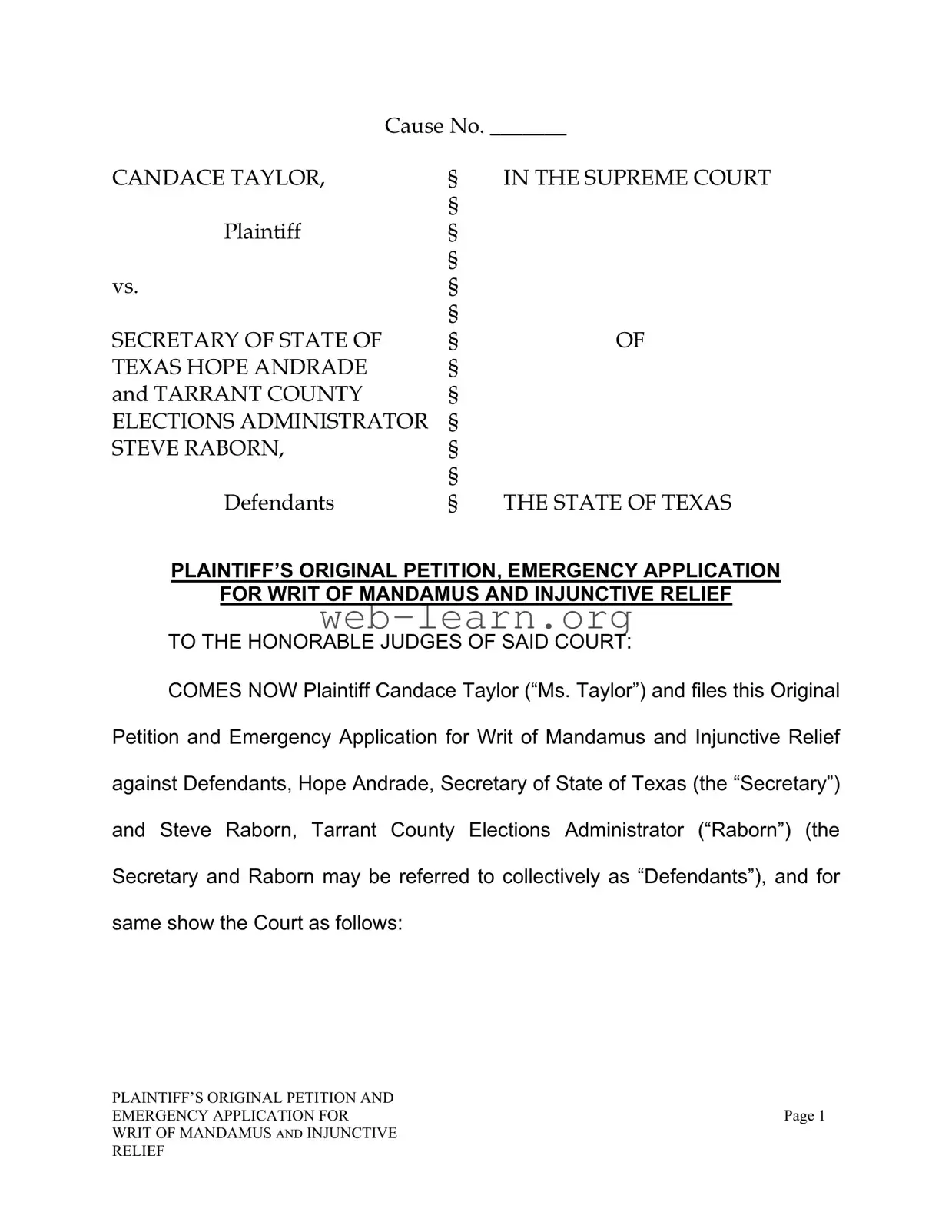
Cause No. _______ |
|
|
CANDACE TAYLOR, |
§ IN THE SUPREME COURT |
|
|
§ |
|
Plaintiff |
§ |
|
|
§ |
|
vs. |
§ |
|
|
§ |
|
SECRETARY OF STATE OF |
§ |
OF |
TEXAS HOPE ANDRADE |
§ |
|
and TARRANT COUNTY |
§ |
|
ELECTIONS ADMINISTRATOR |
§ |
|
STEVE RABORN, |
§ |
|
|
§ |
|
Defendants |
§ THE STATE OF TEXAS |
|
PLAINTIFF’S ORIGINAL PETITION, EMERGENCY APPLICATION
FOR WRIT OF MANDAMUS AND INJUNCTIVE RELIEF
TO THE HONORABLE JUDGES OF SAID COURT:
COMES NOW Plaintiff Candace Taylor (“Ms. Taylor”) and files this Original Petition and Emergency Application for Writ of Mandamus and Injunctive Relief against Defendants, Hope Andrade, Secretary of State of Texas (the “Secretary”) and Steve Raborn, Tarrant County Elections Administrator (“Raborn”) (the Secretary and Raborn may be referred to collectively as “Defendants”), and for same show the Court as follows:
PLAINTIFF’S ORIGINAL PETITION AND
EMERGENCY APPLICATION FORPage 1
WRIT OF MANDAMUS AND INJUNCTIVE RELIEF
I.
JURISDICTION AND VENUE; SERVICE OF PROCESS
This Court has jurisdiction pursuant to TEXAS ELECTION CODE §§ 273.061 and 273.081. The Secretary of State of Texas may be served with process at 1100 Congress, Capitol Bldg., Room 1E.8, Austin, Texas 78701. Steve Raborn, Tarrant County Elections Administrator, may be served with process at 2700 Premier Street, Fort Worth 76111.
II.
REQUEST FOR EXPEDITED HEARING
Because of the upcoming deadlines relating to candidacy for the upcoming general election, scheduled for November 2, 2010, the necessity of resolving the issues that are the subject of this Petition is urgent, and Plaintiff requests that the Court set this matter for hearing on an expedited basis. The deadline for submitting a candidate’s name for inclusion on the ballot is August 20, 2010, which Plaintiff Candace Taylor has already done, as evidenced by the letter from the Secretary of State, rejecting Ms. Taylor’s application, which is attached to this Petition as Exhibit A. The deadline for certifying the ballot is on or about August 24, 2010, a date after which Defendant's will argue adding a candidate to the ballot for the 432nd District Court will be moot.
PLAINTIFF’S ORIGINAL PETITION AND
EMERGENCY APPLICATION FORPage 2
WRIT OF MANDAMUS AND INJUNCTIVE RELIEF
III.
FACTUAL BACKGROUND
1.Plaintiff Candace Taylor is an attorney licensed to practice law in the State of Texas, having been granted her law license in 1996. Ms. Taylor meets all of the qualifications for a candidate for public office pursuant to Section 141.001 of the TEXAS ELECTION CODE.
2.In 2009, a new criminal district court was created in Tarrant County, Texas. This was the 432nd District Court, and the initial Judge of the court was Ruben Gonzalez, who was appointed by Governor Rick Perry in accordance with Texas law governing the filling of judicial posts in newly created courts between elections. Judge Gonzalez’s term is set to expire, and the position will be filled by the winning candidate in the general election this coming November.
3.In March 2010, the Republican and Democratic Parties each held primary elections to determine the parties’ respective choices for candidates to be placed on the ballot for the general election scheduled for November 2, 2010 (hereinafter, the “General Election”). Ms. Taylor was aware that the Republican nominee for the 432nd District Court was Tom Zachry, whom Ms. Taylor believed was a highly qualified candidate, and that Mr. Zachry would win the primary election against Judge Gonzalez. Ms. Taylor, and the Democratic Party generally, were satisfied that Mr. Zachry would be an excellent judge, which was
PLAINTIFF’S ORIGINAL PETITION AND
EMERGENCY APPLICATION FORPage 3
WRIT OF MANDAMUS AND INJUNCTIVE RELIEF
an important reason why the Democratic Party chose not to run a candidate in
the primary elections for the 432nd District Court.
4.Mr. Zachry did, in fact, defeat Judge Gonzalez in the primary, and was to have been the Republican candidate for the judgeship for the 432nd Court in the General Election. The Democrats and Ms. Taylor, not wanting to run a candidate against Mr. Zachry, were content for Mr. Zachry to run unopposed in the general election.
5.Unfortunately, Mr. Zachry was killed in a tragic boating accident shortly after the primary election. On March 19, 2010, Mr. Zachry’s boat capsized on Aquilla Lake, and Mr. Zachry was subsequently pronounced dead.
Mr. Zachry’s death created a vacancy in the nominees for judge of the 432nd District Court in the November General Election. As Mr. Zachry was to have been unopposed, his passing left no candidate for the position.
6.As a further result of Mr. Zachry’s untimely death, Plaintiff Candace Taylor (and Democratic Party officials of Tarrant County) now faces the prospect of having the Republican Party offer a replacement for Mr. Zachry. In fact, the Republican Party has named Judge Ruben Gonzalez – the very candidate whom Mr. Zachry defeated in the March primary - as the replacement for Mr. Zachry. Neither Ms. Taylor nor Democratic Party officials finds Judge Gonzalez to be a satisfactory replacement nominee, and do not believe Judge Gonzalez is the best candidate to hold the position of Judge of the 432nd District Court.
PLAINTIFF’S ORIGINAL PETITION AND
EMERGENCY APPLICATION FORPage 4
WRIT OF MANDAMUS AND INJUNCTIVE RELIEF
Accordingly, Ms. Taylor has been requested by the Democratic Party to run against Judge Gonzalez in the General Election, and Ms. Taylor has been named by the Democratic Party of Tarrant County as a replacement candidate due to the death of Tom Zachry.
7.On July 19, 2010, the Tarrant County Democratic Party Executive Committee, a quorum being present, nominated Candace Taylor as the Democratic Party for the office of 432nd District Court. Tarrant County Democratic Party Chairman Steve Maxwell immediately certified the nomination and forwarded Candace Taylor's nomination to the Texas Secretary of State. Ms. Taylor’s name was submitted to the Texas Secretary of State in accordance with Texas law and procedure. See Tex. Elec. Code §143.037. A copy of a letter from Mr. Stephen C. Maxwell, Tarrant County Democratic Party Chair, to the Secretary is attached hereto as Exhibit A. The Secretary, however, has rejected Ms. Taylor as a candidate, stating that she is not qualified to run in the General Election against Judge Gonzalez for the sole reason that Ms. Taylor was not selected as a candidate by the Democratic Party in its March primary elections. A copy of an August 3, 2010 letter from the Secretary to Mr. Maxwell, denying certification of Ms. Taylor as a nominee, is attached hereto as Exhibit B.
8.Plaintiff Candace Taylor believes the Secretary of State’s position on this issue is unfounded, and therefore brings this action seeking an order from this Court that Candace Taylor be placed on the ballot as a judicial candidate for
PLAINTIFF’S ORIGINAL PETITION AND
EMERGENCY APPLICATION FORPage 5
WRIT OF MANDAMUS AND INJUNCTIVE RELIEF
the 432nd District Court in the General Election scheduled to be held in the State
of Texas on November 2, 2010.
IV.
ARGUMENT AND LEGAL AUTHORITIES
9.The Secretary relies on Sections 145.035 and 145.036 of the Texas Election Code (the “Code”) as the basis for denying Ms. Taylor a place on the General Election ballot. Section 145.036(a) of the Code states as follows:
(a)Except as provided by Subsection (b), if a candidate's name is to be omitted from the ballot under Section 145.035, the political party's state, district, county, or precinct executive committee, as appropriate for the particular office, may nominate a replacement candidate to fill the vacancy in the nomination.
Subsection (b) establishes the conditions whereby a committee may select
a replacement nominee who has withdrawn due to a catastrophic illness, and is
therefore inapplicable to the situation at hand.
10.The Secretary contends that, because Ms Taylor was not a candidate for the 432nd judicial post in the Democratic Party’s primary election, Ms. Taylor may not now be listed as a candidate for the position on the General Election ballot. The Secretary’s position is that, for candidates who withdraw because of death, the replacement process requires that any replacement nominee must be one who was a candidate in a party’s primary (or at least that the party must have listed a candidate for the position in its primary election).
PLAINTIFF’S ORIGINAL PETITION AND
EMERGENCY APPLICATION FORPage 6
WRIT OF MANDAMUS AND INJUNCTIVE RELIEF

The Secretary’s Position Violates the Texas Constitution
11.Article 5, Section 28 of the Texas Constitution states that, in the event of a vacancy in the office of judge of a district court, any such vacancy will be filled by the Governor of Texas, and the appointee shall serve until “the next succeeding General Election….” TEX. CONST. ART. 5, SEC. 28. At the General Election, “…the voters shall fill the vacancy for the unexpired term.” Id.
12.Under the circumstances of this case, the “vacancy” occurred only because a new court was created, and the Governor properly appointed a judge – Judge Gonzalez – to serve until the next General Election.
13.The Texas Constitution, however, requires that at the next General Election, it is the voters who decide who will serve as judge. The voters are not even being given that opportunity in this case and, in fact, if the Secretary’s position were to be sustained, the voters would be allowed to select only one major party candidate whom voters (those who voted in the Republican primary) have already rejected as a candidate!1 The inequity of such a situation is obvious, fundamentally flawed, and violates the precepts of our State’s Constitution.
14.Furthermore, the Texas Election Code, as applied by the Texas Secretary of State, violates Candace Taylor’s right to Equal Protection, Candace
1Judge Gonzalez lost the primary election by some 20 points.
PLAINTIFF’S ORIGINAL PETITION AND
EMERGENCY APPLICATION FORPage 7
WRIT OF MANDAMUS AND INJUNCTIVE RELIEF
Taylor's First Amendment Right to be a candidate, and the voters of Tarrant County's rights to vote, as protected by the Texas Constitution. There is no rational basis or compelling interest under the Texas Equal Protection Clause to allow the Republican Party to nominate a candidate while not allowing the Democratic Party to nominate a candidate after the death of the Republican nominee. Candace Taylor had no desire to run when Tom Zachary was a candidate; only upon Mr. Zachry’s death did Ms. Taylor agree to run for the 432nd District Court. There is no rational basis or compelling interest under the Equal Protection Clause to deny voters the right to choose between two candidates for the 432nd District Court after the death of Tom Zachary.
Statutes Must Be Strictly Construed in Favor of Ballot Access
15.Any constitutional or statutory provision which restricts the right to hold office must be strictly construed against ineligibility. Texas Democratic Party v. Benkiser, 459 F.3d 582, 590 (5th Cir. 2006); Wentworth v. Meyer, 839 S.W.2d
PLAINTIFF’S ORIGINAL PETITION AND
EMERGENCY APPLICATION FORPage 8
WRIT OF MANDAMUS AND INJUNCTIVE RELIEF
the ballot. See Pilcher v. Rains, 853 F.2d 334, 336 (5th Cir. 1988); Davis, 930
S.W.2d at 583.
Strict Adherence to Code Deadlines Inapplicable in Unusual Situations
16.Moreover, the Texas Supreme Court has explicitly held that “withdrawal and replacement deadlines in the Election Code are not intended to apply to unusual situations when there is not a reasonable opportunity to comply with a statutorily set deadline.” Slagle v. Hannah, 837 S.W.2d 100, 102 (Tex. 1992). Nor is it unprecedented for a candidate to be placed on a general election ballot by a process other than primary election, where circumstances prevented the candidate from running in the primary. See In re Dupont, 142 S.W.3d 528 (Tex. App. – Fort Worth 2004, orig. proceeding). In Dupont, a vacancy occurred too late for nominees to be selected by voters in a primary election; therefore, the Parker County Republican Party selected a nominee by a meeting of the Party’s Executive Committee. Id. at
17.The Secretary nevertheless has opted for a construction of Code §145.036 that would prevent access to the ballot by Ms. Taylor, despite the lack of any concrete basis for such an interpretation. As reflected in the Secretary’s August 3rd letter, the Secretary relies upon a single phrase – emphasized in the letter – as the basis for denying Ms. Taylor’s nomination. The portion of the statute at issue states:
PLAINTIFF’S ORIGINAL PETITION AND
EMERGENCY APPLICATION FORPage 9
WRIT OF MANDAMUS AND INJUNCTIVE RELIEF
Except as provided by Subsection (b), if a candidate’s name is to be omitted from the ballot under Section 145.035, the political party’s state, district or precinct executive committee….may nominate a replacement candidate….”
(emphasis taken from Secretary of State’s August 3, 2010 letter).
18.The Secretary, however, ignores the unusual circumstances of this case. At the time the primary elections were held, Ms. Taylor (and Democratic Party representatives) was confident that Mr. Zachry would defeat Judge Gonzalez in the primary election, and that Mr. Zachry would be an excellent judge for the 432nd District Court. Accordingly, Ms. Taylor, content with Mr. Zachry as a nominee for the judgeship, with the blessing of the Democratic Party, did not run in the primary. Candace Taylor's nomination is proper and not prohibited by the terms of section 145.036 of the Texas Election Code.
19.Obviously, circumstances changed with Mr. Zachry’s tragic death. Neither Ms. Taylor nor the Democratic Party is satisfied that Judge Gonzalez – who lost the primary election to Mr. Zachry – will serve at the same level as Mr. Zachry would have. As such, both Ms. Taylor and the Democratic Party are compelled to offer voters another selection for the judgeship, someone other than a candidate who was rejected by primary voters in March 2010.
20.This is precisely the type of “unusual situation” to which the Texas Supreme Court referred in holding that Election Code withdrawal and replacement deadlines must not be construed in such a way as to prevent
PLAINTIFF’S ORIGINAL PETITION AND
EMERGENCY APPLICATION FORPage 10
WRIT OF MANDAMUS AND INJUNCTIVE RELIEF
| Fact Name | Fact Description |
|---|---|
| Governing Law | The Texas Writ of Mandamus is governed by the Texas Election Code, specifically sections 273.061 and 273.081. |
| Purpose | This form is used to request a court order compelling a government official to perform a duty that they are legally obligated to fulfill. |
| Jurisdiction | The Supreme Court of Texas has jurisdiction over matters involving election-related disputes and the issuance of writs of mandamus. |
| Parties Involved | The form typically involves a plaintiff, who is seeking relief, and defendants, who are the government officials being compelled to act. |
| Expedited Hearing | The form allows for a request for an expedited hearing, especially crucial when deadlines are approaching, such as election dates. |
| Candidate Qualifications | It requires the plaintiff to demonstrate that they meet all qualifications to run for the office in question, as outlined in the Texas Election Code. |
| Service of Process | The defendants must be properly served with the petition, which specifies their addresses for legal notification. |
| Factual Background | The form includes a section where the plaintiff must outline the factual background of their case, detailing the events leading to the writ request. |
| Attachments | Supporting documents, such as letters and evidence of prior actions taken, should be attached to substantiate the claims made in the petition. |
Filling out the Texas Writ Mandamus form requires careful attention to detail. Once completed, this form will be submitted to the court to request a specific action regarding your legal rights. Ensure that all information is accurate and supported by any necessary documentation.
What is a Writ of Mandamus?
A Writ of Mandamus is a legal order issued by a court to compel a government official or entity to perform a duty they are legally obligated to complete. In the context of Texas law, it is often used when a party believes that a governmental body has failed to act in accordance with the law, particularly in election-related matters.
Who can file a Writ of Mandamus in Texas?
Any individual or entity that has a legal interest in a matter may file a Writ of Mandamus in Texas. Typically, this includes candidates for public office, voters, or political parties who believe their rights or interests are being infringed upon by a governmental action or inaction.
What are the requirements for filing a Writ of Mandamus?
To file a Writ of Mandamus in Texas, the petitioner must demonstrate:
In election cases, the urgency often arises from approaching deadlines, making the need for an expedited hearing common.
What is the process for serving the Writ of Mandamus?
Service of process must be completed according to Texas law. The Writ must be served to the relevant parties, which may include government officials or agencies. In the example provided, the Secretary of State and the Tarrant County Elections Administrator were named as defendants. Proper addresses for service must be used, and proof of service is typically required to proceed with the case.
How does one request an expedited hearing for a Writ of Mandamus?
A request for an expedited hearing can be included in the petition itself. The petitioner must explain the urgency of the matter, often citing specific deadlines that necessitate a swift resolution. In election-related cases, this is particularly important due to the time-sensitive nature of ballot certifications and candidate nominations.
What happens if the Writ of Mandamus is granted?
If the court grants the Writ of Mandamus, it will issue an order compelling the governmental body to take the required action. This may include placing a candidate's name on the ballot or certifying election results. Compliance with the court's order is mandatory, and failure to comply can result in further legal consequences for the officials involved.
Filling out the Texas Writ Mandamus form can be a daunting task, and many individuals make mistakes that can hinder their case. One common error is the failure to provide accurate and complete information in the designated sections. Each part of the form requires specific details, such as the names of the parties involved and the nature of the complaint. Omitting or incorrectly entering this information can lead to delays or even dismissal of the petition.
Another mistake often made is neglecting to adhere to the required deadlines. The urgency of the situation may cause individuals to overlook the importance of timely submissions. For example, in the context of the upcoming general election, missing the deadline for submitting a candidate’s name can render the petition moot. It is crucial to be aware of all relevant deadlines and ensure that all documents are filed promptly.
Additionally, many applicants fail to attach necessary supporting documents. The Texas Writ Mandamus form requires accompanying evidence to substantiate the claims made in the petition. Without these documents, the court may not have enough information to make a decision. This oversight can significantly weaken the petitioner's case and may result in a denial of the request for relief.
Furthermore, individuals sometimes overlook the importance of clarity and coherence in their written arguments. The petition should clearly outline the facts and legal basis for the request. A lack of clarity can confuse the court and lead to misunderstandings about the petitioner’s intentions. It is advisable to present the information in a logical manner, ensuring that the narrative flows smoothly and supports the legal claims being made.
Lastly, some individuals may not fully understand the nature of the relief being sought. A Writ of Mandamus is a specific type of legal remedy, and it is essential to articulate why this particular remedy is appropriate for the situation at hand. Failing to clearly explain the need for this relief can result in the court not granting the request. It is vital to demonstrate a clear connection between the facts of the case and the requested action from the court.
The Texas Writ of Mandamus form is often accompanied by several other important documents that help clarify the legal context and support the petitioner's case. These documents serve various purposes, including providing evidence, establishing jurisdiction, and outlining the legal basis for the request. Below are four common forms and documents that are frequently used alongside the Texas Writ of Mandamus.
These accompanying documents play a crucial role in the legal process, ensuring that the court has all necessary information to make an informed decision. Properly preparing and submitting these forms can significantly impact the outcome of the case.
The Texas Writ of Mandamus form shares similarities with several other legal documents. Each of these documents serves a specific purpose in the legal process. Here are four documents that are comparable:
When filling out the Texas Writ Mandamus form, there are several important considerations to keep in mind. Here’s a list of things you should and shouldn’t do:
Misconceptions about the Texas Writ Mandamus Form
Filing a Texas Writ of Mandamus form requires careful attention to detail. Here are some key takeaways to consider:
Following these guidelines can help ensure that your application is clear and compelling. This process is vital for addressing urgent legal matters effectively.