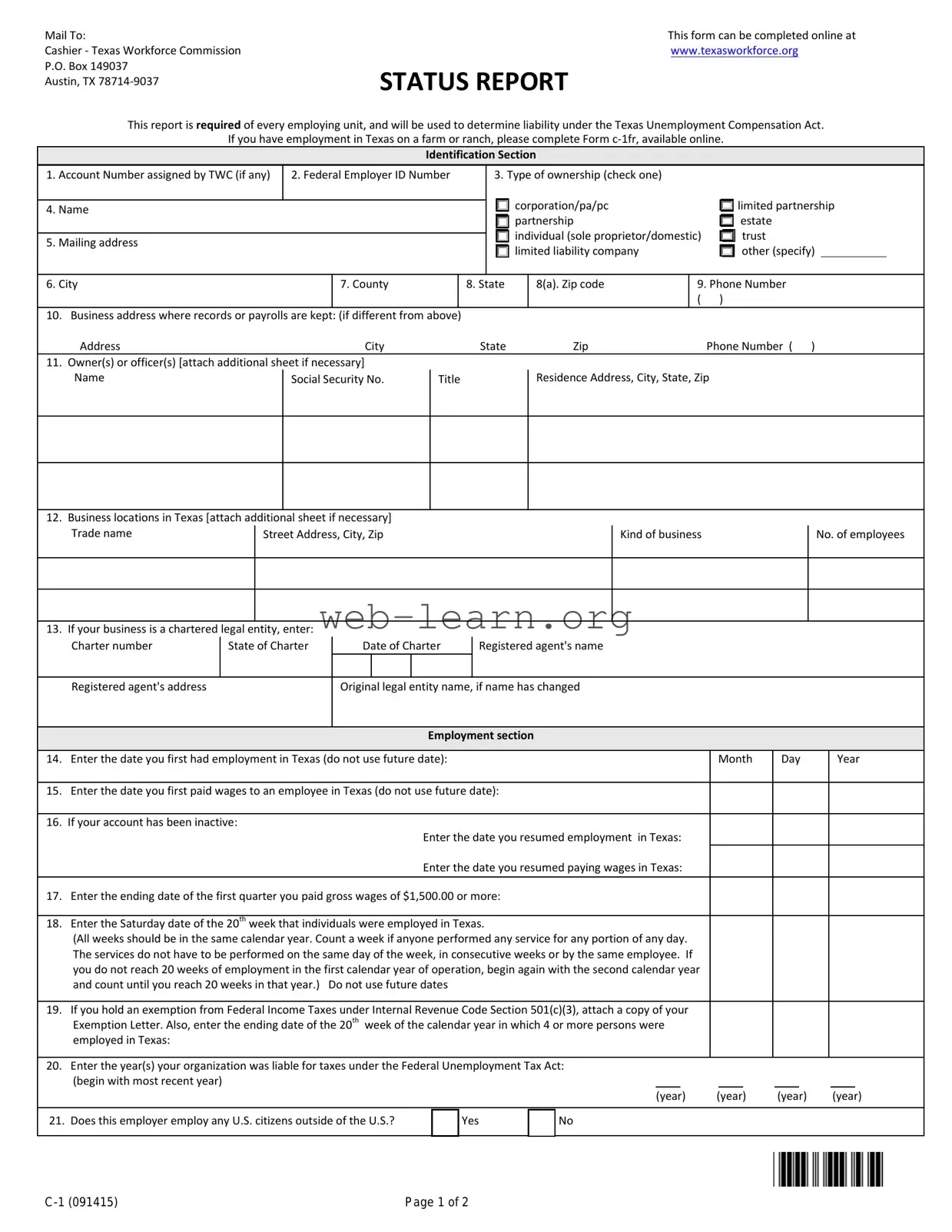
The Texas Workforce Commission (TWC) Report form plays a crucial role for employers operating in Texas. This report is mandatory for every employing unit and serves to establish liability under the Texas Unemployment Compensation Act. It requires various details about the business, including the account number assigned by TWC, the Federal Employer ID Number, and the type of ownership, such as corporation or sole proprietorship. Employers must provide their mailing address, business address, and contact information, ensuring that the TWC can easily reach them. The form also delves into employment specifics, asking for dates related to when employment began and when wages were first paid. For those involved in domestic or household employment, additional information is required. Furthermore, if a business has been acquired from another entity, the form necessitates details about the previous owner and the nature of the acquisition. Importantly, non-liable employers have the option to voluntarily elect to pay state unemployment tax, committing to a minimum two-year period. Completing this form accurately is essential, as it helps determine the employer's responsibilities under state law, ensuring compliance and support for both the business and its employees.

Mail To:
Cashier - Texas Workforce Commission
P.O. Box 149037
Austin, TX
This form can be completed online at
www.texasworkforce.org
STATUS REPORT
This report is required of every employing unit, and will be used to determine liability under the Texas Unemployment Compensation Act.
If you have employment in Texas on a farm or ranch, please complete Form
Identification Section
1. Account Number assigned by TWC (if any) |
2. Federal Employer ID Number |
|
|
3. Type of ownership (check one) |
|
|
|
|
|
|||||||||||
|
|
|
|
|
|
|
|
|
|
|
|
|
corporation/pa/pc |
|
limited partnership |
|||||
4. Name |
|
|
|
|
|
|
|
|
|
|
|
|
||||||||
|
|
|
|
|
|
|
|
|
|
|
partnership |
|
estate |
|||||||
|
|
|
|
|
|
|
|
|
|
|
|
|
|
|||||||
|
|
|
|
|
|
|
|
|
|
|
|
|
individual (sole proprietor/domestic) |
trust |
||||||
5. Mailing address |
|
|
|
|
|
|
|
|
|
|
|
|||||||||
|
|
|
|
|
|
|
|
|
|
|
limited liability company |
|
other (specify) |
|
|
|||||
|
|
|
|
|
|
|
|
|
|
|
|
|
|
|||||||
|
|
|
|
|
|
|
|
|
|
|
|
|
|
|
|
|
||||
6. City |
|
|
|
7. County |
|
|
8. State |
|
8(a). Zip code |
9. Phone Number |
||||||||||
|
|
|
|
|
|
|
|
|
|
|
|
|
|
|
|
( |
) |
|
|
|
10. |
Business address where records or payrolls are kept: |
(if different from above) |
|
|
|
|
|
|
|
|
|
|
|
|
||||||
|
Address |
|
|
|
City |
|
|
|
State |
|
Zip |
|
Phone Number ( ) |
|||||||
11. |
Owner(s) or officer(s) [attach additional sheet if necessary] |
|
|
|
|
|
|
|
|
|
|
|
|
|
||||||
|
Name |
|
|
Social Security No. |
Title |
|
|
|
|
Residence Address, City, State, Zip |
||||||||||
|
|
|
|
|
|
|
|
|
|
|
|
|
|
|
|
|
|
|
|
|
|
|
|
|
|
|
|
|
|
|
|
|
|
|
|
|
|
|
|
|
|
|
|
|
|
|
|
|
|
|
|
|
|
|
|
|
|
|
|
|
|
|
12. |
Business locations in Texas [attach additional |
sheet if necessary] |
|
|
|
|
|
|
|
|
|
|
|
|
|
|||||
|
Trade name |
|
Street Address, City, Zip |
|
|
|
|
|
|
|
Kind of business |
|
No. of employees |
|||||||
|
|
|
|
|
|
|
|
|
|
|
|
|
|
|
|
|
|
|
|
|
|
|
|
|
|
|
|
|
|
|
|
|
|
|
|
|
|
|
|
|
|
|
|
|
|
|
|
|
|
|
|
|
|
|
|
|
|
|
|
|
|
|
13. |
If your business is a chartered legal |
entity, enter: |
|
|
|
|
|
|
|
|
|
|
|
|
|
|
|
|
||
|
Charter number |
State of Charter |
Date of Charter |
|
Registered agent's name |
|
|
|
|
|
||||||||||
|
|
|
|
|
|
|
|
|
|
|
|
|
|
|||||||
|
Registered agent's address |
|
|
|
Original legal entity name, if name has changed |
|
|
|
|
|
||||||||||
Employment section
14. |
Enter the date you first had employment in Texas (do not use future date): |
|
|
|
|
Month |
Day |
Year |
||||
|
|
|
|
|
|
|
|
|
|
|
|
|
15. |
Enter the date you first paid wages to an employee in Texas (do not use future date): |
|
|
|
|
|
|
|
|
|
|
|
|
|
|
|
|
|
|
|
|
|
|
|
|
16. |
If your account has been inactive: |
Enter the date you resumed employment in Texas: |
|
|
|
|
|
|
|
|||
|
|
|
|
|
|
|
|
|
||||
|
|
Enter the date you resumed paying wages in Texas: |
|
|
|
|
|
|
|
|||
17. |
Enter the ending date of the first quarter you paid gross wages of $1,500.00 or more: |
|
|
|
|
|
|
|
|
|
|
|
|
|
|
|
|
|
|
|
|
|
|
|
|
18. |
Enter the Saturday date of the 20th week that individuals were employed in Texas. |
|
|
|
|
|
|
|
|
|
|
|
|
(All weeks should be in the same calendar year. Count a week if anyone performed any service for any portion of any day. |
|
|
|
|
|
|
|
||||
|
The services do not have to be performed on the same day of the week, in consecutive weeks or by the same employee. If |
|
|
|
|
|
|
|
||||
|
you do not reach 20 weeks of employment in the first calendar year of operation, begin again with the second calendar year |
|
|
|
|
|
|
|
||||
|
and count until you reach 20 weeks in that year.) Do not use future dates |
|
|
|
|
|
|
|
|
|
|
|
|
|
|
|
|
|
|
|
|
|
|
||
19. |
If you hold an exemption from Federal Income Taxes under Internal Revenue Code Section 501(c)(3), attach a copy of your |
|
|
|
|
|
|
|
||||
|
Exemption Letter. Also, enter the ending date of the 20th week of the calendar year in which 4 or more persons were |
|
|
|
|
|
|
|
||||
|
employed in Texas: |
|
|
|
|
|
|
|
|
|
|
|
|
|
|
|
|
|
|
|
|
||||
20. |
Enter the year(s) your organization was liable for taxes under the Federal Unemployment Tax Act: |
|
|
|
|
|
|
|
||||
|
(begin with most recent year) |
|
|
|
|
|
|
|
|
|
|
|
|
|
|
|
(year) |
(year) |
(year) |
(year) |
|||||
|
|
|
|
|
|
|
|
|
|
|||
21. Does this employer employ any U.S. citizens outside of the U.S.? |
Yes |
No |
|
|
|
|
|
|
|
|||
Page 1 of 2 |

Domestic - Household Employment Section
Complete 22 only if you have domestic or household employees (includes maids, cooks, chauffeurs, gardeners, etc.)
22. Enter the ending date of the first calendar quarter in which you paid gross wages of $1,000 or more to employees |
Month |
Day |
Year |
performing domestic service: |
|
|
|
Nature of Activity Section |
|
|
|
|
|
|
|
23.Describe fully the nature of activity in Texas, and list the principal products or services in order of importance:
_________________________________________________________________________________________________________________________________
_________________________________________________________________________________________________________________________________
24.If the business in Texas was acquired from another legal entity, you must complete items
a) |
Previous owner’s TWC Account Number (if known) |
______________________________________________________________________________ |
|||
b) |
Date of acquisition |
_________________________________________________________________________________________________________ |
|||
c) |
Name of previous owner(s) |
_________________________________________________________________________________________________ |
|||
d) |
Address |
________________________________________________________________________________________________________________ |
|||
e) City |
_______________________ |
What portion of business was acquired? (check one)
State |
__________________________ |
Zip |
_________________________________ |
||
all |
part (specify) |
|
|
|
|
25.On the date of the acquisition, was the previous owner(s), or any partner(s), officer(s), shareholder(s), other owner(s) or a person related by blood or marriage to any of these individuals, holding a legal or equitable interest in the predecessor business, also an owner, partner, officer, shareholder, or other owner of a legal or
equitable interest in the successor business? |
Yes |
No |
If “Yes”, check all that apply:
same owner, officer, partner, or shareholder
sole proprietor incorporating
same parent company
other (describe below)
_________________________________________________
If “No,” on the date of the acquisition, did the previous owner(s), partner(s), officer(s), shareholder(s), other owner(s) or a person related by blood or marriage to any of these individuals, holding a legal or equitable interest in the predecessor business, hold an option to purchase such an interest in the successor business?
yes
no
26.After the acquisition, did the predecessor continue to:
•Own or manage the organization that conducts the organization, trade or business?
•Own or manage the assets necessary to conduct the organization, trade or business?
•Control through security or lease arrangement the assets necessary to conduct the organization, trade or business?
•Direct the internal affairs or conduct of the organization, trade or business?
Yes
No
If “Yes” to any of above, describe: |
_____________________________________________________________________________________________ |
Voluntary Election Section
27.A
Yes, effective Jan. 1, |
|
|
I wish to cover all employees (except those performing service(s) which are specifically exempt in the Texas Unemployment |
Compensation Act). |
|
||
|
|
|
|
|
|
|
Signature Section |
|
|
|
|
I hereby certify that the preceding information is true and correct, and that I am authorized to execute this Status Report on behalf of the employing unit named herein. (this report must be signed by the owner, officer, partner or individual with a valid Written Authorization on file with the Texas Workforce Commission)
Date of signature:
Month ___ Day |
___ Year ___ |
Sign here ________________________________________ |
Title |
_______________ |
|||||
|
|
||||||||
|
|
|
|
|
|
|
|
||
Driver's license number |
__________________ State |
__________ |
______________________________________________ |
||||||
|
|
|
|
|
|
|
|
|
|
Individuals may receive, review and correct information that TWC collects about the individual by emailing to [email protected] or writing to: TWC Open
Records, 101 E. 15th St., Rm. 266, Austin, TX
Page 2 of 2 |
| Fact Name | Description |
|---|---|
| Mailing Address | The form must be mailed to Cashier - Texas Workforce Commission, P.O. Box 149037, Austin, TX 78714-9037. |
| Online Submission | This report can be completed online at www.texasworkforce.org. |
| Employer Requirement | Every employing unit is required to submit this report to determine liability under the Texas Unemployment Compensation Act. |
| Identification Section | The form includes an identification section for details such as account number, Federal Employer ID Number, and type of ownership. |
| Employment Dates | Employers must provide specific employment dates, including the date they first had employment in Texas and when they first paid wages. |
| Voluntary Election | A non-liable employer may elect to pay state unemployment tax voluntarily for a minimum of two calendar years. |
Completing the Texas Workforce Commission Report form is an essential step for every employing unit in Texas. After filling out the form, it must be submitted to the Texas Workforce Commission to ensure compliance with state regulations. Below are the steps to guide you through the process of filling out the form accurately.
The Texas Workforce Commission Report form is a necessary document for all employing units in Texas. It is primarily used to determine an employer's liability under the Texas Unemployment Compensation Act. By completing this report, employers provide essential information about their business operations, employment history, and compliance with state regulations.
Every employing unit in Texas must complete the Texas Workforce Commission Report form. This includes various types of ownership structures, such as corporations, partnerships, sole proprietorships, and limited liability companies. If your business involves employment on a farm or ranch, you will need to complete a different form, specifically Form C-1FR.
You can complete the Texas Workforce Commission Report form online at the Texas Workforce Commission's website, www.texasworkforce.org. If you prefer to submit a paper form, you can mail it to:
Ensure that all required sections are filled out accurately to avoid any delays in processing.
The report requires various pieces of information, including:
It is important to provide accurate and complete information, as this will be used to assess your liability for unemployment taxes and ensure compliance with state laws.
Filling out the Texas Workforce Commission Report form can be straightforward, but there are common mistakes that can lead to delays or complications. One frequent error occurs when individuals fail to provide their Account Number assigned by the TWC. This number is crucial for the TWC to process the report accurately. Without it, the report may be considered incomplete.
Another common mistake is using future dates in the employment section. For instance, when reporting the date of first employment or the date wages were first paid, it is essential to use only past dates. Future dates can result in the rejection of the report, requiring resubmission and causing unnecessary delays.
Inaccurate or incomplete contact information is also a significant issue. Individuals often overlook the importance of providing a valid mailing address, phone number, and email address. This information is vital for the TWC to communicate effectively regarding any questions or issues that may arise.
Many people neglect to attach necessary documentation, particularly when claiming exemptions under the Internal Revenue Code. For example, if an employer holds an exemption from Federal Income Taxes, they must attach a copy of the Exemption Letter. Failing to do so can result in the processing of the report being halted.
Another mistake is not specifying the type of ownership correctly. The form requires individuals to check the appropriate box, such as corporation, partnership, or sole proprietor. Misclassification can lead to confusion regarding tax liabilities and responsibilities.
Some individuals also forget to report all business locations in Texas. If there are multiple locations, it's essential to provide details for each one. Incomplete information can lead to misunderstandings about the business's operations and its tax obligations.
Additionally, failing to provide a complete description of the nature of the business activity can hinder the TWC's understanding of the employer's operations. A detailed description helps the TWC determine appropriate classifications and compliance requirements.
Lastly, some individuals do not ensure that the report is signed by an authorized person. The signature section must be completed correctly, including the title and date. An unsigned report or one signed by an unauthorized individual can lead to delays in processing.
The Texas Workforce Commission Report form is a crucial document for employers in Texas, helping to determine their liability under the Texas Unemployment Compensation Act. However, it is often accompanied by several other forms and documents that provide additional information or fulfill specific requirements. Below is a list of these commonly used documents, each with a brief description.
Each of these documents plays a significant role in ensuring compliance with both state and federal regulations. Properly managing these forms can help businesses navigate the complexities of employment law and maintain a good standing with regulatory agencies.
The Texas Workforce Commission Report form shares similarities with several other documents used in employment and tax reporting. Here are seven documents that have comparable purposes or structures:
When filling out the Texas Workforce Commission Report form, it's essential to get it right. Here are some important dos and don’ts to keep in mind:
Following these guidelines will help ensure a smoother filing process. Good luck!
The Texas Workforce Commission Report form is essential for employers in Texas, but several misconceptions exist regarding its purpose and requirements. Understanding these misconceptions can help ensure compliance and proper submission of the form.
This is incorrect. Every employing unit in Texas is required to complete this report to determine liability under the Texas Unemployment Compensation Act.
While mailing is one option, the form can also be completed online at www.texasworkforce.org, providing flexibility for employers.
This is a common misunderstanding. All businesses, regardless of size, must submit the report if they have employees in Texas.
In reality, the report requires detailed information, including account numbers, ownership type, and employment history. Employers must be prepared to provide comprehensive data.
Employers must update the report as necessary, especially if there are changes in business structure or employment status. Failure to do so may lead to compliance issues.
Every employing unit in Texas must complete the Texas Workforce Commission (TWC) Report form to determine their liability under the Texas Unemployment Compensation Act.
The form can be filled out online at www.texasworkforce.org, making it more accessible for users.
Accurate identification information is crucial. This includes your TWC account number, Federal Employer ID Number, and type of ownership.
Provide a complete mailing address and business address where records or payrolls are maintained, if different from the mailing address.
Be sure to list all owners or officers of the business. If necessary, attach an additional sheet for more names.
Document your business's employment history in Texas, including the dates you first had employment and paid wages.
If your business has domestic employees, fill out the specific section related to domestic or household employment.
Finally, ensure that the report is signed by an authorized individual, such as the owner or an officer, to validate the information provided.