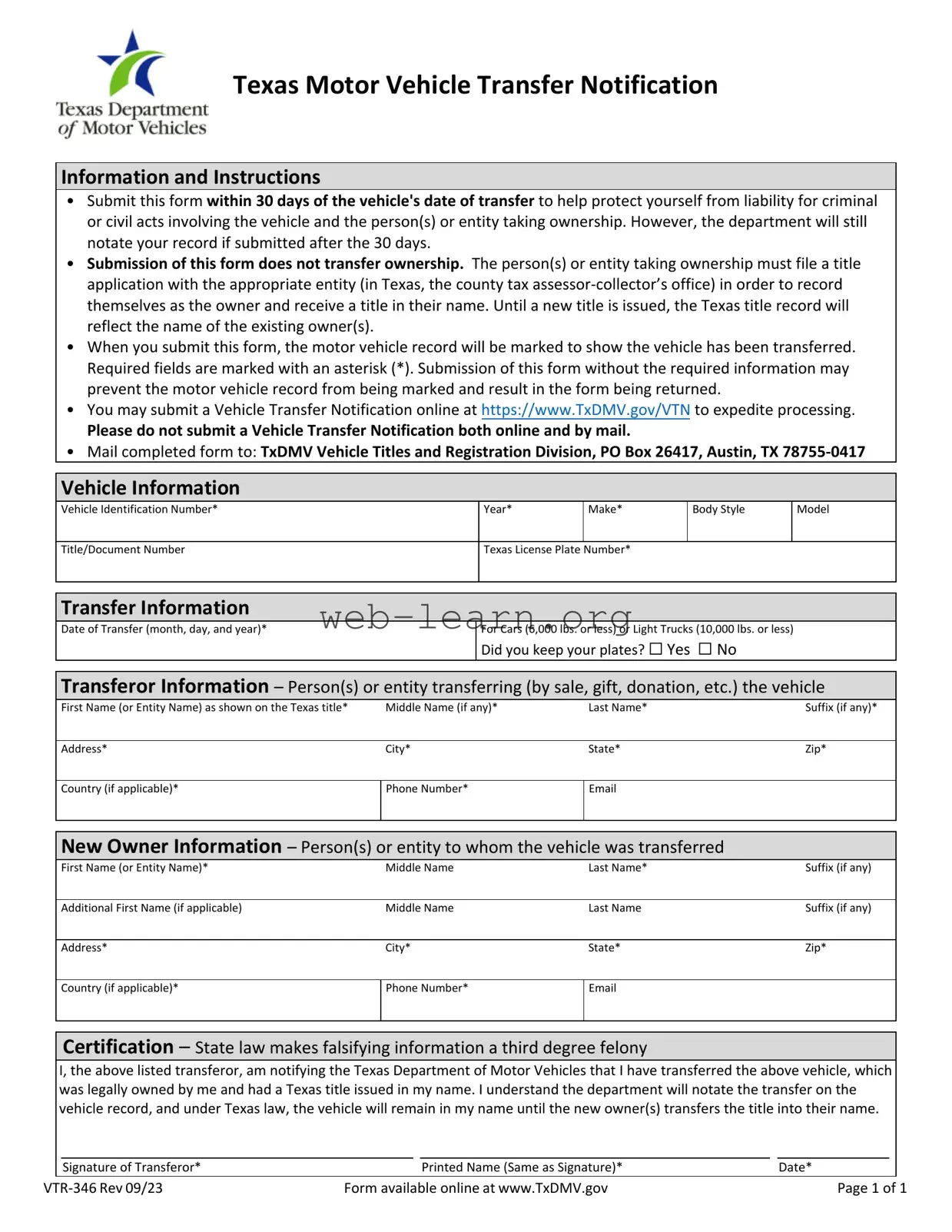
The Texas VTR-346 form serves as a vital document for anyone involved in the transfer of vehicle ownership within the state. This form is designed to notify the Texas Department of Transportation (TxDOT) about the sale or transfer of a motor vehicle, ensuring that all parties involved are recognized and protected under state law. It is essential for sellers to provide complete and accurate information, particularly regarding the buyer’s name and address, as this establishes the buyer as the presumed owner. The form includes sections for seller and buyer information, vehicle details, and a declaration confirming the transfer. By submitting this form, sellers can mark the vehicle records to reflect the change in ownership, although the vehicle will remain in the seller's name until a new Texas Certificate of Title is issued to the buyer. It's important to note that any inaccuracies or omissions can lead to the form being returned, causing delays in processing. Therefore, careful attention to detail is crucial. In addition to facilitating the transfer process, the form also serves as a legal document, carrying implications for both civil and criminal liability if misrepresented. As such, understanding the significance and requirements of the VTR-346 form is essential for a smooth transaction and compliance with Texas law.
Texas Motor Vehicle Transfer Notification
Information and Instructions
•Submit this form within 30 days of the vehicle's date of transfer to help protect yourself from liability for criminal or civil acts involving the vehicle and the person(s) or entity taking ownership. However, the department will still notate your record if submitted after the 30 days.
•Submission of this form does not transfer ownership. The person(s) or entity taking ownership must file a title application with the appropriate entity (in Texas, the county tax
•When you submit this form, the motor vehicle record will be marked to show the vehicle has been transferred. Required fields are marked with an asterisk (*). Submission of this form without the required information may prevent the motor vehicle record from being marked and result in the form being returned.
•You may submit a Vehicle Transfer Notification online at https://www.TxDMV.gov/VTN to expedite processing.
Please do not submit a Vehicle Transfer Notification both online and by mail.
•Mail completed form to: TxDMV Vehicle Titles and Registration Division, PO Box 26417, Austin, TX
Vehicle Information
Vehicle Identification Number* |
Year* |
Make* |
Body Style |
Model |
Title/Document Number |
Texas License Plate Number* |
|
|
|
Transfer Information
Date of Transfer (month, day, and year)* |
For Cars (6,000 lbs. or less) or Light Trucks (10,000 lbs. or less) |
|
Did you keep your plates? ☐ Yes ☐ No |
Transferor Information – Person(s) or entity transferring (by sale, gift, donation, etc.) the vehicle
First Name (or Entity Name) as shown on the Texas title* |
Middle Name (if any)* |
Last Name* |
Suffix (if any)* |
|
|
|
|
Address* |
City* |
State* |
Zip* |
|
|
|
|
Country (if applicable)* |
Phone Number* |
|
|
|
|
|
|
New Owner Information – Person(s) or entity to whom the vehicle was transferred
First Name (or Entity Name)* |
Middle Name |
Last Name* |
Suffix (if any) |
|
|
|
|
Additional First Name (if applicable) |
Middle Name |
Last Name |
Suffix (if any) |
|
|
|
|
Address* |
City* |
State* |
Zip* |
|
|
|
|
Country (if applicable)* |
Phone Number* |
|
|
|
|
|
|
Certification – State law makes falsifying information a third degree felony
I, the above listed transferor, am notifying the Texas Department of Motor Vehicles that I have transferred the above vehicle, which was legally owned by me and had a Texas title issued in my name. I understand the department will notate the transfer on the vehicle record, and under Texas law, the vehicle will remain in my name until the new owner(s) transfers the title into their name.
Signature of Transferor* |
|
Printed Name (Same as Signature)* |
|
Date* |
Form available online at www.TxDMV.gov |
Page 1 of 1 |
| Fact Name | Details |
|---|---|
| Purpose | The VTR-346 form is used to notify the Texas Department of Transportation about the transfer of a motor vehicle from the seller to the buyer. |
| Legal Requirement | Under Texas law, specifically Transportation Code §520.023, this form is essential for documenting the transfer of ownership of a vehicle. |
| Processing Time | After submission, the processing of the form takes approximately two weeks before the transfer is officially recorded. |
| Consequences of Falsification | Providing false information on the form can lead to severe penalties, including imprisonment and fines, as outlined in Transportation Code §501.155. |
| Record Keeping | Sellers are advised to keep a copy of the completed VTR-346 form for their records to ensure proof of the transfer. |
After completing the Texas VTR-346 form, it must be submitted to the Texas Department of Transportation for processing. Ensure that all required information is accurate and legible. Retain a copy of the form for your records, as it may be needed for future reference.
The Texas VTR-346 form is a Vehicle Transfer Notification form. It is used to inform the Texas Department of Transportation (TxDOT) about the transfer of ownership of a vehicle. This form is essential for documenting the sale or transfer of a vehicle to ensure that the buyer is recognized as the new owner.
The seller or transferor of the vehicle must complete the VTR-346 form. This includes providing accurate details about both the seller and the buyer, as well as information about the vehicle being transferred.
When filling out the VTR-346 form, you need to provide:
Once you have completed the VTR-346 form, you should mail it to the Texas Department of Transportation, Vehicle Titles and Registration Division, at the address provided on the form. Make sure to keep a copy for your records.
After the Texas Department of Transportation receives your completed VTR-346 form, processing typically takes about two weeks. The department will update its records to reflect the transfer of ownership.
If the VTR-346 form is incomplete or contains errors, TxDOT may return it for corrections. Common issues include missing information such as the buyer's name or vehicle identification number. Ensure all required fields are filled out accurately to avoid delays.
Providing false information on the VTR-346 form is a serious offense. Under Texas law, it is considered a third-degree felony, which could result in imprisonment for up to ten years and fines reaching $10,000.
If you have questions or need assistance regarding the VTR-346 form, you can contact the TxDOT Vehicle Titles and Registration Division at (512) 465-7611. They can provide guidance and help resolve any issues you may encounter.
Filling out the Texas VTR-346 form can seem straightforward, but many people make common mistakes that can delay the transfer process. Understanding these pitfalls can help ensure a smoother experience.
One frequent error is providing incomplete information. Each section of the form requires specific details, including the names and addresses of both the seller and buyer. Omitting any of this information can lead to the form being returned. It’s essential to double-check that every field is filled out completely before submission.
Another mistake is failing to legibly print or type the information. If the handwriting is unclear, the Texas Department of Transportation may not be able to read it. This can cause delays or even rejection of the form. Always take the time to ensure that your writing is neat and easy to read.
People often forget to include the date of delivery to the buyer. This date is crucial for the transfer record. Without it, the form may be considered incomplete. Make sure to add this detail to avoid unnecessary complications.
Some individuals neglect to keep a copy of the completed form for their records. This can be a problem if there are any discrepancies later on. Having a copy allows you to reference what was submitted if needed.
Another common oversight is not signing the form. The signature of the seller is mandatory, and without it, the form will not be processed. Always remember to sign and date the form before sending it off.
Many people also miss the requirement to provide the vehicle identification number (VIN). This number is unique to each vehicle and is crucial for identification purposes. Ensure that this is accurately filled out to avoid confusion.
Not including the title/document number is another frequent mistake. This number is essential for tracking the vehicle's history and ownership. Double-check that this information is present and correct.
Some individuals may assume that if they do not know a particular piece of information, they can leave it blank. However, it is important to write “unknown” in the applicable space rather than leaving it empty. This indicates that you have acknowledged the missing information.
Lastly, many forget to check the vehicle make and model. Providing incorrect details can lead to confusion and delays in processing. Always verify that the information matches what is on the vehicle’s title or registration.
By being aware of these common mistakes, you can help ensure that your Texas VTR-346 form is completed correctly. Taking the time to review your submission can save you from potential headaches down the road.
When transferring ownership of a vehicle in Texas, the VTR-346 form is a crucial document. However, several other forms and documents often accompany it to ensure a smooth and compliant transaction. Understanding these additional documents can help sellers and buyers navigate the vehicle transfer process more effectively.
By familiarizing yourself with these additional forms and documents, you can facilitate a more efficient vehicle transfer process. Each document plays a vital role in ensuring that the transfer is legally recognized and that both parties are protected throughout the transaction.
The Texas VTR-346 form serves as a vehicle transfer notification, but it shares similarities with several other important documents related to vehicle ownership and transfer. Below are four documents that have comparable functions or purposes:
When completing the Texas VTR-346 form, certain practices can help ensure a smooth process. Here are some important dos and don'ts:
Following these guidelines can help facilitate the transfer process and minimize the risk of complications. Always review the form before submission to ensure accuracy and completeness.
There are several misconceptions regarding the Texas VTR-346 form, which can lead to confusion for individuals involved in vehicle transfers. Below are six common misconceptions, along with clarifications for each.
Understanding these misconceptions can help ensure a smoother vehicle transfer process and compliance with Texas law.
When filling out and using the Texas VTR-346 form, keep the following key takeaways in mind:
Following these guidelines will help ensure a smooth vehicle transfer process in Texas.