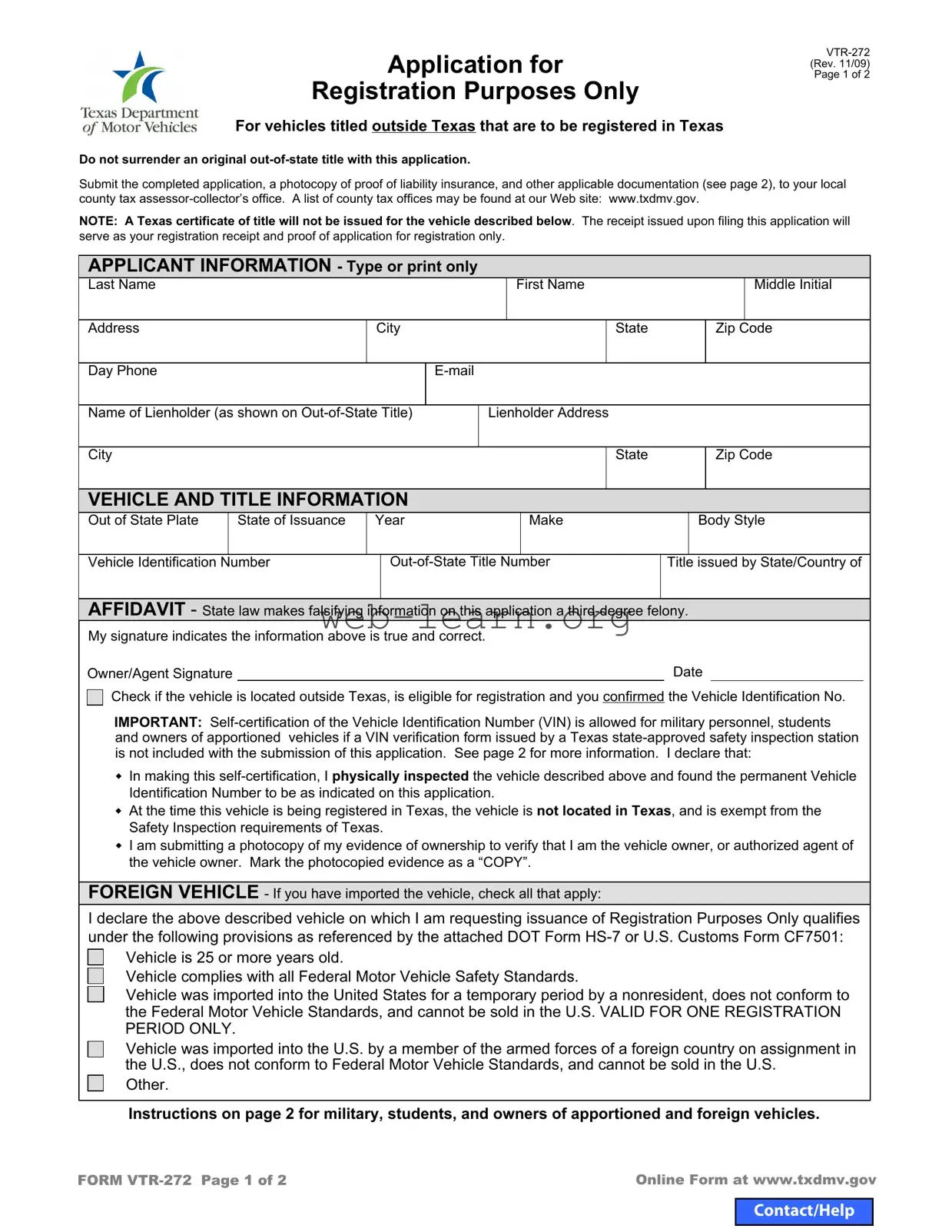
The Texas VTR-272 form serves as a crucial document for individuals looking to register vehicles that have been titled outside of Texas. This application is specifically designed for those who need to register their vehicles in Texas without surrendering their original out-of-state title. When completing the form, applicants must provide essential information such as their personal details, vehicle specifics, and any lienholder information. Alongside the completed application, a photocopy of proof of liability insurance and other relevant documentation must be submitted to the local county tax assessor-collector’s office. It’s important to note that while this form allows for registration purposes only, it does not result in the issuance of a Texas certificate of title. The form also includes an affidavit section where applicants must affirm the accuracy of the information provided, as falsifying details can lead to serious legal consequences. Additionally, certain provisions apply for military personnel, students, and owners of apportioned vehicles, allowing for self-certification of the Vehicle Identification Number (VIN) under specific circumstances. Understanding the requirements and instructions outlined in the VTR-272 form is essential for a smooth registration process in Texas.
Application for
Registration Purposes Only
For vehicles titled outside Texas that are to be registered in Texas
Do not surrender an original
Submit the completed application, a photocopy of proof of liability insurance, and other applicable documentation (see page 2), to your local county tax
NOTE: A Texas certificate of title will not be issued for the vehicle described below. The receipt issued upon filing this application will serve as your registration receipt and proof of application for registration only.
APPLICANT INFORMATION - Type or print only
Last Name |
|
|
First Name |
Middle Initial |
Address |
|
City |
State |
Zip Code |
Day Phone |
|
|
|
|
Name of Lienholder (as shown on |
Lienholder Address |
|
||
City |
|
|
State |
Zip Code |
VEHICLE AND TITLE INFORMATION |
|
|
||
Out of State Plate |
State of Issuance |
Year |
Make |
Body Style |
Vehicle Identification Number |
Title issued by State/Country of |
|||
AFFIDAVIT - State law makes falsifying information on this application a
My signature indicates the information above is true and correct.
Owner/Agent Signature |
|
Date |
Check if the vehicle is located outside Texas, is eligible for registration and you confirmed the Vehicle Identification No.
IMPORTANT:
wIn making this
wAt the time this vehicle is being registered in Texas, the vehicle is not located in Texas, and is exempt from the Safety Inspection requirements of Texas.
wI am submitting a photocopy of my evidence of ownership to verify that I am the vehicle owner, or authorized agent of the vehicle owner. Mark the photocopied evidence as a “COPY”.
FOREIGN VEHICLE - If you have imported the vehicle, check all that apply:
I declare the above described vehicle on which I am requesting issuance of Registration Purposes Only qualifies under the following provisions as referenced by the attached DOT Form
Vehicle is 25 or more years old.
Vehicle complies with all Federal Motor Vehicle Safety Standards.
Vehicle was imported into the United States for a temporary period by a nonresident, does not conform to the Federal Motor Vehicle Standards, and cannot be sold in the U.S. VALID FOR ONE REGISTRATION PERIOD ONLY.
Vehicle was imported into the U.S. by a member of the armed forces of a foreign country on assignment in the U.S., does not conform to Federal Motor Vehicle Standards, and cannot be sold in the U.S.
Other.
Instructions on page 2 for military, students, and owners of apportioned and foreign vehicles.
FORM |
Online Form at www.txdmv.gov |
Contact/Help
Instructions
Foreign Vehicle
wOwners of foreign vehicles brought into Texas must submit U.S. Customs Form
wCheck the appropriate box(es) in the Foreign Vehicle section on page 1 if you imported the vehicle.
Vehicle Identification Number Verification
This application must be accompanied by a Vehicle Identification Number (VIN) verification form issued
by a Texas
Military personnel located outside Texas
Active duty military personnel who are Texas residents with stations located outside Texas may use this form for
wThe vehicle is located outside Texas, and
wThe form is verified by the Provost Marshal. If the form is not verified by the Provost Marshal, you must provide verification that the applicant is currently stationed outside Texas. Verification may consist of military orders, etc., that indicate the current duty station of the applicant.
Students located outside Texas
Texas residents who are students located outside Texas may use this form for
wThe vehicle is located outside Texas, and
wYou provide verification that the applicant is a student currently enrolled in an accredited college or university outside Texas. Verification may consist of a tuition receipt, enrollment form, student identification card, etc., that confirms current enrollment.
Apportioned Vehicle
This
wCommercial vehicle owners must submit a weight certificate.
Submit this application to your County Tax
documentation, appropriate fees and completed Form
FORM |
Online Form at www.txdmv.gov |
| Fact Name | Description |
|---|---|
| Purpose | The VTR-272 form is used for registering vehicles titled outside Texas. It serves as an application for registration purposes only. |
| Documentation Required | Applicants must submit a completed VTR-272 form, a photocopy of proof of liability insurance, and any other applicable documents to their local county tax assessor-collector’s office. |
| Title Issuance | No Texas certificate of title will be issued for vehicles registered using this form. The receipt from filing serves as proof of registration application. |
| Self-Certification | Military personnel, students, and owners of apportioned vehicles may self-certify their Vehicle Identification Number (VIN) if they meet specific criteria. |
| Governing Law | The use of the VTR-272 form is governed by Texas Transportation Code and related regulations regarding vehicle registration. |
Filling out the Texas VTR-272 form is an essential step for registering a vehicle that has been titled outside of Texas. Once you complete the form, you will need to submit it along with necessary documentation to your local county tax assessor-collector’s office. This process will help you obtain a registration receipt for your vehicle.
The Texas VTR-272 form is used for registering vehicles that have been titled outside of Texas. It is specifically for individuals who wish to register their out-of-state vehicles in Texas without surrendering the original out-of-state title. This form serves as an application for registration purposes only and does not result in the issuance of a Texas certificate of title.
When submitting the VTR-272 form, applicants must include the following:
It is important to send these documents to your local county tax assessor-collector’s office.
Yes, military personnel who are Texas residents and currently stationed outside of Texas can use the VTR-272 form for self-certification of the VIN. However, the vehicle must be located outside Texas, and the form must be verified by the Provost Marshal. If not verified, the applicant must provide proof of their current military station.
Texas residents who are students and are located outside Texas may also use the VTR-272 form for self-certification of the VIN. To do this, they must ensure that the vehicle is outside Texas and provide verification of their student status, such as a tuition receipt or student ID that confirms their current enrollment in an accredited college or university.
After the VTR-272 form is submitted along with the required documents, the applicant will receive a receipt. This receipt serves as proof of application for registration and is valid for one registration period only. It is crucial to note that a Texas certificate of title will not be issued for the vehicle described in the application.
Filling out the Texas VTR-272 form can be a straightforward process, but several common mistakes can lead to complications. Understanding these pitfalls can help ensure a smoother registration experience.
One frequent error is failing to provide complete applicant information. This section requires the applicant's full name, address, and contact details. Omitting any part of this information can delay processing or even result in rejection of the application. It is essential to double-check that all fields are filled in accurately and legibly.
Another mistake involves incorrect Vehicle Identification Number (VIN) entry. The VIN is a crucial piece of information that uniquely identifies the vehicle. If the VIN is entered incorrectly, it can lead to significant issues, including the inability to register the vehicle. Applicants should verify the VIN on the vehicle and ensure it matches what is provided on the form.
Many applicants also overlook the requirement for proof of liability insurance. A photocopy of this documentation must accompany the VTR-272 form. Failing to include this proof can result in delays or the need to resubmit the application. It is advisable to prepare this documentation in advance to avoid any last-minute issues.
Lastly, applicants sometimes neglect to check the appropriate boxes in the foreign vehicle section if applicable. If the vehicle has been imported, this information is vital for proper classification and processing. Not indicating the correct status can lead to confusion and further complications in the registration process. Ensuring that all relevant sections are completed accurately is crucial for a successful application.
When registering a vehicle in Texas using the VTR-272 form, several other documents may be required or helpful in ensuring a smooth registration process. Each of these documents serves a specific purpose and can help clarify the ownership, condition, or compliance of the vehicle in question. Here’s a brief overview of some commonly used forms alongside the VTR-272.
Understanding these documents can help streamline the registration process and ensure compliance with Texas regulations. Having the right paperwork ready can save time and reduce stress when dealing with vehicle registration.
The Texas VTR-272 form serves as an application for vehicles titled outside Texas that need to be registered in the state. Several other documents share similarities with this form, primarily in their purpose and requirements. Below are four such documents:
When filling out the Texas VTR-272 form, it's important to ensure accuracy and completeness. Here are four things you should and shouldn't do:
Understanding the Texas VTR 272 form can be challenging, and several misconceptions often arise. Here are eight common misunderstandings about this important document:
Many people believe that this form is used to apply for a title. In reality, it is only for registration purposes and does not result in a Texas certificate of title.
This is incorrect. You should not surrender the original out-of-state title when submitting the VTR 272 form. Instead, keep it for your records.
Only vehicles titled outside of Texas and eligible for registration can use this form. Ensure your vehicle meets the necessary criteria.
While the receipt issued upon filing the application serves as proof of application for registration, it is not a title and does not confer ownership.
Self-certification is limited to military personnel, students, and owners of apportioned vehicles. Others must provide a VIN verification form from an approved safety inspection station.
Not all foreign vehicles qualify. Specific criteria must be met, such as age and compliance with federal safety standards.
This form must be submitted in person to your local county tax assessor-collector’s office along with the required documentation. Online submission is not an option.
Proof of liability insurance is a required document when submitting the VTR 272 form. Ensure you include a photocopy of your insurance documentation.
By clarifying these misconceptions, individuals can better navigate the registration process in Texas and avoid potential pitfalls.
The Texas VTR-272 form is essential for registering vehicles that are titled outside of Texas. Here are some key takeaways regarding its use: