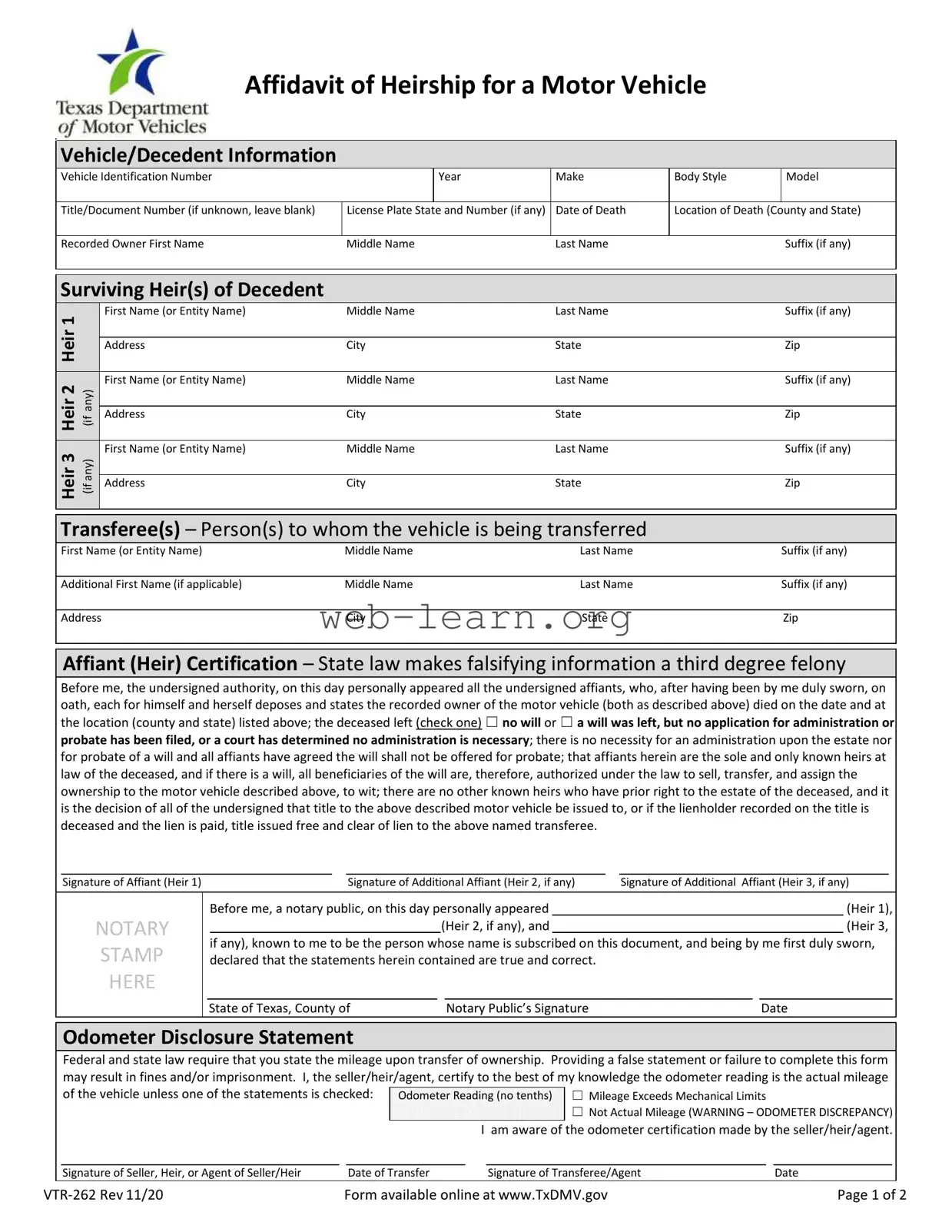
The Texas VTR 262 form, officially known as the Affidavit of Heirship for a Motor Vehicle, serves a crucial role in the transfer of vehicle ownership when the recorded owner has passed away. This form is particularly important for heirs who need to establish their legal right to the vehicle without going through the probate process. It requires detailed information about the vehicle, including its identification number, year, make, and title number, as well as the recorded owner's details and date of death. Heirs must provide their names and addresses, and if there are multiple heirs, they can all be included on the form. The VTR 262 also includes a section for the transferee—who will receive the vehicle—ensuring that ownership is clearly transferred. A significant aspect of this form is the certification by the heirs, affirming that they are the sole heirs and that no will is being probated, or if there is a will, it is agreed not to be offered for probate. Notarization is a requirement, adding a layer of authenticity to the document. Additionally, the form includes an odometer disclosure statement, which is mandated by federal and state law, ensuring that the mileage is accurately reported during the transfer. Overall, the Texas VTR 262 form streamlines the process of transferring vehicle ownership in a manner that respects the legal rights of heirs while providing a clear path for ownership transition.
Affidavit of Heirship for a Motor Vehicle
Vehicle/Decedent Information
Vehicle Identification Number |
|
Year |
Make |
|
|
|
|
Title/Document Number (if unknown, leave blank) |
License Plate State and Number (if any) |
Date of Death |
|
|
|
|
|
Recorded Owner First Name |
Middle Name |
Last Name |
|
Surviving Heir(s) of Decedent
1 |
|
First Name (or Entity Name) |
Middle Name |
Last Name |
|
|
|
|
|
||
Heir |
|
Address |
City |
State |
|
|
|
||||
|
|
First Name (or Entity Name) |
Middle Name |
Last Name |
|
Heir2 |
(ifany) |
||||
Address |
City |
State |
|||
|
|
||||
|
|
First Name (or Entity Name) |
Middle Name |
Last Name |
|
Heir3 |
(ifany) |
||||
Address |
City |
State |
|||
|
|
||||
|
|
|
|
|
Transferee(s) – Person(s) to whom the vehicle is being transferred
First Name (or Entity Name) |
Middle Name |
Last Name |
Additional First Name (if applicable) |
Middle Name |
Last Name |
Address |
City |
State |
Body Style |
Model |
|
|
Location of Death (County and State)
Suffix (if any)
Suffix (if any)
Zip
Suffix (if any)
Zip
Suffix (if any)
Zip
Suffix (if any)
Suffix (if any)
Zip
Affiant (Heir) Certification – State law makes falsifying information a third degree felony
Before me, the undersigned authority, on this day personally appeared all the undersigned affiants, who, after having been by me duly sworn, on oath, each for himself and herself deposes and states the recorded owner of the motor vehicle (both as described above) died on the date and at the location (county and state) listed above; the deceased left (check one) ☐ no will or ☐ a will was left, but no application for administration or probate has been filed, or a court has determined no administration is necessary; there is no necessity for an administration upon the estate nor for probate of a will and all affiants have agreed the will shall not be offered for probate; that affiants herein are the sole and only known heirs at law of the deceased, and if there is a will, all beneficiaries of the will are, therefore, authorized under the law to sell, transfer, and assign the ownership to the motor vehicle described above, to wit; there are no other known heirs who have prior right to the estate of the deceased, and it is the decision of all of the undersigned that title to the above described motor vehicle be issued to, or if the lienholder recorded on the title is deceased and the lien is paid, title issued free and clear of lien to the above named transferee.
Signature of Affiant (Heir 1) |
|
Signature of Additional Affiant (Heir 2, if any) |
|
Signature of Additional Affiant (Heir 3, if any) |
NOTARY
STAMP
HERE
|
Before me, a notary public, on this day personally appeared |
|
|
|
(Heir |
1), |
||||
|
|
|
(Heir 2, if any), and |
|
|
|
(Heir 3, |
|||
|
if any), known to me to be the person whose name is subscribed on this document, and being by me first duly sworn, |
|
||||||||
declared that the statements herein contained are true and correct. |
|
|
|
|
||||||
|
|
|
|
|
|
|
||||
State of Texas, County of |
|
Notary Public’s Signature |
|
Date |
|
|||||
|
Odometer Disclosure Statement |
|
|
|
|
|
|
|
||
|
Federal and state law require that you state the mileage upon transfer of ownership. Providing a false statement or failure to complete this form |
|
||||||||
|
may result in fines and/or imprisonment. I, the seller/heir/agent, certify to the best of my knowledge the odometer reading is the actual mileage |
|
||||||||
|
of the vehicle unless one of the statements is checked: |
|
|
|
|
|
|
|||
|
Odometer Reading (no tenths) |
☐ Mileage Exceeds Mechanical Limits |
|
|
||||||
|
|
|
|
|
|
|
☐ Not Actual Mileage (WARNING – ODOMETER DISCREPANCY) |
|
||
|
|
|
|
|
I am aware of the odometer certification made by the seller/heir/agent. |
|
||||
|
|
|
|
|
|
|
|
|
||
|
Signature of Seller, Heir, or Agent of Seller/Heir |
|
Date of Transfer |
|
Signature of Transferee/Agent |
Date |
|
|||
Form available online at www.TxDMV.gov |
Page 1 of 2 |
|||||||||

Affidavit of Heirship for a Motor Vehicle
Information
The section is for informational purposes only. Affiant(s) must obtain their own legal advice if required.
If the estate has been probated, the executor or administrator may assign the title provided a certified copy of the probate proceedings, Letters Testamentary, or Letters of Administration is attached. In this situation, this form is not required. Otherwise, the procedures in the “Instructions” section below must be met to transfer ownership.
If there has been no administration on the estate, and no administration is necessary, the heirs may complete this form, and no further documentation is required.
If an heirship affidavit is used when a court has determined no administration is necessary, the affiant(s) must attach the original or certified copy of the court document indicating no administration of the will is necessary and the portions of the will that specify the will is in the deceased owner’s name and indicates the name(s) of the heir(s).
If all heirs cannot appear before one notary public on the same date, or there are more than three heirs, additional copies of this form must be completed. If additional copies of this form are completed, all copies must be submitted by the transferee (or purchaser) with the title application at the time of application to a county tax
If one of the heirs is a surviving spouse, that heir is the only heir needing to complete this form unless there are surviving children of the decedent with a parent who is other than the surviving spouse in which case all surviving children must also complete this form.
If there is no surviving spouse, all children of the decedent (if any) must sign as affiants.
If the decedent left neither a spouse nor children, consult legal counsel as to who are the “heirs at law.”
Children
Children born to or legally adopted by the decedent qualify for this procedure as “children” of the decedent.
A guardian must sign for any surviving minor children of the decedent and attach Letters of Guardianship.
Instructions
1.Complete the “Vehicle/Decedent Information” section on page 1. All fields are required unless indicated otherwise.
2.The heir(s) (up to three) must complete the “Surviving Heir(s) of Decedent” section on page 1. Refer to the “Information” section above for additional information. If there are more than three heirs, additional completed forms are necessary.
3.Complete the “Transferee(s)” section to indicate to whom the vehicle is being transferred. An heir may also be listed as a transferee.
4.Complete the “Affiant (Heir) Certification” section by marking the appropriate selection as to the will. The preceding three sections of the form must be completed prior to completion of this section. Each heir (up to three) must sign this form before a notary. All signatures must be notarized. This section may not be completed by execution of a power of attorney.
5.The “Odometer Disclosure Statement” section must be completed by an heir (or any agent of an heir) and the purchaser of the motor vehicle if the vehicle is subject to odometer disclosure. This section may be completed after the notarization has been completed. Only one seller/heir is required to execute the odometer disclosure statement.
6.The following documentation is required in order for a title transfer to be processed by the county tax assessor- collector’s office in the name of the title applicant(s):
Application for Texas Title and/or Registration (Form
Affidavit of Heirship for a Motor Vehicle (Form
If a court has determined no administration is necessary:
Original or certified copy of the court document indicating no administration of the will is necessary; and
The portions of the will specifying the will is in the decedent’s name and indicating the heir(s);
Title and/or registration verification if the vehicle was last titled out of state;
Release of Lien (if a lien is recorded on the title record); and
A copy of current proof of liability insurance in the applicant’s name (if applying for registration).
Note: Errors that have been lined through and corrected require a statement of fact. Erasures and significant alterations may require a new form to be completed.
Form available online at www.TxDMV.gov |
Page 2 of 2 |
| Fact Name | Details |
|---|---|
| Purpose | The Texas VTR-262 form is used to establish the transfer of ownership of a motor vehicle when the recorded owner has passed away, through an affidavit of heirship. |
| Governing Law | This form is governed by Texas state law, specifically the Texas Estates Code and Texas Transportation Code. |
| Required Information | It requires details such as the vehicle identification number, the deceased owner's information, and the surviving heirs' names and addresses. |
| Notarization | All signatures on the form must be notarized to validate the affidavit, ensuring that the information provided is true and correct. |
| Odometer Disclosure | The form includes an odometer disclosure statement, which must be completed to confirm the vehicle's mileage at the time of transfer. |
Filling out the Texas VTR-262 form involves several key steps to ensure accurate and complete information is provided. Once the form is filled out correctly, it can be submitted to the county tax assessor-collector’s office for processing.
What is the purpose of the Texas VTR 262 form?
The Texas VTR 262 form, also known as the Affidavit of Heirship for a Motor Vehicle, is used to transfer ownership of a motor vehicle from a deceased individual to their heirs. This form is particularly relevant when the deceased has not left a will, or when there is no need for formal probate proceedings. It serves as a legal declaration that the signatories are the rightful heirs of the deceased and have the authority to transfer the vehicle title.
Who should complete the VTR 262 form?
The form should be completed by the surviving heirs of the deceased. Up to three heirs can sign the form as affiants. If there are more than three heirs, additional copies of the form must be filled out. In cases where a surviving spouse exists, that spouse is the only heir required to complete the form unless there are surviving children from a different parent.
What information is required on the form?
The VTR 262 form requires several pieces of information, including:
All fields must be completed unless otherwise indicated.
Is notarization required for the VTR 262 form?
Yes, notarization is required. Each heir signing the form must do so in the presence of a notary public. The notary will confirm the identities of the affiants and witness their signatures, ensuring the document is legally binding.
What if the deceased left a will?
If the deceased left a will, the heirs may still use the VTR 262 form if the will has not been probated and no administration is necessary. However, if the estate has been probated, the executor or administrator of the estate must handle the title transfer using appropriate probate documents instead of this form.
What additional documentation is needed for the title transfer?
To process the title transfer, several documents must be submitted along with the VTR 262 form, including:
What happens if there are errors on the form?
If errors are made on the VTR 262 form, they must be corrected in a specific manner. Errors that are crossed out and corrected require a statement of fact explaining the changes. Significant alterations or erasures may necessitate the completion of a new form to ensure clarity and legal validity.
Can a guardian sign for minor children?
Yes, if there are surviving minor children of the deceased, a guardian may sign the VTR 262 form on their behalf. The guardian must also attach Letters of Guardianship to validate their authority to act for the minor heirs.
Filling out the Texas VTR-262 form can be a straightforward process, but many individuals make common mistakes that can lead to delays or complications. One frequent error is failing to provide complete vehicle information. This includes not entering the Vehicle Identification Number (VIN), year, or make of the vehicle. Each piece of information is crucial for accurately identifying the vehicle being transferred.
Another mistake involves the “Surviving Heir(s) of Decedent” section. Many people neglect to list all heirs, or they mistakenly omit necessary details such as middle names or suffixes. This can create confusion and may result in the form being rejected. It's essential to ensure that every heir is listed correctly and completely.
Inaccurate or incomplete signatures are also a common issue. Each heir must sign the form in front of a notary public. If any signature is missing or not properly notarized, the form will not be valid. This can cause significant delays in the title transfer process.
Some individuals overlook the importance of the “Odometer Disclosure Statement.” This section must be filled out accurately, as it is required by federal and state law. Failing to provide the correct odometer reading or neglecting to check the appropriate box can lead to penalties or complications during the transfer.
Additionally, not attaching necessary documentation is a frequent oversight. If the estate has been probated, a certified copy of the probate proceedings must be included. If no administration is necessary, the original or certified copy of the court document indicating this must be attached. Missing these documents can halt the transfer process.
People often misinterpret the requirements regarding heirs. For instance, if there is a surviving spouse, they may be the only heir required to fill out the form unless there are children from a different parent. Misunderstanding these rules can lead to incomplete submissions.
Another mistake is failing to check for additional heirs. If there are more than three heirs, additional copies of the form must be completed. This requirement is sometimes overlooked, leading to unnecessary delays.
Errors in the “Affiant (Heir) Certification” section can also cause issues. It is vital to mark the correct option regarding the will and ensure all heirs sign this section. Incorrect markings or missing signatures can invalidate the affidavit.
Lastly, individuals sometimes forget to review the entire form for errors before submission. Simple mistakes, such as typos or incorrect information, can lead to significant delays. Taking the time to double-check all entries can save time and effort in the long run.
The Texas VTR-262 form, known as the Affidavit of Heirship for a Motor Vehicle, is essential for transferring ownership of a vehicle after the owner's death. However, several other forms and documents are often required to ensure a smooth transfer process. Below is a list of these documents, along with a brief description of each.
Gathering these documents ensures that the transfer of ownership is legally sound and adheres to Texas laws. Proper documentation helps prevent delays and complications during the title transfer process.
The Texas VTR 262 form, known as the Affidavit of Heirship for a Motor Vehicle, serves as a legal document to establish the transfer of vehicle ownership when the recorded owner has passed away. Several other documents share similarities with this form in terms of their purpose and function. Below are four documents that are comparable to the Texas VTR 262 form:
When filling out the Texas VTR-262 form, it's important to approach the task with care and attention to detail. Here’s a list of things to keep in mind:
Misconceptions about the Texas VTR 262 form can lead to confusion and potential legal issues for heirs and transferees. Understanding the realities surrounding this form is crucial. Below is a list of common misconceptions along with clarifications.
This is incorrect. The form can be used when there is no will or when a will exists but no administration or probate has been filed. It serves as a way to transfer ownership without going through probate.
In fact, all heirs must sign the form unless there is a surviving spouse. If there are more than three heirs, additional copies of the form must be completed.
This is not true. All signatures on the form must be notarized to ensure the authenticity of the document.
The VTR 262 form is specifically for motor vehicles. It cannot be used for other types of property or assets.
Additional documentation may be required depending on the circumstances. For example, if a court has determined no administration is necessary, a certified copy of that court document must be attached.
This is false. Federal and state laws require the odometer disclosure statement to be completed during the transfer of ownership. Failure to do so may result in fines or other penalties.
While it is preferable for all heirs to appear together, if that is not possible, additional copies of the form can be completed and submitted separately.
If the estate has been probated, the executor or administrator should handle the title transfer using the appropriate probate documents. The VTR 262 form is not necessary in that case.
Filling out the Texas VTR-262 form, known as the Affidavit of Heirship for a Motor Vehicle, is an important step for heirs seeking to transfer ownership of a vehicle after the recorded owner's death. Here are some key takeaways to keep in mind:
By keeping these points in mind, heirs can navigate the process of transferring vehicle ownership with greater confidence and clarity.