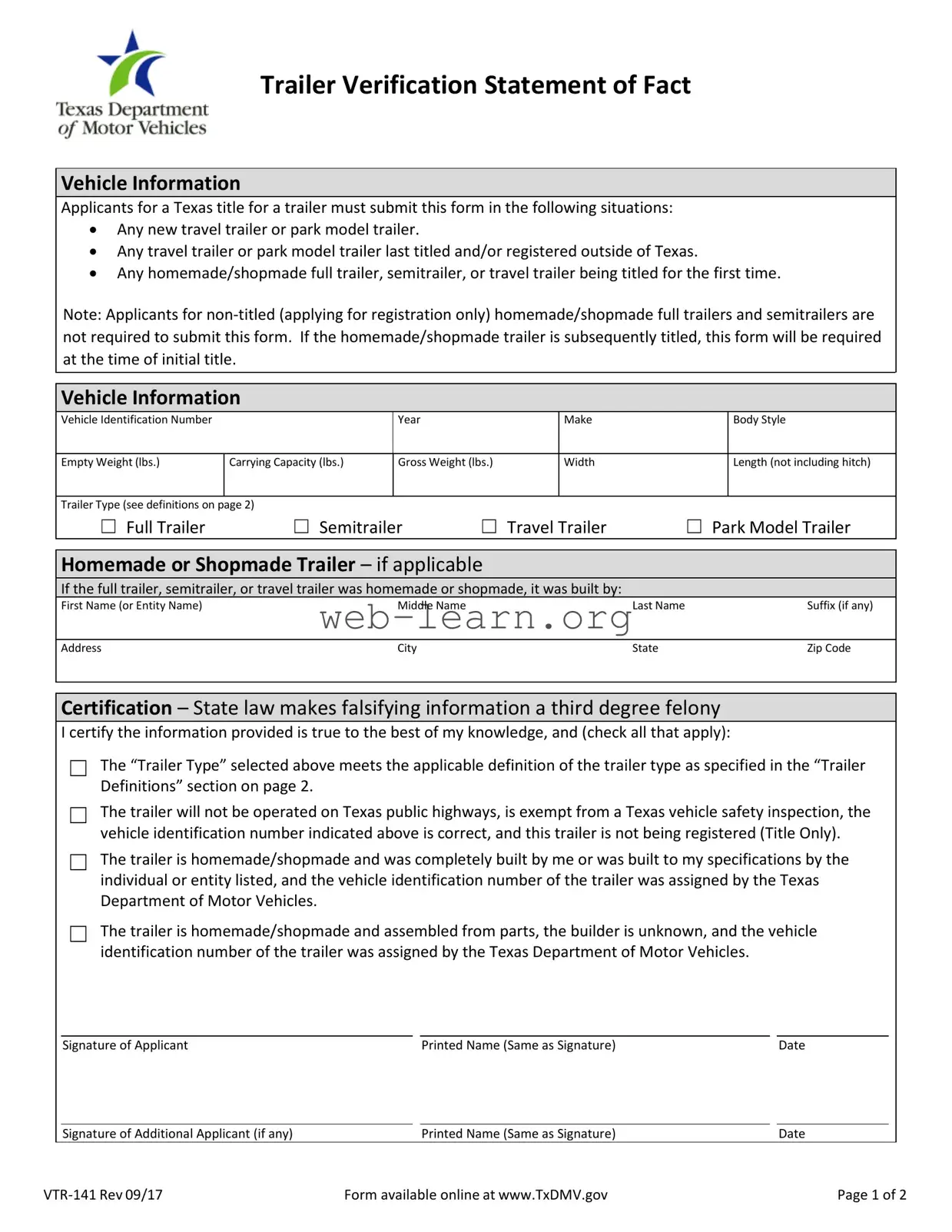
The Texas VTR 141 form serves as a crucial document for individuals seeking to title trailers in the state. This form is specifically required in several scenarios, including the titling of new travel trailers or park model trailers, as well as trailers last titled and registered outside of Texas. Additionally, it applies to homemade or shopmade trailers being titled for the first time. However, applicants for non-titled homemade or shopmade trailers, which are only seeking registration, do not need to submit this form. The VTR 141 collects essential vehicle information such as the Vehicle Identification Number (VIN), year, make, body style, and weight specifications. It also includes a certification section where applicants must affirm the accuracy of the information provided, as well as acknowledge the trailer type based on specific definitions. This form not only ensures compliance with state regulations but also plays a significant role in the proper registration and operation of trailers on Texas public highways. Understanding the requirements and implications of the VTR 141 is vital for all trailer owners and prospective applicants in Texas.

Trailer Verification Statement of Fact
Vehicle Information
Applicants for a Texas title for a trailer must submit this form in the following situations:
•Any new travel trailer or park model trailer.
•Any travel trailer or park model trailer last titled and/or registered outside of Texas.
•Any homemade/shopmade full trailer, semitrailer, or travel trailer being titled for the first time.
Note: Applicants for
Vehicle Information
Vehicle Identification Number |
|
Year |
|
Make |
|
Body Style |
|
|
|
|
|
|
|
Empty Weight (lbs.) |
Carrying Capacity (lbs.) |
Gross Weight (lbs.) |
Width |
|
Length (not including hitch) |
|
|
|
|
|
|
|
|
Trailer Type (see definitions on |
page 2) |
|
|
|
|
|
☐ Full Trailer |
☐ Semitrailer |
☐ Travel Trailer |
☐ Park Model Trailer |
|||
|
|
|
|
|
|
|
Homemade or Shopmade Trailer – if applicable |
|
|
|
|||
If the full trailer, semitrailer, or travel trailer was homemade or shopmade, it was built by: |
|
|
||||
First Name (or Entity Name) |
|
Middle Name |
|
|
Last Name |
Suffix (if any) |
|
|
|
|
|
|
|
Address |
|
City |
|
|
State |
Zip Code |
|
|
|
|
|
|
|
Certification – State law makes falsifying information a third degree felony
I certify the information provided is true to the best of my knowledge, and (check all that apply):
☐The “Trailer Type” selected above meets the applicable definition of the trailer type as specified in the “Trailer Definitions” section on page 2.
☐The trailer will not be operated on Texas public highways, is exempt from a Texas vehicle safety inspection, the vehicle identification number indicated above is correct, and this trailer is not being registered (Title Only).
☐The trailer is homemade/shopmade and was completely built by me or was built to my specifications by the individual or entity listed, and the vehicle identification number of the trailer was assigned by the Texas Department of Motor Vehicles.
☐The trailer is homemade/shopmade and assembled from parts, the builder is unknown, and the vehicle identification number of the trailer was assigned by the Texas Department of Motor Vehicles.
Signature of Applicant |
|
Printed Name (Same as Signature) |
|
Date |
Signature of Additional Applicant (if any) |
|
Printed Name (Same as Signature) |
|
Date |
Form available online at www.TxDMV.gov |
Page 1 of 2 |

Trailer Verification Statement of Fact
Trailer Definitions
Full Trailer
•Designed or used to carry its load wholly on its own structure and is drawn or designed to be drawn by a motor vehicle.
Semitrailer
•Designed or used with a motor vehicle, so part of the weight of the semitrailer and its load rests on or is carried by the motor vehicle drawing the semitrailer.
Travel Trailer
•Not designed or used primarily as a permanent dwelling, but as temporary living quarters for recreational, camping, travel, or seasonal use;
•Built on a single chassis; and
•Must be less than eight (8) feet, six (6) inches in width or less than
Park Model Trailer
•Not designed for use or primarily used as a permanent dwelling, but as temporary living quarters for recreational, camping, travel, or seasonal use;
•Built on a single chassis;
•Permanently towable by a light duty truck; and
•Eight (8) feet, six (6) inches or greater in width and
Note: Manufactured homes designed as a permanent dwelling may not be titled and registered as a travel trailer or park model trailer. Custom trailers with living quarters primarily used for commercial purposes must be titled and registered as a full trailer or semitrailer (including those with farm registration).
Permit Required to Move on Public Highways
Any trailer in excess of eight (8) feet, six (6) inches in width or fourteen (14) feet in height is required to be issued an oversize/overweight permit in addition to regular registration to legally move the trailer on a Texas public highway.
Additionally, a semitrailer exceeding
To obtain an oversize/overweight permit, contact the Texas Department of Motor Vehicles’ Motor Carrier Division at
Last Titled and Registered Out of State
Any trailer last titled and registered out of state is required to pass a Texas vehicle safety inspection if the gross weight exceeds 7,500 lbs. before it may be titled and/or registered in Texas.
Any trailer that will not be used on a public highway is not subject to the Texas vehicle safety inspection requirements, and the applicant is required to certify the travel trailer or the park model trailer will not be operated on Texas public highways (and is applying for a Title Only) by marking the second box in the “Certification” section on page 1. Applicants are also required to physically inspect the vehicle to verify the correct vehicle identification number.
A Title Only transaction is also permissible for a full trailer or semitrailer. The vehicle identification number can be
Weights on New or Out of State Trailers
The empty weight or shipping weight reflected on the evidence of ownership (i.e., manufacturer’s certificate of origin or out of state title) is considered the empty weight. A weight certificate is required if the required weight information is not located on the manufacturer’s certificate of origin or out of state title.
Form available online at www.TxDMV.gov |
Page 2 of 2 |
| Fact Name | Details |
|---|---|
| Purpose of Form | The VTR-141 form is used for applicants seeking a Texas title for certain types of trailers. |
| When to Submit | This form must be submitted for new travel trailers, trailers last titled outside Texas, and homemade trailers being titled for the first time. |
| Exemption | Applicants registering homemade trailers without a title do not need to submit this form until the trailer is titled. |
| Certification Requirement | Applicants must certify that the information provided is true and that the trailer meets applicable definitions. |
| Oversize Permit | Trailers exceeding specific dimensions require an oversize/overweight permit to move legally on Texas public highways. |
| Inspection Requirement | Trailers last titled out of state must pass a Texas vehicle safety inspection if their gross weight exceeds 7,500 lbs. |
| Governing Law | The use of the VTR-141 form is governed by Texas Transportation Code, Section 501.023. |
Completing the Texas VTR 141 form is essential for those seeking a title for a trailer under specific circumstances. This form gathers necessary information about the trailer, including its identification details and the applicant's certification of accuracy. Follow the steps below to fill out the form correctly.
What is the purpose of the Texas VTR-141 form?
The Texas VTR-141 form, known as the Trailer Verification Statement of Fact, is necessary for individuals applying for a title for a trailer in specific situations. This includes:
It is important to note that if you are applying for registration only for a homemade or shopmade trailer, this form is not required. However, if you later decide to title the trailer, you will need to submit the VTR-141 at that time.
What information is required on the form?
The form requires several pieces of information about the trailer, including:
Additionally, if the trailer is homemade or shopmade, the builder's name and address must be provided. This information helps ensure that the trailer is accurately classified and complies with state regulations.
What are the certification requirements for the VTR-141 form?
When completing the VTR-141 form, applicants must certify that the information provided is accurate to the best of their knowledge. This certification includes checking boxes that confirm:
Falsifying information on this form is considered a serious offense, classified as a third-degree felony under state law.
Are there any additional requirements for trailers last titled out of state?
Yes, trailers that were last titled and registered outside of Texas must meet specific requirements before they can be titled or registered in Texas. If the gross weight of the trailer exceeds 7,500 lbs, it must pass a Texas vehicle safety inspection. However, if the trailer will not be used on public highways, it is exempt from this inspection. In such cases, the applicant must certify that the trailer will not be operated on public highways by marking the appropriate box in the certification section of the form.
When filling out the Texas VTR-141 form, applicants often encounter several common mistakes that can lead to delays or complications in the title application process. One significant error is failing to provide complete vehicle information. Each section of the form requires specific details, including the Vehicle Identification Number (VIN), year, make, body style, and various weight specifications. Omitting any of this critical information can result in a rejection of the application.
Another frequent mistake is incorrectly selecting the trailer type. The form includes options such as full trailer, semitrailer, travel trailer, and park model trailer. Each type has distinct definitions and requirements. Misclassifying the trailer can lead to legal issues and complications with registration. It is essential to carefully review the definitions provided on the form to ensure the correct type is selected.
Many applicants overlook the certification section, which requires them to affirm the accuracy of the information provided. Failing to check the appropriate boxes or to sign the certification can invalidate the application. This section is not just a formality; it holds legal significance, and any falsification can lead to serious consequences. Therefore, attention to detail in this area is crucial.
Another common error involves the misunderstanding of the requirements for homemade or shopmade trailers. If a trailer falls into this category, applicants must provide specific information about the builder, including their name and address. Neglecting to include this information or incorrectly stating the builder's details can cause unnecessary delays.
Additionally, applicants sometimes misinterpret the weight requirements associated with trailers last titled and registered out of state. If the gross weight exceeds 7,500 lbs., a Texas vehicle safety inspection is mandatory before the title can be issued. Failing to comply with this requirement can result in further complications, so it is vital to understand the weight implications fully.
Lastly, many individuals forget to include their contact information or provide inaccurate details. This oversight can hinder communication with the Texas Department of Motor Vehicles, leading to delays in processing the application. Ensuring that all contact information is accurate and up to date is essential for a smooth application process.
The Texas VTR-141 form is essential for individuals seeking to title a trailer in Texas under specific circumstances. However, several other forms and documents are often required or recommended to complete the trailer registration process effectively. Below is a list of these related documents, each serving a unique purpose in the titling and registration process.
Understanding these forms and their purposes can streamline the process of titling and registering a trailer in Texas. Each document plays a vital role in ensuring compliance with state regulations and protecting the rights of the trailer owner. Be sure to gather all necessary paperwork before initiating the registration process to avoid delays.
The Texas VTR 141 form is used for various vehicle-related situations, particularly for trailers. Here are ten documents that are similar to the VTR 141 form, along with explanations of how they are alike:
When filling out the Texas VTR 141 form, there are several important things to keep in mind. Here is a list of dos and don'ts to ensure your application is processed smoothly.
Following these guidelines will help ensure that your application is complete and correct, minimizing delays in processing your title request.
Misconceptions about the Texas VTR-141 form can lead to confusion. Here are four common misunderstandings:
Key Takeaways for Filling Out the Texas VTR-141 Form