The Texas Visitation Enforcement form is an essential tool for parents who possess a court order granting them visitation rights with their children. When one parent fails to comply with this order, it can create significant emotional distress and legal challenges. This enforcement kit is designed to assist custodial parents in taking appropriate action to uphold their rights. It includes a variety of documents that guide parents through the process of enforcing their visitation rights. For instance, the kit features a sample demand letter that serves as a reminder to the other parent about the legal implications of violating the court order. Additionally, it provides a visitation journal, which is crucial for documenting instances of denied visitation. This documentation can be instrumental in court proceedings. The kit also outlines the steps necessary for enforcement, from understanding what constitutes a denial of visitation to preparing for a court hearing. Each step is clearly detailed, ensuring that parents know exactly what actions to take. By following this structured approach, parents can effectively navigate the legal system and work towards ensuring their right to spend time with their children is respected.
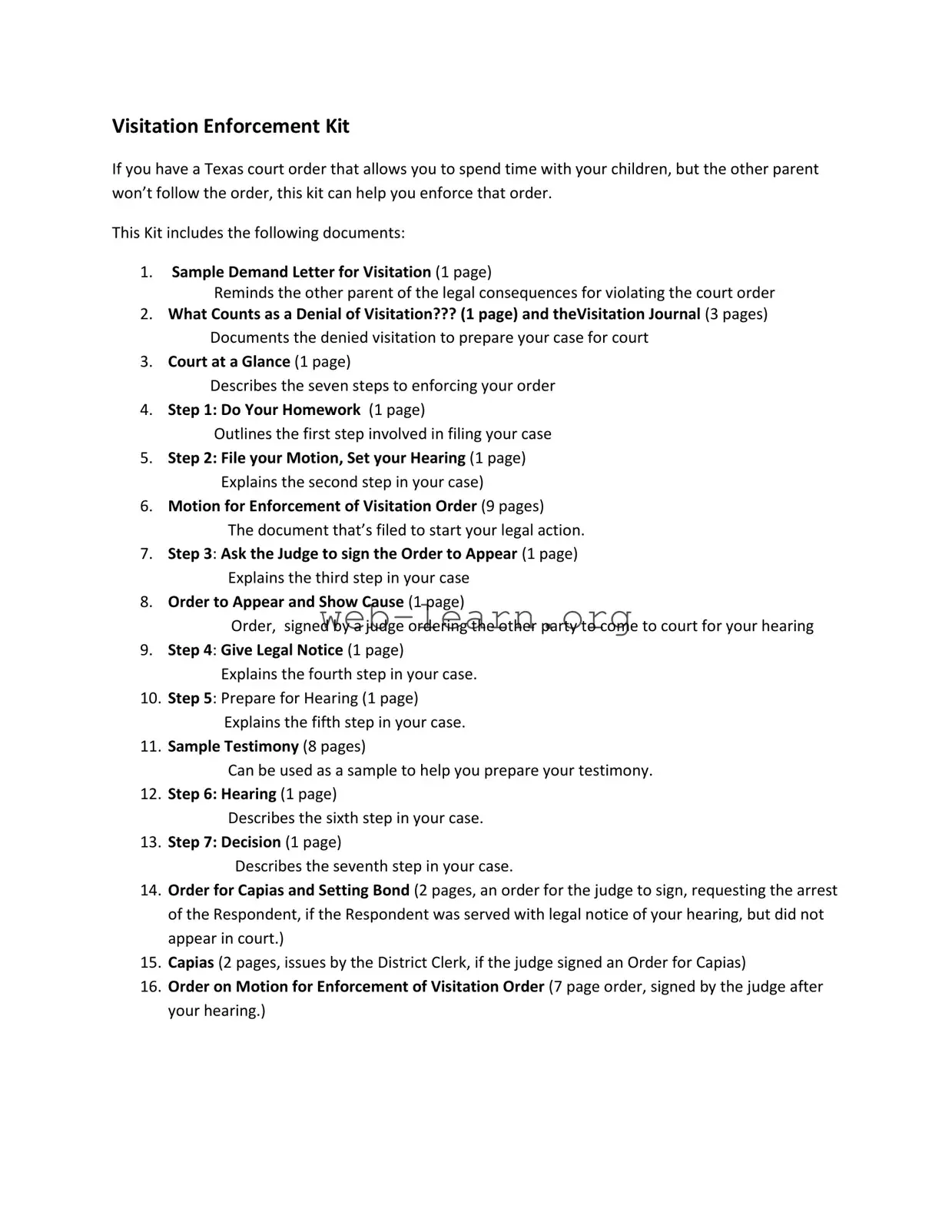
Visitation Enforcement Kit
If you have a Texas court order that allows you to spend time with your children, but the other parent wo ’t follow the order, this kit ca help you e force that order.
This Kit includes the following documents:
1.Sample Demand Letter for Visitation (1 page)
Reminds the other parent of the legal consequences for violating the court order
2.What Counts as a Denial of Visitation??? (1 page) and theVisitation Journal (3 pages) Documents the denied visitation to prepare your case for court
3.Court at a Glance (1 page)
Describes the seven steps to enforcing your order
4.Step 1: Do Your Homework (1 page)
Outlines the first step involved in filing your case
5.Step 2: File your Motion, Set your Hearing (1 page) Explains the second step in your case)
6.Motion for Enforcement of Visitation Order (9 pages)
The docu e t that’s filed to start your legal action.
7.Step 3: Ask the Judge to sign the Order to Appear (1 page) Explains the third step in your case
8.Order to Appear and Show Cause (1 page)
Order, signed by a judge ordering the other party to come to court for your hearing
9.Step 4: Give Legal Notice (1 page)
Explains the fourth step in your case.
10.Step 5: Prepare for Hearing (1 page) Explains the fifth step in your case.
11.Sample Testimony (8 pages)
Can be used as a sample to help you prepare your testimony.
12.Step 6: Hearing (1 page)
Describes the sixth step in your case.
13.Step 7: Decision (1 page)
Describes the seventh step in your case.
14.Order for Capias and Setting Bond (2 pages, an order for the judge to sign, requesting the arrest of the Respondent, if the Respondent was served with legal notice of your hearing, but did not appear in court.)
15.Capias (2 pages, issues by the District Clerk, if the judge signed an Order for Capias)
16.Order on Motion for Enforcement of Visitation Order (7 page order, signed by the judge after your hearing.)
[DATE]
[Custodial Parent]
[Custodial Parent’s Address]
Re: Notice to Exercise
Dear [Custodial Parent]:
Iplan to see our [children / child], according to the
Iwill be at
□[your residence at 6:00 pm]
OR
□[the school where our [children /child] is enrolled, when school is dismissed]
OR
□[Other fill in the time and place where your visitation is ordered to take place. ]
on [the date designated in the court order for you to take possession] to exercise my rights to see our [children / child].
You should have our [children / child ]ready for my visitation as provided for in the court order.
I will return our [children / child] to you as required by the court order.
I intend to continue exercising my possession and access (visitation) rights according to the court ordered schedule from now on.
Interfering with my
finds you in contempt for denying me
court costs. It would be best for everyone, especially our [children / child], to avoid such litigation.
Sincerely,
[Your Name]
[Your Address]
[Your Telephone]

WHAT COUNTS AS A DENIAL OF VISITATION???
To enforce your visitation order and ask the court to hold the other parent in contempt, you must follow very specific rules when you try to exercise your visitation.
You are not technically denied visitation unless you actually appear in person at the
By not producing the child at the
that you were there and she was not.
APRIL 11th
6 pm – pick up son at
his mother’s house
Step 1: Look at your court order, or at your Visitation Calendar if one has been prepared for you. Find the next exact date and time that you are supposed to pick up your child.
Step 2: Arrive at the
Step 3: Knock on the door. Wait. Knock on the door again. You must give some indication that you are there and are ready to pick up your child.
Step 4: Try to obtain evidence that you were at the right location at the right date and time. You can take a witness with you to observe what happened. You can go to a nearby convenience store or fast food restaurant and buy a drink or a pack of gum, and keep the receipt showing you were in the area at a certain date and time. Some police departments may be willing to file
a report for you.
Step 5: Immediately write down what happened in your visitation journal. Write down the date, time, and place where you tried to pick up your child. If you have a witness, write down his or her name. If you have a receipt or other evidence, keep it safe.

VISITATION JOURNAL (Use this journal to document your attempts to exercise your court ordered visitation. An accurate and complete Visitation Journal can help you explain your case to the court.)
My name is: _____________________________________________________.
I am the child’s □father. |
□mother. |
□______________________________.
My child’s name is/ My children’s names are: |
(other, please print your relationship to the child.) |
|
|
||
Child’s Name |
|
Child’s Birthday (month, day, and year) |
|
|
|
|
|
|
|
|
|
|
|
|
The child/ren live(s) with (print name of person child/ren live with):
_____________________________________________________________________.
I have court orders allowing me to see my child/ren on specific days and at specific times. My court order states a specific location for me to pick up my children.
(If you do not have a court order, or your order does not include specific days and times for your visitation, or if your order does not include a specific location for you to exchange your child/ren with the other parent, you will need to go back to court to get an order that includes these things, before a court can enforce your order.)
I have tried to see my children, according to my court order, but the child’s other parent did not allow me to see the child/ren.
This journal records the times I tried to see my child/ren, according to the court ordered schedule. I tried to see my child/ren on the following dates, but was not allowed to.
(Complete the charts with information about when you tried to see your child/ren, according to your court schedule, but were not allowed to. You can copy and add additional charts, if you need to.)
Date |
|
|
|
|
|
Month: ______ |
Day: _______ Year: ________ |
||
Day (check one.) |
□Monday |
□Tuesday |
□Wednesday □Thursday |
|
|
□Friday |
□Saturday |
□Sunday |
|
Time |
______:______ |
□am □pm |
||
|
||||
Place |
|
|
|
|
(ex. Mother’s residence, |
|
|
|
|
McDonald’s, etc.) |
|
|
|
|
|
|
|
|
|
Address |
Street Address: |
|
|
|
|
|
__________________________________________________________ |
||
|
City, State: |
|
|
|
Witnesses |
|
|
|
|
(List names of people |
|
|
|
|
who were there when |
|
|
|
|
you tried to see your |
|
|
|
|
child/ren.) |
|
|
|
|
What happened? |
|
|
|
|
(no one home, wouldn’t |
|
|
|
|
let me see child/ren, etc) |
|
|
|
|
|
|
|||
Visitation Journal, Texas Law Help, POLL, April 15, 2011 |
||||
page 1 OF 3 |
|
|
|
|
Date |
|
|
|
|
|
Month: ______ |
Day: _______ Year: ________ |
||
Day (check one.) |
□Monday |
□Tuesday |
□Wednesday □Thursday |
|
|
□Friday |
□Saturday |
□Sunday |
|
Time |
______:______ |
□am □pm |
||
|
||||
Place |
|
|
|
|
(ex. Mother’s residence, |
|
|
|
|
McDonald’s, etc.) |
|
|
|
|
|
|
|
|
|
Address |
Street Address: |
|
|
|
|
|
__________________________________________________________ |
||
|
City, State: |
|
|
|
Witnesses |
|
|
|
|
(List names of people |
|
|
|
|
who were there when |
|
|
|
|
you tried to see your |
|
|
|
|
child/ren.) |
|
|
|
|
What happened? |
|
|
|
|
(no one home, wouldn’t |
|
|
|
|
let me see child/ren, etc) |
|
|
|
|
|
|
|
|
|
Date |
|
|
|
|
|
Month: ______ |
Day: _______ Year: ________ |
||
Day (check one.) |
□Monday |
□Tuesday |
□Wednesday □Thursday |
|
|
□Friday |
□Saturday |
□Sunday |
|
Time |
______:______ |
□am □pm |
||
|
||||
Place |
|
|
|
|
(ex. Mother’s residence, |
|
|
|
|
McDonald’s, etc.) |
|
|
|
|
|
|
|
|
|
Address |
Street Address: |
|
|
|
|
|
__________________________________________________________ |
||
|
City, State: |
|
|
|
Witnesses |
|
|
|
|
(List names of people |
|
|
|
|
who were there when |
|
|
|
|
you tried to see your |
|
|
|
|
child/ren.) |
|
|
|
|
What happened? |
|
|
|
|
(no one home, wouldn’t |
|
|
|
|
let me see child/ren, etc) |
|
|
|
|
|
|
|
|
|
Visitation Journal, Texas Law Help, POLL, April 15, 2011 page 2 OF 3

Date |
|
|
|
Month: ______ |
Day: _______ Year: ________ |
Day (check one.) |
□Monday □Tuesday □Wednesday □Thursday |
|
|
□Friday □Saturday □Sunday |
|
Time |
______:______ |
□am □pm |
|
||
Place |
|
|
(ex. Mother’s residence, |
|
|
McDonald’s, etc.) |
|
|
|
|
|
Address |
Street Address: |
|
|
__________________________________________________________ |
|
|
City, State: |
|
Witnesses |
|
|
(List names of people |
|
|
who were there when |
|
|
you tried to see your |
|
|
child/ren.) |
|
|
What happened? |
|
|
(no one home, wouldn’t |
|
|
let me see child/ren, etc) |
|
|
|
|
|
Date |
|
|
|
|
|
Month: ______ |
Day: _______ Year: ________ |
||
Day (check one.) |
□Monday |
□Tuesday |
□Wednesday □Thursday |
|
|
□Friday |
□Saturday |
□Sunday |
|
Time |
______:______ |
□am □pm |
||
|
||||
Place |
|
|
|
|
(ex. Mother’s residence, |
|
|
|
|
McDonald’s, etc.) |
|
|
|
|
|
|
|
|
|
Address |
Street Address: |
|
|
|
|
|
__________________________________________________________ |
||
|
City, State: |
|
|
|
Witnesses |
|
|
|
|
(List names of people |
|
|
|
|
who were there when |
|
|
|
|
you tried to see your |
|
|
|
|
child/ren.) |
|
|
|
|
What happened? |
|
|
|
|
(no one home, wouldn’t |
|
|
|
|
let me see child/ren, etc) |
|
|
|
|
|
|
|
|
|
Visitation Journal, Texas Law Help, POLL, April 15, 2011 page 3 OF 3

Court at a Glance, Enforcement Kit
There are basically 7 steps in enforcement cases.
Step 1: Do your Homework.
Step 2: File your Motion, and set your hearing
Step 3: Ask the Judge to sign the Order to Appear
Step 4: Give Legal Notice
Tell the other party what you want.
(Process server or Post Office does this for you.)
Step 5: Prepare for Hearing
More homework.
Step 6: Hearing
Ask the judge for what you want, and explain why you should get it.
Step 6: Decision
The Judge decides whether or not you should get what you asked for.
You give the judge an Order to sign.
The order needs to say exactly what the judge decided.
Court at a Glance, Visitation Enforcement, Texas Law Help, POLL, April 15, 2011

Step 1: Do your Homework
For “tep O e, you’ll need the following:
Civil Case Information Sheet you’ll get this fro the District Clerk’s office.
Motion for Enforcement of Visitation Order
1.Civil Case Information Sheet get this when you are at the District Clerk’s Office.
Complete it.
Make a copy for your records. (The District Clerk will keep the original.)
2.Motion for Enforcement of Possession or Access
Read through the Motion for Enforcement of Visitation Order and Order to Appear very
carefully. Fill in your case information in the blank spaces. Check only those boxes that apply i your case. If you’re ot sure what to put i the la ks, talk to a lawyer.
Sign the last page of the Motion for Enforcement of Possession or Access, in front of a notary.
Make a copy for yourself and for every party in your case (The District Clerk will keep the original.)
3.Filing Fee
Be prepared to pay a filing fee to the clerk when you file your papers.
|
Call the District Clerk to fi d out how |
uch you’ll ha e to pay. |
|
If you ca ’t afford to pay, you ca file a |
Affidavit of Inability to Pay Costs, which asks |
the court to waive the filing fees.
You can get this form from the this we site’s www.TexasLawHelp.org ) alphabetical list of forms
4.Learn how to set the hearing, and have the judge sign your Order to Appear
Call the judge’s court coordi ator,
_________________________________________________________(name), at
_________________________________________________________ (phone).
E plai that you’re fili g a Motion to Enforce, and you need know :
1.What the procedure is to get the judge to sign the Order to Appear, and
2.What the procedure is to set the motion for a hearing.
Write the instructions down here:
______________________________________________________________________________
______________________________________________________________________________
______________________________________________________________________________
______________________________________________________________________________
Court at a Glance, Visitation Enforcement, Texas Law Help, POLL, April 15, 2011

STEPS 2 - 4 will be completed the same day
and at the courthouse
Step 2: File your Motion, and set your hearing
For Step Two, you’ll eed the followi g:
Civil Case Information Sheet get this fro the District Clerk’s Office
Motion for Enforcement of Visitation Order
A check or money order for your filing fee (or the Affidavit of Inability to Pay Costs)
1.File your papers with the District Clerk’s Office in the county where you got the order that you’re trying to enforce.
Take your documents (and your copies) to the District Clerk’s Office.
|
Tell the clerk you’re there to file a Motio |
to E force, a d ha |
d the clerk all of your |
|
documents. (Place the original on top, and the copies of each document behind the |
||
|
original.) |
|
|
|
The clerk will file sta p your papers, |
oti g the date whe |
you filed your Motio . |
The clerk will give you your copies, but will keep the original for the court’s file.
Make sure to keep a copy of everything for yourself.
2.Set the Hearing
Follow the Court Coordinator’s i structio s to set a hearing to have your motion heard. (You should have written them in Step One: Do your Homework.)
Be sure to set your case at least 20 days from the date you file your motion. This
will give you enough time to give the other parties legal notice. The parties must ha e at least days’ otice for a co te pt heari g.
Court at a Glance, Visitation Enforcement, Texas Law Help, POLL, April 15, 2011

In the interest of (List children): |
§ |
|
|
|
|||
|
|
|
§ |
|
|
|
|
1 |
Name: |
|
|
§ Cause No: |
|
|
|
2 |
Name: |
|
|
§ |
|
|
|
|
|
|
|||||
3 |
Name: |
|
|
§ In the __________ District County Court of: |
|||
|
|
|
|
|
|||
4 |
Name: |
|
§ |
|
|
County, T |
|
|
|
|
|
||||
MOTION FOR ENFORCEMENT OF VISITATION ORDER
1.DISCOVERY LEVEL
Discovery should be conducted under Level 2 of Rule 190 of the Texas Rules of Civil
Procedure. [Discovery is a procedure that can be used by parties in a lawsuit to find out information about the other party.]
2.PARTIES
Petitioner [You]
I am the Movant.
My name is ___________________________________________________________.
|
|
[PRINT your full name] |
I live at |
__________________________________________________________ |
|
|
[address]. |
|
I am the child/ren’s [CHECK one.] |
|
|
mother. |
father. |
______________________________ . |
I am the child/ren’s [CHECK one.] |
|
|
Joint Managing Conservator. |
Possessory Conservator. |
|
Respondent
The child lives with the Respondent. The Respondent in this case is the child’s:
mother. |
father. |
______________________________ . |
Respondent is the child/ren’s [CHECK one.] |
|
|
Joint Managing Conservator. |
Possessory Conservator |
|
The Respondent’s name is:
______________________________________________________________________.
[PRINT Respondent’s full name]
1 OF 9
Motion for Enforcement of Visitation, Texas Law Help, POLL, April 15, 2011
| Fact Name | Description |
|---|---|
| Purpose of the Kit | This kit helps enforce a Texas court order for visitation when the other parent does not comply. |
| Sample Demand Letter | A one-page letter reminding the other parent of the legal consequences of violating the court order. |
| Denial of Visitation | To claim denial, you must show up at the pick-up location as specified in the court order. |
| Visitation Journal | A tool to document denied visitations, which can help prepare your case for court. |
| Court Process Overview | Includes a one-page outline of the seven steps to enforce your visitation order. |
| Motion for Enforcement | This nine-page document initiates legal action to enforce the visitation order. |
| Legal Notice Requirement | You must provide legal notice to the other parent about the hearing date and time. |
| Order to Appear | A court order requiring the other parent to attend the hearing regarding visitation enforcement. |
| Consequences of Contempt | If found in contempt for denying visitation, the other parent may face jail time or fines. |
| Governing Law | The enforcement of visitation orders in Texas is governed by the Texas Family Code. |
Filling out the Texas Visitation Enforcement form is an important step if you're facing challenges with a court-ordered visitation schedule. This process will help you document your attempts to exercise your visitation rights and prepare for potential legal action if necessary.
Once you have filled out the form, it’s essential to keep a copy for yourself and send it to the other parent. This step not only serves as a formal reminder of your visitation rights but also lays the groundwork for further action if the visitation order continues to be ignored.
What is the Texas Visitation Enforcement form?
The Texas Visitation Enforcement form is part of a kit designed for parents who have a court order granting them visitation rights with their children. If the other parent is not complying with this order, the kit provides the necessary documents to help enforce those rights. It includes sample letters, legal motions, and guidelines to navigate the court system effectively.
What documents are included in the Visitation Enforcement Kit?
The kit contains several important documents:
These documents guide you through the process of enforcing your visitation rights in a structured manner.
How do I know if my visitation rights have been denied?
To establish a denial of visitation, you must physically show up at the designated pick-up location on the specified date and time outlined in your court order. If the other parent fails to present the child at that time, it constitutes a violation. However, keep in mind that you cannot rely solely on the other parent's statements; your presence and evidence of your attempt are crucial.
What should I do if my visitation is denied?
If you find yourself in a situation where your visitation is denied, take the following steps:
This documentation will be essential if you decide to take legal action to enforce your visitation rights.
What are the potential consequences for denying visitation?
Denial of court-ordered visitation can lead to serious legal repercussions. If a court finds that the other parent is in contempt for not allowing visitation, they may face penalties such as fines, attorney’s fees, or even jail time. It’s important to understand that failing to pay child support does not justify denying visitation rights.
How can I prepare for a hearing regarding visitation enforcement?
Preparation is key for a successful hearing. Here are some steps to follow:
Being well-prepared can greatly enhance your chances of a favorable outcome.
Filling out the Texas Visitation Enforcement form can be a daunting task, and mistakes can lead to complications in enforcing your visitation rights. One common error is failing to provide accurate information regarding the court order. It's crucial to ensure that the cause number, dates, and times are correct. Inaccuracies can undermine your case and lead to unnecessary delays.
Another frequent mistake involves not documenting visitation attempts properly. The Visitation Journal is a vital tool for keeping track of denied visitation. Many people neglect to fill it out consistently or forget to include essential details, such as the date, time, and location of each attempt. This journal serves as a record that can significantly strengthen your case in court.
People often overlook the importance of gathering evidence during visitation attempts. It's not enough to simply show up; you must also document your presence. Witnesses, receipts, or even photographs can serve as proof that you were at the designated location. Failing to collect this evidence can weaken your position if the other parent disputes your claims.
Another common error is misunderstanding what constitutes a denial of visitation. Some individuals believe that a verbal refusal from the other parent is sufficient, but the law requires that you physically be at the pick-up location. Without this crucial step, your claim may not hold up in court.
Additionally, many people do not take the time to review their court order thoroughly before attempting to enforce it. Understanding the specific terms and conditions outlined in the order is essential. Missing details could lead to miscommunication and further complications in enforcing your rights.
People sometimes fail to give proper notice to the other parent before attempting to exercise visitation. While the law allows for certain situations where notice may not be required, it’s generally a good practice to inform the other parent of your intent to visit. This can prevent misunderstandings and help maintain a cooperative co-parenting relationship.
Another mistake is not preparing adequately for the hearing. Many individuals underestimate the importance of being organized and presenting their case clearly. Gathering all necessary documents and evidence in advance can make a significant difference in the outcome of your case.
Some individuals also forget to follow the required steps outlined in the enforcement kit. Each step is designed to build your case and ensure that you are following legal procedures. Skipping steps or not adhering to the outlined process can jeopardize your efforts to enforce your visitation rights.
Finally, failing to seek legal advice can be a significant oversight. While the forms and guidelines provide valuable information, consulting with a lawyer can offer personalized guidance tailored to your specific situation. Legal professionals can help you navigate the complexities of the enforcement process and avoid common pitfalls.
When navigating the complexities of enforcing visitation rights in Texas, several additional forms and documents can play a critical role in supporting your case. Each of these documents serves a specific purpose and can help streamline the process, ensuring that your rights as a parent are upheld. Here’s a list of essential forms you may encounter alongside the Texas Visitation Enforcement form:
Understanding these documents and their roles in the enforcement process is crucial. Each piece contributes to building a strong case, ensuring that your parental rights are recognized and upheld. Stay informed and proactive in your approach to visitation enforcement; your children deserve the stability and security that comes from consistent access to both parents.
When filling out the Texas Visitation Enforcement form, it's essential to follow specific guidelines to ensure your submission is effective. Here’s a list of things you should and shouldn’t do:
Misconception 1: The Texas Visitation Enforcement form can be used without a court order.
This form is designed specifically for individuals who already have a court order regarding visitation rights. Without a court order, the enforcement process cannot proceed, as there is no legal basis for visitation rights to be enforced.
Misconception 2: You can claim denial of visitation without being present at the designated pick-up location.
To establish a denial of visitation, you must physically show up at the agreed location and time. If you do not appear, the other parent cannot be held in contempt for failing to provide access, even if they previously indicated they would not comply.
Misconception 3: Documenting denied visitation is optional.
Keeping a detailed Visitation Journal is crucial. This documentation helps support your case in court. It is important to record the dates, times, and any witnesses present during your attempts to exercise visitation rights.
Misconception 4: Child support payments are a valid defense against visitation enforcement.
Failure to pay child support does not justify or excuse interference with court-ordered visitation rights. Courts may impose penalties, including jail time or fines, for denying access to the other parent, regardless of any child support issues.
Here are some key takeaways for filling out and using the Texas Visitation Enforcement form: