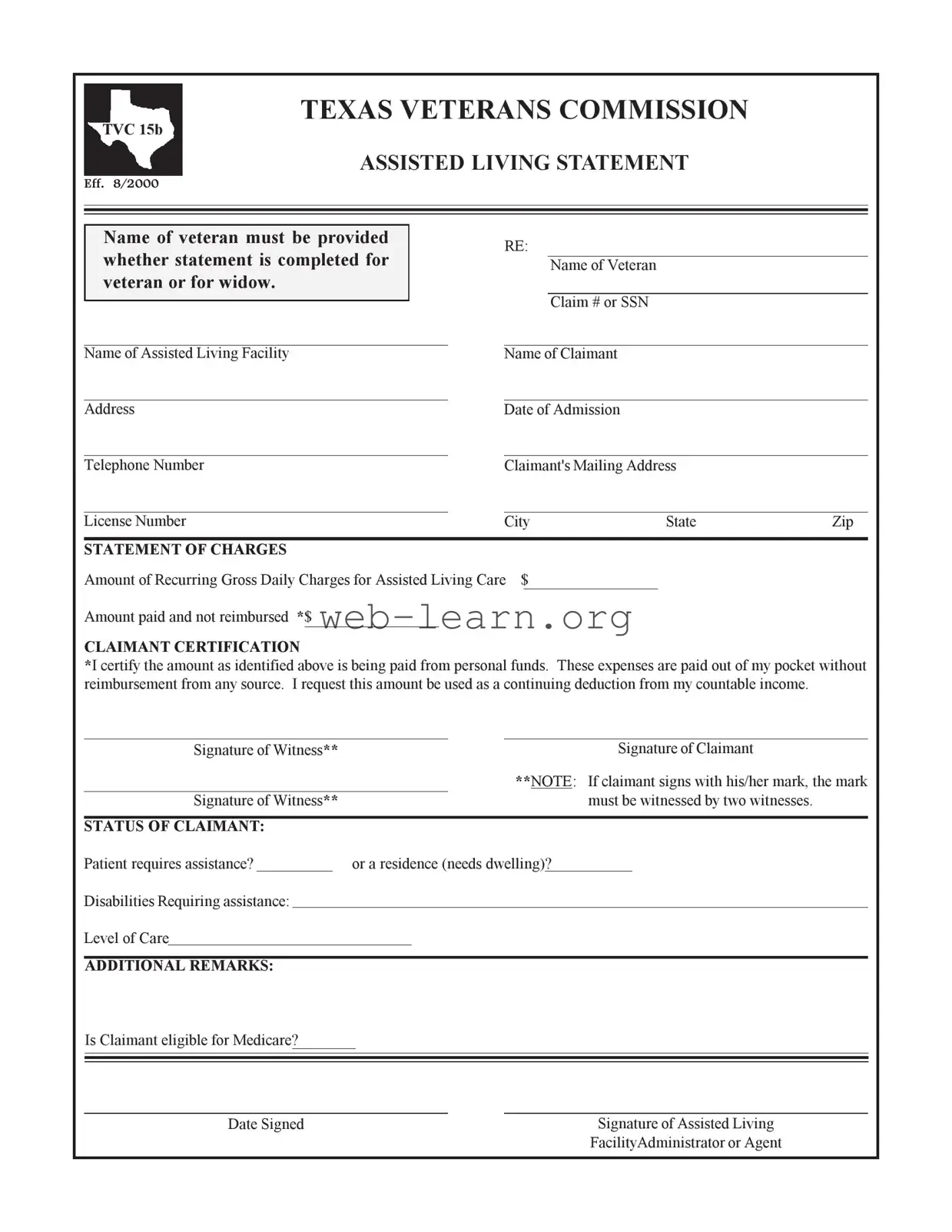
The Texas Veterans Commission form, specifically the TVC15b Assisted Living Statement, serves a vital purpose for veterans and their families navigating the complexities of assisted living care. This form requires essential information, including the name of the veteran or widow, the details of the assisted living facility, and the specific charges related to care. To ensure accuracy, the form asks for the veteran's claim number or Social Security number, along with the date of admission and the claimant's mailing address. A key aspect of the form is the Statement of Charges, where the amount of recurring daily charges for assisted living care is documented, along with any amounts paid that have not been reimbursed. Claimants must certify that these expenses are paid from personal funds, underscoring the importance of financial transparency. Additionally, the form requires signatures from both the claimant and a witness, ensuring that the information provided is verified. It also addresses the claimant's status, including whether they require assistance or a residence, and notes any disabilities that necessitate care. Lastly, there is a section for additional remarks and questions regarding Medicare eligibility, making this form a comprehensive tool for managing assisted living expenses for veterans.

TEXASVETERANSCOMMISSION
TVC15b
ASSISTEDLIVINGSTATEMENT
EFF. 8/2000
Name of veteran must be provided whether statement is completed for veteranorforwidow.
NameofAssistedLivingFacility
Address
TelephoneNumber
LicenseNumber
RE:
NameofVeteran
Claim#orSSN
NameofClaimant
DateofAdmission
Claimant'sMailingAddress
City State Zip
STATEMENTOFCHARGES
AmountofRecurringGrossDailyChargesforAssistedLivingCare $
Amountpaidandnotreimbursed *$
CLAIMANTCERTIFICATION
*Icertifytheamountasidentifiedaboveisbeingpaidfrompersonalfunds. Theseexpensesarepaidoutofmypocketwithout reimbursementfromanysource. Irequestthisamountbeusedasacontinuingdeductionfrommycountableincome.
|
SignatureofWitness** |
|
|
|
SignatureofClaimant |
||||
|
|
|
|
|
|
|
**NOTE: Ifclaimantsignswithhis/hermark,themark |
||
|
SignatureofWitness** |
|
|
|
mustbewitnessedbytwowitnesses. |
||||
|
|
|
|
|
|
|
|
|
|
STATUSOFCLAIMANT: |
|
|
|
|
|
||||
Patientrequiresassistance? |
|
|
oraresidence(needsdwelling)? |
||||||
|
|
|
|
|
|
|
|
|
|
DisabilitiesRequiringassistance: |
|
|
|
|
|
|
|||
LevelofCare |
|
|
|
|
|
||||
|
|
|
|
|
|
|
|
|
|
ADDITIONALREMARKS: |
|
|
|
|
|
||||
IsClaimanteligibleforMedicare?
DateSigned |
SignatureofAssistedLiving |
|
FacilityAdministratororAgent |
| Fact Name | Description |
|---|---|
| Form Title | The form is titled "TEXAS VETERANS COMMISSION TVC15b ASSISTED LIVING STATEMENT" and was last effective in August 2000. |
| Veteran Identification | It is mandatory to provide the name of the veteran, regardless of whether the statement is completed for the veteran or their widow. |
| Claimant Certification | The claimant must certify that the amount listed as charges is being paid from personal funds without reimbursement from any source. |
| Governing Law | This form is governed by Texas Administrative Code, Title 40, Part 1, Chapter 463, which pertains to the Texas Veterans Commission. |
To complete the Texas Veterans Commission form, follow these steps carefully. Ensure you have all necessary information at hand, including the veteran's details and the assisted living facility's information. This form must be filled out accurately to reflect the current status and charges related to the veteran's care.
What is the purpose of the Texas Veterans Commission form?
The Texas Veterans Commission form, specifically the TVC15b Assisted Living Statement, is designed to assist veterans or their widows in documenting the costs associated with assisted living care. This information is crucial for determining eligibility for benefits and for making necessary deductions from the claimant's countable income.
What information must be provided on the form?
The form requires several key pieces of information:
What does the claimant certification entail?
The claimant certification section requires the claimant to certify that the amount identified as being paid for assisted living care is from personal funds. This certification ensures that the expenses are not reimbursed by any other source, which is essential for the claim process. The claimant must sign the form, and if they use a mark instead of a signature, it must be witnessed by two individuals.
What should be included in the status of the claimant section?
This section asks whether the claimant requires assistance or if they need a residence. Additionally, it requires details about any disabilities that necessitate assistance and the level of care required. This information helps assess the specific needs of the claimant and ensures appropriate support is provided.
Is eligibility for Medicare relevant to this form?
Yes, the form includes a question regarding the claimant's eligibility for Medicare. This information is pertinent as it may affect the overall assessment of the claimant's financial situation and their eligibility for additional benefits. Providing accurate information here is essential for a comprehensive review of the claim.
Who must sign the form?
The form must be signed by the claimant and the administrator or agent of the assisted living facility. The signature of a witness is also required if the claimant signs with a mark. This ensures that there is proper validation of the information provided, which is critical for the processing of the claim.
Filling out the Texas Veterans Commission form can be a straightforward process, but mistakes often occur that can delay claims or lead to complications. One common error is failing to provide the veteran's name. Regardless of whether the statement is for the veteran or their widow, the veteran's name must always be included. Omitting this crucial detail can result in confusion and may slow down the processing of the form.
Another frequent mistake involves the address of the assisted living facility. It is essential to ensure that the address is complete and accurate. Missing or incorrect information can lead to issues in communication and verification, which are vital for the approval of claims.
People often overlook the telephone number and license number of the assisted living facility as well. These details are necessary for the Texas Veterans Commission to verify the facility's legitimacy and to ensure that all information is correct. Providing these numbers helps streamline the process and prevents delays.
When it comes to the statement of charges, many individuals make the mistake of not clearly stating the amount of recurring gross daily charges for assisted living care. This figure must be accurate and reflect the actual costs incurred. Inaccuracies in this section can lead to misunderstandings about the claim and may affect the amount of assistance provided.
Additionally, the certification section is often filled out incorrectly. Claimants must certify that the amount stated is being paid from personal funds without reimbursement from any source. Failing to complete this section correctly can lead to the rejection of the claim. It is important to read the certification statement carefully and ensure that it is completed as required.
Finally, many individuals neglect to have their signature witnessed appropriately. If a claimant signs with a mark, it is necessary for that mark to be witnessed by two individuals. Not adhering to this requirement can invalidate the signature and delay the claim process. Ensuring that all signatures are properly witnessed is a critical step in completing the form accurately.
The Texas Veterans Commission form is an essential document for veterans seeking assistance with assisted living costs. However, it is often accompanied by several other forms and documents that help streamline the application process and ensure all necessary information is collected. Below is a list of commonly used documents that may accompany the Texas Veterans Commission form.
Having these documents ready can significantly enhance the application process for veterans and their families. Each form plays a vital role in ensuring that all necessary information is submitted for a smooth review and approval of benefits.
Medicaid Application Form: Similar to the Texas Veterans Commission form, the Medicaid Application Form requires personal information about the applicant and their financial situation. Both documents aim to assess eligibility for assistance programs.
Social Security Administration (SSA) Disability Report: This report collects information about the applicant's medical condition and work history. Like the Texas Veterans Commission form, it is used to determine eligibility for benefits based on specific needs.
Veterans Affairs (VA) Form 21-526EZ: This form is for veterans applying for disability compensation. It requires detailed information about the veteran's service and health, similar to how the Texas Veterans Commission form requires information about the veteran's care needs.
Long-Term Care Insurance Claim Form: This document is used to request benefits for long-term care services. Both forms require a statement of charges and certification of payment, reflecting the financial obligations of the claimant.
Power of Attorney Form: A Power of Attorney allows someone to make decisions on behalf of another. Similar to the Texas Veterans Commission form, it often requires signatures and witness verification to ensure authenticity.
Assisted Living Facility Admission Agreement: This agreement outlines the terms of residency and care in an assisted living facility. Like the Texas Veterans Commission form, it includes details about the individual’s needs and financial arrangements.
Medicare Enrollment Application: This application is used to enroll in Medicare, requiring personal information and medical history. It serves a similar purpose in assessing eligibility for benefits based on healthcare needs.
Financial Assistance Application for Seniors: This document collects financial and personal information to determine eligibility for senior assistance programs. Both forms focus on the financial aspects of care and require detailed disclosures.
Home Health Care Service Agreement: This agreement outlines the terms of service for home health care. It shares similarities with the Texas Veterans Commission form in detailing the services required and the associated costs.
Disability Benefits Application: This application is used to apply for various disability benefits. Like the Texas Veterans Commission form, it requires comprehensive information about the claimant’s condition and financial situation.
When filling out the Texas Veterans Commission form, it's important to approach the task with care. Here are some essential do's and don'ts to keep in mind.
Understanding the Texas Veterans Commission form can be challenging due to various misconceptions. Here are seven common misunderstandings about this important document:
Some individuals believe that the veteran's name can be omitted if the form is for a widow. However, the veteran's name must always be provided, regardless of who is completing the form.
This form can also be completed by a claimant, such as a spouse or family member. The claimant must have the appropriate information to ensure accuracy.
The form specifically addresses assisted living charges, which may include a range of services beyond medical care, such as housing and personal assistance.
Many assume that expenses will be reimbursed by insurance or other sources. In reality, the form requires a certification that the expenses are paid from personal funds and are not reimbursed.
It is crucial for the claimant to sign the form. This signature certifies the accuracy of the information provided and the payment of expenses from personal funds.
For claimants who sign with a mark, it is mandatory to have two witnesses sign the form. This ensures the legitimacy of the claimant's signature.
While the form is often used for current residents, it can also be applicable for those who are planning to move into an assisted living facility in the near future.
By clarifying these misconceptions, individuals can better navigate the Texas Veterans Commission form and ensure that they provide accurate information for assistance.
When filling out and using the Texas Veterans Commission form, several key points should be kept in mind to ensure accurate completion and proper use.
Completing the Texas Veterans Commission form accurately is vital for ensuring that veterans and their families receive the support they need. Each section of the form plays a significant role in the overall assessment of the claim.