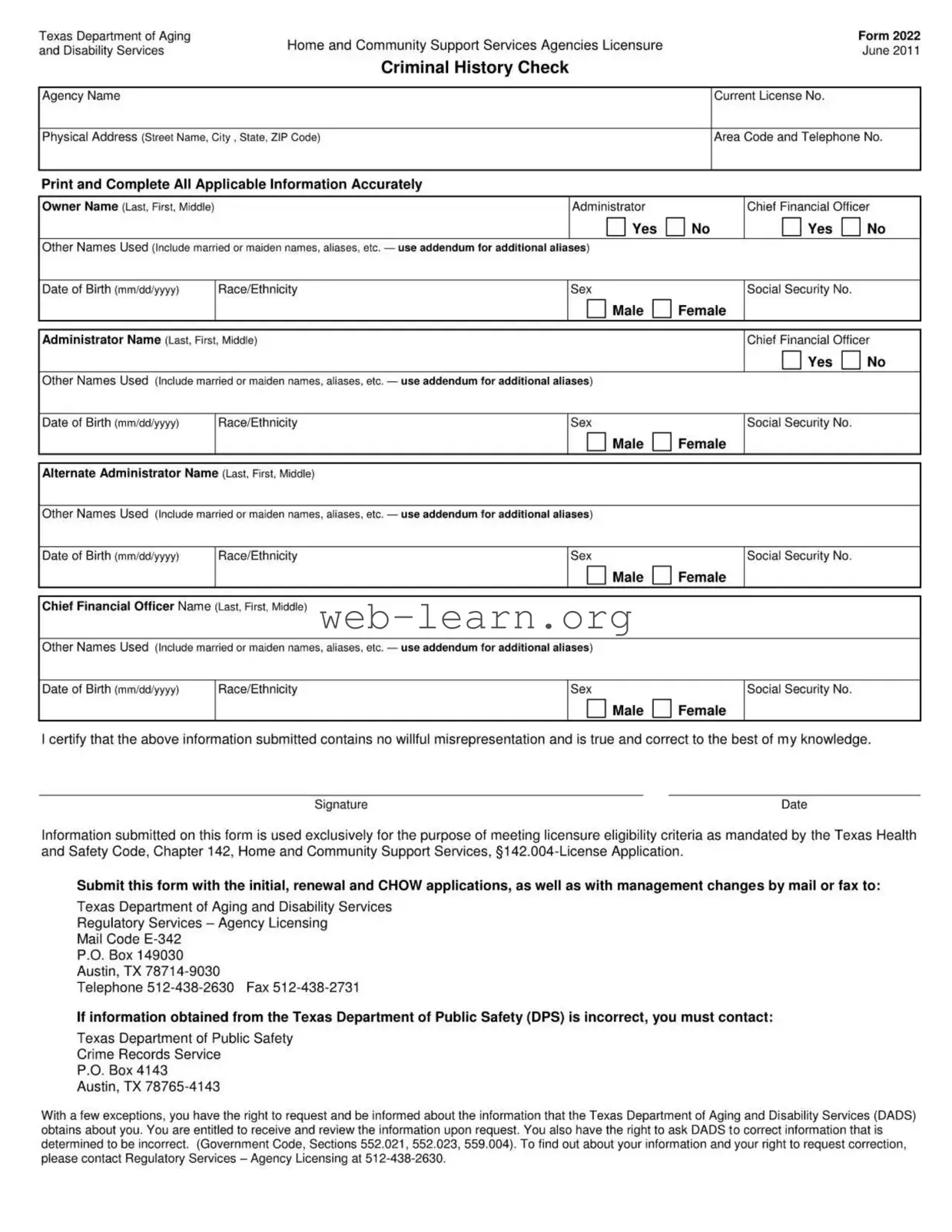
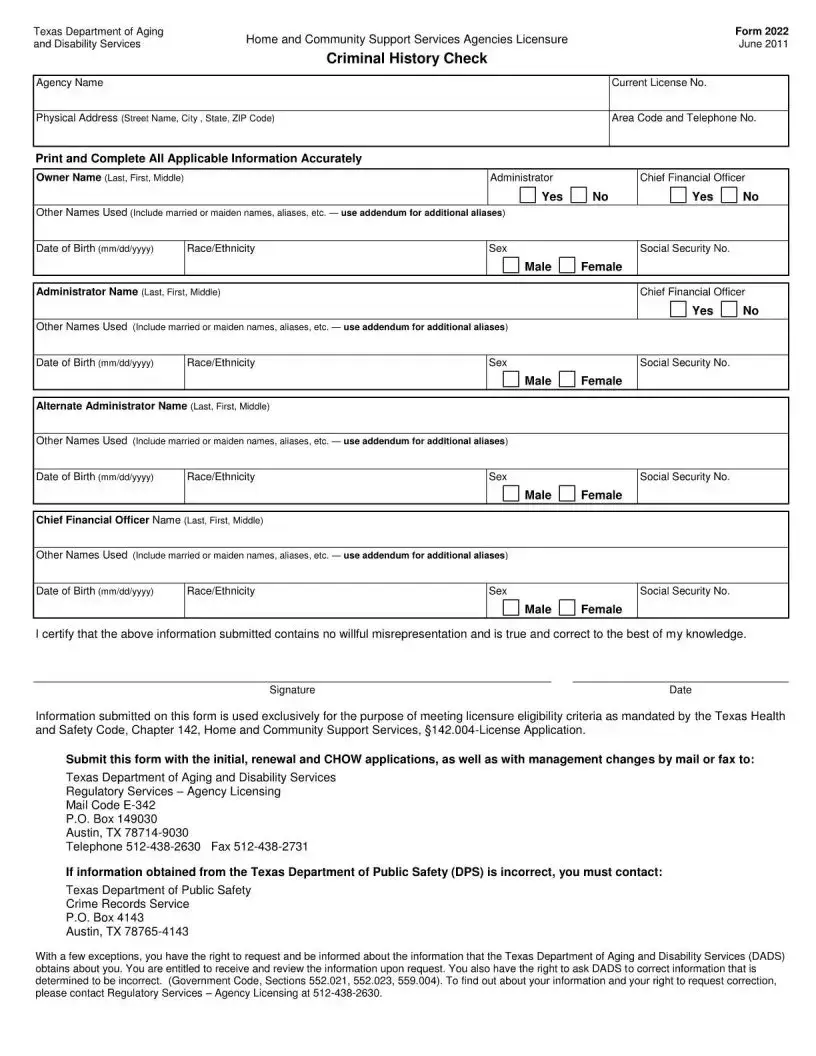
The Texas Department of Aging and Disability Services has established a vital framework for ensuring the integrity and safety of Home and Community Support Services Agencies through the use of the Criminal History Check Form. This form plays a crucial role in the licensure process, requiring detailed information from agency owners, administrators, and chief financial officers. Key aspects include personal identification details such as names, dates of birth, and social security numbers, as well as the disclosure of any aliases. The form also mandates a declaration of accuracy from the submitter, reinforcing the importance of truthful reporting. It is essential for applicants to submit this form alongside initial, renewal, and change of ownership applications, ensuring compliance with Texas Health and Safety Code regulations. By facilitating thorough background checks, the form aims to protect vulnerable populations and uphold the standards of care within the community. Furthermore, individuals have the right to access and correct their information, promoting transparency and accountability within the licensing process.
| Fact Name | Details |
|---|---|
| Governing Law | This form is governed by the Texas Health and Safety Code, Chapter 142. |
| Purpose | The form is used to meet licensure eligibility criteria for Home and Community Support Services Agencies. |
| Required Information | Applicants must provide accurate personal information, including names, dates of birth, and social security numbers. |
| Submission Methods | Forms can be submitted via mail or fax to the Texas Department of Aging and Disability Services. |
| Contact Information | For inquiries, contact the Texas Department of Aging and Disability Services at 512-438-2630. |
| Correction Rights | Individuals have the right to request correction of any incorrect information obtained by the agency. |
| Signature Requirement | A signature is required to certify that the information provided is true and correct. |
| Additional Names | Applicants must list any other names used, including married or maiden names and aliases. |
Filling out the Texas Criminal History Check Form requires careful attention to detail. Ensure that all information is accurate and complete. This form is essential for meeting licensure eligibility criteria. Follow these steps to fill out the form correctly.
What is the purpose of the Texas Criminal History Check Form?
The Texas Criminal History Check Form is designed to collect necessary information for licensure eligibility of Home and Community Support Services Agencies. This form ensures that individuals associated with these agencies meet the requirements set forth by the Texas Health and Safety Code.
Who needs to complete this form?
This form must be completed by key personnel within the agency, including the owner, administrator, alternate administrator, and chief financial officer. Each individual must provide personal information, including their name, date of birth, and any aliases used.
How should the form be submitted?
The completed form should be submitted along with initial, renewal, or change of ownership applications. You can send it by mail or fax to the Texas Department of Aging and Disability Services. The mailing address is:
Texas Department of Aging and Disability Services
Regulatory Services - Agency Licensing
Mail Code E-342
P.O. Box 149030
Austin, TX 78714-9030
For fax submissions, use 512-438-2731.
What rights do I have regarding the information submitted?
You have the right to request and be informed about the information that the Texas Department of Aging and Disability Services obtains about you. If any information is incorrect, you can ask for corrections. For inquiries, contact Regulatory Services - Agency Licensing at 512-438-2630.
Filling out the Texas Criminal History Check Form can be a straightforward process, but many individuals make common mistakes that can delay their application or lead to complications. One significant error is failing to provide complete and accurate information. Each section of the form requires specific details, such as names, dates of birth, and social security numbers. Omitting any of this information can result in the form being rejected or returned for corrections.
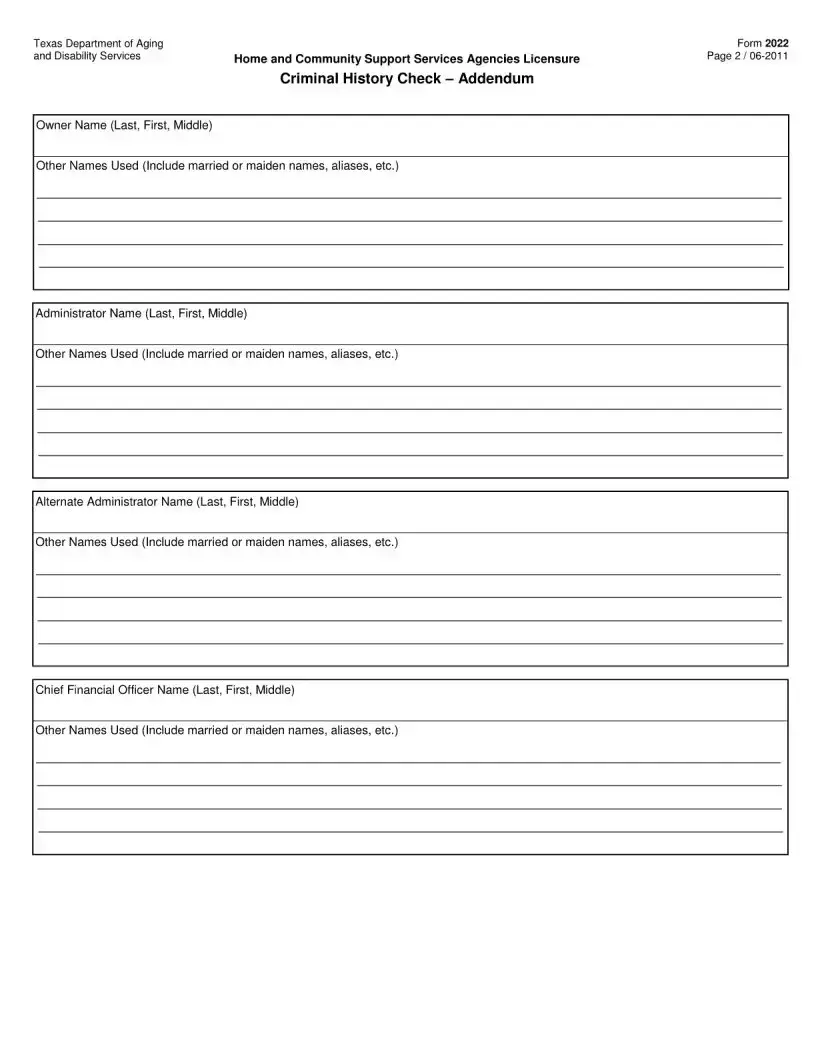
Another frequent mistake is neglecting to include all names used by the individual. This includes maiden names, aliases, and any other variations. When applicants do not list these names, it can create confusion during the background check process. It’s essential to be thorough in this section to ensure that all records are accounted for.
People often overlook the importance of signing and dating the form. This certification is a crucial step that verifies the accuracy of the information provided. Without a signature, the form is incomplete, and the application may not be processed. Additionally, failing to date the form can lead to questions about when the information was submitted, causing further delays.
Many applicants also mistakenly assume that their contact information is optional. Providing a current telephone number and physical address is essential for follow-up communications. If there are any issues or questions regarding the application, the licensing agency needs a way to reach the applicant quickly.
Another common error is misunderstanding the requirements for the chief financial officer section. Some individuals may think that they can skip this part if they are not the CFO themselves. However, the form requires information for all relevant positions, and failing to include this can lead to complications in the licensing process.
In addition, applicants sometimes forget to check for typos or errors before submitting the form. Simple mistakes, such as incorrect spellings of names or wrong dates, can cause significant issues. Taking a moment to review the form can save time and prevent unnecessary back-and-forth with the licensing agency.
Lastly, many individuals do not keep a copy of the submitted form. This can be problematic if there are questions or if the agency requests clarification later. Keeping a record ensures that applicants have all the information readily available for future reference. By avoiding these common mistakes, individuals can help ensure a smoother application process.
The Texas Department of Aging and Disability Services requires several forms and documents to ensure compliance with licensing regulations for Home and Community Support Services Agencies. Alongside the Criminal History Check Form, there are other important documents that play a vital role in the licensing process. Here are five such documents commonly used in conjunction with the Texas form.
These documents, along with the Texas Criminal History Check Form, are critical for maintaining the integrity and safety of services provided by Home and Community Support Services Agencies. Proper completion and submission of these forms help ensure compliance with state laws and regulations.
When filling out the Texas form for the Department of Aging and Disability Services, it’s essential to be thorough and accurate. Here are five helpful tips to keep in mind:
By following these guidelines, you can help ensure that your application is processed smoothly and efficiently. Good luck with your submission!
This form is required not only for new applicants but also for license renewals and management changes. It's essential for maintaining compliance with state regulations.
All key personnel, including administrators and chief financial officers, must provide their information on the form. This ensures a comprehensive background check.
Submitting false information can lead to severe consequences, including denial of licensure. Accuracy is crucial for compliance.
While criminal history is a component, the form also collects personal information such as names, dates of birth, and contact details to verify eligibility.
The form must be submitted by mail or fax to the Texas Department of Aging and Disability Services. Email submissions are not accepted.
If you find that the information is incorrect, you have the right to request corrections. It's important to act quickly to ensure compliance.
Even if you are not a Texas resident, if you are involved in a business that provides services in Texas, you may still need to complete this form.
All home and community support services agencies must complete this form as part of the licensure process, regardless of their size or type.
This form must be completed for each application, renewal, or management change. Keeping it updated is essential for ongoing compliance.
The Texas Department of Aging and Disability Services is required to protect your personal information. You have the right to know what information they collect and request corrections if needed.
When completing the Texas Department of Aging and Disability Services Criminal History Check Form, consider the following key takeaways: