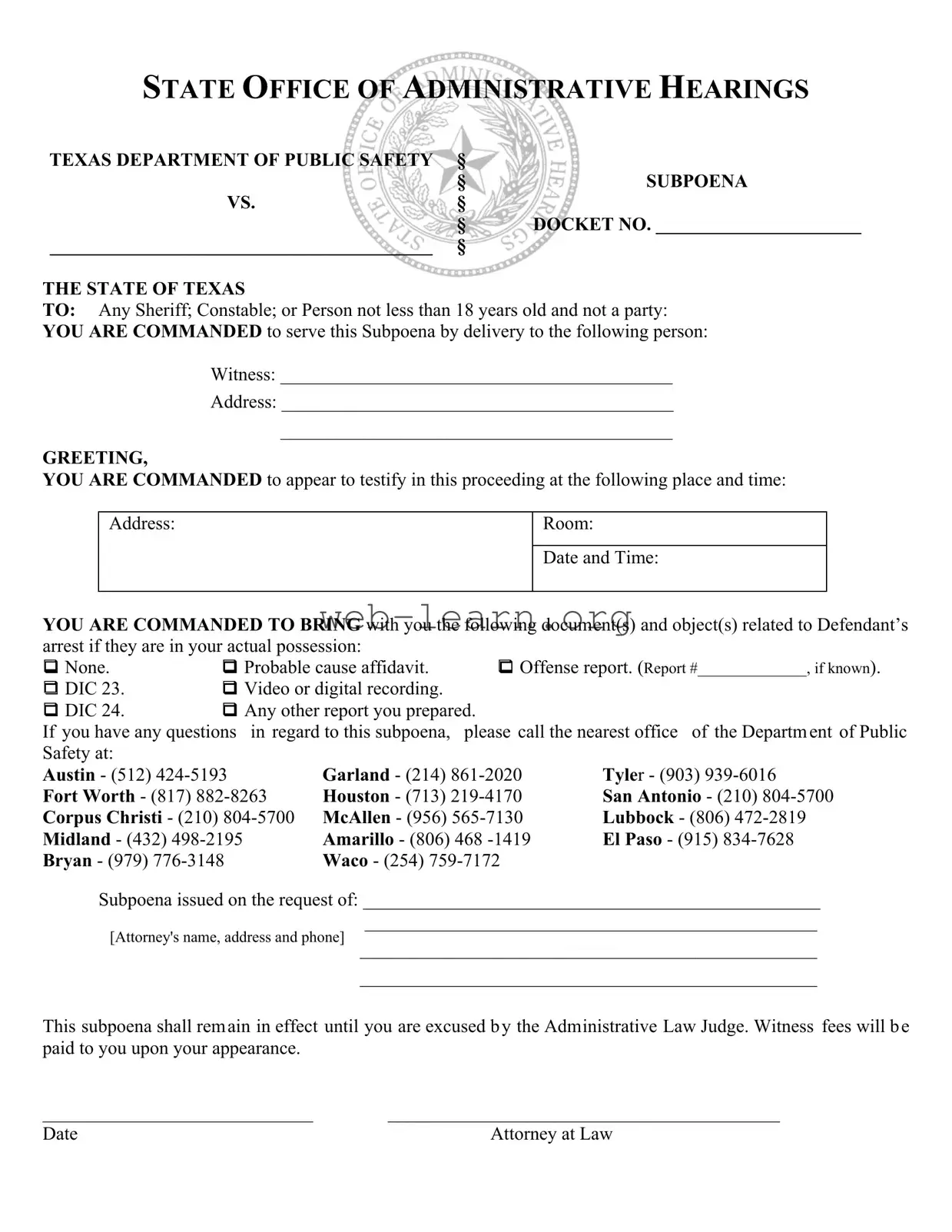
The Texas Subpoena form is a crucial legal document that facilitates the process of compelling witnesses to appear in administrative hearings. This form is issued by the State Office of Administrative Hearings and is directed to individuals such as sheriffs, constables, or any person over 18 who is not a party to the case. It contains essential details, including the name and address of the witness, the time and location for their required appearance, and specific documents or objects that must be brought to the hearing. Notably, the subpoena outlines the types of evidence needed, such as probable cause affidavits, offense reports, and any video or digital recordings related to the defendant's arrest. The form also includes contact information for various offices of the Texas Department of Public Safety, providing a resource for individuals with questions about the subpoena. Additionally, the document specifies that witness fees will be paid upon appearance and remains in effect until the Administrative Law Judge excuses the witness. Proper completion of the form ensures that all parties are informed and prepared for the proceedings.
STATE OFFICE OF ADMINISTRATIVE HEARINGS
TEXAS DEPARTMENT OF PUBLIC SAFETY §
§SUBPOENA
VS.§
§ DOCKET NO. ______________________
_________________________________________ §
THE STATE OF TEXAS
TO: Any Sheriff; Constable; or Person not less than 18 years old and not a party: YOU ARE COMMANDED to serve this Subpoena by delivery to the following person:
Witness: __________________________________________
Address: __________________________________________
__________________________________________
GREETING,
YOU ARE COMMANDED to appear to testify in this proceeding at the following place and time:
Address:
Room:
Date and Time:
YOU ARE COMMANDED TO BRING with you the following document(s) and object(s) related to Defendant’s arrest if they are in your actual possession:
None. |
Probable cause affidavit. |
Offense report. (Report #______________, if known). |
DIC 23. |
Video or digital recording. |
|
DIC 24. |
Any other report you prepared. |
|
If you have any questions in regard to this subpoena, please call the nearest office of the Department of Public Safety at:
Austin - (512) |
Garland - (214) |
Tyler - (903) |
Fort Worth - (817) |
Houston - (713) |
San Antonio - (210) |
Corpus Christi - (210) |
McAllen - (956) |
Lubbock - (806) |
Midland - (432) |
Amarillo - (806) 468 |
El Paso - (915) |
Bryan - (979) |
Waco - (254) |
|
Subpoena issued on the request of: _________________________________________________
[Attorney's name, address and phone] |
_________________________________________________ |
_________________________________________________ |
|
|
_________________________________________________ |
This subpoena shall remain in effect until you are excused by the Administrative Law Judge. Witness fees will be paid to you upon your appearance.
_____________________________ |
__________________________________________ |
Date |
Attorney at Law |

RETURN TO
THE STATE OFFICE OF ADMINISTRATIVE HEARINGS
___________________________________________________________________________________________
Defendant Name:______________________________ SOAH Docket No.: ______________________________
Date of Hearing:____________________ Officer/Witness Name: _____________________________________
[This Information must be completed]
___________________________________________________________________________________________
CERTIFICATE OF SERVICE
___________________________________________________________________________________________
I received this subpoena for service on ____________________________ at _____________ (A.M.) (P.M.).
I executed this subpoena by de livering a copy to _________________________________________________ in
person at ______________________________________________ on ___________________ at ________
(A.M.) (P.M.).
Any and all fees and costs incurred for service of this subpoena were submitted to the requesting Party for payment.
|
|
|
I declare the foregoing is true and correct: |
|
Date: ______________________________________ |
Signed: ____________________________________ |
|||
Name: _____________________________________ |
||||
|
|
|
||
|
|
|
Address: ___________________________________ |
|
|
|
|
___________________________________________ |
|
|
|
|
___________________________________________ |
|
Copies to: |
(1) |
Texas Department of Public Safety |
|
|
|
(2) |
Defendant or Attorney |
|
|
___________________________________________________________________________________________
ACCEPTANCE OF SERVICE
___________________________________________________________________________________________
I acknowledge that I received and accep ted service of this S ubpoena at __________________________________
on _________________ at ___________(A.M.) (P.M.). I further understand my legal obligation to appear at
the hearing. |
|
____________________________________________ |
______________________________________ |
Date |
Witness signature |
| Fact Name | Details |
|---|---|
| Governing Law | The Texas Subpoena form is governed by Texas Government Code § 2001.051. |
| Issuing Authority | The form is issued by the State Office of Administrative Hearings (SOAH) and the Texas Department of Public Safety. |
| Delivery Requirement | The subpoena must be served by a sheriff, constable, or any person who is at least 18 years old and not a party to the case. |
| Witness Appearance | The subpoena commands the witness to appear and testify at a specified time and place. |
| Document Production | Witnesses are required to bring specific documents related to the defendant's arrest, such as the probable cause affidavit and offense report. |
| Contact Information | The form provides contact numbers for various Texas Department of Public Safety offices for any inquiries. |
| Witness Fees | Witness fees will be paid upon appearance, ensuring compensation for the time spent. |
| Certificate of Service | A certificate of service section is included, documenting the delivery of the subpoena to the witness. |
Filling out the Texas Subpoena form requires careful attention to detail. This process ensures that all necessary information is accurately recorded, facilitating the legal proceedings that follow. Below are the steps to complete the form effectively.
Once the form is completed, it should be served to the witness as instructed. This ensures that they are legally notified of their obligation to appear in court. It is essential to keep copies of the completed form for your records and to provide necessary copies to relevant parties, such as the Texas Department of Public Safety and the defendant or their attorney.
What is a Texas Subpoena?
A Texas Subpoena is a legal document that commands an individual to appear in court or at a specified hearing to provide testimony or produce evidence. This document is often issued in administrative hearings and is crucial for gathering information relevant to a case. It ensures that witnesses and relevant parties can be legally compelled to participate in the proceedings, which helps maintain the integrity of the judicial process.
Who can be served with a Texas Subpoena?
Any person who is at least 18 years old and not a party to the case can be served with a Texas Subpoena. This includes witnesses, law enforcement officers, and other individuals who may have information pertinent to the case. It's important to note that the subpoena must be delivered by a sheriff, constable, or another authorized individual to ensure it is valid and enforceable.
What should I do if I receive a Texas Subpoena?
If you receive a Texas Subpoena, it is essential to take it seriously. First, read the document carefully to understand the date, time, and location where you are required to appear. You should also note any documents or evidence you are commanded to bring with you. If you have questions or need clarification, contact the nearest office of the Texas Department of Public Safety as listed on the subpoena. Ignoring a subpoena can lead to legal consequences, so it’s crucial to comply with its requirements.
Will I be compensated for my time?
Yes, if you are required to appear as a witness, you will be paid witness fees upon your appearance. These fees are typically set by law and are meant to compensate you for your time and any expenses incurred while attending the hearing. Make sure to keep any receipts or documentation related to your attendance, as this may be necessary for reimbursement purposes.
Filling out the Texas Subpoena form can be straightforward, but many people make common mistakes that can lead to complications. One frequent error is leaving the docket number blank. This number is essential for identifying the specific case related to the subpoena. Without it, the subpoena may not be valid, and the recipient could be confused about which case they are being summoned for.
Another mistake involves not providing complete information about the witness. The form requires a full name and address. Omitting any part of this information can hinder the process of serving the subpoena. It is crucial to ensure that all details are accurate to avoid delays.
Some individuals fail to specify the date and time of the hearing. This information is critical as it informs the witness when they need to appear. Leaving this section incomplete can lead to misunderstandings and missed appearances, which may have legal consequences.
Additionally, people often neglect to list the documents or objects that the witness must bring. The form includes a section for this purpose. If this section is left blank or improperly filled out, the witness may not bring the necessary materials, potentially affecting the outcome of the hearing.
Another common issue is incorrect contact information for the attorney requesting the subpoena. Providing an outdated or incorrect phone number can prevent the witness from reaching out with questions or concerns. Clear communication is vital in legal proceedings.
Some individuals also forget to sign and date the subpoena. This step is essential for validating the document. Without a signature, the subpoena may not be enforceable, leading to further complications.
In some cases, people do not include the certificate of service section, which confirms that the subpoena was delivered to the witness. This section is important for maintaining a record of service and ensuring that all parties are aware of the subpoena's issuance.
Lastly, individuals may overlook the acceptance of service section. This part confirms that the witness acknowledges receiving the subpoena and understands their obligation to appear. Failing to complete this section can lead to confusion and potential legal issues down the line.
When dealing with a Texas Subpoena form, several other documents may also be required to support the legal process. Here’s a brief overview of these related forms.
These documents play a crucial role in the legal process surrounding a subpoena. Each one serves a specific purpose, ensuring that all parties are informed and that the proceedings run smoothly.
When filling out the Texas Subpoena form, it is important to follow certain guidelines to ensure accuracy and compliance. Here is a list of things you should and shouldn't do:
Understanding the Texas Subpoena form can be challenging, and many misconceptions exist. Here are ten common misunderstandings:
Being informed about these misconceptions can help individuals better navigate the legal landscape surrounding subpoenas in Texas.
When filling out and using the Texas Subpoena form, several important considerations should be kept in mind: