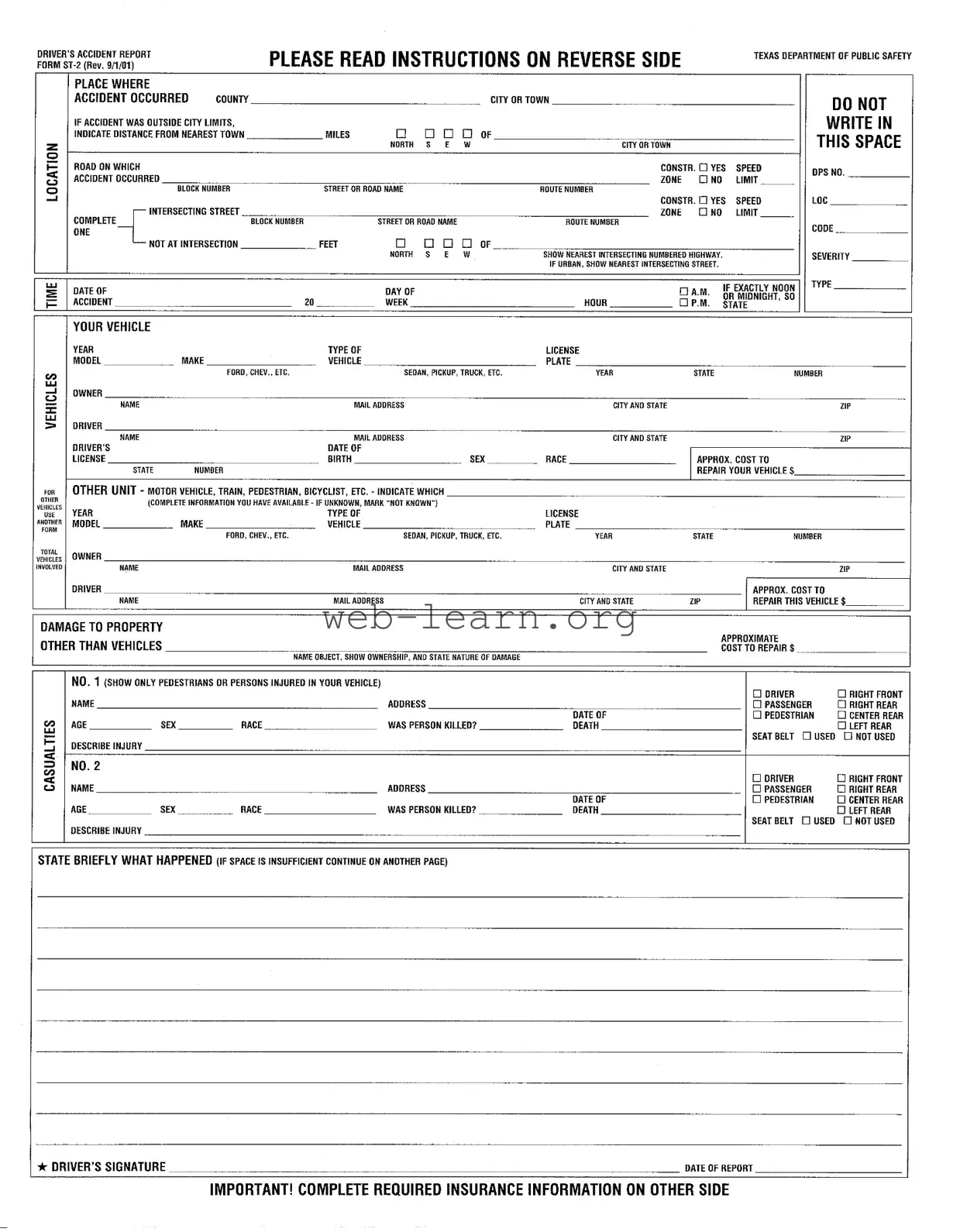
Homepage Blank Texas St 2 Form
Outline

The Texas St 2 form, officially known as the Driver’s Accident Report Form, serves a critical role in documenting motor vehicle accidents that occur within the state. It is specifically designed for use when an accident results in injury, death, or property damage exceeding $1,000, and it must be submitted within ten days of the incident if no law enforcement officer investigates the scene. This form collects essential information, including the location of the accident, details about the vehicles involved, and the identities of the drivers and any injured parties. It requires the driver to provide a narrative description of the accident, which aids in understanding the circumstances surrounding the event. Additionally, the form includes sections for insurance information, ensuring compliance with Texas motor vehicle laws. Completing this form accurately is vital, as it not only facilitates the processing of claims but also helps maintain safety and accountability on the roads. The instructions provided on the form guide users in filling it out correctly, emphasizing the importance of clarity and completeness to avoid the need for supplemental reports.
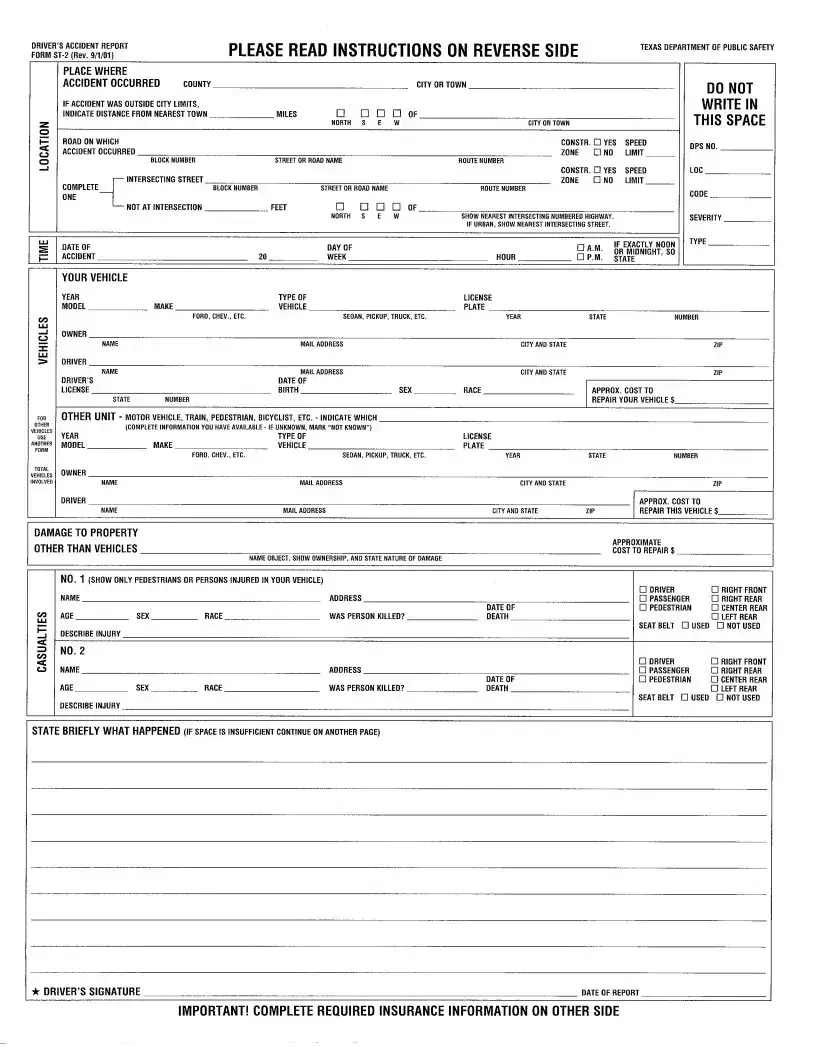
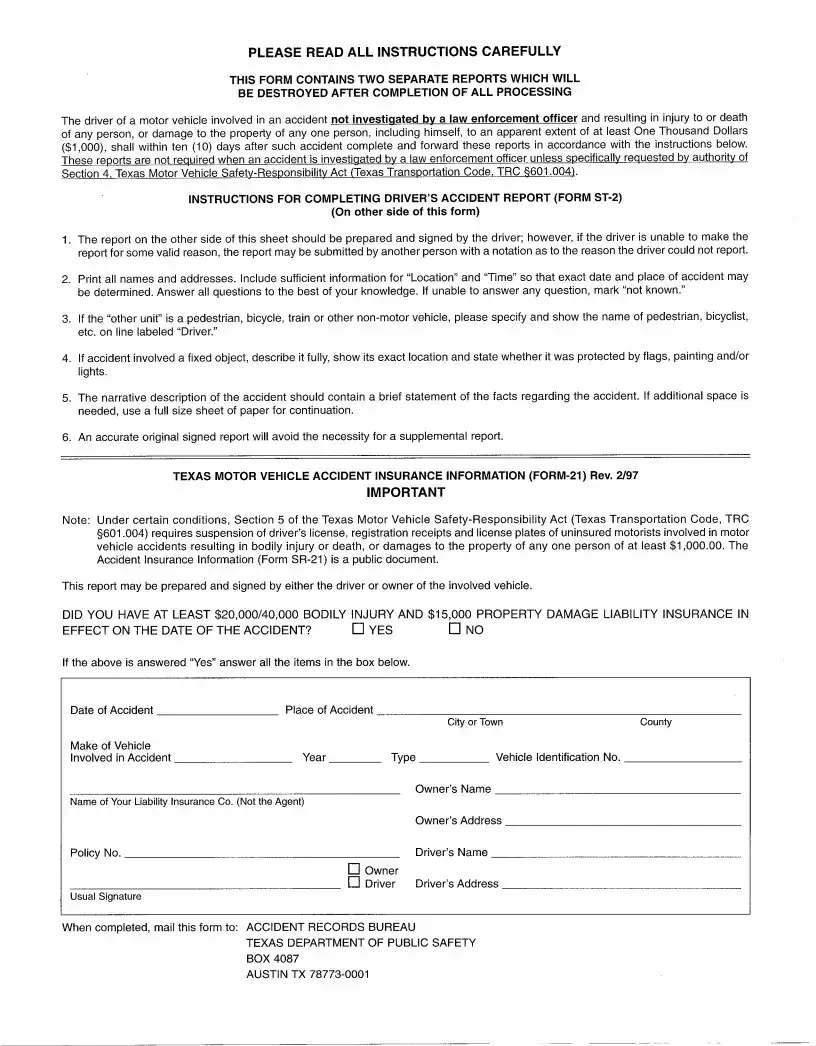
Sample - Texas St 2 Form

Form Information

Fact Name Description
Form Title Driver’s Accident Report Form ST-2
Revision Date Revised on September 1, 2001
Governing Law Texas Transportation Code, TRC §601.004
Filing Requirement Must be submitted within ten days of the accident if not investigated by law enforcement.
Damage Threshold Report required for damages of at least $1,000.
Signature Requirement The driver must sign the report, or another person may sign with a valid reason noted.
Insurance Information Must confirm if liability insurance was in effect at the time of the accident.
Additional Reports A supplemental report may be needed if the original is not accurate.

Detailed Guide for Filling Out Texas St 2

Completing the Texas St 2 form is an important step after being involved in a motor vehicle accident. This form must be filled out accurately and submitted within ten days if the accident meets certain criteria. Follow the steps below to ensure you provide all necessary information clearly and correctly.

  1. Begin by filling in the place where the accident occurred. Include the county, city or town, and the distance from the nearest town if the accident was outside city limits.
  2. Next, indicate the road on which the accident occurred, including the street or road name and route number. Specify if the accident was at an intersection or not.
  3. Provide the date of the accident, including the year, day of the week, and the time (A.M. or P.M.).
  4. Fill in details about your vehicle, including the year, model, make, type, and license plate number.
  5. Enter the owner's information, including the name, address, city, state, and ZIP code.
  6. Complete the driver's information, including their name, date of birth, sex, race, and driver's license number.
  7. Estimate the approximate cost to repair your vehicle and provide this amount.
  8. If there were other vehicles involved, complete a separate form for each vehicle, providing similar information.
  9. List any other units involved in the accident, such as pedestrians or cyclists, and fill in their details as required.
  10. Describe any injuries sustained by passengers or pedestrians, including their names, ages, and whether they were killed or used seat belts.
  11. In the narrative section, briefly describe what happened during the accident. If you need more space, continue on another page.
  12. Sign and date the report at the bottom of the form.
  13. Complete the required insurance information on the reverse side of the form.
  14. Once everything is filled out, mail the completed form to the address provided at the bottom of the document.

Obtain Answers on Texas St 2

  1. What is the Texas St 2 form?

    The Texas St 2 form, also known as the Driver’s Accident Report Form, is a document that must be completed by drivers involved in motor vehicle accidents that result in injury, death, or property damage exceeding $1,000. This form is necessary when an accident is not investigated by law enforcement. It serves as a record of the accident details and is submitted to the Texas Department of Public Safety.

  2. When do I need to submit the Texas St 2 form?

    You must submit the Texas St 2 form within ten days of the accident if:

    • The accident resulted in injury to or death of any person.
    • There was damage to property, including your own, totaling at least $1,000.

    If a law enforcement officer investigates the accident, you typically do not need to submit this form unless specifically requested.

  3. How do I complete the Texas St 2 form?

    To complete the form, follow these steps:

    • Provide accurate details about the accident location, time, and date.
    • Fill in information about all vehicles involved, including make, model, and license plate numbers.
    • Include details about any injuries sustained and whether seat belts were used.
    • Describe the accident in a brief narrative, noting any contributing factors.
    • Ensure the form is signed by the driver or another person if the driver is unable to report.
  4. What if I don’t know some of the information required on the form?

    If you are unsure about certain details, it is acceptable to mark those sections as “not known.” It is important to provide as much information as you can, but do not guess or provide inaccurate data.

  5. Where do I send the completed Texas St 2 form?

    Once you have completed the Texas St 2 form, mail it to the following address:

    ACCIDENT RECORDS BUREAU
    TEXAS DEPARTMENT OF PUBLIC SAFETY
    BOX 4087
    AUSTIN, TX 78773-0001

    Make sure to send the form promptly to comply with the ten-day submission requirement.

Common mistakes

Completing the Texas St 2 form accurately is essential for ensuring that all necessary information is recorded and processed correctly. One common mistake people make is failing to provide complete information regarding the location of the accident. It is crucial to specify the exact county and any relevant distances from nearby towns or landmarks. Omitting this information can lead to delays in processing the report.

Another frequent error involves neglecting to include details about the vehicles involved in the accident. This includes not only the make, model, and year but also the license plate numbers. Incomplete vehicle information can hinder the investigation and may lead to complications in insurance claims. Always double-check that all relevant vehicle details are filled out accurately.

Many individuals also overlook the importance of describing the accident's circumstances. The narrative section should provide a clear and concise account of what happened. Failing to include sufficient details can result in misunderstandings or misinterpretations of the events leading up to the accident. If more space is needed, it is advisable to use an additional sheet to ensure a thorough explanation is provided.

Additionally, people often forget to sign the form before submission. The driver's signature is a critical component of the report, as it validates the information provided. Without a signature, the form may be deemed incomplete, leading to further complications. Always ensure that the signature is included and that it matches the name on the form.

Lastly, neglecting to provide insurance information is a significant oversight. The form requires specific details about the insurance coverage in effect at the time of the accident. Failing to provide this information can have serious repercussions, including potential legal consequences. It is essential to review the insurance section carefully and provide all requested details to avoid any issues.

Documents used along the form

When filing a Driver's Accident Report Form ST-2 in Texas, several additional forms and documents may be necessary to complete the process. Each of these documents serves a specific purpose and helps ensure that all relevant information is accurately reported and processed. Below is a list of commonly used forms alongside the ST-2.

  • Texas Motor Vehicle Accident Insurance Information (Form SR-21): This form is essential for reporting insurance details related to the accident. It must indicate whether the driver had the required liability insurance at the time of the incident. The information collected helps determine compliance with state insurance laws.
  • Texas Peace Officer's Crash Report (Form CR-3): If law enforcement investigates the accident, this report is typically completed by the officer on the scene. It provides an official account of the accident, including details about the vehicles, drivers, and any citations issued.
  • Driver's License Information: A copy of the driver's license may be required to verify the identity of the individuals involved in the accident. This document ensures that all parties are accurately identified in the reports.
  • Vehicle Registration: Proof of vehicle registration may be necessary to confirm ownership of the vehicles involved in the accident. This document helps establish liability and insurance coverage.
  • Medical Records or Reports: If injuries occurred as a result of the accident, medical documentation may be needed to support claims for damages. This information can be crucial for insurance purposes and potential legal actions.
  • Witness Statements: Statements from individuals who witnessed the accident can provide additional perspectives on the event. These statements can be valuable in establishing the facts of the case.

Collecting and submitting these documents along with the Texas St 2 form can facilitate a smoother claims process and ensure compliance with state regulations. It is important to keep copies of all submitted documents for personal records.

Similar forms

The Texas St 2 form is a document used to report motor vehicle accidents. It shares similarities with other forms used in similar contexts. Here are ten documents that are comparable to the Texas St 2 form:

  • SR-21 Form: This form is also used in Texas to report insurance information following an accident. Like the Texas St 2, it requires details about the vehicles involved and the parties' insurance coverage.
  • DMV Accident Report: Many states have their own versions of an accident report form. These documents typically ask for similar information, such as the date, location, and parties involved in the accident.
  • Police Report: When law enforcement investigates an accident, they create a report. This document often contains details about the accident, witness statements, and any citations issued, similar to the narrative section in the Texas St 2 form.
  • Insurance Claim Form: This form is used to file a claim with an insurance company after an accident. It requires details about the accident and damages, much like the Texas St 2 form.
  • Accident Investigation Report: Conducted by insurance companies or other entities, this report summarizes the findings of an accident investigation. It includes information similar to that found on the Texas St 2 form.
  • Vehicle Damage Report: This document details the extent of damage to vehicles involved in an accident. It often includes similar information regarding the vehicles and their owners.
  • Medical Report: When injuries occur in an accident, medical reports document the injuries sustained. These reports complement the information provided in the Texas St 2 form regarding injuries.
  • Witness Statement Form: This form collects statements from witnesses of an accident. It often includes details about the accident that align with the narrative section of the Texas St 2 form.
  • Personal Injury Claim Form: This form is used to claim compensation for injuries sustained in an accident. It requires detailed information about the accident, similar to the Texas St 2 form.
  • Traffic Collision Report: Some jurisdictions have a specific report for traffic collisions. This document gathers similar information about the accident, including location, involved parties, and circumstances.

Dos and Don'ts

When filling out the Texas St 2 form, it is essential to approach the task with care and attention to detail. Below are some recommendations on what to do and what to avoid to ensure the form is completed correctly.

  • Do read all instructions carefully before starting to fill out the form.
  • Do provide accurate and complete information, especially regarding the accident's location and time.
  • Do print all names and addresses clearly to avoid any confusion.
  • Do include a brief narrative description of the accident, focusing on the facts.
  • Don't leave any required fields blank; if you do not know an answer, mark it as “not known.”
  • Don't submit the form without the driver's signature unless there is a valid reason for someone else to submit it.
  • Don't forget to include insurance information as required on the other side of the form.
  • Don't rush through the process; take your time to ensure all information is accurate and complete.

By adhering to these guidelines, you can help ensure that the Texas St 2 form is filled out correctly, facilitating the processing of your accident report.

Misconceptions

Understanding the Texas St 2 form is crucial for anyone involved in a motor vehicle accident. However, several misconceptions can lead to confusion. Here are nine common misunderstandings about this important document:

  • The Texas St 2 form is only for accidents involving injuries. Many believe this form is only necessary if someone is hurt. In reality, it must be completed if there is property damage exceeding $1,000, regardless of injuries.
  • You only need to submit the form if law enforcement is not present. This is not entirely true. Even if a police officer investigates the accident, the form may still be required under certain circumstances.
  • Only the driver can fill out the form. While the driver is typically responsible for completing the form, someone else can submit it if the driver is unable to do so for a valid reason.
  • The form is optional if you have insurance. This is incorrect. If the accident meets the reporting criteria, completing and submitting the form is mandatory, regardless of insurance status.
  • All information must be known to complete the form. While providing accurate details is important, if some information is unknown, you can simply mark it as "not known."
  • You can submit the form anytime after the accident. There is a strict deadline. The form must be submitted within ten days of the accident to comply with Texas law.
  • Only one form is needed for multiple vehicles involved. This is a misconception. Each vehicle involved in the accident requires its own form to be filled out.
  • Descriptions of the accident can be vague. A clear and concise narrative is crucial. The description should include specific details about the accident to avoid confusion during processing.
  • Once submitted, the form cannot be changed. If you find an error after submission, you can submit a supplemental report to correct any inaccuracies.

By understanding these misconceptions, you can ensure that you complete the Texas St 2 form correctly and fulfill your legal obligations following an accident.

Key takeaways

When filling out and using the Texas St 2 form, several key points should be kept in mind to ensure accuracy and compliance.

  • Accurate Information: Provide precise details regarding the accident location, including the county, city, and specific road names.
  • Timely Submission: Submit the completed form within ten days of the accident if it resulted in injury, death, or property damage exceeding $1,000.
  • Driver's Responsibility: The driver involved in the accident should ideally complete and sign the report. If unable, another person can submit it with a valid reason noted.
  • Detailing the Accident: Include a brief narrative describing the accident. If more space is needed, attach an additional sheet.
  • Insurance Information: Complete the required insurance section on the form to avoid potential penalties related to uninsured motorists.
  • Other Units: If a non-motor vehicle, such as a pedestrian or bicycle, was involved, specify this clearly and provide their details.
  • Complete All Sections: Answer every question to the best of your knowledge. If unsure, indicate “not known” rather than leaving it blank.
  • Accurate Reporting: A well-completed original report minimizes the need for follow-up or supplemental reports, streamlining the processing of the accident.

Following these guidelines can help ensure that the Texas St 2 form is filled out correctly and submitted on time, aiding in the efficient handling of the accident report process.