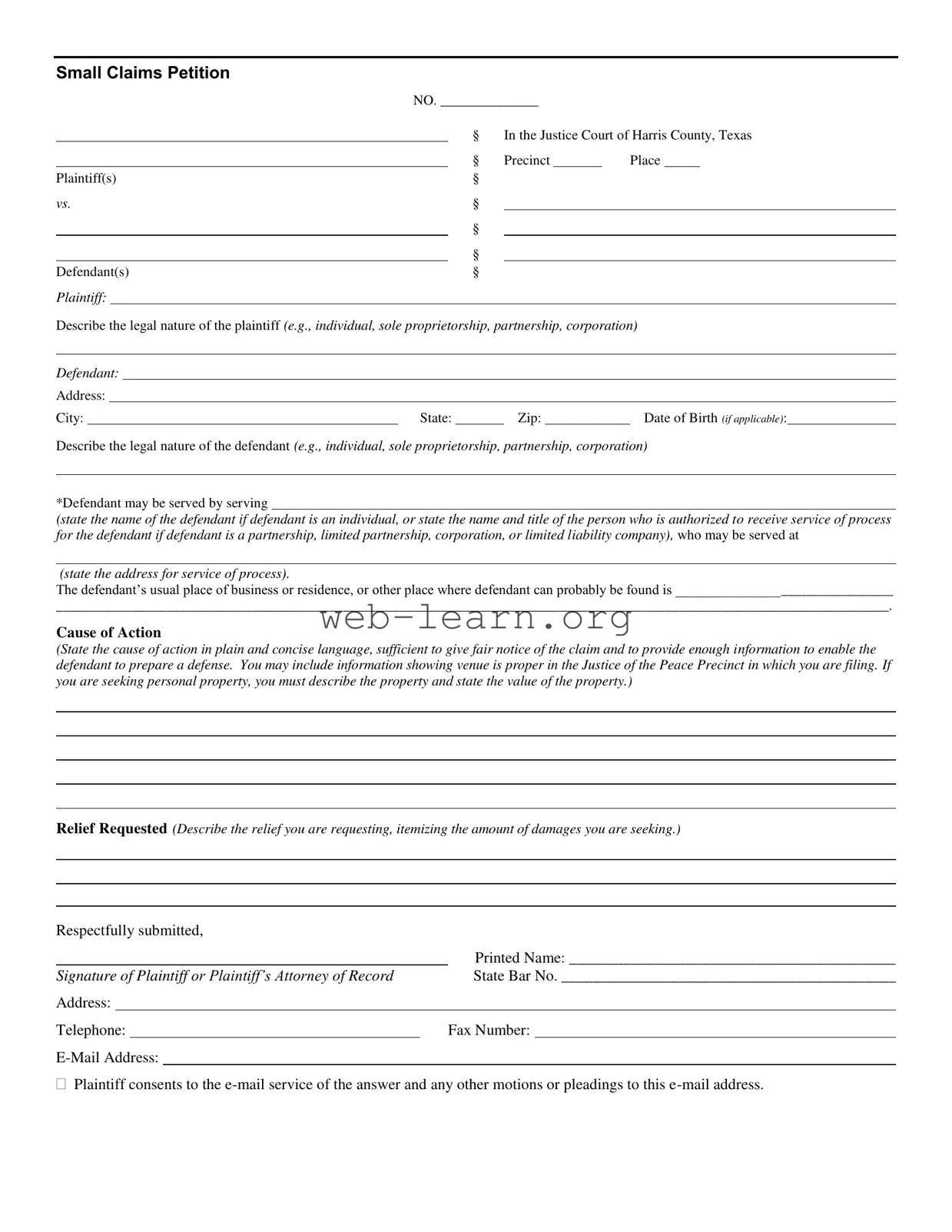
When individuals find themselves in a dispute that requires legal resolution, the Texas Small Claims form serves as a vital tool for initiating the process in a straightforward manner. This form is utilized in the Justice Court of Harris County and is designed to allow plaintiffs to present their case against defendants efficiently. The document begins with a section for identifying the parties involved, where the plaintiff must describe their legal nature, whether they are an individual, corporation, or another entity. Similarly, the defendant's information is required, including their address and the legal nature of their business if applicable. A crucial aspect of the form is the section dedicated to the cause of action, where plaintiffs must clearly articulate the basis of their claim in simple terms. This ensures that defendants are adequately informed and can prepare a proper defense. Additionally, the form includes a space for detailing the relief requested, allowing plaintiffs to specify the damages they seek. Finally, the Texas Small Claims form requires the printed name and signature of the plaintiff or their attorney, along with contact information, which is essential for communication throughout the legal process. By understanding the components of this form, individuals can navigate their small claims cases with greater confidence and clarity.

SMALL CLAIMS PETITION
|
NO. ______________ |
|
|
|
|
||
|
|
§ |
In the Justice Court of Harris County, Texas |
||||
|
|
§ |
Precinct |
|
Place |
|
|
Plaintiff(s) |
§ |
|
|
|
|
|
|
vs. |
§ |
|
|
|
|
|
|
|
|
§ |
|
|
|
|
|
|
|
§ |
|
|
|
|
|
Defendant(s) |
§ |
|
|
|
|
|
|
Plaintiff:
Describe the legal nature of the plaintiff (e.g., individual, sole proprietorship, partnership, corporation)
Defendant:
Address:
City: |
|
State: |
|
Zip: |
|
Date of Birth (if applicable): |
Describe the legal nature of the defendant (e.g., individual, sole proprietorship, partnership, corporation)
*Defendant may be served by serving
(state the name of the defendant if defendant is an individual, or state the name and title of the person who is authorized to receive service of process for the defendant if defendant is a partnership, limited partnership, corporation, or limited liability company), who may be served at
(state the address for service of process).
The defendant’s usual place of business or residence, or other place where defendant can probably be found is _______________________________
_______________________________________________________________________________________________________________________.
Cause of Action
(State the cause of action in plain and concise language, sufficient to give fair notice of the claim and to provide enough information to enable the defendant to prepare a defense. You may include information showing venue is proper in the Justice of the Peace Precinct in which you are filing. If you are seeking personal property, you must describe the property and state the value of the property.)
Relief Requested (Describe the relief you are requesting, itemizing the amount of damages you are seeking.)
Respectfully submitted, |
|
|
||||
|
|
|
|
|
Printed Name: __________________________________________ |
|
Signature of Plaintiff or Plaintiff’s Attorney of Record |
State Bar No. ___________________________________________ |
|||||
Address: |
|
|
|
|||
Telephone: |
|
|
Fax Number: |
|
||
|
|
|
||||
Plaintiff consents to the
| Fact Name | Description |
|---|---|
| Governing Law | The Texas Small Claims form is governed by Texas Government Code, Chapter 28. |
| Filing Venue | The form must be filed in the Justice Court of the appropriate precinct where the defendant resides or where the claim arose. |
| Plaintiff Information | The form requires the plaintiff to specify their legal nature, such as individual, partnership, or corporation. |
| Defendant Details | Defendant information must include their address, legal nature, and a designated person for service of process if applicable. |
| Cause of Action | The petitioner must clearly state the cause of action in plain language to inform the defendant of the claim. |
| Relief Requested | The form requires a detailed description of the relief sought, including itemized damages. |
After gathering the necessary information, you can begin filling out the Texas Small Claims form. This process involves providing details about both the plaintiff and the defendant, describing the nature of the claim, and specifying the relief being sought. Following these steps will help ensure that your form is completed accurately.
Once the form is completed, review it for accuracy before submitting it to the appropriate court. Make sure to keep a copy for your records. This will help you track your case as it progresses through the legal system.
What is the Texas Small Claims form used for?
The Texas Small Claims form is designed for individuals or entities seeking to resolve disputes involving relatively small amounts of money, typically up to $20,000. This form allows plaintiffs to file a petition in the Justice Court, detailing their claims against a defendant. Common issues addressed include unpaid debts, property damage, and breach of contract. By using this form, plaintiffs can formally initiate legal proceedings and seek the relief they believe they are entitled to.
Who can file a Small Claims petition in Texas?
Any individual, sole proprietorship, partnership, corporation, or limited liability company can file a Small Claims petition in Texas. The plaintiff must have a legal standing to bring the case, meaning they must be directly affected by the issue at hand. It’s important to ensure that the claim falls within the jurisdiction of the Justice Court, which typically handles disputes involving smaller amounts of money.
What information is required on the Small Claims form?
The Small Claims form requires several key pieces of information:
This information helps the court understand the nature of the dispute and enables the defendant to prepare an appropriate response.
How do I serve the defendant after filing the Small Claims petition?
Once you have filed the Small Claims petition, you must serve the defendant with a copy of the petition and a citation. This can be done in several ways, depending on the type of defendant:
It is crucial to follow the proper procedures for service of process to ensure that the court has jurisdiction over the defendant. Failure to serve the defendant correctly may result in delays or dismissal of your claim.
What happens after the Small Claims petition is filed and served?
After the petition is filed and served, the defendant typically has a specified amount of time to respond, often around 14 to 21 days. If the defendant responds, a hearing will be scheduled where both parties can present their cases. If the defendant does not respond, you may be able to obtain a default judgment in your favor. The outcome will depend on the evidence presented and the merits of the case.
Filling out the Texas Small Claims form can be a straightforward process, but many individuals make common mistakes that can hinder their claims. One frequent error is failing to clearly identify the legal nature of both the plaintiff and the defendant. It is essential to specify whether the parties involved are individuals, corporations, or partnerships. Without this information, the court may struggle to process the case correctly.
Another common mistake is neglecting to provide complete addresses for both the plaintiff and the defendant. The form requires specific details, including the city, state, and zip code. Incomplete addresses can lead to delays in serving the defendant with legal documents, potentially jeopardizing the case.
Many people also overlook the importance of accurately describing the cause of action. This section must be filled out in plain language, clearly outlining the basis of the claim. If the description is vague or overly complex, it may not provide the defendant with sufficient information to prepare a defense, which can weaken the plaintiff's position.
Additionally, failing to include the necessary details about the property involved in the claim is another mistake. If seeking personal property, the form requires a description and the value of that property. Omitting this information can lead to complications in the case and may result in the claim being dismissed.
Another error is not itemizing the relief requested. It is crucial to specify the amount of damages sought in a clear and organized manner. A vague request can confuse the court and the defendant, making it difficult to understand the exact nature of the claim.
Some individuals forget to sign the form or provide their printed name. A signature is a legal requirement that validates the petition. Without it, the court may reject the submission, causing delays in the process.
Providing incorrect contact information is also a common oversight. The form requests a telephone number, fax number, and email address. If this information is inaccurate, it can impede communication between the court and the parties involved, leading to missed deadlines and other complications.
Another mistake involves not consenting to e-mail service when applicable. If the plaintiff wishes to receive documents electronically, this consent must be indicated on the form. Failing to do so may result in the plaintiff not receiving important updates regarding their case.
Lastly, individuals sometimes neglect to check the local rules of the Justice Court where they are filing. Each court may have specific requirements or additional forms that must be completed. Ignoring these local rules can lead to unnecessary delays and complications in the case.
By being aware of these common mistakes and taking the time to complete the Texas Small Claims form accurately, individuals can improve their chances of a successful outcome in their claims.
When filing a Texas Small Claims form, there are several other documents that may be necessary to support your case. These forms help clarify your claims and ensure proper procedures are followed. Here’s a list of common documents used alongside the Small Claims form:
Understanding these forms can make the process smoother and help you present your case effectively. Each document plays a vital role in ensuring that your claims are heard and addressed properly in the court system.
The Texas Small Claims form shares similarities with several other legal documents. Each serves a specific purpose in the legal process, but they all focus on presenting claims or requests for relief. Here are nine documents that have comparable features:
When filling out the Texas Small Claims form, attention to detail is crucial. Here are ten important dos and don’ts to guide you through the process.
By following these guidelines, you can navigate the process more smoothly and increase your chances of a successful claim. Take your time, and double-check your work.
Understanding the Texas Small Claims form can be challenging, especially with the various misconceptions surrounding it. Here are eight common misconceptions clarified:
By understanding these misconceptions, individuals can navigate the Texas Small Claims process more effectively and confidently.
Filing a Texas Small Claims form can be a straightforward process, but it’s essential to understand the key elements involved. Here are some important takeaways to keep in mind:
By following these guidelines, you can enhance the clarity and effectiveness of your Small Claims form, ultimately improving your chances of a successful resolution.