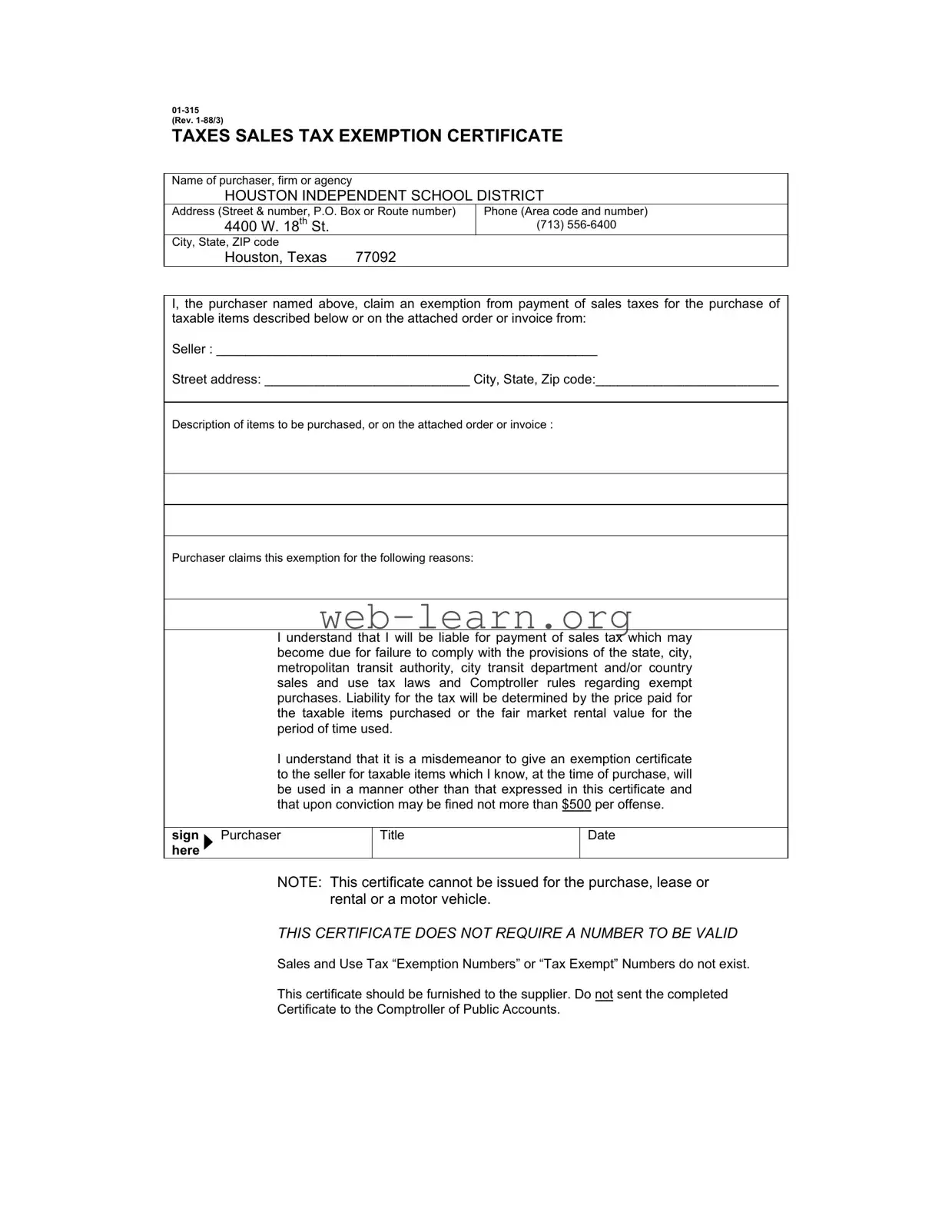
The Texas Sales Tax Exemption Certificate form, known as 01-315, serves as a crucial document for entities claiming exemption from sales tax on certain purchases. This form is particularly relevant for organizations like schools, non-profits, and government agencies, allowing them to avoid paying sales tax on items necessary for their operations. Key information required includes the name of the purchaser, their address, and contact details. The form also mandates a clear description of the items being purchased, along with the seller's information. A critical aspect of this certificate is the purchaser's acknowledgment of their liability for any sales tax due if they fail to comply with relevant tax laws. Misuse of the exemption certificate can lead to legal consequences, including fines. Importantly, the form emphasizes that it does not require a specific exemption number to be valid, and it should not be submitted to the Comptroller of Public Accounts but rather provided directly to the supplier. Understanding the proper use and implications of this form is essential for maintaining compliance and ensuring that tax exemptions are applied correctly.
TAXES SALES TAX EXEMPTION CERTIFICATE
Name of purchaser, firm or agency
HOUSTON INDEPENDENT SCHOOL DISTRICT
Address (Street & number, P.O. Box or Route number) |
Phone (Area code and number) |
|
4400 W. 18th St. |
|
(713) |
City, State, ZIP code |
|
|
Houston, Texas |
77092 |
|
I, the purchaser named above, claim an exemption from payment of sales taxes for the purchase of taxable items described below or on the attached order or invoice from:
Seller : ____________________________________________________
Street address: ____________________________ City, State, Zip code:_________________________
Description of items to be purchased, or on the attached order or invoice :
Purchaser claims this exemption for the following reasons:
I understand that I will be liable for payment of sales tax which may become due for failure to comply with the provisions of the state, city, metropolitan transit authority, city transit department and/or country sales and use tax laws and Comptroller rules regarding exempt purchases. Liability for the tax will be determined by the price paid for the taxable items purchased or the fair market rental value for the period of time used.
I understand that it is a misdemeanor to give an exemption certificate to the seller for taxable items which I know, at the time of purchase, will be used in a manner other than that expressed in this certificate and that upon conviction may be fined not more than $500 per offense.
sign Purchaser here
Title
Date
NOTE: This certificate cannot be issued for the purchase, lease or rental or a motor vehicle.
THIS CERTIFICATE DOES NOT REQUIRE A NUMBER TO BE VALID
Sales and Use Tax “Exemption Numbers” or “Tax Exempt” Numbers do not exist.
This certificate should be furnished to the supplier. Do not sent the completed Certificate to the Comptroller of Public Accounts.
| Fact Name | Details |
|---|---|
| Governing Law | The Texas Sales Tax Exemption Certificate is governed by the Texas Tax Code, specifically Chapter 151. |
| Purpose | This certificate allows qualifying entities, like schools, to claim exemption from sales tax on specific purchases. |
| Valid Usage | The certificate cannot be used for the purchase, lease, or rental of motor vehicles. |
| Liability | Purchasers are liable for any sales tax due if they fail to comply with applicable laws regarding exempt purchases. |
| Submission Instructions | The completed certificate should be provided to the seller and not sent to the Comptroller of Public Accounts. |
Completing the Texas Sales Tax Exemption Certificate form requires attention to detail. Once filled out, this certificate must be provided to the seller. It is essential to ensure accuracy, as errors can lead to complications regarding tax liabilities.
What is the Texas Sales Tax Exemption Certificate?
The Texas Sales Tax Exemption Certificate is a form used by purchasers to claim an exemption from sales tax on certain purchases. This certificate is typically used by government entities, schools, and non-profit organizations when buying items that are exempt from sales tax under Texas law.
Who can use the Texas Sales Tax Exemption Certificate?
Entities such as government agencies, public schools, and non-profit organizations can use this certificate. For example, the Houston Independent School District can claim exemptions on eligible purchases. However, individuals and for-profit businesses generally do not qualify for this exemption.
How do I fill out the certificate?
To complete the certificate, you need to provide the name of the purchaser, their address, and phone number. You must also include the seller's name and address, a description of the items being purchased, and the reason for claiming the exemption. Make sure to sign and date the certificate before providing it to the seller.
Do I need a special number to use this certificate?
No, this certificate does not require a specific exemption number to be valid. Unlike some other states, Texas does not issue "Exemption Numbers" or "Tax Exempt Numbers." Simply complete the form and present it to the seller.
What items are eligible for exemption?
Generally, items purchased for use by exempt organizations, like educational materials or supplies for a school, may qualify. However, this certificate cannot be used for the purchase, lease, or rental of a motor vehicle. Always check to ensure the items meet the criteria for exemption under Texas law.
What happens if I misuse the exemption certificate?
If you provide the certificate for items that you know will be used in a manner other than that stated, you may face legal consequences. Misuse is considered a misdemeanor, and fines can reach up to $500 per offense. It’s essential to use the certificate responsibly and in compliance with state laws.
Do I need to submit the certificate to the state?
No, you do not need to send the completed certificate to the Comptroller of Public Accounts. Instead, you should provide it directly to the seller from whom you are purchasing the exempt items.
What should I do if I have more questions?
If you have further questions about the Texas Sales Tax Exemption Certificate or need assistance, consider reaching out to the Texas Comptroller’s office or consulting with a legal expert familiar with tax laws. They can provide clarity and guidance tailored to your specific situation.
Filling out the Texas Sales Tax Exemption Certificate form can be straightforward, but mistakes can lead to unnecessary complications. Here are eight common errors people make when completing this form.
First, many individuals forget to include the seller’s information. It’s essential to provide the seller’s name, address, and city along with the ZIP code. Omitting this information can result in the certificate being rejected.
Second, some purchasers fail to describe the items they are buying. The form requires a clear description of the taxable items. Without this, it’s unclear what the exemption applies to, which can create issues later on.
Another frequent mistake is not stating the reason for the exemption. The form has a section specifically for this purpose. Leaving it blank can raise red flags and lead to complications during an audit.
Additionally, people sometimes neglect to sign the form. A signature is crucial for validating the exemption. Without it, the certificate is not considered complete, and the seller may still charge sales tax.
Some individuals also misinterpret the rules regarding motor vehicles. This certificate cannot be used for purchasing, leasing, or renting a motor vehicle. Attempting to use it for this purpose can lead to penalties.
Another common error is providing incorrect contact information. Ensure that the address and phone number are accurate. If there are questions or issues, the seller needs to reach you easily.
Moreover, people often misunderstand the requirement regarding exemption numbers. Many believe they need to provide a tax exemption number, but this is not necessary. The certificate is valid without one, and trying to include it can cause confusion.
Finally, some purchasers mistakenly send the completed certificate to the Comptroller of Public Accounts. This form should only be given to the seller. Sending it to the wrong entity can lead to delays and unnecessary paperwork.
The Texas Sales Tax Exemption Certificate is an important document for organizations seeking to purchase items without incurring sales tax. However, several other forms and documents are often used in conjunction with this certificate to ensure compliance with tax regulations and facilitate the purchasing process. Below is a list of these documents, each accompanied by a brief description.
Understanding these additional forms and documents can help ensure a smooth purchasing process while maintaining compliance with Texas tax laws. Each document serves a specific purpose and may be required depending on the nature of the transaction and the entities involved.
The Texas Sales Tax Exemption Certificate serves a specific purpose in facilitating tax-exempt purchases. Several other documents share similarities with this certificate, each serving its own unique function in the realm of taxation and exemptions. Below is a list of four such documents, along with a brief explanation of how they relate to the Texas Sales Tax Exemption Certificate.
Each of these documents, while tailored to specific jurisdictions or purposes, operates under the same fundamental principle of allowing certain entities or transactions to be exempt from sales tax. Understanding these similarities can help clarify the broader context of tax exemptions in various states.
When filling out the Texas Sales Tax Exemption Certificate form, it is crucial to follow specific guidelines to ensure that the process goes smoothly. Here are ten important dos and don’ts to keep in mind:
By adhering to these guidelines, you can help ensure that your sales tax exemption process is efficient and compliant with Texas law. Remember, understanding the requirements can save you from potential liabilities in the future.
This is not true. The certificate is valid without any exemption number. Simply complete the form and provide it to the seller.
This is incorrect. The exemption certificate is only valid for specific taxable items that fall under certain categories, such as those purchased by qualifying organizations like schools.
Not quite. You remain liable for any sales tax if you do not comply with the rules regarding exempt purchases. If you misuse the exemption, you may face penalties.
This is a common misunderstanding. You should not send the completed certificate to the Comptroller. Instead, it should be given directly to the supplier.
This is false. The Texas Sales Tax Exemption Certificate cannot be used for the purchase, lease, or rental of a motor vehicle. It is strictly limited to other taxable items.
Understanding the Texas Sales Tax Exemption Certificate is essential for both purchasers and sellers. Here are key takeaways to consider when filling out and using the form:
By following these guidelines, users can navigate the process of using the Texas Sales Tax Exemption Certificate more effectively.