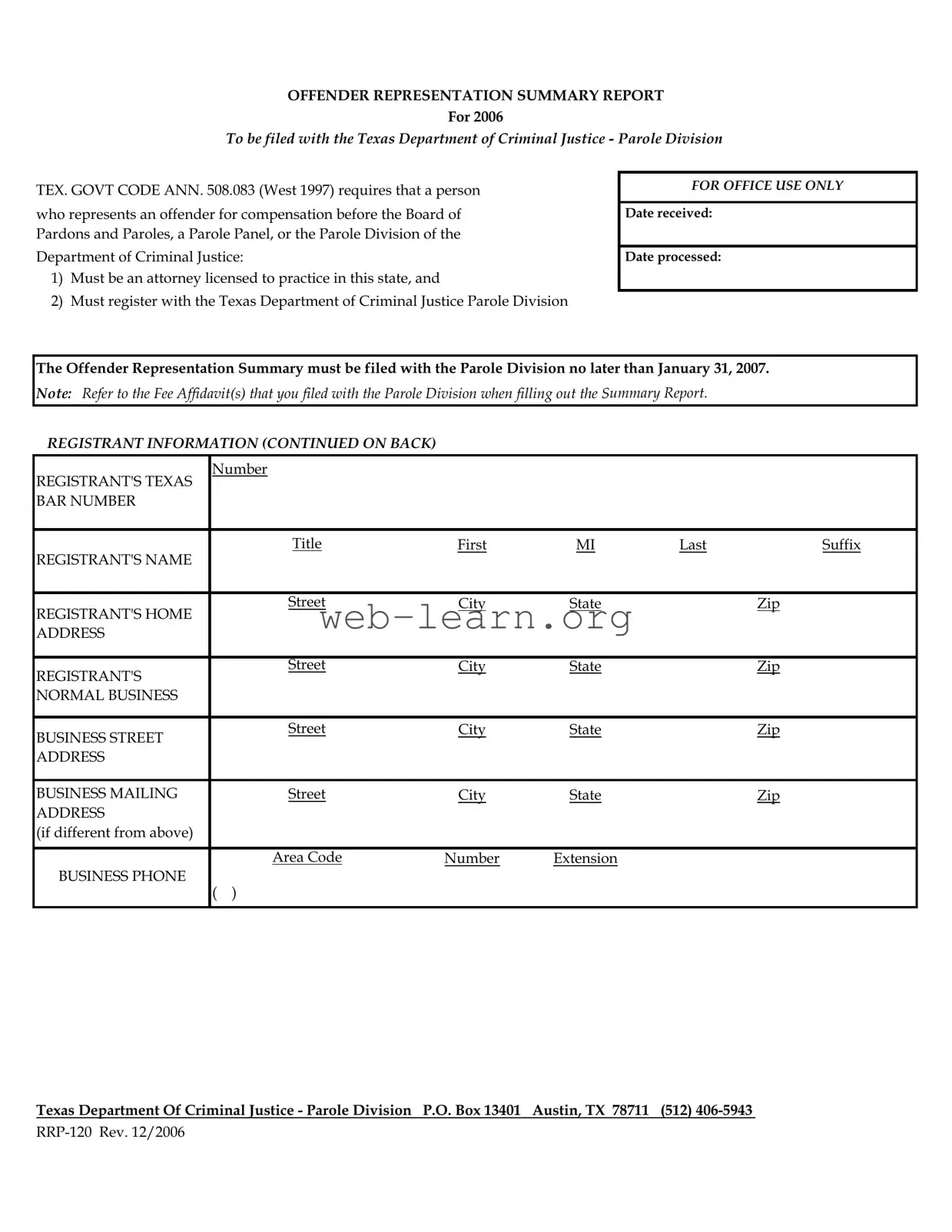
The Texas RRP 120 form, officially known as the Offender Representation Summary Report, plays a crucial role in the oversight of legal representation for offenders seeking parole. This form must be submitted to the Texas Department of Criminal Justice - Parole Division by individuals who represent offenders for compensation before the Board of Pardons and Paroles or related panels. Notably, the law mandates that only licensed attorneys in Texas can act in this capacity, ensuring that offenders receive professional legal assistance. The report requires registrants to provide detailed information about themselves, including their Texas Bar number and business addresses, as well as any relationships they may have with former board members or employees of the Texas Department of Criminal Justice. Additionally, registrants must list all offenders they have represented for compensation since January 1, 2006, along with relevant identification numbers. The completed form must be filed by January 31, 2007, and serves as a vital tool for maintaining transparency and accountability in the parole process. Understanding the requirements and implications of the RRP 120 form is essential for attorneys involved in this area of law.

OFFENDER REPRESENTATION SUMMARY REPORT
For 2006
To be filed with the Texas Department of Criminal Justice - Parole Division
TEX. GOVT CODE ANN. 508.083 (West 1997) requires that a person who represents an offender for compensation before the Board of Pardons and Paroles, a Parole Panel, or the Parole Division of the Department of Criminal Justice:
1)Must be an attorney licensed to practice in this state, and
2)Must register with the Texas Department of Criminal Justice Parole Division
FOR OFFICE USE ONLY
Date received:
Date processed:
The Offender Representation Summary must be filed with the Parole Division no later than January 31, 2007. Note: Refer to the Fee Affidavit(s) that you filed with the Parole Division when filling out the Summary Report.
REGISTRANT INFORMATION (CONTINUED ON BACK) |
|
|
|
|
||
|
|
|
|
|
|
|
REGISTRANT'S TEXAS |
Number |
|
|
|
|
|
|
|
|
|
|
|
|
BAR NUMBER |
|
|
|
|
|
|
|
|
|
|
|
|
|
|
|
Title |
First |
MI |
Last |
Suffix |
REGISTRANT'S NAME |
|
|
|
|
|
|
|
|
|
|
|
|
|
REGISTRANT'S HOME |
|
Street |
City |
State |
|
Zip |
|
|
|
|
|
|
|
ADDRESS |
|
|
|
|
|
|
|
|
|
|
|
|
|
REGISTRANT'S |
|
Street |
City |
State |
|
Zip |
|
|
|
|
|
|
|
NORMAL BUSINESS |
|
|
|
|
|
|
|
|
|
|
|
|
|
BUSINESS STREET |
|
Street |
City |
State |
|
Zip |
|
|
|
|
|
|
|
ADDRESS |
|
|
|
|
|
|
|
|
|
|
|
|
|
BUSINESS MAILING |
|
Street |
City |
State |
|
Zip |
ADDRESS |
|
|
|
|
|
|
(if different from above) |
|
|
|
|
|
|
|
|
|
|
|
|
|
|
|
Area Code |
Number |
Extension |
|
|
BUSINESS PHONE |
|
|
|
|
|
|
|
( |
) |
|
|
|
|
|
|
|
|
|
|
|
Texas Department Of Criminal Justice - Parole Division P.O. Box 13401 Austin, TX 78711 (512)
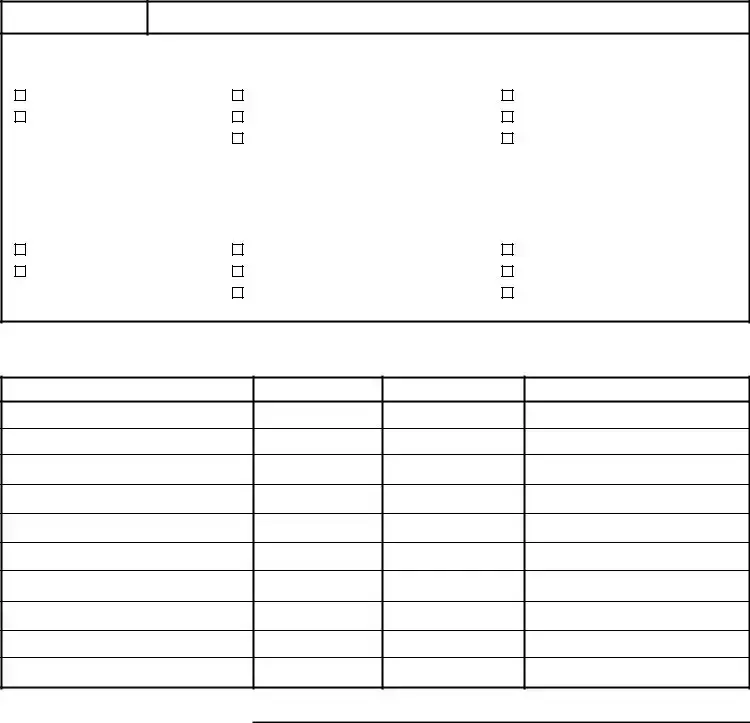
Provide the full name of any former member or employee of the Board of Pardons and Paroles or the Texas Board of Criminal Justice or former employee of the Texas Department of Criminal Justice with whom you are associated, have a relationship as an employer or employee, or maintain a contractual relationship to provide services. Check the information that applies to each individual.
NAME OF INDIVIDUAL
Individual's Status |
|
Relationship to Registrant |
|
former member of board |
Board of Pardons and Paroles |
associate |
|
former employee |
Board of Criminal Justice |
employer/employee |
|
|
|
Texas Dept. of Criminal Justice |
contractual relationship |
|
|
|
to provide service |
NAME OF INDIVIDUAL |
|
|
|
|
|
|
|
Individual's Status |
|
Relationship to Registrant |
|
former member of board |
Board of Pardons and Paroles |
associate |
|
former employee |
Board of Criminal Justice |
employer/employee |
|
|
|
Texas Dept. of Criminal Justice |
contractual relationship |
|
|
|
to provide service |
Offender Information: Provide information below for all offenders whom you represented for compensation since January 1, 2006
Name of Offender
SID#
PIA/TDCJ#
COMPENSATION
Signature |
Date |
Texas Department Of Criminal Justice - Parole Division P.O. Box 13401 Austin, TX 78711 (512)
| Fact Name | Fact Description |
|---|---|
| Form Purpose | The Texas RRP 120 form is used to summarize representation of offenders before the Board of Pardons and Paroles. |
| Filing Requirement | This form must be filed with the Texas Department of Criminal Justice - Parole Division. |
| Governing Law | Texas Government Code Annotated Section 508.083 governs the requirements for this form. |
| Attorney Requirement | Only licensed attorneys in Texas may represent offenders for compensation. |
| Registration | Attorneys must register with the Texas Department of Criminal Justice Parole Division. |
| Submission Deadline | The form must be submitted no later than January 31, 2007. |
| Fee Affidavit Reference | Registrants should refer to their previously filed Fee Affidavit(s) when completing the form. |
| Registrant Information | The form requires detailed registrant information, including name and contact details. |
| Offender Information | Details for all offenders represented since January 1, 2006, must be provided. |
| Contact Information | The form includes contact details for the Texas Department of Criminal Justice - Parole Division. |
Filling out the Texas RRP 120 form is a straightforward process. This form needs to be submitted to the Texas Department of Criminal Justice - Parole Division by January 31, 2007, if you represent an offender for compensation. Ensure all required information is accurate and complete to avoid any delays in processing.
What is the Texas RRP 120 form?
The Texas RRP 120 form, also known as the Offender Representation Summary Report, is a document required to be filed with the Texas Department of Criminal Justice - Parole Division. It is intended for individuals who represent offenders for compensation before the Board of Pardons and Paroles or the Parole Division.
Who is required to file the RRP 120 form?
Any attorney who represents an offender for compensation must file the RRP 120 form. The attorney must be licensed to practice in Texas and must also register with the Texas Department of Criminal Justice Parole Division.
What is the deadline for filing the RRP 120 form?
The completed form must be filed with the Parole Division no later than January 31, 2007. It is crucial to meet this deadline to ensure compliance with Texas law.
What information is required on the RRP 120 form?
The form requires several pieces of information, including:
What should I do if I have represented multiple offenders?
If you have represented multiple offenders, you must provide information for each offender in the designated section of the form. This includes their names, SID numbers, and PIA/TDCJ numbers.
Is there a specific format for submitting the RRP 120 form?
The form should be completed accurately and submitted to the Texas Department of Criminal Justice - Parole Division at the provided address. Ensure that all required sections are filled out before submission.
What happens if I fail to file the RRP 120 form?
Failure to file the RRP 120 form by the deadline may result in penalties, including potential disciplinary action against the attorney. Compliance with the filing requirement is essential to maintain good standing with the Texas Bar and the Parole Division.
Where can I get assistance with the RRP 120 form?
If you need assistance, you can contact the Texas Department of Criminal Justice - Parole Division at (512) 406-5943. They can provide guidance on completing the form and answering any specific questions you may have.
Completing the Texas RRP 120 form can be a straightforward process, but many individuals make common mistakes that can lead to delays or complications. Awareness of these pitfalls is crucial for ensuring a smooth submission.
One frequent error is failing to provide accurate registrant information. This includes the registrant's full name, Texas Bar Number, and contact details. Incomplete or incorrect information can result in the form being rejected or returned for corrections.
Another mistake involves the omission of necessary relationships with former members or employees of the relevant boards. It is essential to disclose any associations, as this is a requirement of the form. Neglecting to do so may raise red flags during the review process.
Additionally, individuals often overlook the deadline for submission. The form must be filed no later than January 31, 2007. Missing this deadline can lead to penalties or issues with representation.
Many registrants also fail to check the information against their previously filed Fee Affidavit(s). This oversight can lead to discrepancies that complicate the review process. Ensuring consistency between documents is vital.
Another common issue is neglecting to sign the form. A signature is not just a formality; it is a confirmation that the information provided is accurate. Without it, the form cannot be processed.
Some individuals mistakenly assume that all required fields are optional. Each section of the form serves a purpose, and leaving sections blank can result in incomplete submissions. It is important to read the form carefully and provide all requested information.
Furthermore, failing to include the correct offender information is a significant error. This includes the name, SID#, and PIA/TDCJ#. Inaccurate or missing details can hinder the processing of the report.
Lastly, some registrants do not retain copies of the submitted form. Keeping a copy for personal records is essential in case follow-up communication is needed or if there are questions about the submission in the future.
By avoiding these common mistakes, individuals can enhance the likelihood of a successful filing of the Texas RRP 120 form. Prompt attention to detail and adherence to guidelines will facilitate a smoother process with the Texas Department of Criminal Justice - Parole Division.
The Texas RRP 120 form is a crucial document for attorneys representing offenders before the Board of Pardons and Paroles. However, there are several other forms and documents that often accompany it. Here’s a list of some of those important documents.
Understanding these documents can help attorneys navigate the parole process more effectively. Each form plays a role in ensuring that both the offender's rights and the interests of justice are upheld.
The Texas RRP 120 form, known as the Offender Representation Summary Report, is a crucial document for anyone representing offenders before the Board of Pardons and Paroles. Its purpose is to ensure transparency and compliance with state regulations. Several other documents share similarities with the RRP 120 form in terms of purpose, requirements, or context. Here are four such documents:
Understanding these documents helps ensure compliance with Texas laws and regulations, promoting ethical representation in the criminal justice system.
When filling out the Texas RRP 120 form, it's essential to be thorough and accurate. Here’s a helpful list of things you should and shouldn’t do:
Following these guidelines will help ensure your submission is correct and complete, reducing the chances of delays or issues with processing.
This is not true. Only individuals who are licensed attorneys in Texas can represent offenders for compensation. It's crucial to ensure that the person you choose to represent you meets this requirement.
In reality, the RRP 120 form must be filed with the Texas Department of Criminal Justice Parole Division. Failing to do so can lead to complications in the representation process.
This form has a strict deadline. It must be submitted no later than January 31 of the year following the representation period. Missing this deadline can affect your ability to represent offenders.
The form actually requires detailed information about the registrant, including their bar number, business addresses, and any relationships with former board members or employees. Complete and accurate information is essential.
This is incorrect. Attorneys must file this form for each representation period. Staying compliant with these requirements is vital for maintaining your ability to represent offenders.
Here are key takeaways regarding the Texas RRP 120 form: