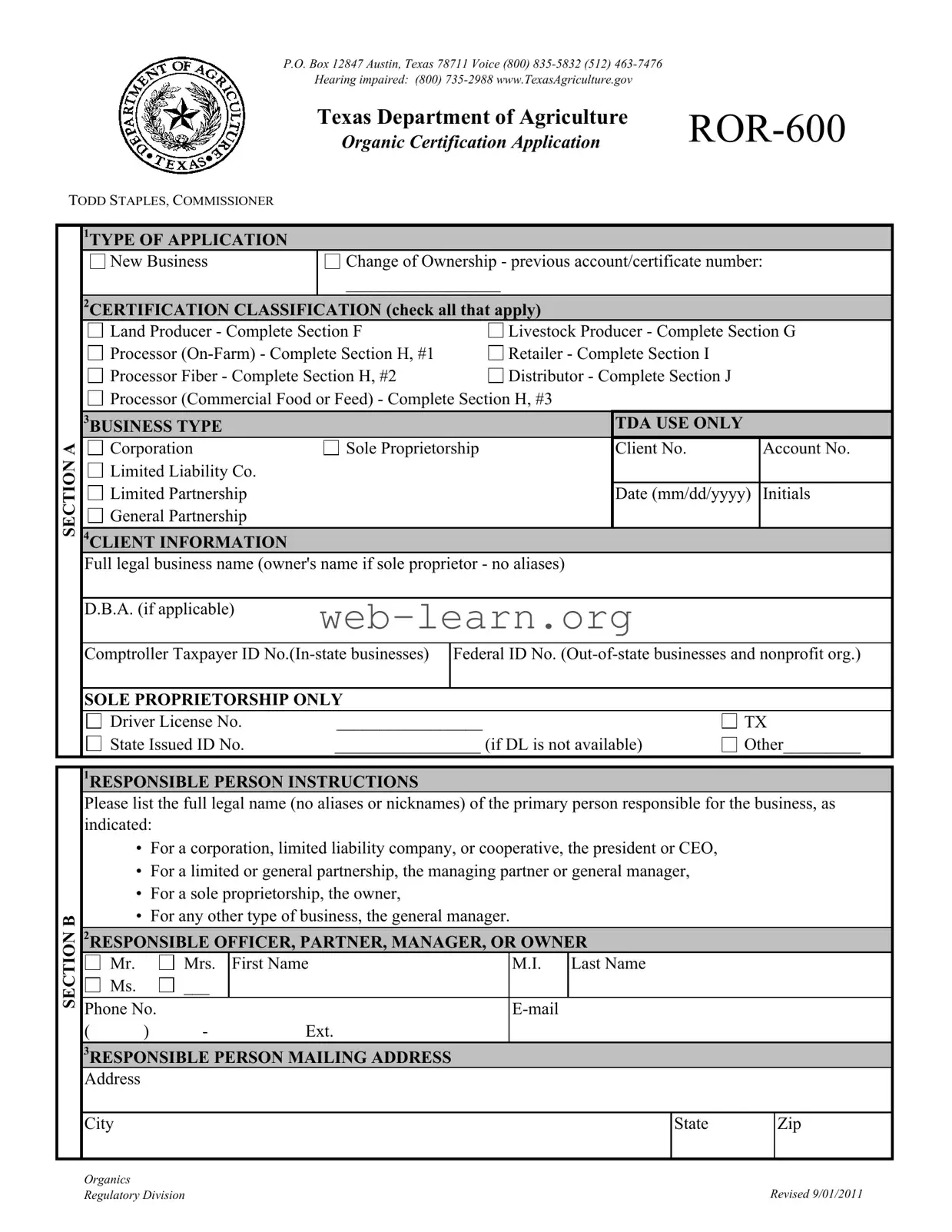
The Texas ROR 600 form is a vital document for anyone seeking organic certification in the Lone Star State. This application is not just a formality; it’s your gateway to ensuring that your organic farming or processing practices meet state and federal standards. When you fill out this form, you will identify the type of application you are submitting—whether it’s for a new business or a change of ownership. You’ll also classify your operation, whether as a land producer, livestock producer, processor, retailer, or distributor. Each category has specific sections that require detailed information about your business, including legal names, taxpayer IDs, and the responsible parties involved. Additionally, if you’re an out-of-state applicant, you’ll need to designate a resident agent in Texas. The form also includes sections for facility information, previous certifications, and payment methods, emphasizing the importance of complete and accurate submissions. Remember, an incomplete application can lead to delays, so attention to detail is essential. This process is not just about compliance; it’s about commitment to organic integrity and consumer trust.

P.O. Box 12847 Austin, Texas 78711 Voice (800)
Hearing impaired: (800)
|
|
|
|
|
|
Texas Department of Agriculture |
||||||||
|
|
|
|
|
|
Organic Certification Application |
|
|||||||
TODD STAPLES, COMMISSIONER |
|
|
|
|
|
|
|
|
|
|
||||
|
|
|
|
|
|
|
|
|
|
|
|
|
||
|
1TYPE OF APPLICATION |
|
|
|
|
|
|
|
|
|
|
|||
|
New Business |
|
Change of Ownership - previous account/certificate number: |
|||||||||||
|
|
|
|
|
|
__________________ |
|
|
|
|
|
|
|
|
|
|
|
|
|
|
|
|
|
|
|
|
|||
|
2CERTIFICATION CLASSIFICATION (check all that apply) |
|
|
|
|
|
||||||||
|
Land Producer - Complete Section F |
Livestock Producer - Complete Section G |
||||||||||||
|
Processor |
Retailer - Complete Section I |
|
|
|
|||||||||
|
Processor Fiber - Complete Section H, #2 |
Distributor - Complete Section J |
|
|
|
|||||||||
|
Processor (Commercial Food or Feed) - Complete Section H, #3 |
|
|
|
|
|
||||||||
|
3BUSINESS TYPE |
|
|
|
|
|
TDA USE ONLY |
|
|
|
||||
A |
Corporation |
|
Sole Proprietorship |
|
|
Client No. |
|
Account No. |
||||||
SECTION |
Limited Liability Co. |
|
|
|
|
|
|
|
|
|
|
|||
|
|
|
|
|
|
|
|
|
|
|
||||
|
Limited Partnership |
|
|
|
|
|
Date (mm/dd/yyyy) |
Initials |
||||||
|
General Partnership |
|
|
|
|
|
|
|
|
|
|
|||
|
4CLIENT INFORMATION |
|
|
|
|
|
|
|
|
|
|
|||
|
Full legal business name (owner's name if sole proprietor - no aliases) |
|
|
|
|
|
||||||||
|
|
|
|
|
|
|
|
|
|
|
|
|||
|
D.B.A. (if applicable) |
|
|
|
|
|
|
|
|
|
|
|||
|
|
|
|
|
|
|
||||||||
|
Comptroller Taxpayer ID |
Federal ID No. |
||||||||||||
|
|
|
|
|
|
|
|
|
|
|
||||
|
SOLE PROPRIETORSHIP ONLY |
|
|
|
|
|
|
|
||||||
|
Driver License No. |
_________________ |
|
|
|
|
TX |
|||||||
|
State Issued ID No. |
|
_________________ (if DL is not available) |
|
Other_________ |
|||||||||
|
|
|
|
|
|
|
|
|
|
|
|
|||
|
|
|
|
|
|
|
|
|
|
|
|
|
|
|
|
1RESPONSIBLE PERSON INSTRUCTIONS |
|
|
|
|
|
|
|
||||||
|
Please list the full legal name (no aliases or nicknames) of the primary person responsible for the business, as |
|||||||||||||
|
indicated: |
|
|
|
|
|
|
|
|
|
|
|||
|
• |
|
For a corporation, limited liability company, or cooperative, the president or CEO, |
|
|
|
||||||||
|
• |
|
For a limited or general partnership, the managing partner or general manager, |
|
|
|
||||||||
|
• |
|
For a sole proprietorship, the owner, |
|
|
|
|
|
|
|
||||
B |
• |
|
For any other type of business, the general manager. |
|
|
|
|
|
||||||
SECTION |
2RESPONSIBLE OFFICER, PARTNER, MANAGER, OR OWNER |
|
|
|
|
|
||||||||
|
Mr. |
|
Mrs. |
First Name |
M.I. |
Last Name |
|
|
|
|
||||
|
Ms. |
|
___ |
|
|
|
|
|
|
|
|
|
|
|
|
Phone No. |
|
|
|
|
|
|
|
|
|||||
|
( |
) |
- |
|
Ext. |
|
|
|
|
|
|
|
||
|
3RESPONSIBLE PERSON MAILING ADDRESS |
|
|
|
|
|
|
|
||||||
|
Address |
|
|
|
|
|
|
|
|
|
|
|
|
|
|
|
|
|
|
|
|
|
|
|
|
|
|
|
|
|
City |
|
|
|
|
|
|
|
|
|
State |
|
|
Zip |
|
|
|
|
|
|
|
|
|
|
|
|
|
|
|
|
Organics |
|
|
|
|
|
|
|
|
|
|
|
|
|
|
Regulatory Division |
|
|
|
|
|
|
|
|
Revised 9/01/2011 |
||||
Legal Business Name: ______________________________
SECTION C
1PERSON TO CONTACT FOR
Mr. |
|
Mrs. |
First Name |
M.I. |
Last Name |
|
|
||
Ms. |
|
___ |
|
|
|
|
|
|
|
Title |
|
|
|
Primary Phone |
|
|
|
|
|
|
|
|
|
( |
) |
- |
|
Ext. |
|
Secondary Phone (optional) |
Fax (optional) |
|
|
|
|
||||
( |
) |
- |
Ext. |
( |
) |
- |
|
Ext. |
|
|
Would you prefer to be contacted by |
||||||||
|
|
|
|
Yes |
|
|
|
No |
|
2MAILING ADDRESS |
|
|
|
|
|
|
|||
Address |
|
|
|
|
|
|
|
|
|
|
|
|
|
|
|
|
|
|
|
City |
|
|
|
|
|
|
State |
|
Zip |
|
|
|
|
|
|
|
|
|
|
SECTION D
1FACILITY INFORMATION
Facility Name
2PHYSICAL ADDRESS OF LOCATION OF LICENSEE, LICENSED ACTIVITIES or EQUIPMENT
Address (No P.O. Box)
City |
State |
Zip |
County |
|
|
|
|
Directions to Physical Location if address above is difficult to find
SECTION E
An applicant for an Organic Certification whose principal place of business is situated outside the State of Texas must appoint and designate a resident citizen of Texas as said applicant's resident agent with Texas. If the address provided in Section B is out of state, resident agent information is REQUIRED.
Who do you wish to designate as resident agent?
The Texas Secretary of State Other (list below)
Resident Agent Name
Resident Agent Address
City |
Zip |
Business Phone |
|
|
|
|
( |
) |
- |
|
|
|
|
|
Organics
Regulatory Division |
Revised 9/01/2011 |

Legal Business Name: ______________________________
|
1LAND PRODUCER (check all that apply) |
|
|
|
|||
|
Fields In Crop Production: |
|
|
|
|
|
|
F |
Organic acres: |
____________ |
|
Transitional acres: |
____________ |
|
|
Total Organic and Transitional acres: |
____________ |
|
|
|
|||
SECTION |
|
|
|
||||
|
|
|
|
|
|
|
|
Fields Not In Crop Production: |
|
|
|
|
|
||
|
|
|
|
|
|
||
|
Organic acres: |
____________ |
|
Transitional acres: |
____________ |
|
|
|
Total Organic and Transitional acres: |
____________ |
|
|
|
||
|
|
|
|
|
|
|
|
|
Greenhouse/Indoor Production: |
|
|
|
|
|
|
|
Organic Sq. Ft: |
____________ |
|
Transitional Sq. Ft: |
____________ |
|
|
|
Total Organic and Transitional Sq. Ft: ____________ |
|
|
|
|||
|
|
|
|
||||
|
|
|
|
|
|
|
|
|
1LIVESTOCK PRODUCER (Land/Herd information) (check all that apply) |
|
|
||||
|
Cattle, Horses: |
|
|
|
|
|
|
G |
No. of Head |
____________ |
|
Actual acreage available to livestock: |
____________ |
||
|
|
|
|
|
|
|
|
Goats, Swine, Sheep |
|
|
|
|
|
||
SECTION |
|
|
|
|
|
||
No. of Head |
____________ |
|
Actual acreage available to livestock: |
____________ |
|||
|
|
||||||
|
|
|
|
|
|||
|
Avian Species (Chicken, Turkey, or other Poultry) |
|
|
|
|||
|
No. of Head |
____________ |
|
Actual acreage available to livestock: |
____________ |
||
|
|
|
|
||||
|
Is land/facilities used for livestock production organically certified? |
Yes |
No |
||||
|
If No, you must apply for certification as a Land Producer with either TDA or a private certifier. |
||||||
|
If Yes, what is your organic certification number? ___________________ |
|
|
||||
|
|
||||||
|
|
|
|
|
|
|
|
|
1PROCESSOR |
||||||
H |
|
|
|
|
|
||
|
|
|
|
|
|||
SECTION |
|
|
|
|
|
||
|
|
|
|
|
|||
|
|
|
|
|
|
||
|
2PROCESSOR FIBER |
|
|
|
|
|
|
|
Cotton Ginning |
Textile Manufacturing |
|
|
|
||
|
|
|
|
|
|||
|
3PROCESSOR (COMMERCIAL FOOD OR FEED) |
|
|
|
|||
|
Commercial Food Processor |
Commercial Feed Processor |
|
|
|||
|
|
|
|
|
|
|
|
|
|
|
|
|
|
|
|
|
1RETAILER |
|
|
|
|
|
|
I |
Number of stations for |
________ |
|
|
|||
SECTION |
Please note, retailers are exempt from organic certification under the National Organic Program Regulations. |
||||||
|
|||||||
|
However, if you plan to label products that were made |
or 'Certified |
|||||
|
Organic' statement, you are required to become certified under the National Organic Program Regulations. |
||||||
|
|
|
|
|
|
|
|
Organics
Regulatory Division |
Revised 9/01/2011 |
Legal Business Name: ______________________________
SECTION J
1DISTRIBUTOR
Broker/Trader (check all that apply)
Food Products
Feed Products
Fiber Products
Warehousing/Storage (check all that apply)
Food Products
Feed Products
Fiber Products
Packing/Grading/Sizing (check all that apply)
Food Products
Feed Products
SECTION K
1PAYMENT
See instructions for applicable fees.
CERTIFICATION IS NOT VALID UNTIL APPROVED BY TDA
Method of Payment (payable to Texas Department of Agriculture) |
|
|||
Check # ________ |
|
Cashier's Check # ________ |
Money Order # ________ |
|
|
|
|
|
|
Amount remitted |
|
|
Mail to: Texas Department of Agriculture |
|
|
|
|
P.O. Box 12076, Austin, TX |
|
|
|
|
|
|
TDA USE ONLY |
Receipt No. |
|
Date Receipt Issued |
|
|
|
|
|
|
SECTION L
1PREVIOUS CERTIFICATIONS
Have you previously applied for organic certification with another certifier? |
Yes |
No |
If Yes: |
|
|
1.List the name(s) of any organic certifying agent(s) to which application has previously been made:
_________________________________________________________________________________________
2.List year(s) when application(s) was submitted: ______________________________________________
3. Outcome of the application(s) submission: |
Approved |
Denied |
Withdrawn |
If applicable, attach: |
|
|
|
A.Copy of any certification conditions, notification of noncompliance or denial of certification issued to the applicant
B.Description of actions taken to correct the noncompliance or to meet certification conditions
C.Evidence of such correction
Organics
Regulatory Division |
Revised 9/01/2011 |
Legal Business Name: ______________________________
SECTION M
1SIGNATURE
The applicant, by and through their personal or agent's signature below (1) certifies that all information provided in connection with this application at any time is true and correct to the best of the applicant's knowledge; (2) acknowledges that any misrepresentation or false statement made by the applicant, or an authorized agent of the applicant, in connection with this application, whether intentional or not, will constitute grounds for denial, revocation, or
Applicant Name |
Title |
|
|
|
|
|
|
Applicant Signature |
Date |
/ |
/ |
|
month |
day |
year |
|
|
|
|
SECTION N
1CHECKLIST
Please use this checklist to ensure you are sending all of the necessary information and documents. Organic standards require you to keep a copy of your application and all supporting documentation for your files.
Organic Certification Application
Fees (see instructions for assistance with calculating the correct fee)
All applicable supporting documentation:
Land Producer -
Livestock Producer -
Processor (Food and Feed) -
Distributor -
Please note that an incomplete application will result in processing delays.
This document becomes public record and is subject to disclosure. With few exceptions, you have the right to request and be informed about the information that the State of Texas collects about you. You are entitled to receive and review the information upon request. You also have the right to ask the state agency to correct any information that is determined to be incorrect. (Reference: Government Code, Sections 552.021, 552.023, and 559.004.)
Organics
Regulatory Division |
Revised 9/01/2011 |
| Fact Name | Details |
|---|---|
| Form Purpose | The ROR-600 form is used for applying for organic certification in Texas. |
| Governing Law | This form is governed by the Texas Agriculture Code and the National Organic Program Regulations. |
| Application Types | Applicants can choose from new business or change of ownership options. |
| Certification Classifications | Classifications include land producer, livestock producer, processor, retailer, and distributor. |
| Client Information | Applicants must provide full legal business names and taxpayer identification numbers. |
| Responsible Person | A primary contact person must be designated, including their title and contact information. |
| Facility Information | Applicants need to provide the physical address of the facility where licensed activities will occur. |
| Out-of-State Applicants | Out-of-state applicants must designate a resident agent in Texas for their application. |
| Payment Method | Payment can be made by check, cashier's check, or money order, payable to the Texas Department of Agriculture. |
| Signature Requirement | The application must be signed by the applicant or an authorized agent to certify the information is accurate. |
Filling out the Texas ROR-600 form is an important step for those seeking organic certification in Texas. This form collects essential information about your business, its operations, and your compliance with organic standards. It's crucial to provide accurate and complete details to ensure a smooth application process.
The Texas ROR 600 form is the application for organic certification issued by the Texas Department of Agriculture. It is required for businesses that wish to be certified as organic producers, processors, retailers, or distributors in Texas. This form collects essential information about the business and its operations.
Any business involved in organic production, processing, or distribution in Texas must complete the ROR 600 form. This includes land producers, livestock producers, processors, retailers, and distributors. If you are changing ownership of a business, you must also submit this form with the previous account or certificate number.
The form requires various details, including:
After completing the ROR 600 form, you must mail it to the Texas Department of Agriculture at P.O. Box 12076, Austin, TX 78711-2076. Ensure that you include any required fees and supporting documentation to avoid processing delays.
Fees for organic certification vary based on the type of operation and services requested. Refer to the instructions provided with the form for guidance on calculating the correct fee. Payment can be made via check, cashier's check, or money order made out to the Texas Department of Agriculture.
Once submitted, the Texas Department of Agriculture will review your application. If approved, you will receive your organic certification. If there are issues or missing information, they may contact you for clarification, which can delay the process.
Yes, you can request changes. However, it is best to provide accurate information initially to avoid complications. If changes are necessary, contact the Texas Department of Agriculture directly to discuss the process for updating your application.
Filling out the Texas ROR-600 form can be a straightforward process, but several common mistakes can lead to delays or complications. Understanding these pitfalls is essential for a smooth application experience.
One frequent error is failing to provide the full legal business name. This is crucial, especially for sole proprietors who must list their name without any aliases. Incomplete or incorrect names can result in application rejection, causing unnecessary delays.
Another common mistake involves not checking the appropriate certification classifications. Applicants often overlook this step, which can lead to confusion about the requirements for their specific business type. Ensuring all relevant sections are completed will help streamline the process.
Inaccuracies in the tax identification numbers are also a significant issue. Applicants sometimes provide incorrect Federal ID numbers or fail to include their Comptroller Taxpayer ID. These numbers are vital for processing the application, and inaccuracies can lead to further complications.
Additionally, neglecting to fill out the section on previous certifications can be detrimental. If the applicant has previously applied for organic certification with another certifier, this information must be disclosed. Failing to do so may raise red flags during the review process.
Another mistake involves the signature section. Many applicants forget to sign the form or fail to include the date. This oversight can halt the application process, requiring resubmission and causing delays.
Furthermore, applicants often forget to include all necessary supporting documentation. Each business type has specific requirements, and incomplete submissions can lead to processing delays. Always double-check the checklist provided in the application to ensure all documents are included.
Finally, miscommunication regarding the contact person can create issues. Applicants should clearly identify who will handle license-related matters and ensure that the contact information is accurate. This helps facilitate communication between the applicant and the Texas Department of Agriculture.
By being aware of these common mistakes, applicants can improve their chances of a successful and timely application process. Taking the time to review the form carefully can save significant time and effort down the line.
The Texas ROR-600 form is essential for those seeking organic certification in Texas. However, several other forms and documents complement this application, ensuring that applicants meet all necessary requirements for certification. Below is a list of these supporting documents, each playing a crucial role in the certification process.
Understanding these additional forms and documents is vital for a successful organic certification process. Each one serves a unique purpose, ensuring that applicants are fully prepared to meet the standards set forth by the Texas Department of Agriculture. Proper preparation can lead to a smoother application experience and ultimately, successful certification.
The Texas ROR-600 form, which serves as an Organic Certification Application, shares similarities with several other important documents in the realm of business and agricultural regulation. Below are six documents that exhibit comparable characteristics, each playing a crucial role in various certification and licensing processes.
Understanding these documents and their similarities can help streamline the application process for businesses seeking certification or licensing in Texas and beyond.
When filling out the Texas ROR 600 form, attention to detail is crucial. Here are five important things to keep in mind:
Understanding the Texas ROR 600 form is crucial for anyone looking to navigate the organic certification process in Texas. However, several misconceptions can cloud this understanding. Here are nine common misconceptions clarified:
By dispelling these misconceptions, potential applicants can approach the Texas ROR 600 form with clarity and confidence, ensuring a smoother path toward organic certification.
Filling out the Texas ROR-600 form is an important step for those seeking organic certification. Here are some key takeaways to keep in mind:
By following these guidelines, applicants can enhance their chances of a smooth certification process. It's essential to provide complete and accurate information to avoid complications.