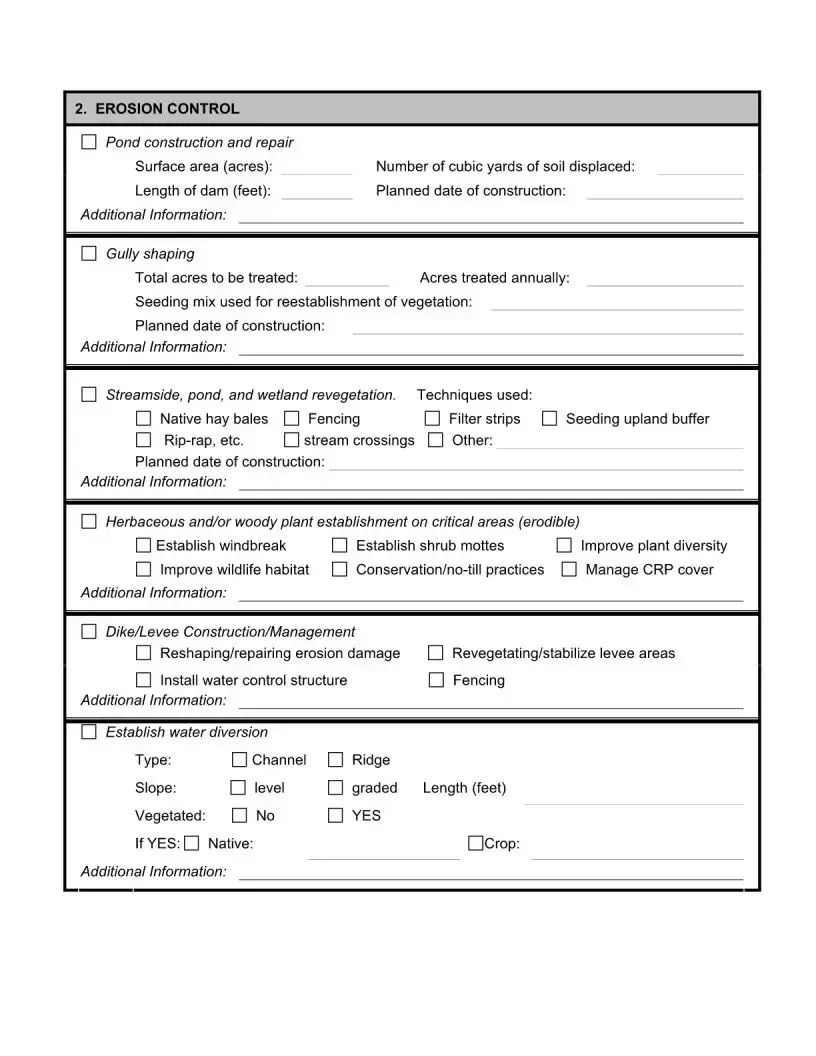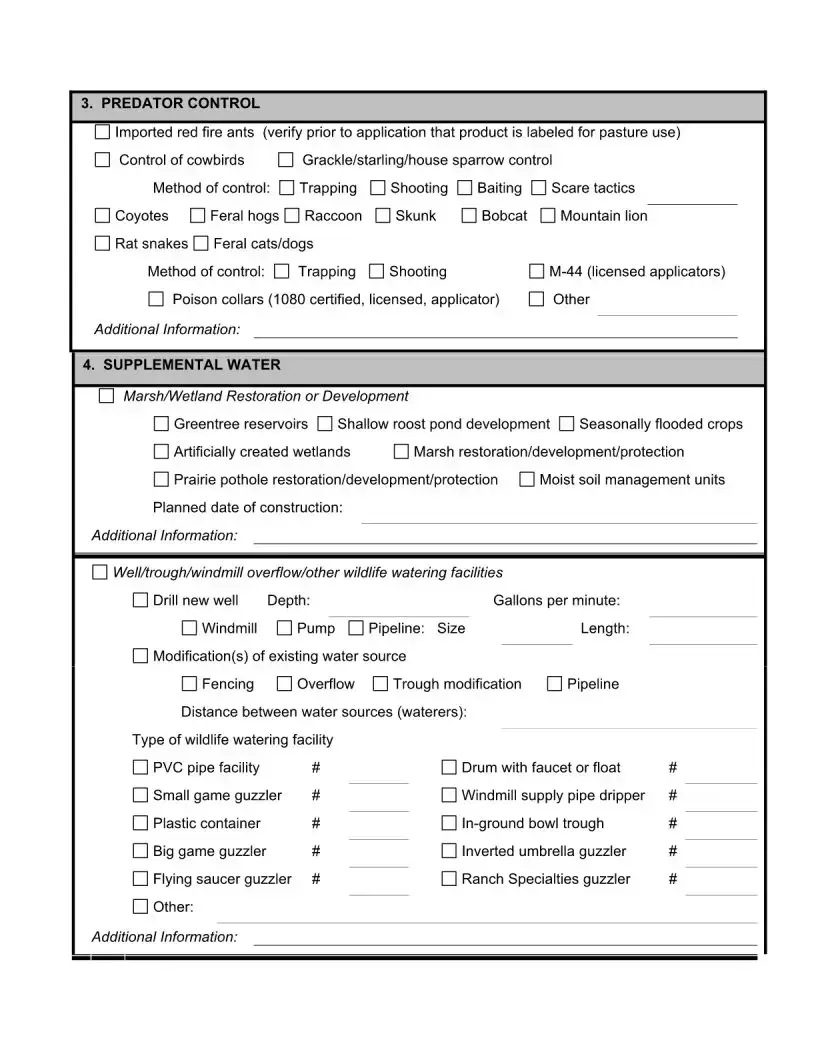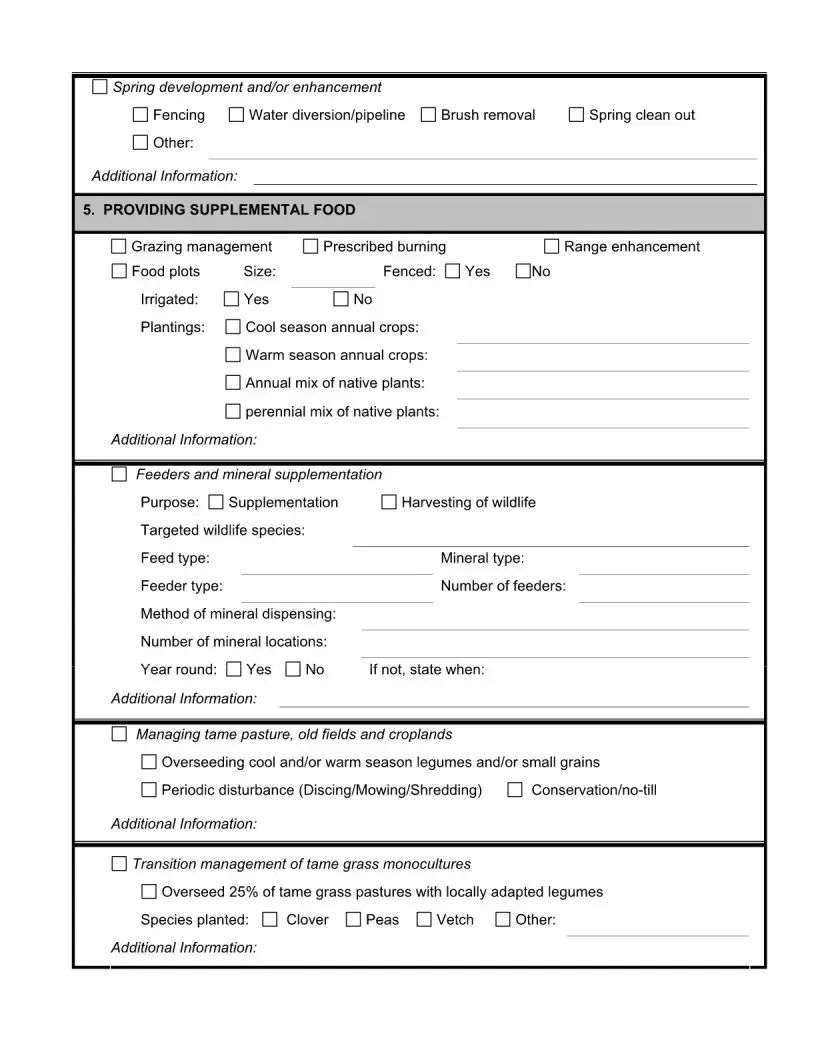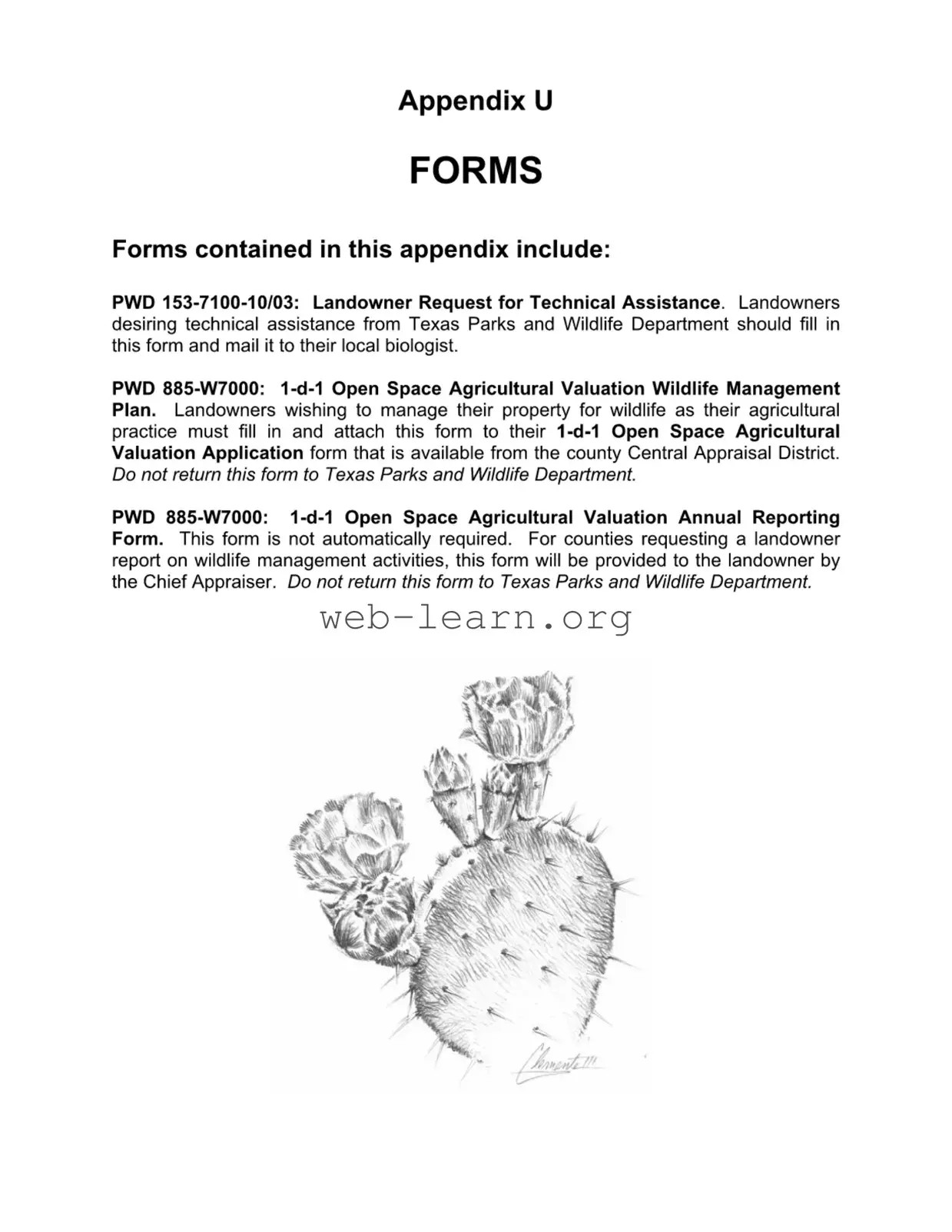
Homepage Blank Texas Pwd Form
Outline

The Texas PWD form is an essential tool for landowners seeking to enhance wildlife management on their properties. It includes several key components designed to facilitate communication between landowners and the Texas Parks and Wildlife Department. The first form, PWD 153-7100-10/03, allows landowners to request technical assistance from local biologists, enabling them to improve habitat and manage wildlife populations effectively. Another critical form, PWD 885-W7000, is the Wildlife Management Plan, which must be attached to the 1-d-1 Open Space Agricultural Valuation Application. This plan outlines the landowner's strategies for managing their property for wildlife as part of their agricultural practice. Additionally, there is an annual reporting form provided by the Chief Appraiser for counties that require updates on wildlife management activities. Each of these forms serves a specific purpose, ensuring that landowners have the necessary support and guidance to meet their wildlife management goals while complying with state regulations. The information collected is confidential, protecting the privacy of landowners while allowing for effective management practices to be implemented.
Sample - Texas Pwd Form

Form Information

Fact Name Description
Form Purpose The Texas PWD form is designed for landowners seeking technical assistance from the Texas Parks and Wildlife Department to enhance wildlife habitats and manage wildlife populations on their property.
Confidentiality Clause Information collected through the landowner request is confidential under Section 12.0251 of the Parks and Wildlife Code, ensuring that specific details about location and species cannot be disclosed.
Non-Binding Recommendations Any recommendations provided by the Texas Parks and Wildlife Department are non-binding and voluntary, allowing landowners to choose whether to implement them.
Submission Guidelines Landowners must mail the completed PWD forms to their local biologist or the County Chief Appraiser, depending on the specific form being submitted.
Wildlife Management Plan The PWD 885-W7000 form is essential for landowners managing their property for wildlife under the 1-d-1 Open Space Agricultural Valuation, requiring attachment to the valuation application.
Annual Reporting Requirement The annual reporting form for wildlife management activities is only required if requested by the county's Chief Appraiser, making it situational rather than automatic.
Title VI Compliance The Texas Parks and Wildlife Department ensures that services are provided without discrimination based on race, color, national origin, age, or handicap, in compliance with Title VI regulations.

Detailed Guide for Filling Out Texas Pwd

Filling out the Texas PWD form requires careful attention to detail. Follow the steps below to ensure that all necessary information is provided accurately. Once the form is completed, it should be submitted to the appropriate local authority as specified in the instructions.

  1. Start by entering your name in the designated field for the landowner or authorized agent.
  2. Provide the name of the property you are requesting assistance for.
  3. Fill in the county where the property is located.
  4. Indicate the total acreage of the property.
  5. Include your contact information: home, office, and any other relevant phone numbers.
  6. Sign the form to certify ownership or authorization to act on behalf of the owner.

For the Wildlife Management Plan, continue with the following steps:

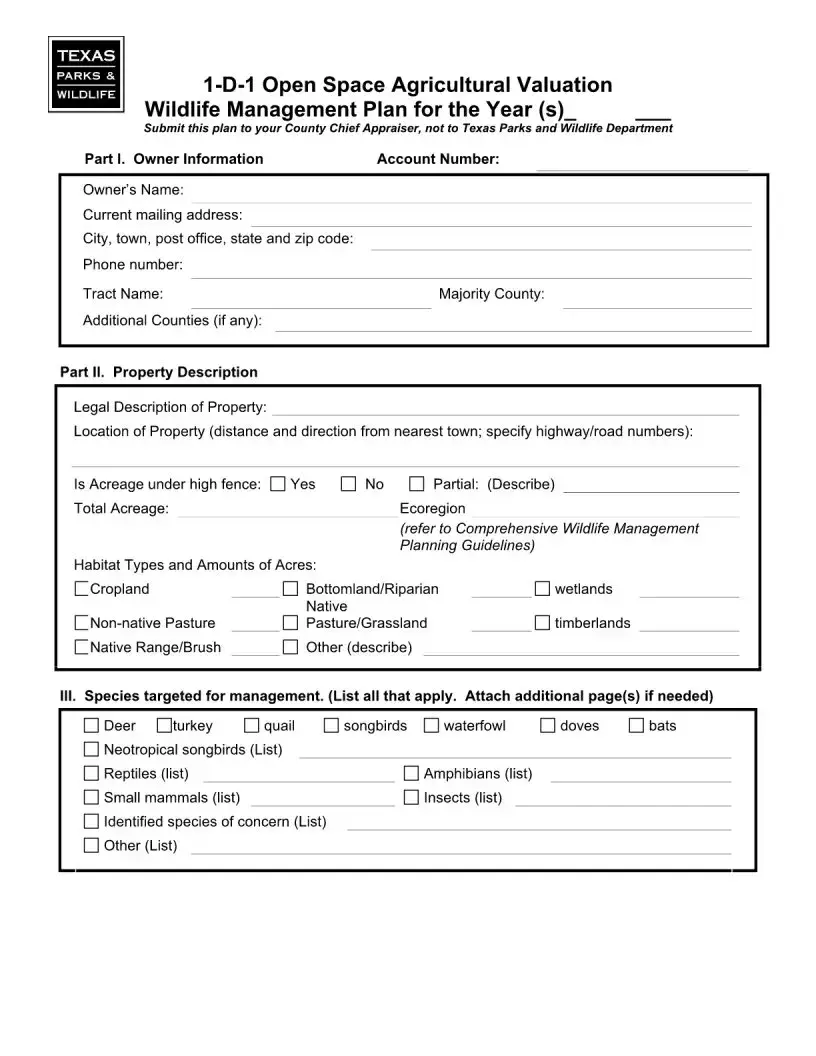
  1. Enter your name as the owner in Part I.
  2. Provide your current mailing address, including city, state, and zip code.
  3. List your phone number and account number.
  4. Fill in the tract name and majority county.
  5. Describe the legal location of the property, including distance and direction from the nearest town.
  6. Indicate if the acreage is under high fence and provide the total acreage.
  7. List the habitat types and the corresponding amounts of acres.
  8. Identify the species targeted for management by listing them in Part III.
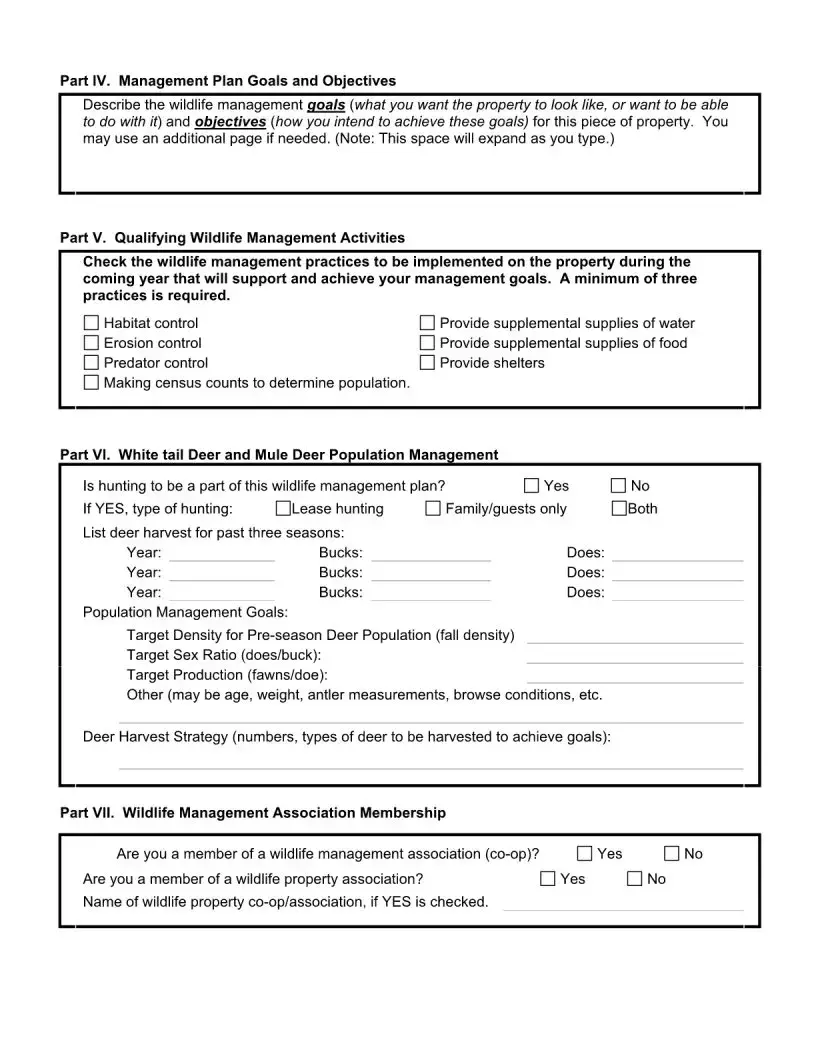
  9. In Part IV, describe your management goals and objectives for the property.
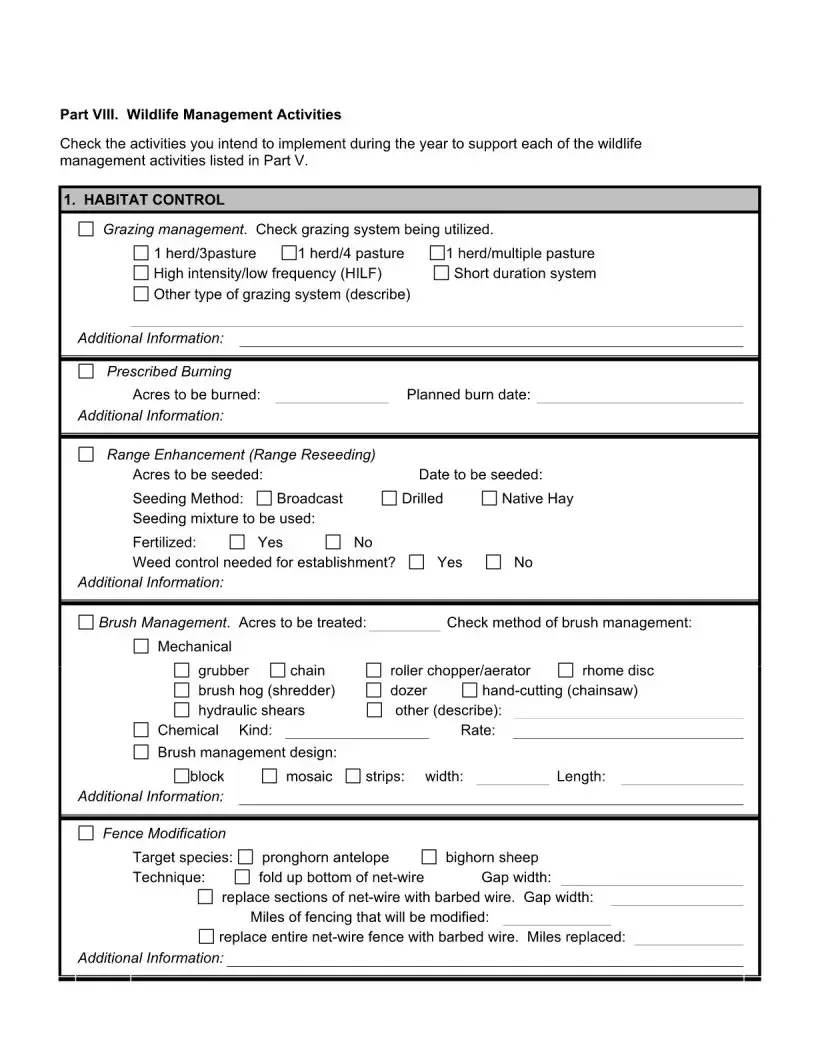
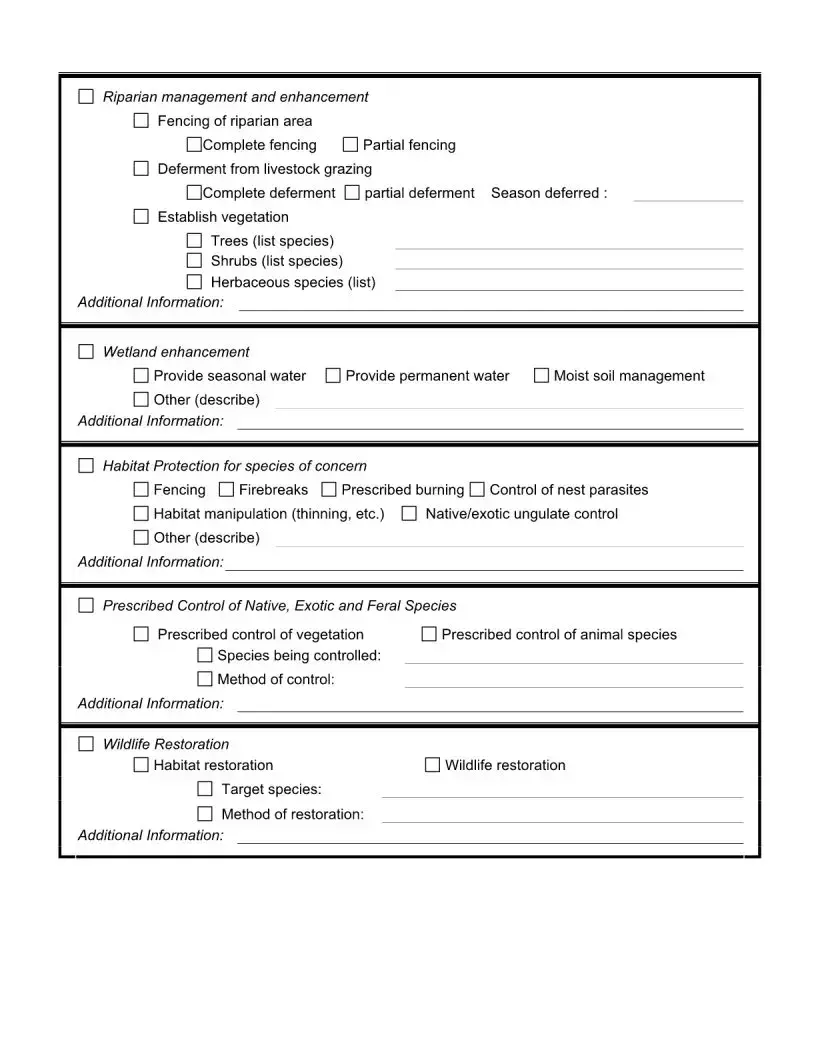
  10. Check the wildlife management practices you plan to implement in Part V.
  11. Indicate if hunting will be part of your management plan in Part VI.
  12. If applicable, provide details about deer harvest for the past three seasons.
  13. State your population management goals, including target density and sex ratio.
  14. Finally, indicate if you are a member of any wildlife property associations in Part VII.

Obtain Answers on Texas Pwd

  1. What is the purpose of the Texas PWD form?

    The Texas PWD form is designed to assist landowners in managing wildlife and enhancing habitat on their properties. It provides a structured way for landowners to request technical assistance from the Texas Parks and Wildlife Department (TPWD) and to report on wildlife management activities.

  2. What types of forms are included in the Texas PWD form?

    • PWD 153-7100-10/03: This form is for landowners requesting technical assistance from TPWD.
    • PWD 885-W7000: This form is for the 1-d-1 Open Space Agricultural Valuation Wildlife Management Plan, which must be submitted with the Open Space Agricultural Valuation Application.
    • PWD 885-W7000 Annual Reporting Form: This form is used for annual reporting of wildlife management activities, but is not automatically required.
  3. How should I submit the Landowner Request for Technical Assistance form?

    Landowners should complete the form and mail it to their local biologist at the Texas Parks and Wildlife Department. It is essential to provide accurate information about the property and contact details.

  4. Is the information I provide confidential?

    Yes, the information collected through the Landowner Request for Technical Assistance form is confidential. Section 12.0251 of the Parks and Wildlife Code ensures that specific details about location, species identification, and quantity of animal or plant life will not be disclosed. However, summarized information may be released without identifying individual landowners.

  5. What are the qualifications for submitting the Wildlife Management Plan?

    To qualify, landowners must outline their wildlife management goals and objectives, describe the property, and detail the management activities they plan to implement. A minimum of three wildlife management practices must be checked on the form.

  6. What happens if I do not submit the Annual Reporting Form?

    The Annual Reporting Form is not automatically required. If your county requests a report on wildlife management activities, the Chief Appraiser will provide the form. Therefore, if your county does not request it, you are not obligated to submit it.

  7. Can I receive assistance if I have a disability?

    Yes, the Texas Parks and Wildlife Department provides services without discrimination. This includes assistance for individuals with disabilities. For more information, you may contact TPWD at 512-389-4959.

Common mistakes

Filling out the Texas Parks and Wildlife Department (TPWD) forms can be a straightforward process, but there are common mistakes that landowners often make. One significant error is failing to provide complete contact information. When submitting forms like the Landowner Request for Technical Assistance, it is crucial to include accurate phone numbers and addresses. Incomplete information can lead to delays in receiving assistance or even result in the request being processed incorrectly.

Another frequent mistake involves misunderstanding the submission guidelines. For instance, the 1-d-1 Open Space Agricultural Valuation Wildlife Management Plan must be submitted to the county Chief Appraiser, not the TPWD. Ignoring this instruction can cause unnecessary confusion and may require landowners to resubmit their forms, wasting valuable time and effort.

Additionally, many landowners overlook the requirement to specify the legal description of their property. This detail is essential for identifying the land accurately. Without it, the TPWD may struggle to provide tailored recommendations. It is advisable to double-check that all property descriptions are precise and complete before sending in the form.

Lastly, some individuals fail to sign the forms or provide the necessary authorization if they are acting as agents for the landowner. A missing signature can render the application invalid. Ensuring that all required signatures are present is a critical step in the submission process. By avoiding these common pitfalls, landowners can facilitate a smoother experience when seeking assistance from the Texas Parks and Wildlife Department.

Documents used along the form

When working with the Texas PWD form, several other documents are often necessary to ensure compliance with state regulations and to facilitate effective wildlife management. Each of these forms serves a specific purpose, helping landowners manage their properties more effectively while adhering to the guidelines set forth by the Texas Parks and Wildlife Department.

  • Landowner Request for Technical Assistance (PWD 153-7100-10/03): This form allows landowners to seek technical guidance from the Texas Parks and Wildlife Department. By submitting it, landowners grant permission for staff to access their property for assessments aimed at improving habitat and wildlife management.
  • 1-d-1 Open Space Agricultural Valuation Wildlife Management Plan (PWD 885-W7000): This document is essential for landowners who wish to manage their land for wildlife as part of their agricultural practices. It must be submitted alongside the 1-d-1 Open Space Agricultural Valuation Application to the county Central Appraisal District.
  • 1-d-1 Open Space Agricultural Valuation Annual Reporting Form (PWD 885-W7000): While not always required, this form is provided to landowners by the Chief Appraiser in counties that request annual reports on wildlife management activities. It is crucial for tracking the effectiveness of management practices over time.
  • Wildlife Management Goals and Objectives Form: This form outlines the specific goals and objectives for wildlife management on a property. It helps landowners clarify their vision for the land and establish a plan to achieve those goals through targeted actions.
  • Habitat Management Practices Checklist: This checklist allows landowners to identify and commit to various management practices that will support their wildlife management goals. It ensures that at least three practices are implemented, promoting a comprehensive approach to habitat management.

These forms and documents are integral to the wildlife management process in Texas. By understanding and utilizing them effectively, landowners can enhance their property’s ecological value while complying with state regulations. Proper documentation not only aids in management but also fosters a better relationship with the Texas Parks and Wildlife Department.

Similar forms

When dealing with wildlife management and land use in Texas, several forms are similar to the Texas PWD form. Each of these documents serves a specific purpose but shares common themes of land management, wildlife conservation, and regulatory compliance. Here’s a look at five documents that are comparable:

  • Texas 1-d-1 Open Space Agricultural Valuation Application: This form is essential for landowners seeking agricultural valuation based on wildlife management. Like the Texas PWD form, it requires detailed property information and outlines the landowner's intentions regarding wildlife management practices.
  • Wildlife Management Plan Guidelines: These guidelines provide a framework for developing a comprehensive wildlife management plan. Similar to the Texas PWD form, they emphasize the importance of habitat enhancement and outline specific management goals, ensuring landowners understand the requirements for effective wildlife management.
  • Annual Wildlife Management Report: This document is used by landowners to report on their wildlife management activities over the year. Much like the Texas PWD form, it includes sections for detailing actions taken to support wildlife populations and habitat health, ensuring compliance with local regulations.
  • Landowner Assistance Program Application: This application allows landowners to request technical assistance for wildlife management. It parallels the Texas PWD form in that it involves a request for expert guidance and includes similar confidentiality provisions regarding the information shared with the Texas Parks and Wildlife Department.
  • Habitat Conservation Plan (HCP): An HCP outlines the measures landowners will take to protect endangered species and their habitats. Like the Texas PWD form, it requires a commitment to specific management practices and includes a detailed description of the property and its ecological significance.

Each of these documents plays a crucial role in wildlife management and land stewardship in Texas. Understanding their similarities can help landowners navigate the regulatory landscape more effectively.

Dos and Don'ts

When filling out the Texas PWD form, it is essential to adhere to certain guidelines to ensure accuracy and compliance. Below is a list of ten things to do and not to do during this process.

  • Do read all instructions carefully before starting to fill out the form.
  • Do provide accurate and complete information regarding your property and contact details.
  • Do ensure that you sign the form, certifying your ownership or authorization to act on behalf of the landowner.
  • Do submit the form to the appropriate local biologist or county Chief Appraiser, as specified.
  • Do keep a copy of the completed form for your records.
  • Don't submit the form directly to the Texas Parks and Wildlife Department unless instructed.
  • Don't leave any sections blank; provide information for all required fields.
  • Don't include personal information that is not requested on the form.
  • Don't forget to check the box regarding hunting if it applies to your management plan.
  • Don't use abbreviations or unclear terms that may confuse the reviewer.

Misconceptions

Misconceptions about the Texas PWD form can lead to confusion among landowners seeking assistance. Below are eight common misconceptions, along with clarifications for each.

  • The PWD form must be submitted to the Texas Parks and Wildlife Department. This is incorrect. The form is intended for local biologists, and landowners should mail it directly to them.
  • All landowners are required to complete the Annual Reporting Form. This is a misconception. The form is only provided to landowners if their county requests a report on wildlife management activities.
  • Information collected through the PWD form is public and can be accessed by anyone. This is misleading. Information regarding specific locations or species is confidential and cannot be disclosed without proper summarization.
  • Recommendations provided by the Texas Parks and Wildlife Department are mandatory. This is false. The guidelines offered are non-binding and voluntary for landowners to follow.
  • Landowners can submit the Wildlife Management Plan to the Texas Parks and Wildlife Department. This is incorrect. The plan must be submitted to the County Chief Appraiser, not the department.
  • Landowners must have a high fence to qualify for wildlife management assistance. This is a misconception. While high fencing can be relevant, it is not a requirement for all wildlife management activities.
  • Technical assistance is only available for large landowners. This is misleading. The Texas Parks and Wildlife Department provides assistance to all landowners, regardless of property size.
  • Landowners cannot correct any information collected through the PWD form. This is false. Under Texas law, landowners have the right to review and correct their information.

Key takeaways

Filling out and utilizing the Texas PWD form requires attention to detail and adherence to specific guidelines. Here are key takeaways to ensure proper submission and use of these forms:

  • Identify the Correct Form: Determine which form you need based on your specific needs, such as the Landowner Request for Technical Assistance or the Wildlife Management Plan.
  • Complete All Sections: Fill in all required sections of the form accurately. Incomplete forms may lead to delays or denial of assistance.
  • Submit to the Right Office: Mail the completed forms to the appropriate local biologist or the County Chief Appraiser, as specified. Do not send certain forms to Texas Parks and Wildlife Department.
  • Understand Confidentiality: Information collected is confidential and cannot be disclosed in a way that identifies individual landowners or specific properties.
  • Follow Recommendations: While recommendations provided are non-binding, they can significantly enhance your wildlife management efforts if implemented effectively.
  • Know Your Rights: Under Texas law, you have the right to access and correct information collected through these forms.
  • Seek Assistance if Needed: If you have questions or need help, contact Texas Parks and Wildlife Department at 512-389-4959 for guidance.

Adhering to these takeaways will facilitate a smoother process when filling out and utilizing the Texas PWD forms.