The Texas PWD 790 form, known as the Rights of Survivorship Ownership Agreement for a Boat and/or Outboard Motor, plays a vital role for individuals looking to establish joint ownership of watercraft. This form is essential for those who want to ensure that ownership automatically transfers to the surviving co-owner in the event of one owner's death. To complete the process, the PWD 790 must be submitted alongside the appropriate vessel or outboard motor application forms, specifically the PWD 143 and PWD 144, along with any necessary support documents and fees. This agreement not only outlines the ownership details but also mandates that both owners must consent to any future transactions involving the boat or motor, such as sales or transfers. Importantly, the form requires notarization, adding a layer of authenticity and legal validity to the agreement. It’s crucial for individuals filling out this form to provide accurate information, as falsifying details can lead to serious legal consequences. By understanding the Texas PWD 790 form and its requirements, owners can protect their interests and ensure a smooth transition of ownership should the need arise.
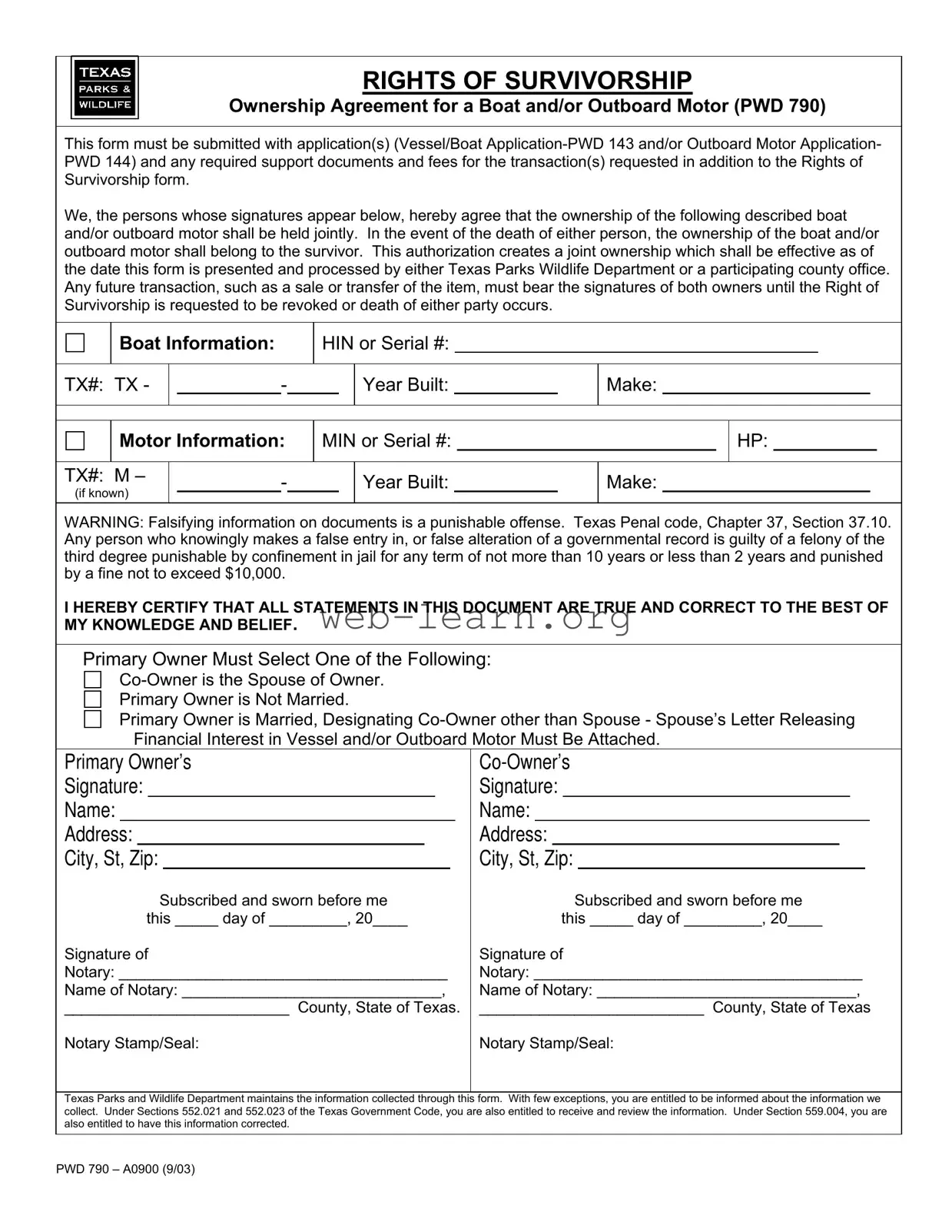
RIGHTS OF SURVIVORSHIP
Ownership Agreement for a Boat and/or Outboard Motor (PWD 790)
This form must be submitted with application(s) (Vessel/Boat
We, the persons whose signatures appear below, hereby agree that the ownership of the following described boat and/or outboard motor shall be held jointly. In the event of the death of either person, the ownership of the boat and/or outboard motor shall belong to the survivor. This authorization creates a joint ownership which shall be effective as of the date this form is presented and processed by either Texas Parks Wildlife Department or a participating county office. Any future transaction, such as a sale or transfer of the item, must bear the signatures of both owners until the Right of Survivorship is requested to be revoked or death of either party occurs.
|
Boat Information: |
|
|
HIN or Serial #: |
|
|
|
|
|
|
|
|
|
|
|
||||
|
|
|
|
|
|
|
|
|
|
|
|
|
|
|
|
|
|
|
|
TX#: TX - |
|
|
- |
|
|
|
Year Built: |
|
|
|
Make: |
|
|
|
|
||||
|
|
|
|
|
|
|
|
|
|
|
|
|
|
|
|
||||
|
|
|
|
|
|
|
|
|
|
|
|
|
|||||||
|
Motor Information: |
MIN or Serial #: |
|
|
|
|
|
|
HP: |
|
|
|
|||||||
|
|
|
|
|
|
|
|
|
|
|
|
|
|
|
|
|
|
||
TX#: M – |
|
- |
|
|
|
Year Built: |
|
|
|
Make: |
|
|
|
||||||
(if known) |
|
|
|
|
|
|
|
|
|
|
|
||||||||
|
|
|
|
|
|
|
|
|
|
|
|
|
|
|
|
|
|
||
|
|
|
|
|
|
|
|
|
|
|
|
|
|
|
|
|
|
|
|
WARNING: Falsifying information on documents is a punishable offense. Texas Penal code, Chapter 37, Section 37.10. Any person who knowingly makes a false entry in, or false alteration of a governmental record is guilty of a felony of the third degree punishable by confinement in jail for any term of not more than 10 years or less than 2 years and punished by a fine not to exceed $10,000.
I HEREBY CERTIFY THAT ALL STATEMENTS IN THIS DOCUMENT ARE TRUE AND CORRECT TO THE BEST OF MY KNOWLEDGE AND BELIEF.
Primary Owner Must Select One of the Following:
Primary Owner is Married, Designating
Primary Owner’s
Signature:
Name:
Address:
City, St, Zip:
Subscribed and sworn before me this _____ day of _________, 20____
Signature of
Notary: ______________________________________
Name of Notary: ______________________________,
__________________________ County, State of Texas.
Notary Stamp/Seal:
Signature:
Name:
Address:
City, St, Zip:
Subscribed and sworn before me this _____ day of _________, 20____
Signature of
Notary: ______________________________________
Name of Notary: ______________________________,
__________________________ County, State of Texas
Notary Stamp/Seal:
Texas Parks and Wildlife Department maintains the information collected through this form. With few exceptions, you are entitled to be informed about the information we collect. Under Sections 552.021 and 552.023 of the Texas Government Code, you are also entitled to receive and review the information. Under Section 559.004, you are also entitled to have this information corrected.
PWD 790 – A0900 (9/03)
| Fact Name | Details |
|---|---|
| Form Purpose | The PWD 790 form establishes a Rights of Survivorship agreement for joint ownership of a boat and/or outboard motor. |
| Submission Requirements | This form must be submitted alongside the Vessel/Boat Application (PWD 143) and/or Outboard Motor Application (PWD 144), along with any necessary supporting documents and fees. |
| Joint Ownership | Ownership is held jointly, and upon the death of one owner, the surviving owner automatically receives full ownership. |
| Transaction Requirements | Both owners must sign any future transactions involving the boat or motor until the Rights of Survivorship is revoked or one owner passes away. |
| Legal Warning | Falsifying information on the PWD 790 form is a felony under Texas Penal Code, Chapter 37, Section 37.10, punishable by up to 10 years in jail and a fine of up to $10,000. |
| Notary Requirement | The signatures of both owners must be notarized to validate the form and the agreement it represents. |
| Governing Law | The form is governed by the Texas Parks and Wildlife Code and relevant sections of the Texas Government Code, particularly Sections 552.021, 552.023, and 559.004. |
Filling out the Texas PWD 790 form is an important step in establishing joint ownership of a boat or outboard motor. Make sure you have all necessary information and documents ready before you start. Below are the steps to complete the form accurately.
Once completed, submit the form along with any required applications and fees to the Texas Parks and Wildlife Department or a participating county office. Ensure that all information is accurate to avoid any issues with the processing of your ownership agreement.
What is the Texas PWD 790 form?
The Texas PWD 790 form is an Ownership Agreement for a Boat and/or Outboard Motor. It establishes joint ownership between two parties, allowing the surviving owner to retain ownership of the vessel or motor in the event of one owner's death.
Who needs to fill out the PWD 790 form?
Both parties who wish to establish joint ownership of a boat or outboard motor must fill out and sign this form. It is essential for those who want to ensure that ownership passes directly to the surviving co-owner upon death.
What additional documents are required with the PWD 790 form?
This form must be submitted alongside the Vessel/Boat Application (PWD 143) and/or the Outboard Motor Application (PWD 144). Any required support documents and fees must also accompany the submission.
What happens if one of the owners dies?
In the event of the death of either co-owner, the ownership of the boat or outboard motor automatically transfers to the surviving owner. This transfer is effective as soon as the PWD 790 form is processed by the Texas Parks and Wildlife Department or a participating county office.
Can the PWD 790 form be revoked?
Yes, the Rights of Survivorship can be revoked. However, any future transactions involving the boat or motor must still include the signatures of both owners until the revocation is formally processed.
What are the penalties for falsifying information on the form?
Providing false information on the PWD 790 form is considered a felony under Texas law. The penalties can include imprisonment for 2 to 10 years and fines up to $10,000.
What should I do if I am married but want to designate a co-owner who is not my spouse?
If the primary owner is married and wishes to designate a co-owner who is not their spouse, a letter from the spouse releasing any financial interest in the vessel or motor must be attached to the PWD 790 form.
How is the information collected through the PWD 790 form protected?
The Texas Parks and Wildlife Department maintains the information collected through this form. Under Texas law, individuals have the right to access, review, and correct their information, with some exceptions.
Filling out the Texas PWD 790 form can seem straightforward, but many people make common mistakes that can lead to delays or complications. One frequent error occurs in the ownership designation. Applicants often forget to clarify the relationship between co-owners. If the co-owner is a spouse, it should be explicitly stated. Failing to do so can create confusion and may necessitate additional documentation.
Another mistake is related to the signatures. Both the primary owner and the co-owner must sign the form. Sometimes, individuals mistakenly believe that only one signature is necessary. This oversight can lead to the rejection of the application, as both parties must agree to the terms of joint ownership.
Inaccurate information about the boat or outboard motor is another common pitfall. Applicants frequently misreport details such as the HIN or serial number, year built, or make of the vessel. These inaccuracies can cause significant issues, as the Texas Parks and Wildlife Department relies on this information for proper identification and registration.
People often neglect to attach required documents, particularly when designating a co-owner who is not a spouse. A spouse's letter releasing financial interest must accompany the form in these cases. Forgetting this step can halt the processing of the application until the necessary documentation is provided.
Another area of concern is the completion of the notary section. Some applicants fail to have their signatures notarized correctly. The form must be sworn before a notary public, and missing this step can render the document invalid. It is crucial to ensure that the notary's signature and seal are present and legible.
Additionally, people sometimes overlook the warning about falsifying information. The consequences of providing false information are serious, including potential criminal charges. Applicants should take care to ensure that all statements are accurate and truthful to avoid legal repercussions.
Another common error is not reviewing the entire form before submission. Many individuals rush through the process and miss errors that could easily be caught with a careful review. Taking the time to double-check all entries can save significant time and effort later.
Finally, applicants may misunderstand the implications of joint ownership. They often do not fully grasp that both owners must agree on any future transactions involving the boat or motor. This misunderstanding can lead to disputes later, particularly if one owner wishes to sell or transfer the vessel without the other's consent.
When completing the Texas PWD 790 form, several other documents may be necessary to ensure a smooth transaction. Each of these forms serves a specific purpose in the ownership and registration process of boats and outboard motors. Below is a list of related forms that are often used in conjunction with the PWD 790.
These forms work together to clarify ownership and ensure compliance with Texas regulations. Completing each document accurately is crucial for a seamless registration process and to avoid potential legal issues in the future.
The Texas PWD 790 form serves as an important document for establishing joint ownership of a boat or outboard motor, particularly with a focus on the rights of survivorship. Similar documents often share the purpose of outlining ownership rights or transferring interests in property. Below are ten documents that are comparable to the Texas PWD 790 form, along with a brief explanation of how each relates to it.
Each of these documents shares a common goal of clarifying ownership rights and ensuring a smooth transition of assets, much like the Texas PWD 790 form does for boats and outboard motors.
When filling out the Texas PWD 790 form, it’s essential to follow certain guidelines to ensure your application is processed smoothly. Here are some important dos and don’ts to keep in mind:
By following these guidelines, you can help ensure that your submission is handled efficiently and accurately.
Understanding the Texas PWD 790 form is essential for anyone involved in joint ownership of a boat or outboard motor. However, several misconceptions can lead to confusion. Below are nine common misconceptions about this form, along with clarifications.
Being aware of these misconceptions can help ensure a smoother process when dealing with joint ownership of boats and outboard motors in Texas.
When filling out and using the Texas PWD 790 form, it’s essential to understand its implications and requirements. Here are some key takeaways to keep in mind:
Understanding these key points can help ensure that the process of establishing joint ownership is smooth and legally sound. It is crucial to approach this task with care and attention to detail.