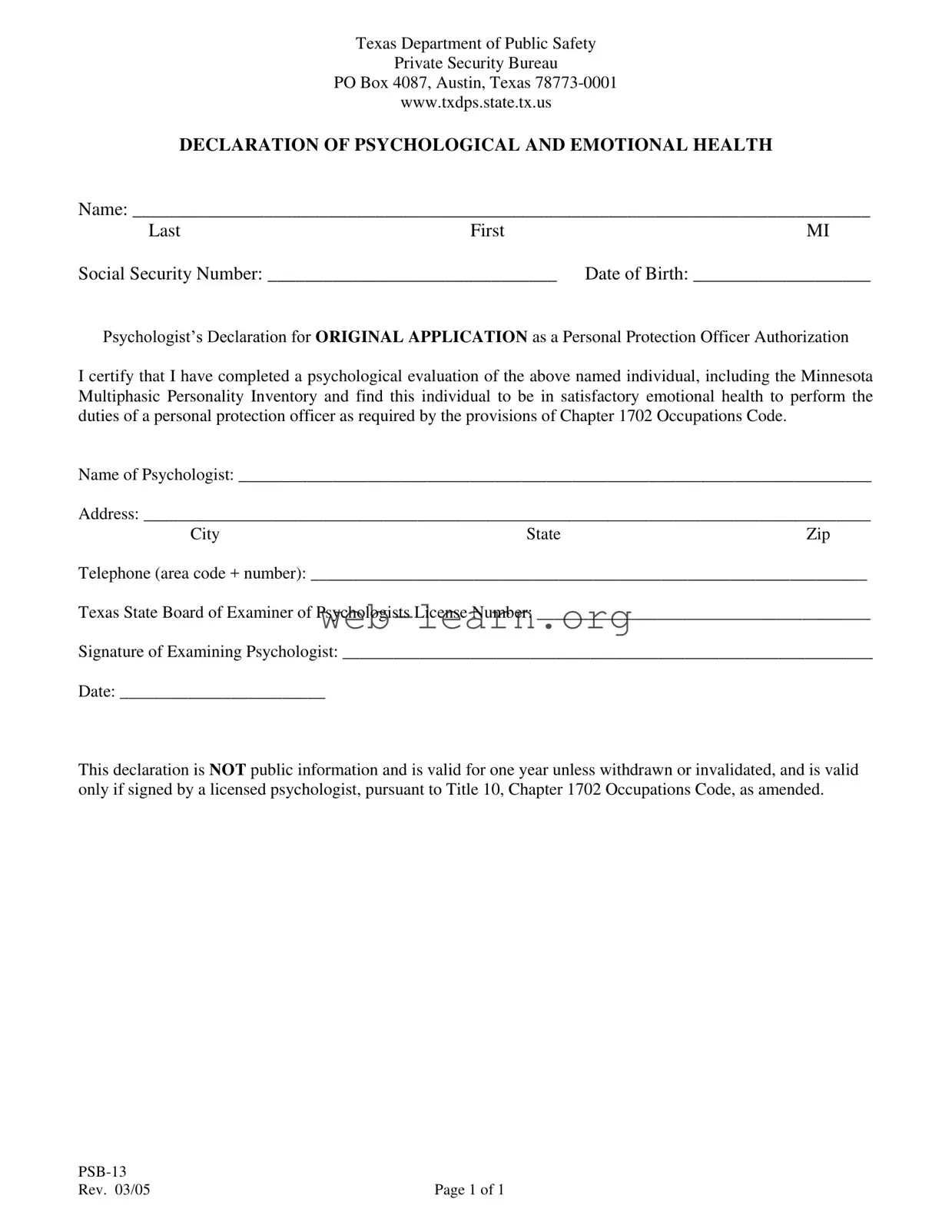
The Texas PSB 13 form plays a crucial role in the licensing process for individuals seeking to become personal protection officers in the state. This form is specifically designed to ensure that applicants meet the psychological and emotional health standards necessary for such a demanding role. At its core, the PSB 13 requires a licensed psychologist to conduct a thorough evaluation of the applicant, which includes administering the Minnesota Multiphasic Personality Inventory. This assessment helps determine whether the individual is emotionally fit to handle the responsibilities associated with personal protection duties. The form also captures essential personal information, such as the applicant's name, Social Security number, and date of birth. Furthermore, it mandates the psychologist's details, including their license number and signature, affirming the validity of the evaluation. Importantly, the declaration is not considered public information and remains valid for one year, unless it is withdrawn or invalidated. By adhering to these requirements, the PSB 13 form ensures that only those who are psychologically prepared are entrusted with the safety and security of others.
Texas Department of Public Safety
Private Security Bureau
PO Box 4087, Austin, Texas
www.txdps.state.tx.us
DECLARATION OF PSYCHOLOGICAL AND EMOTIONAL HEALTH
Name: _______________________________________________________________________________
Last |
First |
MI |
Social Security Number: _______________________________ |
Date of Birth: ___________________ |
|
Psychologist’s Declaration for ORIGINAL APPLICATION as a Personal Protection Officer Authorization
I certify that I have completed a psychological evaluation of the above named individual, including the Minnesota Multiphasic Personality Inventory and find this individual to be in satisfactory emotional health to perform the duties of a personal protection officer as required by the provisions of Chapter 1702 Occupations Code.
Name of Psychologist: __________________________________________________________________________
Address: _____________________________________________________________________________________
CityStateZip
Telephone (area code + number): _________________________________________________________________
Texas State Board of Examiner of Psychologists License Number: _______________________________________
Signature of Examining Psychologist: ______________________________________________________________
Date: ________________________
This declaration is NOT public information and is valid for one year unless withdrawn or invalidated, and is valid only if signed by a licensed psychologist, pursuant to Title 10, Chapter 1702 Occupations Code, as amended.
|
|
Rev. 03/05 |
Page 1 of 1 |
| Fact Name | Description |
|---|---|
| Governing Law | The Texas PSB 13 form is governed by Title 10, Chapter 1702 of the Texas Occupations Code. |
| Purpose | This form serves as a declaration of psychological and emotional health for individuals applying to become personal protection officers. |
| Validity Period | The declaration is valid for one year unless it is withdrawn or invalidated. |
| Confidentiality | The information contained in the PSB 13 form is not considered public information. |
| Required Evaluation | A psychological evaluation must include the Minnesota Multiphasic Personality Inventory. |
| Licensed Psychologist | The form must be signed by a licensed psychologist to be valid. |
| Submission Address | Completed forms should be sent to the Texas Department of Public Safety, Private Security Bureau, PO Box 4087, Austin, Texas 78773-0001. |
| Contact Information | The Texas Department of Public Safety provides a website at www.txdps.state.tx.us for additional resources and information. |
Completing the Texas PSB 13 form is an important step in the process of applying for a Personal Protection Officer license. Ensure that all information is accurate and complete to avoid delays in processing. Below are the steps to fill out the form correctly.
After completing the form, review it for accuracy before submitting it to the appropriate address. This ensures that your application progresses smoothly.
What is the Texas PSB 13 form?
The Texas PSB 13 form is a declaration of psychological and emotional health required for individuals applying to become personal protection officers in Texas. It verifies that the applicant has undergone a psychological evaluation and meets the necessary emotional health standards as mandated by Texas law.
Who needs to complete the PSB 13 form?
Individuals applying for a personal protection officer license must complete the PSB 13 form. This includes those seeking to work in security roles that involve personal protection services.
What does the evaluation process involve?
The evaluation process includes a psychological assessment, which typically involves the Minnesota Multiphasic Personality Inventory (MMPI). This assessment helps determine the applicant's emotional and psychological fitness for the responsibilities of a personal protection officer.
Who conducts the psychological evaluation?
A licensed psychologist must conduct the psychological evaluation. The psychologist will fill out the PSB 13 form, certifying that the applicant is in satisfactory emotional health to perform their duties.
How long is the PSB 13 form valid?
The PSB 13 form is valid for one year from the date of the psychologist's signature. It can be invalidated or withdrawn before the year is up if necessary.
Is the information on the PSB 13 form public?
No, the information contained in the PSB 13 form is not public. It is considered confidential and is protected under Texas law.
What should I do if my psychological evaluation is unfavorable?
If your psychological evaluation does not meet the required standards, it may be beneficial to discuss the results with the psychologist. They can provide insights and possibly recommend steps to improve your emotional health before reapplying.
Can I use a PSB 13 form from another state?
No, the PSB 13 form is specific to Texas and must be completed by a licensed psychologist in Texas. Evaluations from other states may not be accepted.
What happens if I fail to submit the PSB 13 form with my application?
Failing to submit the PSB 13 form with your application will likely result in a delay or denial of your application for a personal protection officer license. It is crucial to include this form to ensure your application is complete.
Where do I send the completed PSB 13 form?
The completed PSB 13 form should be sent to the Texas Department of Public Safety, Private Security Bureau, at the following address:
PO Box 4087, Austin, Texas 78773-0001
Filling out the Texas PSB 13 form requires careful attention to detail. One common mistake individuals make is leaving out essential personal information. The form requests specific details, such as the full name and Social Security number. Omitting any of this information can lead to delays or even rejection of the application.
Another frequent error involves providing incorrect or incomplete information regarding the psychologist. The name, address, and license number of the examining psychologist must be accurately filled out. Errors in this section can raise questions about the validity of the psychological evaluation.
Many applicants overlook the requirement for a signature from the examining psychologist. Without this signature, the declaration is considered invalid. It is crucial to ensure that the psychologist has signed the form before submission.
Some individuals fail to understand the importance of the date on the form. The declaration is only valid for one year unless it is withdrawn or invalidated. Submitting a form with an outdated date can lead to complications in the application process.
In addition, applicants sometimes neglect to verify that the psychologist is licensed in Texas. The Texas State Board of Examiners of Psychologists requires that only licensed professionals conduct these evaluations. Using an unlicensed psychologist can invalidate the entire application.
Another mistake is not thoroughly reviewing the completed form before submission. Errors such as typos or missing information can easily occur. Taking the time to review the form can prevent unnecessary delays and ensure that all required information is present.
Some applicants may also fail to keep a copy of the submitted form for their records. Having a copy can be beneficial for future reference or in case any issues arise during the application process.
Additionally, individuals sometimes misunderstand the confidentiality of the declaration. The form states that it is not public information, yet some may worry about privacy. It is important to understand that this information is protected under Texas law.
Lastly, applicants might misinterpret the requirements for the psychological evaluation itself. It is essential to ensure that the evaluation includes the Minnesota Multiphasic Personality Inventory as specified. Failing to meet this requirement can result in an incomplete application.
By being aware of these common mistakes, individuals can improve their chances of successfully completing the Texas PSB 13 form and moving forward in the application process.
The Texas PSB 13 form is an essential document used in the application process for individuals seeking to become personal protection officers. Along with this form, several other documents are typically required to ensure a thorough evaluation of the applicant's qualifications and fitness for the role. Below is a list of additional forms and documents that are often submitted alongside the Texas PSB 13 form.
These documents collectively support the application process and help ensure that only qualified individuals are granted the authority to serve as personal protection officers in Texas. Properly completing and submitting all required forms is crucial for a successful application outcome.
The Texas PSB 13 form is essential for personal protection officers, ensuring they meet psychological and emotional health standards. Several other documents serve similar purposes in different contexts. Here are four documents that share similarities with the Texas PSB 13 form:
When filling out the Texas PSB 13 form, it is important to follow specific guidelines to ensure accuracy and compliance. Here are five things you should and shouldn't do:
Here are five misconceptions about the Texas PSB 13 form:
Filling out the Texas PSB 13 form is an important step for individuals seeking to become licensed personal protection officers. Here are some key takeaways to keep in mind:
By keeping these points in mind, individuals can navigate the process of completing the Texas PSB 13 form more effectively and ensure compliance with state requirements.