Homepage Blank Texas Premarital Course Certificate Form
Outline

The Texas Premarital Course Certificate form plays a crucial role in the preparation of couples for marriage. This certificate serves as a formal acknowledgment that both partners have completed a qualifying premarital education course together. Such courses typically cover a range of essential topics, including conflict management, communication skills, financial responsibilities, and parenting duties, among others. The requirement of at least six hours of instruction ensures that couples engage deeply with these critical areas, fostering a stronger foundation for their future together. Additionally, the form must be completed by a qualified professional—such as a licensed counselor, psychologist, or member of the clergy—who verifies the couple's participation and the course's compliance with established guidelines. This certification not only signifies the couple's commitment to understanding the complexities of marriage but may also provide benefits, such as reduced waiting periods for marriage licenses in certain jurisdictions. Completing this course is an important step that many couples choose to take seriously, recognizing the value of preparation in building a lasting partnership.

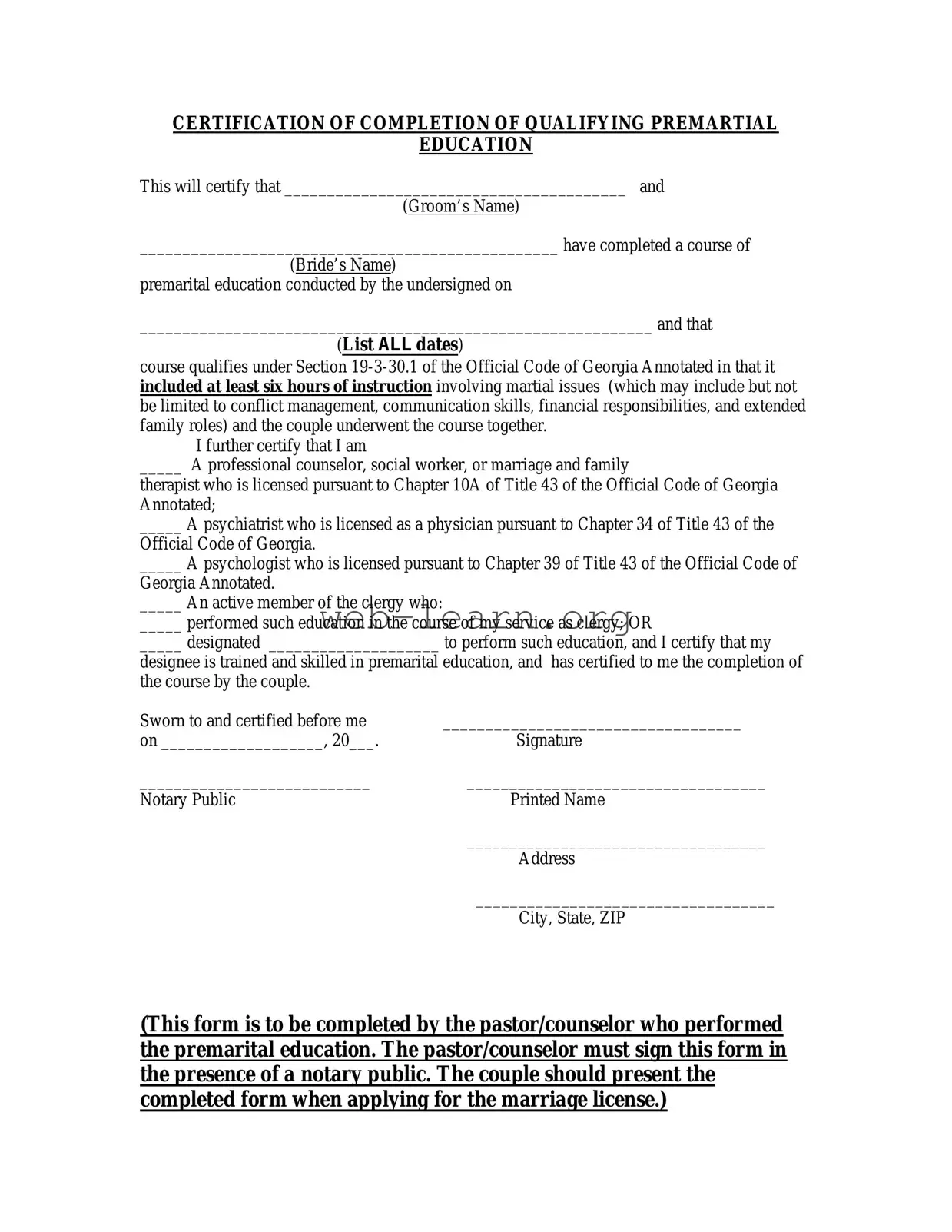
Sample - Texas Premarital Course Certificate Form

CERTIFICATION OF COMPLETION OF QUALIFYING PREMARTIAL

EDUCATION

This will certify that ________________________________________ and

(Groom’s Name)

_________________________________________________ have completed a course of

(Bride’s Name)

premarital education conducted by the undersigned on

____________________________________________________________ and that

(List ALL dates)

course qualifies under Section 19-3-30.1 of the Official Code of Georgia Annotated in that it included at least six hours of instruction involving martial issues (which may include but not be limited to conflict management, communication skills, financial responsibilities, and extended family roles) and the couple underwent the course together.

I further certify that I am

_____ A professional counselor, social worker, or marriage and family

therapist who is licensed pursuant to Chapter 10A of Title 43 of the Official Code of Georgia Annotated;

_____ A psychiatrist who is licensed as a physician pursuant to Chapter 34 of Title 43 of the

Official Code of Georgia.

_____ A psychologist who is licensed pursuant to Chapter 39 of Title 43 of the Official Code of

Georgia Annotated.

_____ An active member of the clergy who:

_____ performed such education in the course of my service as clergy; OR

_____ designated ____________________ to perform such education, and I certify that my

designee is trained and skilled in premarital education, and has certified to me the completion of the course by the couple.

Sworn to and certified before me

___________________________________

on ___________________, 20___.

Signature

___________________________

___________________________________

Notary Public

Printed Name


___________________________________


Address


___________________________________


City, State, ZIP

(This form is to be completed by the pastor/counselor who performed the premarital education. The pastor/counselor must sign this form in the presence of a notary public. The couple should present the completed form when applying for the marriage license.)

Form Information

Fact Name Description
Purpose This certificate verifies that a couple has completed a qualifying premarital education course.
Course Duration The course must include at least six hours of instruction on marital issues.
Topics Covered Instruction may include conflict management, communication skills, financial responsibilities, child and parenting responsibilities, and extended family roles.
Governing Law This certificate is governed by Section 19-3-30.1 of the Official Code of Georgia Annotated.
Instructor Qualifications Only licensed professionals such as counselors, social workers, therapists, psychiatrists, psychologists, or clergy can conduct the course.
Joint Participation The couple must undergo the course together to qualify for the certificate.
Notary Requirement The certificate must be sworn to and certified before a notary public.

Detailed Guide for Filling Out Texas Premarital Course Certificate

Completing the Texas Premarital Course Certificate form requires careful attention to detail. This document serves as proof that a couple has successfully completed a qualifying premarital education course. Follow the steps outlined below to ensure accurate completion of the form.

  1. Identify the couple's names: Write the full names of both individuals who completed the course in the designated space.
  2. Enter the completion date: Fill in the date when the course was completed. This should be the exact date of the last session.
  3. Specify the course details: Ensure that the course included at least six hours of instruction on relevant marital issues. This can include topics such as conflict management and communication skills.
  4. Certify the instructor's qualifications: Indicate the title and qualifications of the instructor. This could be a licensed counselor, social worker, psychiatrist, psychologist, or clergy member.
  5. Provide the instructor's signature: The instructor must sign the form, confirming the completion of the course by the couple.
  6. Include the notary information: The form requires a notary public's signature. Ensure the notary's name, address, and any required identification numbers are filled out correctly.
  7. Complete the address section: Fill in the instructor's address, including city, state, and ZIP code, to provide a complete record.

Once the form is filled out completely, it should be submitted to the relevant authorities or kept for personal records, depending on the requirements of the marriage license application process.

Obtain Answers on Texas Premarital Course Certificate

  1. What is the Texas Premarital Course Certificate?

    The Texas Premarital Course Certificate is a document that proves a couple has completed a premarital education course. This course is designed to help couples prepare for marriage by covering important topics such as communication, conflict resolution, and financial responsibilities.

  2. Why should couples complete this course?

    Completing the premarital course can be beneficial for couples in many ways. It helps them understand each other's perspectives, learn effective communication strategies, and tackle potential issues before they arise. Moreover, couples who complete this course may qualify for a discount on their marriage license fees in Texas.

  3. What topics are typically covered in the course?

    The course usually includes at least six hours of instruction on various marital issues. These can include:

    • Conflict management
    • Communication skills
    • Financial responsibilities
    • Child and parenting responsibilities
    • Extended family roles
  4. Who can conduct the premarital education course?

    The course must be conducted by a qualified professional. This can include:

    • A licensed professional counselor, social worker, or marriage and family therapist
    • A licensed psychiatrist
    • A licensed psychologist
    • An active member of the clergy who has been designated to perform such education
  5. How do couples obtain the certificate?

    After successfully completing the premarital education course, the instructor will provide a certificate. This certificate will include details such as the couple's names, the date of completion, and the instructor's credentials.

  6. Is the certificate required to get a marriage license in Texas?

    While the Texas Premarital Course Certificate is not mandatory for obtaining a marriage license, having one can provide benefits. Couples who present this certificate may be eligible for a discount on their marriage license fees.

  7. How long is the certificate valid?

    The Texas Premarital Course Certificate does not expire. However, it is essential to present it when applying for the marriage license, as it serves as proof of course completion.

Common mistakes

Completing the Texas Premarital Course Certificate form is an important step for couples preparing for marriage. However, there are common mistakes that can lead to delays or complications. One frequent error is failing to include both partners' names in the designated fields. It is essential that both individuals are clearly identified to ensure the certificate is valid.

Another mistake involves incorrect dates. The date of course completion must be accurate and match the date the couple actually attended the course. A mismatch can cause confusion and may result in the certificate being rejected.

Many couples overlook the requirement for a signature from the professional who conducted the course. This signature is crucial, as it verifies that the couple completed the necessary education. Without it, the form may be considered incomplete.

Additionally, some individuals neglect to check that the professional completing the form is appropriately licensed. The form specifies that the educator must hold a valid license in their field, such as counseling or psychology. Using an unqualified individual can invalidate the certificate.

Providing an incomplete address for the notary public is another common oversight. The notary's printed name, address, and other identifying information must be included to ensure the certificate is properly notarized.

Lastly, couples sometimes forget to double-check the overall presentation of the form. Errors in spelling, grammar, or formatting can lead to misunderstandings or delays in processing. Taking the time to review the form carefully can help avoid these pitfalls.

Documents used along the form

When preparing for marriage in Texas, couples often need various documents alongside the Texas Premarital Course Certificate. Each of these documents serves a specific purpose in ensuring that couples are well-prepared for their future together. Below is a list of commonly used forms and documents.

  • Marriage License Application: This document must be completed and submitted to obtain a marriage license. It typically requires personal information about both partners, such as names, addresses, and identification details.
  • Marriage License: Once the application is approved, couples receive a marriage license. This legal document allows them to marry and is usually valid for a limited time.
  • Affidavit of Consent: If one or both partners are underage, this affidavit may be required. It serves as a formal consent from parents or guardians, allowing the underage individual to marry.
  • Pre-marital Counseling Agreement: This document outlines the terms of the premarital counseling sessions. It often includes details about the counselor's qualifications and the topics to be discussed.
  • Financial Disclosure Statement: Couples may choose to complete this statement to share their financial situations. It can help foster transparency and communication regarding finances in the marriage.
  • Postnuptial Agreement: While this is typically created after marriage, some couples may consider it before the wedding. It outlines the distribution of assets and responsibilities, should the marriage end.
  • Certificate of Completion for Counseling: Similar to the premarital course certificate, this document verifies completion of any additional counseling sessions that may be recommended.
  • Witness Statements: Some couples may want to have statements from witnesses who can attest to their relationship and readiness for marriage. This can be useful for legal or personal reasons.

Gathering these documents can help ensure a smooth wedding planning process. Each form plays a crucial role in preparing couples for their new life together, addressing both legal and personal aspects of marriage.

Similar forms

  • Marriage License Application: Similar to the Texas Premarital Course Certificate, this document is required for couples planning to marry. It often requires proof of premarital education completion in some states.
  • Divorce Decree: This document outlines the terms of a divorce. Like the premarital course certificate, it signifies that a couple has undergone a formal process regarding their relationship.
  • Child Custody Agreement: This agreement details custody arrangements for children. Both documents involve significant planning and understanding of family dynamics.
  • Power of Attorney: This document allows one person to act on behalf of another. It requires trust and understanding, similar to the trust built during premarital education.
  • Living Will: A living will outlines medical preferences. Like the premarital course, it involves communication about important life decisions.
  • Financial Planning Agreement: This document outlines financial responsibilities in a relationship. It shares similarities with the premarital course in addressing financial issues.
  • Parenting Plan: This plan is created to guide co-parenting after separation. It, too, emphasizes communication and responsibility, much like premarital education.
  • Pre-Nuptial Agreement: A pre-nup outlines asset division in case of divorce. It requires open discussions about finances and expectations, akin to the discussions in a premarital course.
  • Marriage Certificate: This official document confirms a couple's marriage. It is the end result of the commitment process, which often begins with premarital education.
  • Affidavit of Support: This document is used in immigration processes to show financial support. It requires a commitment similar to that found in premarital education.

Dos and Don'ts

When filling out the Texas Premarital Course Certificate form, it’s important to follow specific guidelines to ensure accuracy and compliance. Here’s a helpful list of what you should and shouldn’t do:

  • Do ensure that both partners' names are clearly written on the form.
  • Do include the date when the premarital course was completed.
  • Do verify that the course meets the state requirements, including the minimum hours of instruction.
  • Do have the form signed by a qualified professional, such as a licensed counselor or member of the clergy.
  • Do keep a copy of the completed form for your records.
  • Don't leave any sections blank; incomplete forms may lead to delays.
  • Don't use abbreviations or nicknames for names; full legal names are required.
  • Don't forget to check for spelling errors before submission.
  • Don't submit the form without the necessary signatures and notary verification.
  • Don't assume the form is valid without confirming it meets all legal requirements.

Misconceptions

Understanding the Texas Premarital Course Certificate form can be a bit confusing. Here are nine common misconceptions that people often have:

  1. It’s only required for a marriage license. Many believe that the certificate is mandatory for obtaining a marriage license in Texas. While it can provide benefits, it is not a strict requirement.
  2. Any premarital course qualifies. Not all courses will meet the state’s requirements. The course must include at least six hours of instruction on specific marital topics.
  3. Only licensed professionals can conduct the course. While many courses are led by licensed professionals, there are also courses offered by qualified clergy members or trained individuals.
  4. It’s a waste of time. Some couples think the course is unnecessary. However, many find that it helps improve communication and understanding in their relationship.
  5. Completion of the course guarantees a successful marriage. While the course provides valuable tools, success in marriage ultimately depends on the couple's commitment and effort.
  6. The certificate is valid forever. The certificate is specific to the couple and their marriage application. It doesn't carry over to future marriages.
  7. You can take the course after getting married. The course is designed for couples before they tie the knot. Taking it afterward may not provide the same benefits.
  8. All courses are the same. Courses can vary significantly in content and quality. It’s essential to research and choose one that fits your needs.
  9. The certificate is difficult to obtain. In reality, once you complete the course, receiving the certificate is usually straightforward, provided the course meets state requirements.

By clearing up these misconceptions, couples can better prepare for their marriage and make informed decisions about their premarital education.

Key takeaways

When considering the Texas Premarital Course Certificate form, it is essential to understand its significance and requirements. Below are key takeaways to keep in mind:

  • Completion Requirement: Both partners must complete the premarital education course together for the certificate to be valid.
  • Duration of Course: The course must consist of at least six hours of instruction that covers various marital topics.
  • Qualified Instructors: Only certified professionals, such as licensed counselors, therapists, or clergy, can conduct the course.
  • Content Focus: Instruction should include essential topics like conflict management, communication skills, financial responsibilities, and parenting roles.
  • Certification Process: The instructor must sign and date the certificate, confirming the couple's completion of the course.
  • Notary Requirement: The certificate must be sworn before a notary public to ensure its authenticity.
  • Submission for Benefits: Couples may need to submit this certificate to receive benefits, such as a discount on marriage licenses in Texas.