The Texas Plaintiffs Petition form is a crucial document for tenants seeking legal recourse after an improper lockout from their rental property. This form serves two primary purposes: it requests an emergency writ of reentry, allowing tenants to regain access to their homes, and it seeks damages for the unlawful eviction. Tenants can claim actual damages, twice the amount of their monthly rent plus an additional $500, reasonable attorney's fees, and court costs. The form is designed for use in justice court, which is the only court authorized to issue a writ of reentry. While the form includes helpful instructions, further resources like "Sue Your Landlord" can guide tenants through the entire process of filing the lawsuit and presenting their case. Completing the form involves filling in specific details, such as the case number assigned by the court clerk, the correct precinct and place of the court, and the names and addresses of both the plaintiff and defendant. Ensuring that all information is accurate is vital, as it facilitates the timely serving of court papers. After signing the form, tenants must make copies for their records and for serving the defendant, ensuring they are well-prepared for the upcoming legal proceedings.
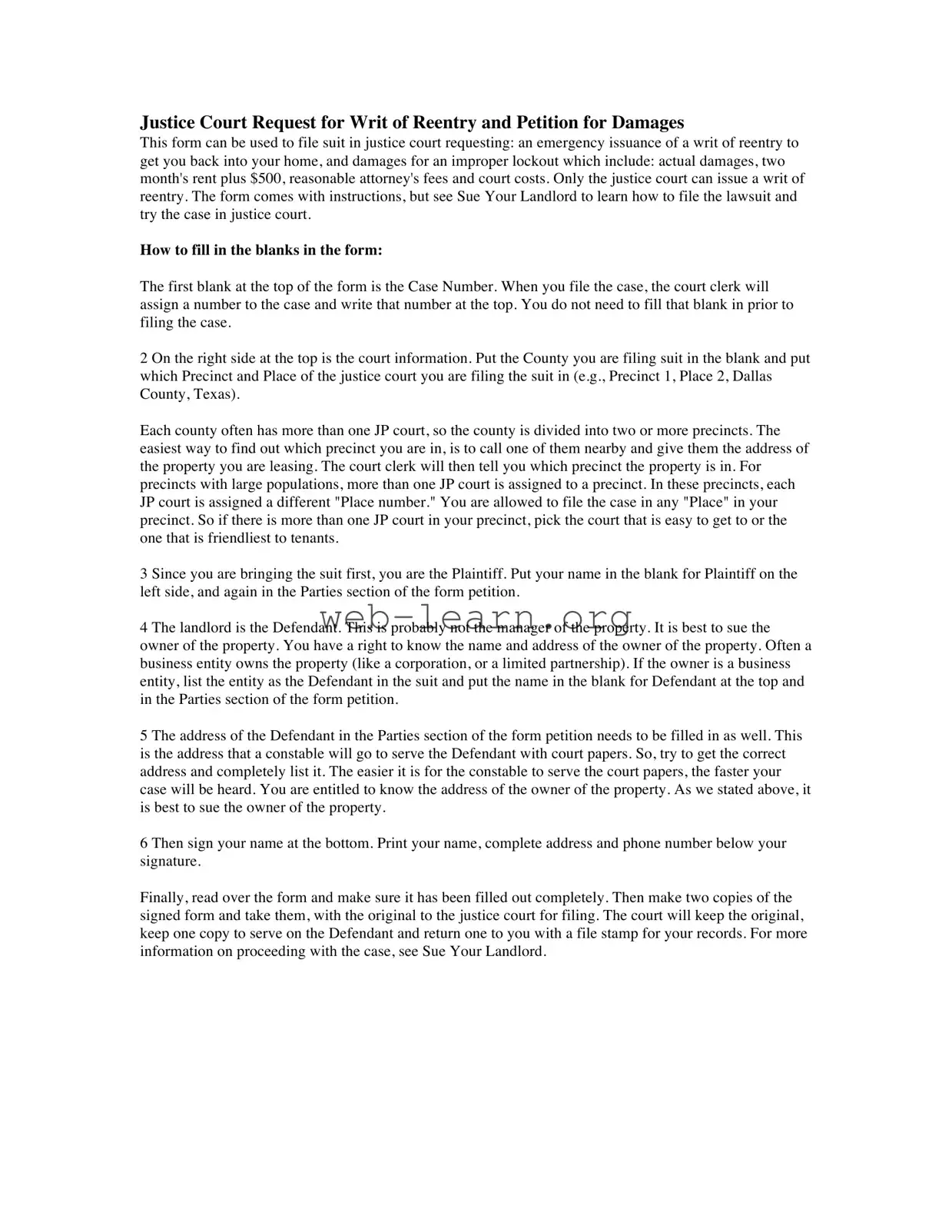
Justice Court Request for Writ of Reentry and Petition for Damages
This form can be used to file suit in justice court requesting: an emergency issuance of a writ of reentry to
get you back into your home, and damages for an improper lockout which include: actual damages, two month's rent plus $500, reasonable attorney's fees and court costs. Only the justice court can issue a writ of reentry. The form comes with instructions, but see Sue Your Landlord to learn how to file the lawsuit and try the case in justice court.
How to fill in the blanks in the form:
The first blank at the top of the form is the Case Number. When you file the case, the court clerk will assign a number to the case and write that number at the top. You do not need to fill that blank in prior to filing the case.
2 On the right side at the top is the court information. Put the County you are filing suit in the blank and put which Precinct and Place of the justice court you are filing the suit in (e.g., Precinct 1, Place 2, Dallas County, Texas).
Each county often has more than one JP court, so the county is divided into two or more precincts. The easiest way to find out which precinct you are in, is to call one of them nearby and give them the address of the property you are leasing. The court clerk will then tell you which precinct the property is in. For precincts with large populations, more than one JP court is assigned to a precinct. In these precincts, each JP court is assigned a different "Place number." You are allowed to file the case in any "Place" in your precinct. So if there is more than one JP court in your precinct, pick the court that is easy to get to or the one that is friendliest to tenants.
3 Since you are bringing the suit first, you are the Plaintiff. Put your name in the blank for Plaintiff on the left side, and again in the Parties section of the form petition.
4 The landlord is the Defendant. This is probably not the manager of the property. It is best to sue the owner of the property. You have a right to know the name and address of the owner of the property. Often a business entity owns the property (like a corporation, or a limited partnership). If the owner is a business entity, list the entity as the Defendant in the suit and put the name in the blank for Defendant at the top and in the Parties section of the form petition.
5 The address of the Defendant in the Parties section of the form petition needs to be filled in as well. This is the address that a constable will go to serve the Defendant with court papers. So, try to get the correct address and completely list it. The easier it is for the constable to serve the court papers, the faster your case will be heard. You are entitled to know the address of the owner of the property. As we stated above, it is best to sue the owner of the property.
6 Then sign your name at the bottom. Print your name, complete address and phone number below your signature.
Finally, read over the form and make sure it has been filled out completely. Then make two copies of the signed form and take them, with the original to the justice court for filing. The court will keep the original, keep one copy to serve on the Defendant and return one to you with a file stamp for your records. For more information on proceeding with the case, see Sue Your Landlord.
NO. _________________
(filled in by court)
_________________________________, |
) |
IN THE JUSTICE COURT |
PLAINTIFF (Your Name), |
) |
|
vs. |
) |
|
|
) |
PRECINCT ___, PLACE ___ |
|
) |
|
_________________________________, |
) |
|
DEFENDANT (Landlord). |
) |
_________ COUNTY, TEXAS |
PLAINTIFF'S ORIGINAL PETITION AND EMERGENCY APPLICATION FOR
WRIT OF REENTRY
TO THE HONORABLE JUDGE OF THE COURT:
Plaintiff files this original petition and emergency application for writ of reentry in the
I.DISCOVERY
1.Plaintiff intends to conduct discovery under Level 1.
II.PARTIES
2.______________________, Plaintiff, is a resident of the county of this Court, within Texas.
3.______________________, Defendant, may be served at the following address:
_________________________________________________________________.
III.JURISDICTION AND VENUE
4.The amount in controversy is within the jurisdictional limits of this Court, and venue is proper as the cause of action arose in the county of this Court within Texas.
IV. FACTS
5.Plaintiff leased premises from Defendant.
6.Defendant locked Plaintiff out of the premises in violation of Section 92.008 of the Texas Property Code and Defendant has been unable to regain entry.
Plaintiff's Original Petition and Emergency Application for Writ of Reentry
V. CAUSE OF ACTION
7.Defendant is liable to Plaintiff for improperly locking out Plaintiff. Pursuant to Section 92.008 and 92.009 of the Texas Property Code, Plaintiff requests the Court issue a writ of reentry to allow Plaintiff to regain entry to the premises; and two times the monthly rent plus $500, actual damages, and court costs from
Defendant.
VI. REQUEST FOR RELIEF
Plaintiff requests this Court grant the following relief:
a.writ of reentry be immediately issued and executed;
b.two times the amount of the rent, plus $500;
c.actual damages;
d.court costs; and
e.any other relief to which Plaintiff is entitled.
Respectfully submitted,
__________________________
(Your Signature)
__________________________
(Your Printed Name)
__________________________
(Your Address)
__________________________
(Your City, State, Zip)
__________________________
(Your Phone Number)
Subscribed and sworn to before me this ____ day of ________________, 20___.
__________________________
Notary Public, State of Texas
Plaintiff's Original Petition and Emergency Application for Writ of Reentry
| Fact Name | Fact Description |
|---|---|
| Purpose of the Form | This form is used to request an emergency writ of reentry to regain access to a residence and to seek damages for an improper lockout. |
| Governing Laws | The form is governed by Section 92.008 and Section 92.009 of the Texas Property Code. |
| Filing Requirements | The case number is assigned by the court clerk upon filing. The plaintiff must provide their name and the defendant's information, including the correct address for service. |
| Relief Requested | The plaintiff may request immediate issuance of a writ of reentry, two months' rent plus $500, actual damages, and court costs. |
Filling out the Texas Plaintiffs Petition form is a crucial step in seeking justice in your housing situation. By carefully completing this form, you set the stage for your case in justice court. Below are the steps to guide you through the process of filling out the form accurately.
Once you have completed these steps and filed your petition, you will be ready to proceed with your case. For further guidance on how to navigate the legal process, additional resources like "Sue Your Landlord" can provide valuable insights.
What is the Texas Plaintiffs Petition form used for?
The Texas Plaintiffs Petition form is primarily utilized to file a lawsuit in justice court. This form allows individuals to request an emergency writ of reentry to regain access to their home after an improper lockout by their landlord. Additionally, it seeks damages for the lockout, which may include actual damages, two months' rent plus $500, reasonable attorney's fees, and court costs. Only the justice court has the authority to issue a writ of reentry, making this form essential for tenants facing such situations.
How do I fill out the Texas Plaintiffs Petition form?
Filling out the form involves several steps:
What should I do after filling out the form?
Once the form is filled out, it is crucial to review it for completeness. After ensuring all information is accurate, make two copies of the signed form. Take the original and the copies to the justice court for filing. The court will retain the original, keep one copy to serve on the defendant, and return the other copy to you with a file stamp. This stamped copy serves as proof of your filing.
What happens if my landlord improperly locks me out?
If your landlord has locked you out without proper legal justification, you have the right to file a lawsuit using the Texas Plaintiffs Petition form. The court can issue a writ of reentry, allowing you to regain access to your home. Additionally, you may be entitled to damages, which can include two months' rent plus $500, actual damages, and court costs. It is essential to act quickly, as there are deadlines for filing such petitions.
Filling out the Texas Plaintiffs Petition form can be a daunting task, and many individuals make mistakes that can delay their case or even jeopardize their claims. One common error is failing to include the correct case number. This number is assigned by the court clerk after filing, so leaving this blank is essential. However, some people mistakenly try to fill it in before filing, which can lead to confusion.
Another frequent mistake involves the court information. Applicants often neglect to specify the correct county, precinct, and place where they are filing. Each county may have multiple justice courts, and not identifying the correct one can result in the case being dismissed or delayed. It's advisable to verify this information by calling the local court.
When listing the parties involved, some individuals mistakenly put their landlord's property manager as the defendant instead of the actual property owner. This error can complicate the legal process. It’s crucial to ensure that the correct entity is named, particularly if the property is owned by a business.
Additionally, many people fail to provide a complete address for the defendant. This address is vital for the constable to serve court papers efficiently. Incomplete or incorrect addresses can lead to delays in the legal process, as the court may need to take extra steps to serve the defendant.
Signing the form is another area where mistakes often occur. Some individuals forget to sign or print their name, address, and phone number below their signature. This omission can render the form invalid. Always double-check that all required signatures and contact information are included.
Reviewing the form is a critical step that many overlook. A thorough review can catch mistakes or omissions before filing. Neglecting this step can lead to unnecessary delays, as the court may return the form for corrections.
Another common mistake is not making two copies of the signed form before filing. One copy is needed for the defendant, and the other is for personal records. Without these copies, individuals may find themselves without proof of what was filed.
Some individuals also misinterpret the relief requested. They may not clearly specify the damages they are seeking or fail to follow the format outlined in the form. This lack of clarity can confuse the court and weaken the case.
Finally, many people neglect to familiarize themselves with the relevant sections of the Texas Property Code. Understanding these laws is essential for effectively arguing your case. Not being informed can lead to significant setbacks in the legal process.
In summary, careful attention to detail is crucial when filling out the Texas Plaintiffs Petition form. Avoiding these common mistakes can significantly improve the chances of a successful outcome in your case.
When filing a lawsuit in Texas, particularly regarding issues with landlords, several forms and documents can complement the Texas Plaintiffs Petition form. Each of these documents serves a specific purpose in the legal process, ensuring that your case is presented clearly and effectively.
Understanding these documents can help you navigate the legal landscape more effectively. Each form plays a vital role in ensuring that your case is presented accurately and comprehensively. Being prepared with the right paperwork can make a significant difference in the outcome of your case.
When filling out the Texas Plaintiffs Petition form, it is essential to follow specific guidelines to ensure that your submission is complete and accurate. Below is a list of things to do and avoid during this process.
Following these guidelines will help streamline the filing process and ensure that your case is heard in a timely manner.
Misconceptions about the Texas Plaintiffs Petition form can lead to confusion and mistakes in the filing process. Here are ten common misunderstandings:
Understanding these misconceptions can help ensure a smoother experience when using the Texas Plaintiffs Petition form. Proper preparation and knowledge of the process can make a significant difference in achieving a favorable outcome.
Filling out and using the Texas Plaintiffs Petition form requires careful attention to detail. Here are some key takeaways to help you navigate the process effectively:
By following these guidelines, you can ensure that your Texas Plaintiffs Petition form is filled out correctly and submitted efficiently. This will help facilitate your case in the justice court.