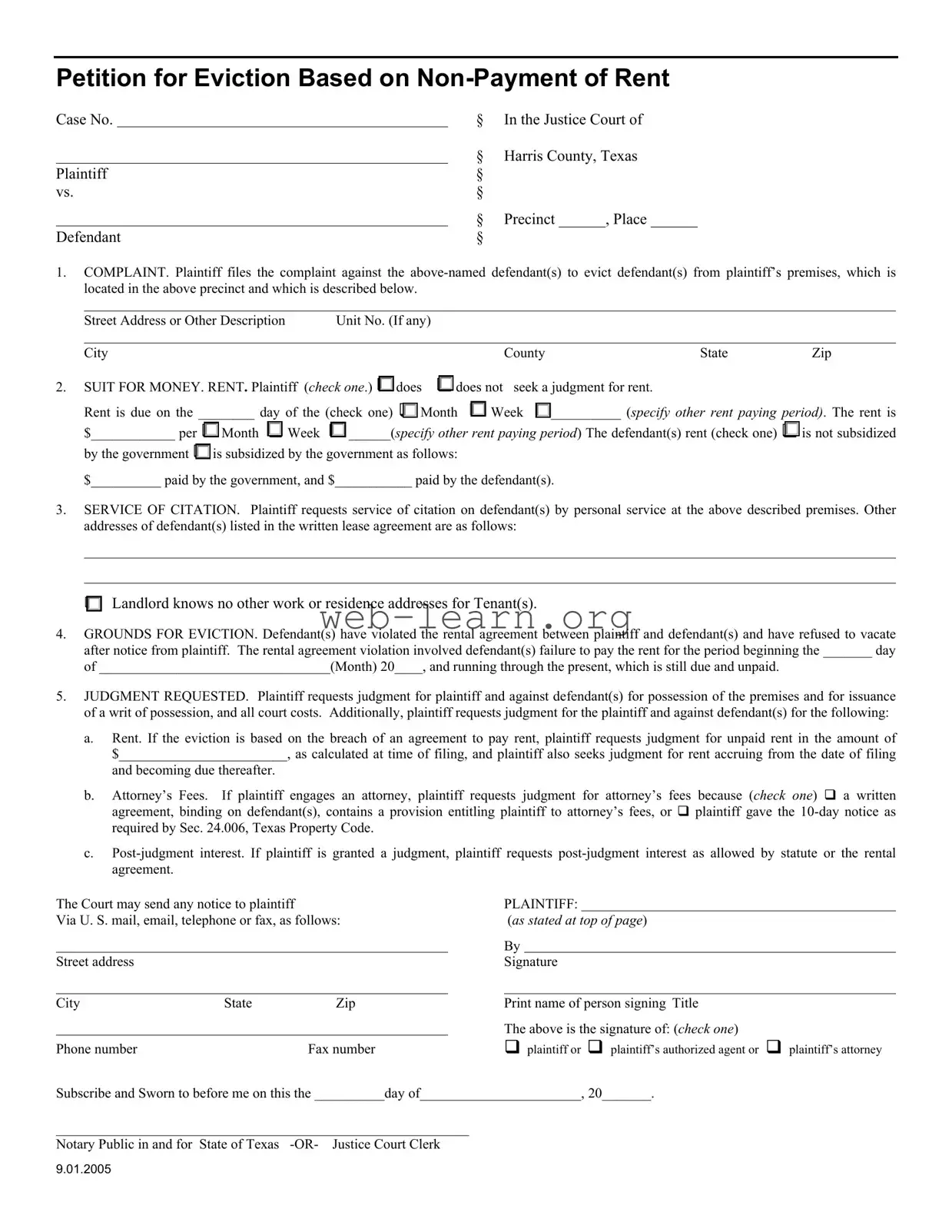
The Texas Petition Eviction form is a crucial document for landlords seeking to regain possession of their rental property due to non-payment of rent. This form initiates the legal process in the Justice Court, specifically within Harris County, Texas. It outlines the basic information required, including the names of the plaintiff and defendant, the address of the property in question, and the specific precinct and place of filing. The form contains a complaint section where the plaintiff states the grounds for eviction, citing the violation of the rental agreement, primarily focusing on the failure to pay rent. Rent details are clearly specified, including whether it is subsidized and the amounts owed by both the government and the tenant. The form also requests service of citation, ensuring that the defendant is properly notified of the legal action. In addition to possession of the premises, the plaintiff may seek a judgment for unpaid rent, attorney's fees, and post-judgment interest. Completing this form accurately is essential for landlords to effectively navigate the eviction process while adhering to Texas law.
Petition for Eviction Based on
Case No. |
§ In the Justice Court of |
||
|
|
§ |
Harris County, Texas |
Plaintiff |
§ |
|
|
vs. |
§ |
|
|
|
|
§ |
Precinct ______, Place ______ |
Defendant |
§ |
|
|
1.COMPLAINT. Plaintiff files the complaint against the
|
Street Address or Other Description |
|
Unit No. (If any) |
|
|
|
|
||
|
|
|
|
|
|
|
|
|
|
|
City |
|
|
|
|
|
County |
State |
Zip |
2. SUIT FOR MONEY. RENT. Plaintiff (check one.) |
does |
does not seek a judgment for rent. |
|
||||||
|
Rent is due on the ________ day of the (check one) |
Month |
Week |
__________ (specify other rent paying period). The rent is |
|||||
|
$____________ per |
Month |
Week |
______(specify other rent paying period) The defendant(s) rent (check one) |
is not subsidized |
||||
by the government is subsidized by the government as follows:
$__________ paid by the government, and $___________ paid by the defendant(s).
3.SERVICE OF CITATION. Plaintiff requests service of citation on defendant(s) by personal service at the above described premises. Other addresses of defendant(s) listed in the written lease agreement are as follows:
Landlord knows no other work or residence addresses for Tenant(s).
4.GROUNDS FOR EVICTION. Defendant(s) have violated the rental agreement between plaintiff and defendant(s) and have refused to vacate after notice from plaintiff. The rental agreement violation involved defendant(s) failure to pay the rent for the period beginning the _______ day of _________________________________(Month) 20____, and running through the present, which is still due and unpaid.
5.JUDGMENT REQUESTED. Plaintiff requests judgment for plaintiff and against defendant(s) for possession of the premises and for issuance of a writ of possession, and all court costs. Additionally, plaintiff requests judgment for the plaintiff and against defendant(s) for the following:
a.Rent. If the eviction is based on the breach of an agreement to pay rent, plaintiff requests judgment for unpaid rent in the amount of $________________________, as calculated at time of filing, and plaintiff also seeks judgment for rent accruing from the date of filing and becoming due thereafter.
b. Attorney’s Fees. If plaintiff engages an attorney, plaintiff requests judgment for attorney’s fees |
because (check one) |
a written |
agreement, binding on defendant(s), contains a provision entitling plaintiff to attorney’s fees, or |
plaintiff gave the |
|
required by Sec. 24.006, Texas Property Code. |
|
|
c.
The Court may send any notice to plaintiff |
|
|
PLAINTIFF: |
|
||
Via U. S. mail, email, telephone or fax, as follows: |
|
(as stated at top of page) |
||||
|
|
|
|
By |
|
|
Street address |
|
|
|
Signature |
||
|
|
|
|
|
||
City |
State |
Zip |
|
Print name of person signing Title |
||
|
|
|
|
The above is the signature of: (check one) |
||
Phone number |
Fax number |
plaintiff or |
plaintiff’s authorized agent or |
plaintiff’s attorney |
Subscribe and Sworn to before me on this the __________day of_______________________, 20_______. |
|
|||
___________________________________________________________ |
|
|
|
|
Notary Public in and for State of Texas |
|
|
|
|
9.01.2005
| Fact Name | Details |
|---|---|
| Form Title | Petition for Eviction Based on Non-Payment of Rent |
| Governing Law | Texas Property Code, Section 24.006 |
| Filing Location | Justice Court of Harris County, Texas |
| Defendant Identification | Includes name and address of the defendant(s). |
| Rent Payment Period | Rent is due on a specified day of the month, week, or other period. |
| Government Subsidy | Form indicates if rent is subsidized by the government. |
| Service of Citation | Requests personal service at the premises or other addresses. |
| Grounds for Eviction | Based on violation of rental agreement and non-payment of rent. |
| Judgment Requested | Includes possession of premises, unpaid rent, attorney's fees, and post-judgment interest. |
Filling out the Texas Petition Eviction form is an important step in the eviction process. After completing the form, you will need to file it with the appropriate court in your precinct. Be sure to keep a copy for your records and follow any additional steps required by the court.
What is the Texas Petition Eviction form?
The Texas Petition Eviction form is a legal document used by landlords to initiate the eviction process for tenants who have not paid their rent. This form is filed in the Justice Court of the relevant precinct in Texas, and it outlines the reasons for the eviction, the details of the rental agreement, and the landlord's requests for judgment.
When should I use this form?
This form should be used when a tenant has failed to pay rent and has refused to vacate the property after receiving notice from the landlord. If you have communicated with your tenant about the overdue rent and they have not responded or paid, it may be time to consider filing this petition.
What information do I need to provide on the form?
When completing the form, you will need to provide:
What are the grounds for eviction listed in the form?
The grounds for eviction typically involve a violation of the rental agreement, specifically the tenant's failure to pay rent. The form allows you to specify the period during which the rent was due and unpaid, supporting your case for eviction.
What judgments can I request?
When filing the form, you can request several judgments, including:
How is the form served to the tenant?
The form requests that the tenant be served by personal service at the rental property. This means that a process server or sheriff will deliver the eviction notice directly to the tenant. It's important to ensure that the tenant receives this notice to proceed with the eviction process.
What happens after I file the petition?
After filing the petition, the court will schedule a hearing. Both the landlord and tenant will have the opportunity to present their cases. If the court rules in favor of the landlord, a judgment will be issued, allowing for the eviction to proceed.
Can I represent myself in court?
Yes, you can represent yourself in court, but it's advisable to seek legal advice if you are unsure about the process. Understanding the legal requirements and procedures can help ensure that your case is presented effectively.
Filling out the Texas Petition Eviction form requires careful attention to detail. One common mistake is failing to provide complete and accurate information about the property. The form asks for the street address, unit number, city, county, state, and zip code. Missing even one of these details can delay the process or lead to the dismissal of the case. Ensure that all information is filled out correctly to avoid unnecessary complications.
Another frequent error is neglecting to specify the rent due date. The form includes a section where you must indicate whether rent is due monthly, weekly, or at another interval. Failing to check the appropriate box or not filling in the specific date can create confusion. This information is crucial for establishing the timeline of the eviction.
People often overlook the section regarding the government's involvement in rent payments. If any portion of the rent is subsidized, it must be clearly stated. This includes specifying how much is paid by the government and how much is the tenant's responsibility. Incomplete or inaccurate reporting here can lead to misunderstandings about the tenant's obligations.
Additionally, many individuals forget to detail the grounds for eviction. The form requires a clear explanation of the rental agreement violation, including the specific period for which rent is due. Vague or incomplete descriptions can weaken your case. Be precise about the violation to strengthen your position in court.
Another common pitfall is failing to request the appropriate judgments. The form allows you to ask for possession of the premises, court costs, and even attorney's fees. If you do not specify what you are seeking, you may miss out on recovering costs associated with the eviction process. Clearly outline all requests to ensure they are considered by the court.
People sometimes neglect to sign the form properly. The signature section must be filled out correctly, indicating whether you are the plaintiff, an authorized agent, or an attorney. A missing or incorrect signature can invalidate the petition. Always double-check this section before submission.
Lastly, individuals may forget to include their contact information. The form requires that you provide a mailing address, phone number, and other relevant details for communication. If the court cannot reach you, it may hinder the progress of your case. Make sure to include complete contact information to facilitate communication throughout the eviction process.
When initiating an eviction process in Texas, the Petition for Eviction form is just one of several documents that may be necessary. Each document serves a specific purpose and helps facilitate the legal proceedings. Below is a list of commonly used forms and documents that often accompany the Texas Petition for Eviction.
Understanding these documents can help both landlords and tenants navigate the eviction process more effectively. Each form plays a vital role in ensuring that the proceedings are conducted fairly and in accordance with the law.
When filling out the Texas Petition Eviction form, it’s essential to ensure accuracy and clarity. Here’s a list of things you should and shouldn’t do:
Here are four common misconceptions about the Texas Petition Eviction form:
While the form is often associated with non-payment cases, it can also be used for other breaches of the rental agreement. This includes issues like property damage or violation of lease terms.
Landlords can represent themselves in eviction cases. However, consulting an attorney can provide valuable guidance, especially if the case is complicated.
The process takes time. After filing, the court must schedule a hearing, and the tenant must be properly notified. Evictions are not instant and follow specific legal procedures.
Landlords must provide tenants with proper notice before initiating eviction proceedings. This typically includes a written notice outlining the reason for eviction and a specified time to remedy the situation.
When filling out and using the Texas Petition Eviction form, it is important to consider several key points to ensure the process is handled correctly.
By following these key takeaways, landlords can effectively navigate the eviction process in Texas.