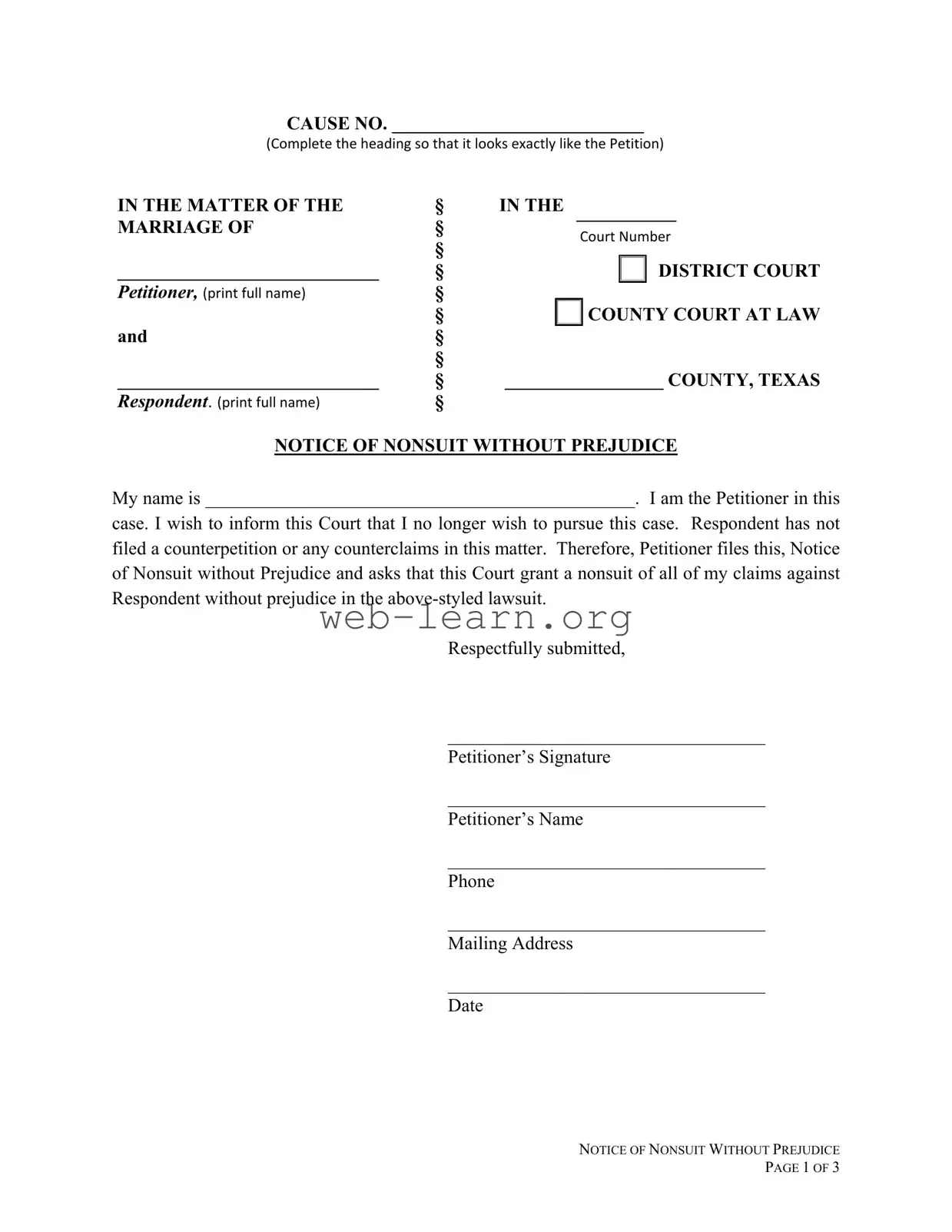
The Texas Notice of Nonsuit form is an important document for individuals who wish to withdraw their claims in a legal case without prejudice, meaning they can potentially refile in the future. This form is primarily used in family law cases, such as divorce proceedings, where one party, known as the Petitioner, decides not to pursue their claims against the other party, referred to as the Respondent. To initiate this process, the Petitioner must complete specific sections of the form, including the cause number and the names of both parties involved. The form requires the Petitioner to state their intention clearly, confirming that the Respondent has not filed any counterclaims. After the Notice of Nonsuit is filed, the court will review it and issue an order granting the nonsuit. This order confirms that the Petitioner’s claims are dismissed without prejudice, allowing for the possibility of re-filing later. Additionally, the form includes a certificate of service, which ensures that the Respondent is properly notified of the Petitioner’s decision. Overall, this form serves as a formal way to communicate the Petitioner’s choice to withdraw their case while preserving their right to take further action in the future.

CAUSE NO. ___________________________
(Complete the heading so that it looks exactly like the Petition)
IN THE MATTER OF THE |
§ |
IN THE |
||
MARRIAGE OF |
§ |
|
|
|
|
Court Number |
|||
|
§ |
|
||
|
|
|
|
|
____________________________ |
§ |
|
DISTRICT COURT |
|
Petitioner, (print full name) |
§ |
|
|
|
|
§ |
|
COUNTY COURT AT LAW |
|
AND |
§ |
|
|
|
|
§ |
|
|
|
____________________________ |
§ |
_________________ COUNTY, TEXAS |
||
Respondent. (print full name) |
§ |
|
|
|
NOTICE OF NONSUIT WITHOUT PREJUDICE
My name is ______________________________________________. I am the Petitioner in this
case. I wish to inform this Court that I no longer wish to pursue this case. Respondent has not filed a counterpetition or any counterclaims in this matter. Therefore, Petitioner files this, Notice of Nonsuit without Prejudice and asks that this Court grant a nonsuit of all of my claims against Respondent without prejudice in the
Respectfully submitted,
__________________________________
Petitioner’s Signature
__________________________________
Petitioner’s Name
__________________________________
Phone
__________________________________
Mailing Address
__________________________________
Date
NOTICE OF NONSUIT WITHOUT PREJUDICE
PAGE 1 OF 3

CAUSE NO. ___________________________
(Complete the heading so that it looks exactly like the Petition)
IN THE MATTER OF THE |
§ |
IN THE |
||
MARRIAGE OF |
§ |
|
|
|
|
Court Number |
|||
|
§ |
|
||
|
|
|
|
|
____________________________ |
§ |
|
DISTRICT COURT |
|
Petitioner, (print full name) |
§ |
|
|
|
|
§ |
|
COUNTY COURT AT LAW |
|
AND |
§ |
|
|
|
|
§ |
|
|
|
____________________________ |
§ |
_________________ COUNTY, TEXAS |
||
Respondent. (print full name) |
§ |
|
|
|
ORDER GRANTING NOTICE OF NONSUIT WITHOUT PREJUDICE
On the date shown below, the Court considered Petitioner’s Notice of Nonsuit without Prejudice in the above styled lawsuit. Having considered Petitioner’s Notice of Nonsuit, the Court hereby ORDERS that all Petitioner’s claims against Respondent be nonsuited without prejudice as to the refiling of same.
It is further ORDERED that all costs of Court be taxed against the party incurring same.
SIGNED on this ____ day of ______________ 20________.
PRESIDING JUDGE
ORDER GRANTING NONSUIT WITHOUT PREJUDICE
PAGE 2 OF 3

CERTIFICATE OF SERVICE
I certify that a true copy of the above was served on the Respondent in accordance with the Texas Rules of Civil Procedure on ____________________ in the manner described below.
(Date)
By Fax to: ___________________________
(Fax number)
By Certified Mail to:
(Respondent)
(Mailing Address)
(City/State/ Zip)
(Certified Mail No.)
By
(Respondent)
(Delivery Address)
(City/State/ Zip)
Certified by:
__________________________________
Petitioner’s Signature
__________________________________
Petitioner’s Name
__________________________________
Phone
__________________________________
Mailing Address
__________________________________
Date
CERTIFICATE OF SERVICE REGARDING ORDER GRANTING NONSUIT WITHOUT PREJUDICE PAGE 3 OF 3
| Fact Name | Details |
|---|---|
| Purpose of the Form | The Texas Notice of Nonsuit form allows a petitioner to voluntarily withdraw their case without prejudice, meaning they can refile in the future if desired. |
| Governing Law | This form is governed by the Texas Rules of Civil Procedure, specifically Rule 162, which outlines the process for nonsuits. |
| Counterclaims | A key requirement is that the respondent must not have filed a counterpetition or counterclaims for the nonsuit to be valid. |
| Signature Requirement | The form must be signed by the petitioner, affirming their intention to withdraw the case. |
| Cost Implications | The court may tax costs against the party incurring them, which is specified in the order granting the nonsuit. |
Completing the Texas Notice of Nonsuit form is an important step in formally withdrawing your case. After filling out the form, you will need to submit it to the court and ensure that the other party is properly notified. Below are the steps to help you fill out the form accurately.
Once you have completed the form, it is essential to submit it to the court and serve a copy to the Respondent. This ensures that all parties are informed of your decision to withdraw the case.
What is a Texas Notice of Nonsuit?
A Texas Notice of Nonsuit is a legal document filed by a petitioner to voluntarily dismiss their case without prejudice. This means the petitioner can refile the case in the future if they choose to do so. It is often used when a party decides not to pursue their claims against the other party at that time.
When should I file a Notice of Nonsuit?
You should file a Notice of Nonsuit when you no longer wish to pursue your claims in a lawsuit. This can happen for various reasons, such as reaching a settlement or needing more time to gather evidence. Importantly, this option is available only if the respondent has not filed a counterpetition or any counterclaims.
What information do I need to include in the Notice of Nonsuit?
The Notice of Nonsuit must include:
What does "without prejudice" mean?
"Without prejudice" means that you can refile your case in the future. It allows you to dismiss your current claims without losing your right to bring them back to court later. This is different from a dismissal "with prejudice," which would prevent you from refiling the same claims.
What happens after I file the Notice of Nonsuit?
After you file the Notice of Nonsuit, the court will review it. If the court approves your request, an order will be issued granting the nonsuit. This order will confirm that your claims are dismissed without prejudice. You will also need to serve a copy of this order to the respondent.
Are there any costs associated with filing a Notice of Nonsuit?
Yes, typically, the costs of court are taxed against the party incurring them. This means that if you are the petitioner and you file a Notice of Nonsuit, you may be responsible for any court costs incurred up to that point.
How do I serve the Notice of Nonsuit to the respondent?
You can serve the Notice of Nonsuit to the respondent in several ways, including:
Make sure to include the date of service and the method used in your Certificate of Service.
Filling out the Texas Notice of Nonsuit form can be straightforward, but many people make common mistakes that can lead to complications. One frequent error is failing to complete the cause number section correctly. This number must match the one listed in the original petition. If it does not, the court may not recognize the document, leading to delays in the process.
Another common mistake is neglecting to include the full names of both the petitioner and the respondent. This information is essential for the court to identify the parties involved. Omitting or misspelling a name can create confusion and might even result in the dismissal of the nonsuit.
People also often forget to check the box indicating whether the nonsuit is with or without prejudice. This distinction is crucial because it determines whether the petitioner can refile the case in the future. A nonsuit without prejudice allows for refiling, while a nonsuit with prejudice does not.
Additionally, some individuals fail to sign the form. A signature is necessary to validate the document. Without it, the court may reject the filing. Similarly, not including the date of signing is another oversight that can lead to complications.
Another mistake involves the certificate of service section. Many people do not serve the respondent properly or fail to document the method of service. This section must detail how the respondent was notified about the nonsuit. If this is not completed correctly, the court may question whether the respondent was adequately informed.
Some individuals also overlook the requirement to include their contact information. Providing a phone number and mailing address is important for the court and the respondent to reach the petitioner if necessary. Without this information, communication can become difficult.
Moreover, people sometimes forget to review the entire form before submission. Errors in any section can lead to unnecessary delays. A thorough review can catch mistakes before they reach the court.
Finally, failing to keep a copy of the filed form for personal records is a mistake that can cause problems later. Having a copy allows the petitioner to reference what was submitted, which is helpful if questions arise in the future.
The Texas Notice of Nonsuit form is often accompanied by several other important documents. Each of these plays a crucial role in the legal process, ensuring that all parties are informed and that the court has the necessary information to proceed. Below is a list of commonly used forms alongside the Notice of Nonsuit.
Understanding these documents can help parties navigate the legal system more effectively. Each form serves a distinct purpose and contributes to the overall process of resolving legal matters.
The Texas Notice of Nonsuit form serves a specific purpose in legal proceedings, allowing a petitioner to withdraw their case without prejudice. This means they can potentially refile the case in the future. Several other legal documents share similarities with this form, either in their function or in the procedural context in which they are used. Below is a list of nine such documents, along with explanations of how they relate to the Notice of Nonsuit.
These documents highlight the various ways parties can manage their cases within the legal system, whether through dismissal, withdrawal, or other procedural actions. Understanding their similarities can provide clarity in navigating legal processes.
When filling out the Texas Notice of Nonsuit form, it is important to follow specific guidelines to ensure accuracy and compliance with legal requirements. Below is a list of things to do and avoid:
Understanding the Texas Notice of Nonsuit form can help individuals navigate their legal situations more effectively. Here are nine common misconceptions about this form:
Being informed about these misconceptions can help individuals make better decisions regarding their legal matters in Texas.
When filling out and using the Texas Notice of Nonsuit form, keep the following key points in mind:
Following these steps will help ensure that your Notice of Nonsuit is properly completed and accepted by the court. It is important to understand that filing a nonsuit does not prevent you from refiling your claims in the future.