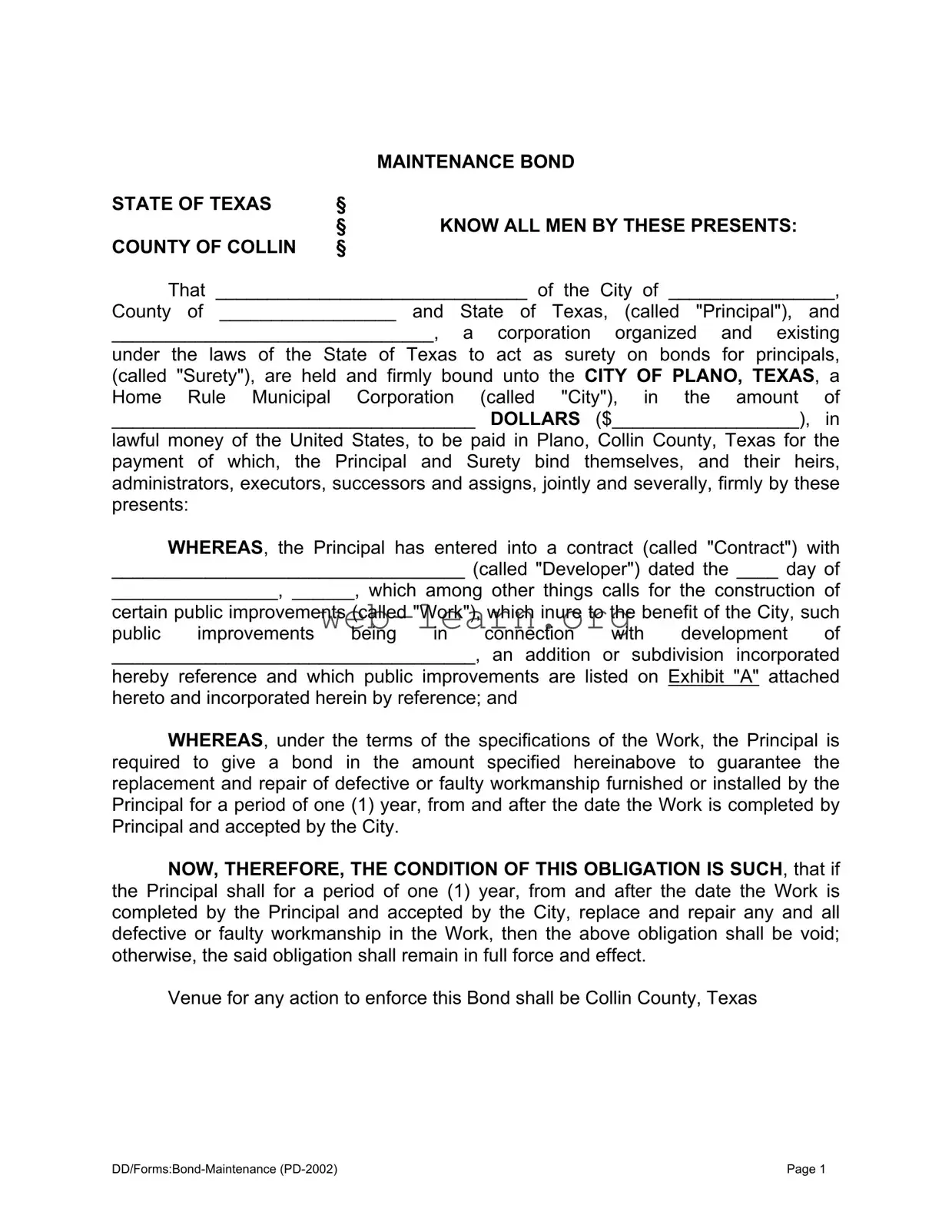
The Texas Maintenance Bond form plays a crucial role in ensuring the quality and reliability of public improvements within the state. This legally binding document involves three key parties: the Principal, who is typically the contractor responsible for the work; the Surety, a corporation that guarantees the Principal’s obligations; and the City, which benefits from the completed improvements. The bond amount, specified in the form, represents a financial commitment to cover any necessary repairs or replacements of defective workmanship for a period of one year after the work is completed and accepted by the City. The form outlines the conditions under which the bond remains valid, emphasizing the Principal's responsibility to rectify any faults in the work. Additionally, it includes important details such as the names and addresses of the involved parties, the specific public improvements being constructed, and provisions for legal action should enforcement of the bond be necessary. Understanding these elements is essential for anyone involved in municipal development projects in Texas, as it helps ensure accountability and quality in construction practices.
|
|
MAINTENANCE BOND |
STATE OF TEXAS |
§ |
|
|
§ |
KNOW ALL MEN BY THESE PRESENTS: |
COUNTY OF COLLIN |
§ |
|
That ______________________________ of the City of ________________,
County of _________________ and State of Texas, (called "Principal"), and
_______________________________, a corporation organized and existing
under the laws of the State of Texas to act as surety on bonds for principals, (called "Surety"), are held and firmly bound unto the CITY OF PLANO, TEXAS, a Home Rule Municipal Corporation (called "City"), in the amount of
___________________________________ DOLLARS ($__________________), in
lawful money of the United States, to be paid in Plano, Collin County, Texas for the payment of which, the Principal and Surety bind themselves, and their heirs, administrators, executors, successors and assigns, jointly and severally, firmly by these presents:
WHEREAS, the Principal has entered into a contract (called "Contract") with
__________________________________ (called "Developer") dated the ____ day of
________________, ______, which among other things calls for the construction of
certain public improvements (called "Work"), which inure to the benefit of the City, such public improvements being in connection with development of
___________________________________, an addition or subdivision incorporated
hereby reference and which public improvements are listed on Exhibit "A" attached hereto and incorporated herein by reference; and
WHEREAS, under the terms of the specifications of the Work, the Principal is required to give a bond in the amount specified hereinabove to guarantee the replacement and repair of defective or faulty workmanship furnished or installed by the Principal for a period of one (1) year, from and after the date the Work is completed by Principal and accepted by the City.
NOW, THEREFORE, THE CONDITION OF THIS OBLIGATION IS SUCH, that if the Principal shall for a period of one (1) year, from and after the date the Work is completed by the Principal and accepted by the City, replace and repair any and all defective or faulty workmanship in the Work, then the above obligation shall be void; otherwise, the said obligation shall remain in full force and effect.
Venue for any action to enforce this Bond shall be Collin County, Texas
Page 1 |

IN WITNESS WHEREOF, the said Principal and Surety have signed and sealed this instrument this ____ day of ________________, ______.
|
Principal |
|
Surety |
By: |
______________________ |
By: |
______________________ |
Title: |
______________________ |
Title: |
______________________ |
Address: |
_______________________ |
Address: |
________________________ |
|
_______________________ |
|
________________________ |
|
_______________________ |
|
________________________ |
The name and address of the Resident Agent of Surety is:
Name: |
______________________________________________________ |
Address: |
______________________________________________________ |
City, State, Zip |
______________________________________________________ |
|
____________ |
For additional information on the above named Surety company you may contact the Texas Department of Insurance at
NOTE: Date on Page 1 of Maintenance Bond must be same date as Contract. Date on Page 2 of Maintenance Bond must be after the date of Contract. If Resident Agent is not a corporation, give a person's name.
Page 2 |
| Fact Name | Details |
|---|---|
| Purpose of the Bond | The Texas Maintenance Bond serves to guarantee the replacement and repair of any defective or faulty workmanship for a period of one year following the completion of the work. |
| Governing Law | This bond is governed by the laws of the State of Texas, specifically under the provisions applicable to municipal corporations and surety bonds. |
| Parties Involved | The bond involves three primary parties: the Principal (the contractor), the Surety (the bonding company), and the City of Plano, Texas (the obligee). |
| Obligation Duration | The obligation under the bond lasts for one year from the date the work is completed and accepted by the City, ensuring accountability for workmanship during that time. |
| Venue for Enforcement | Any legal actions to enforce the terms of the bond must take place in Collin County, Texas, providing a specific jurisdiction for disputes. |
After you gather the necessary information, you can begin filling out the Texas Maintenance Bond form. This form is essential for ensuring that the required public improvements are completed and maintained properly. Follow these steps to complete the form accurately.
A Texas Maintenance Bond is a legal document that ensures the quality of construction work done by a contractor. It guarantees that any defective or faulty workmanship will be repaired or replaced within one year after the work is completed and accepted by the city. This bond protects the city and its residents from potential issues that may arise from the contractor's work.
Typically, the Principal, which is the contractor or developer, is required to file a Maintenance Bond when they enter into a contract for public improvements. This is often mandated by the city to ensure that the work meets specific standards and remains in good condition for a designated period.
The Maintenance Bond is valid for one year from the date the work is completed and accepted by the city. During this period, the contractor is responsible for addressing any defects or issues that arise from their workmanship.
The cost of a Maintenance Bond varies based on the project size, complexity, and the bond amount required. The specific amount is typically outlined in the contract and should be paid in lawful money of the United States. It is advisable to consult with a bonding company for an accurate quote.
If the contractor does not address defective work within the one-year period, the bond remains in full force. The city can take action to enforce the bond and seek compensation for any necessary repairs or replacements. This ensures that the contractor is held accountable for their work.
Generally, Maintenance Bonds are not transferable. They are specifically tied to the contractor who issued them and the particular project they cover. If a new contractor takes over the project, a new bond may need to be secured.
To complete the Maintenance Bond, you will need to provide the following:
A Maintenance Bond can be obtained through a bonding company or surety provider. It is essential to work with a reputable provider familiar with Texas regulations and requirements to ensure compliance and proper documentation.
For additional information about the Surety company, you can contact the Texas Department of Insurance at (800) 578-4677. They can provide guidance on bonding requirements and assist with any questions you may have regarding the Maintenance Bond process.
Completing the Texas Maintenance Bond form requires careful attention to detail. Unfortunately, many individuals make mistakes that can lead to delays or even rejection of the bond. Here are nine common errors to avoid.
First, failing to ensure that the dates are consistent can create significant issues. The date on the first page of the Maintenance Bond must match the date of the contract. If it doesn’t, the bond could be deemed invalid. Additionally, the date on the second page should be after the contract date. Always double-check these dates before submitting the form.
Another frequent mistake is neglecting to include the correct amount of the bond. The bond amount should be clearly stated in both words and numbers. Omitting this detail or providing an incorrect figure can lead to complications. Ensure that the amount reflects the requirements of the contract.
Many applicants also overlook the importance of providing complete and accurate contact information. The addresses for both the Principal and the Surety must be filled out completely. Missing or incorrect addresses can hinder communication and create problems in the enforcement of the bond.
In addition, some individuals fail to identify the Resident Agent of the Surety correctly. If the Resident Agent is not a corporation, it is essential to provide a person's name. This detail is crucial for ensuring that the bond can be enforced if necessary.
Another common error is not attaching the required Exhibit "A" that lists the public improvements. This exhibit is an integral part of the bond. Without it, the bond may not fulfill its purpose, leading to potential disputes down the line.
Moreover, many people forget to sign and seal the bond properly. Both the Principal and the Surety must sign the document. Failing to do so can render the bond ineffective. Ensure that all required signatures are obtained before submission.
Additionally, some applicants do not read the instructions carefully. Important notes regarding the bond's requirements are often overlooked. For instance, the instructions specify that the bond must be in lawful money of the United States. Ignoring these details can lead to unnecessary complications.
Lastly, failing to provide the title of the signatories can be a critical oversight. The titles of those signing the bond must be included to establish their authority. Without this information, the bond may be questioned or challenged.
By being aware of these common mistakes, you can ensure that your Texas Maintenance Bond form is completed accurately and efficiently. Taking the time to review each section carefully will help avoid potential issues that could arise later.
When dealing with a Texas Maintenance Bond, there are several other important forms and documents that often accompany it. Each of these documents plays a crucial role in ensuring that the obligations set forth in the bond are met and that all parties involved are protected. Here’s a brief overview of these related documents.
Understanding these related documents is essential for anyone involved in construction projects in Texas. They not only help clarify responsibilities but also provide a framework for accountability and protection for all parties involved.
When filling out the Texas Maintenance Bond form, it is crucial to follow specific guidelines to ensure the document is completed correctly. Here is a list of things you should and shouldn't do:
By adhering to these guidelines, you can help ensure that the Texas Maintenance Bond form is filled out correctly and processed without unnecessary delays.
Understanding the Texas Maintenance Bond form is crucial for anyone involved in construction or development projects. However, there are several misconceptions that can lead to confusion. Here are seven common misunderstandings:
Being aware of these misconceptions can help you navigate the requirements of the Texas Maintenance Bond form more effectively. Always consult with a knowledgeable professional to ensure compliance and understanding of your obligations.
Ensure you accurately fill in all required fields on the Texas Maintenance Bond form. Missing information can lead to delays or complications.
The bond amount must be clearly stated. It should reflect the total cost of the public improvements as specified in the contract.
Both the Principal and Surety must sign the bond. Their signatures must be accompanied by their titles and addresses to validate the document.
The bond guarantees that the Principal will repair any faulty workmanship for one year after the City accepts the completed work. Understanding this timeline is crucial.
Make sure the date on the Maintenance Bond matches the contract date. This alignment is essential for the bond to be enforceable.
Keep a copy of the completed bond for your records. This document may be needed for future reference or in case of disputes.