Homepage Blank Texas Lhl005 Form
Outline

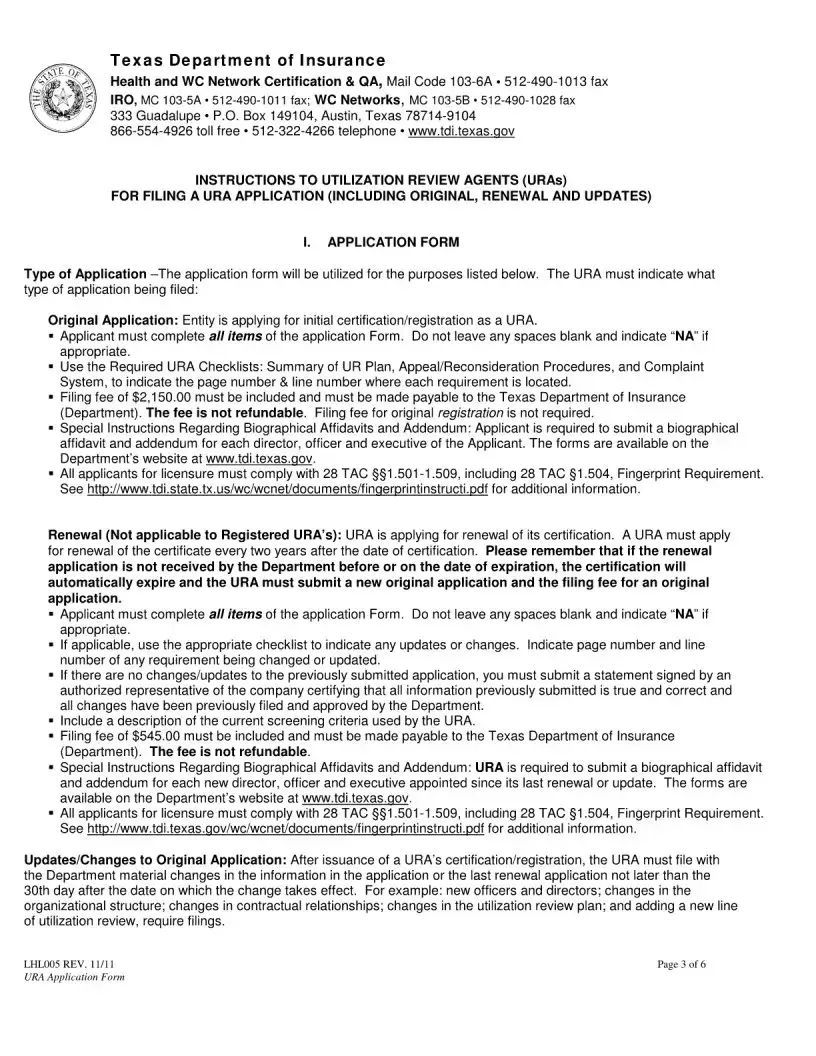
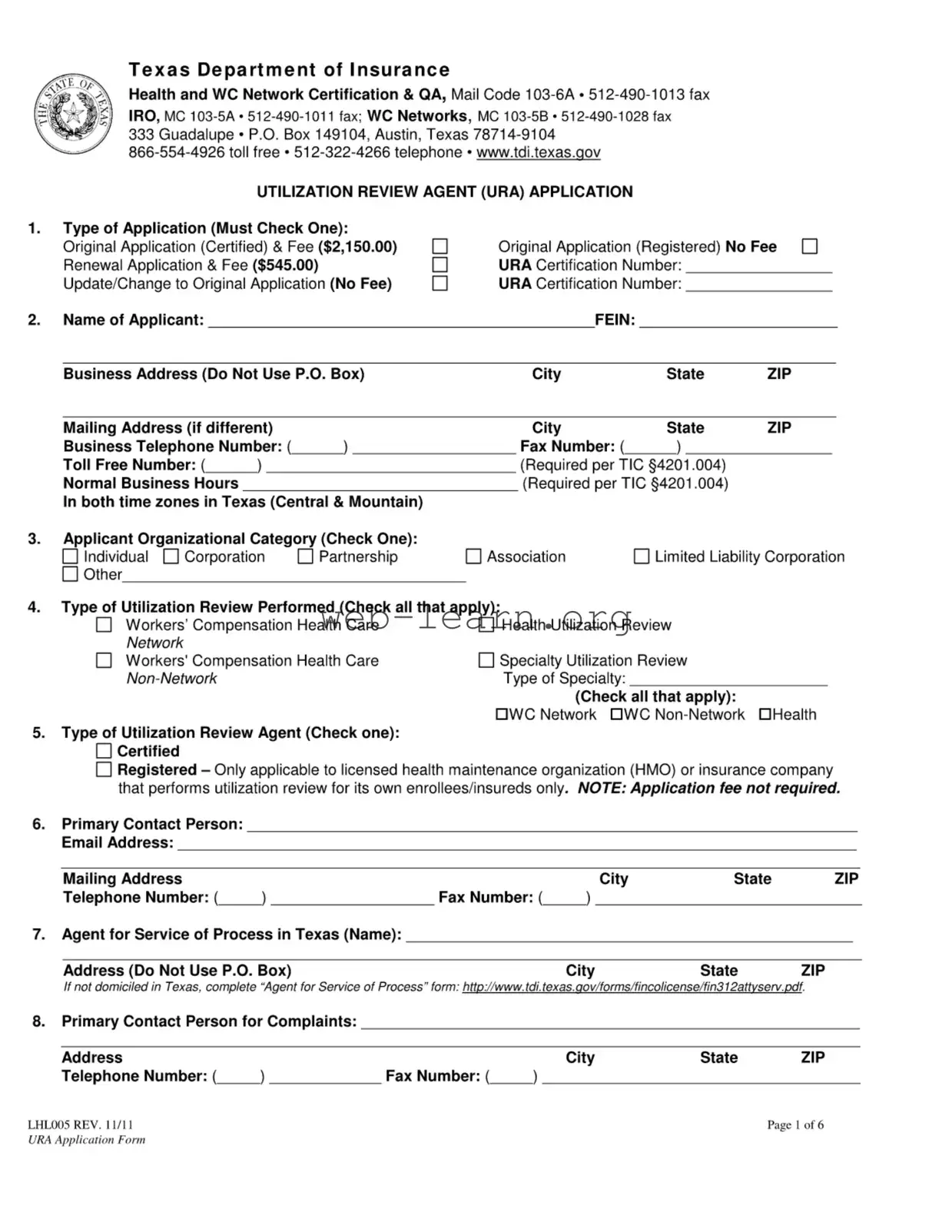
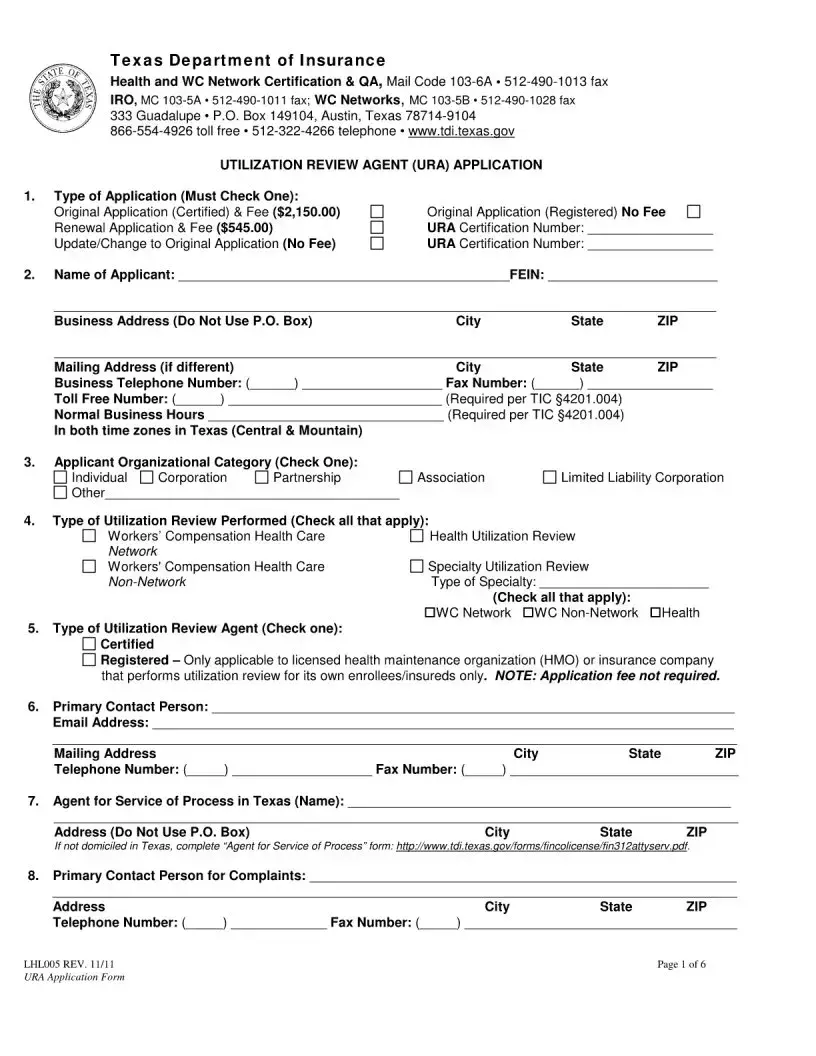
The Texas LHL005 form is a critical document utilized by organizations seeking certification as Utilization Review Agents (URAs) in the state of Texas. This form serves multiple purposes, including original applications for certification, renewals, and updates to previously submitted information. Applicants must indicate the type of application they are submitting, with fees ranging from $2,150 for original applications to $545 for renewals. The form requires detailed information about the applicant, including their organizational category, business addresses, and contact information. Additionally, it prompts applicants to specify the type of utilization review they perform, whether in workers’ compensation or health care networks. The LHL005 also mandates the identification of a primary contact person and an agent for service of process within Texas. Furthermore, it includes a certification section where an authorized representative must attest to the accuracy of the information provided and acknowledge familiarity with relevant Texas statutes and rules. Proper completion of this form is essential for compliance with the Texas Department of Insurance regulations, ensuring that URAs operate within the legal framework established for health care and workers' compensation utilization review.
Sample - Texas Lhl005 Form

Form Information

Fact Name Description
Form Purpose The Texas LHL005 form is used for the application of Utilization Review Agents (URAs) seeking certification or registration in Texas.
Governing Laws This form is governed by the Texas Insurance Code, specifically Chapter 4201 and Chapter 1305, along with applicable rules from the Texas Labor Code.
Application Types Applicants must select from four application types: Original (Certified), Renewal, Update/Change, or Original (Registered).
Fees The application fee for an Original Application (Certified) is $2,150, while the Renewal Application fee is $545. No fee is required for updates or Original (Registered) applications.
Contact Information Applicants must provide detailed contact information, including business address, telephone numbers, and email addresses for primary contacts.
Types of Utilization Review URAs can indicate the type of utilization review they perform, including Workers’ Compensation, Health Care Network, and Health Care Non-Network.
Primary Contact for Complaints Applicants must designate a primary contact person for handling complaints, along with their contact information.
Submission Instructions Applications must be submitted with all required documentation and fees, and any updates must be filed within 30 days of a material change.

Detailed Guide for Filling Out Texas Lhl005

Filling out the Texas LHL005 form is an essential step in the application process for a Utilization Review Agent (URA). This form requires detailed information about the applicant and their operations. Once completed, the form should be submitted to the Texas Department of Insurance along with any applicable fees. Below are the steps to guide you through the process of filling out the form accurately.

  1. Determine the Type of Application: Check one of the following options: Original Application (Certified), Renewal Application, Update/Change to Original Application, or Original Application (Registered).
  2. Provide URA Certification Number: If applicable, fill in the URA Certification Number.
  3. Fill in the Applicant's Information: Include the name of the applicant, Federal Employer Identification Number (FEIN), business address (do not use a P.O. Box), and mailing address if different.
  4. Contact Information: Enter the city, state, ZIP code, fax number, business telephone number, and toll-free number. Also, provide normal business hours in both Central and Mountain time zones.
  5. Select Applicant Organizational Category: Check one of the following: Individual, Corporation, Partnership, Association, Limited Liability Corporation, or Other.
  6. Indicate the Type of Utilization Review Performed: Check all applicable options: Workers’ Compensation Health Care Network, Workers’ Compensation Health Care Non-Network.
  7. Specify the Type of Utilization Review Agent: Check one: Certified Health Utilization Review, Specialty Utilization Review, or Registered (if applicable).
  8. Provide Primary Contact Person Information: Fill in the name, email address, mailing address, telephone number, city, state, and ZIP code of the primary contact person.
  9. Agent for Service of Process: If not domiciled in Texas, provide the name and address of the agent for service of process.
  10. Primary Contact Person for Complaints: Include the name, address, telephone number, and fax number of the primary contact person for complaints.
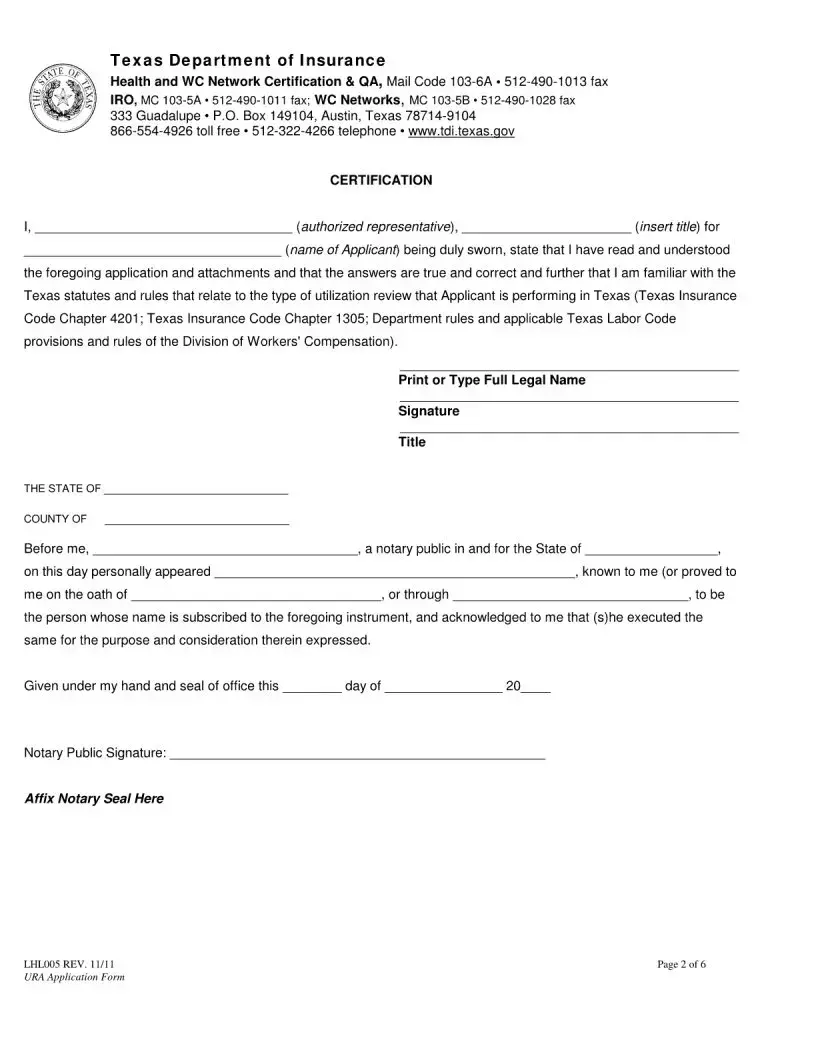
  11. Certification: The authorized representative must print or type their full legal name, sign the form, and include their title.
  12. Notary Section: The form must be notarized. A notary public will complete this section, including the date and place of notarization.

Once you have completed the form, review it carefully to ensure all information is accurate and complete. Gather any required attachments and submit the form along with the appropriate fee to the Texas Department of Insurance. Following these steps will help facilitate a smooth application process.

Obtain Answers on Texas Lhl005

  1. What is the purpose of the Texas LHL005 form?

    The Texas LHL005 form is an application for Utilization Review Agents (URAs) seeking certification or registration in Texas. It is used for various types of applications, including original applications, renewals, and updates. This form ensures that URAs comply with state regulations regarding utilization review practices.

  2. What are the application fees associated with the LHL005 form?

    There are different fees depending on the type of application:

    • Original Application (Certified): $2,150.00
    • Renewal Application: $545.00
    • Update/Change to Original Application: No fee
    • Original Application (Registered): No fee

    It is important to note that these fees are non-refundable and must be made payable to the Texas Department of Insurance.

  3. How often must a URA renew its certification?

    A URA must renew its certification every two years. The renewal application must be submitted before the current certification expires. If the renewal is not received on time, the certification will automatically expire, requiring the URA to submit a new original application along with the applicable fee.

  4. What information is required in the LHL005 form?

    The LHL005 form requires various details, including:

    • Name and address of the applicant
    • Type of application being filed
    • Organizational category of the applicant
    • Type of utilization review performed
    • Contact information for the primary contact person
    • Agent for service of process in Texas

    All sections must be completed accurately, and any changes in information must be reported within 30 days.

Common mistakes

Filling out the Texas LHL005 form can be a straightforward process, but many applicants make common mistakes that can lead to delays or complications. Here are five mistakes to watch out for when completing this important application.

One frequent error is leaving blank spaces on the form. Each section is crucial, and if something doesn’t apply, simply write “NA” instead of skipping it. This shows that you’ve considered each part of the application, and it helps the reviewers understand your submission better. Ignoring this step can lead to unnecessary questions or even rejection of your application.

Another common mistake is not checking the correct type of application. The form requires applicants to specify whether they are submitting an original application, a renewal, or an update. Failing to select the appropriate option can confuse the processing team and result in delays. Always double-check this section to ensure it accurately reflects your situation.

Many applicants also overlook the importance of providing complete contact information. This includes not only your business address but also the primary contact person’s email and phone number. If there are any issues or questions regarding your application, the Texas Department of Insurance needs to reach you quickly. Incomplete contact details can hinder communication and slow down the approval process.

Additionally, applicants sometimes forget to include the required fees. For an original application, the fee is $2,150, while a renewal costs $545. Make sure to include the correct payment with your submission. If the fee is missing, your application will not be processed, and you’ll have to start over.

Finally, it’s essential to remember that the application must be signed by an authorized representative. This signature certifies that the information provided is accurate and that the applicant understands the relevant Texas statutes and rules. Neglecting to include this signature can lead to outright rejection of the application, so don’t forget this critical step.

By avoiding these common pitfalls, you can streamline your application process and increase your chances of a successful submission. Careful attention to detail can make all the difference when it comes to navigating the Texas LHL005 form.

Documents used along the form

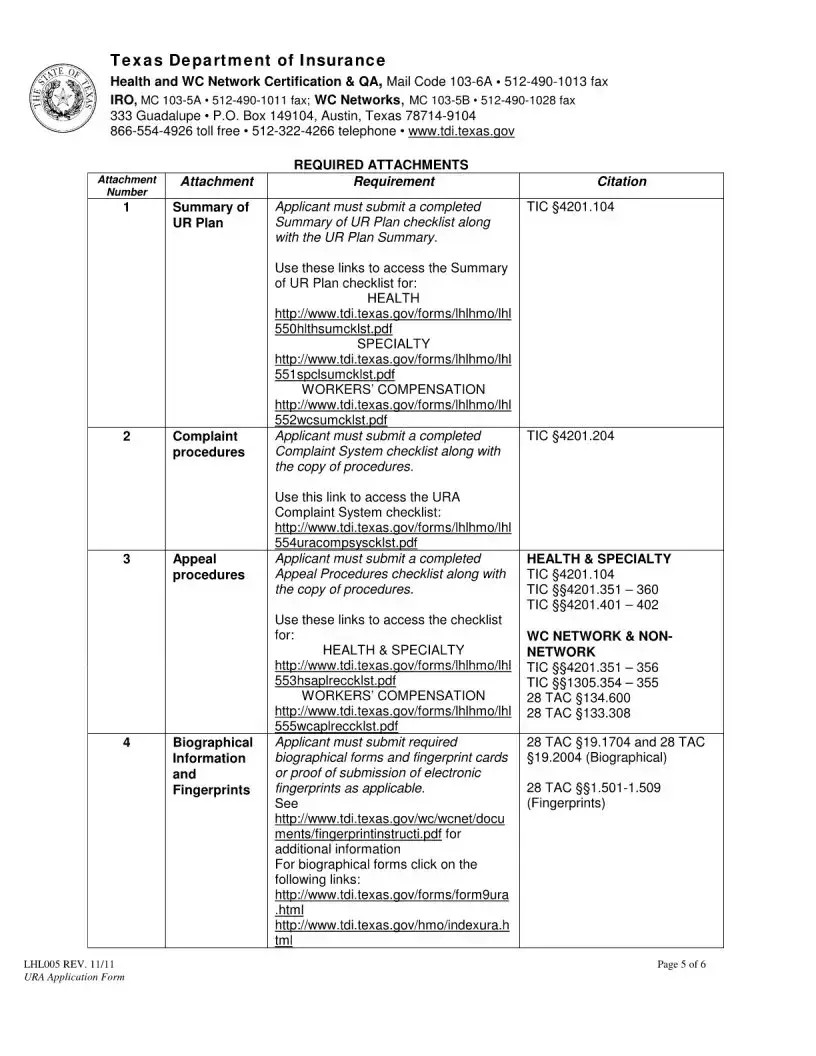
When applying for certification as a Utilization Review Agent (URA) in Texas using the Texas LHL005 form, several other forms and documents may be necessary to support the application process. Each document serves a specific purpose and helps ensure compliance with state regulations. Below is a list of commonly used forms and documents that can accompany the LHL005 form.

  • Biographical Affidavit: This document provides detailed information about the background and qualifications of key personnel within the organization. It is essential for demonstrating the expertise of individuals involved in the utilization review process.
  • Utilization Review Plan: This plan outlines the procedures and criteria used by the URA to evaluate healthcare services. It is crucial for ensuring that the review process is systematic and adheres to state guidelines.
  • Complaint System Documentation: This document details the procedures for handling complaints from patients or providers. A well-defined complaint system is vital for transparency and accountability in the utilization review process.
  • Summary of UR Plan: This summary provides an overview of the utilization review plan, highlighting key components and processes. It helps reviewers quickly understand the URA's approach to utilization management.
  • Change Notification Form: If there are any changes to the information provided in the original application or previous renewals, this form must be submitted. It ensures that the Texas Department of Insurance has the most current information about the URA.
  • Renewal Application: For URAs seeking to maintain their certification, a renewal application must be submitted every two years. This document reaffirms the URA's commitment to compliance and quality assurance.
  • Fee Payment Documentation: Proof of payment for the application or renewal fees is required. This document verifies that the URA has met the financial obligations associated with the application process.
  • Agent for Service of Process Form: This form designates a representative within Texas who can receive legal documents on behalf of the URA. It is essential for ensuring that the URA can be contacted for any legal matters.
  • Organizational Chart: This chart illustrates the structure of the organization, showing the hierarchy and relationships between different roles. It helps clarify the decision-making process within the URA.

By preparing these additional documents alongside the Texas LHL005 form, applicants can enhance their chances of a smooth certification process. Each document plays a crucial role in demonstrating compliance and readiness to engage in utilization review activities in Texas.

Similar forms

  • Texas LHL006 Form: Similar to the LHL005, the LHL006 form is used for the application of a Utilization Review Agent. It requires similar information regarding the applicant, including organizational details and types of utilization review performed.
  • Texas LHL007 Form: This form also pertains to utilization review but focuses specifically on the renewal process. Like the LHL005, it requires detailed information about the applicant and includes a fee structure for renewal applications.
  • Texas LHL008 Form: The LHL008 is an update form for URAs, similar to the update/change section of the LHL005. It allows URAs to report material changes in their information, ensuring compliance with Texas regulations.
  • Texas LHL009 Form: This document is for complaints against utilization review agents. It shares similarities with the LHL005 in terms of requiring contact information and details about the complaint, aimed at maintaining transparency and accountability.
  • Texas LHL010 Form: The LHL010 is a certification form for URAs, which parallels the certification section of the LHL005. It requires an authorized representative's signature and attestation to the accuracy of the information provided.

Dos and Don'ts

When filling out the Texas LHL005 form, there are specific actions to take and avoid. Adhering to these guidelines can help ensure a smooth application process.

  • Do read the entire application carefully before starting to fill it out.
  • Do complete all required fields. If a field does not apply, indicate "NA."
  • Do include the appropriate filing fee based on the type of application you are submitting.
  • Do use the required checklists to reference the page and line numbers for compliance.
  • Don't leave any spaces blank; incomplete applications may lead to delays.
  • Don't forget to submit biographical affidavits for new directors or officers if applicable.

Misconceptions

Understanding the Texas LHL005 form is crucial for those involved in utilization review. However, several misconceptions often arise. Here are seven common misconceptions about this form:

  • It is only for new applications. Many believe the LHL005 form is solely for original applications. In reality, it is also used for renewals and updates, making it versatile.
  • There is no fee for any application type. Some assume that all applications are free. However, original applications require a fee of $2,150, while renewals cost $545.
  • Only corporations can apply. A common belief is that only corporate entities can submit this form. Individuals, partnerships, and associations are also eligible to apply.
  • All sections are optional. Many applicants think they can skip sections. It is essential to complete all items on the form; leaving spaces blank is not allowed.
  • Renewal applications are not time-sensitive. Some believe they can submit renewal applications at any time. In fact, they must be submitted before the expiration date to avoid automatic expiration of certification.
  • Changes to the application do not need to be reported. There is a misconception that once submitted, no updates are necessary. Any material changes must be reported within 30 days.
  • Notarization is optional. Some applicants think notarization can be skipped. However, the application must be signed and notarized to be valid.

Being aware of these misconceptions can help ensure a smoother application process and compliance with Texas regulations.

Key takeaways

When filling out and utilizing the Texas LHL005 form, several important aspects should be kept in mind to ensure a smooth application process. Below are key takeaways that can guide you through the procedure.

  • Understand the Application Types: The LHL005 form caters to various types of applications, including original, renewal, and updates. It is crucial to check the appropriate box to indicate the type of application you are submitting.
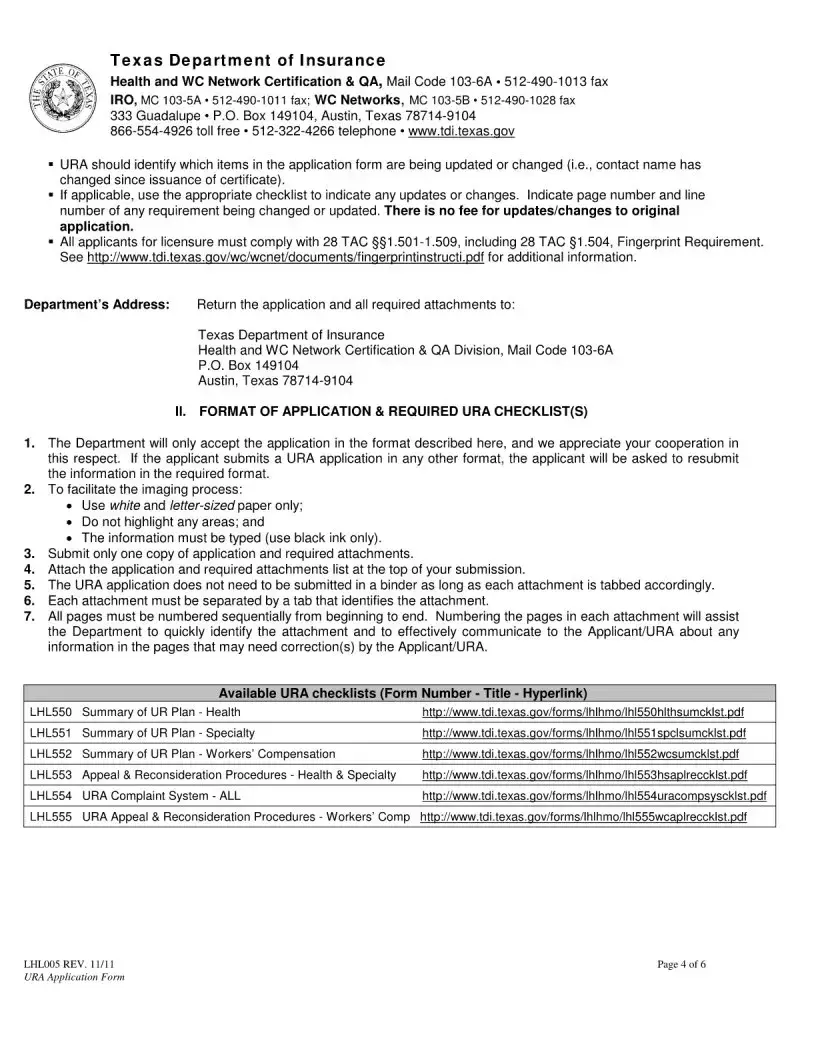
  • Complete All Required Fields: Every section of the application must be filled out completely. Leaving spaces blank can lead to delays or rejections. If a question does not apply, indicate “NA” to avoid confusion.
  • Be Aware of Fees: Each type of application has a corresponding fee. For an original application, the fee is $2,150, while a renewal application costs $545. Remember, these fees are non-refundable.
  • Utilize Checklists: The form requires you to use specific checklists, including summaries of your Utilization Review Plan and complaint systems. These checklists help ensure that all necessary information is included and correctly referenced in your application.
  • Timeliness is Key: If you are applying for renewal, submit your application before the expiration date to avoid automatic expiration of your certification. If your certification expires, you will need to reapply as if it were an original application.
  • Notify of Changes Promptly: Any material changes to your organization’s information must be reported to the Department within 30 days of the change. This includes updates to officers, organizational structure, and utilization review plans.

By keeping these takeaways in mind, individuals and organizations can navigate the application process more effectively, ensuring compliance with Texas regulations and a higher likelihood of approval.