When navigating the complexities of divorce in Texas, the Texas Law Help form serves as a vital resource for those who have children together. Specifically designed for couples with children under the age of 18 or still in high school, this form set is intended for situations where no prior court orders exist regarding the children. If there is a protective order related to family violence, individuals should still utilize this form set, ensuring that a copy of the protective order accompanies the Original Petition for Divorce. The Texas Law Help form includes several essential documents, such as the Original Petition for Divorce, Final Decree of Divorce, and Waiver of Service, among others. Before diving into the paperwork, it's crucial to familiarize oneself with the process of filing an uncontested divorce, which is characterized by mutual agreement between spouses on all pertinent issues or a default situation where one spouse does not respond. The form set also provides guidance on necessary steps, such as determining residency requirements and seeking legal advice, particularly if safety concerns arise. By understanding the purpose and components of the Texas Law Help form, individuals can better prepare for a smoother divorce process.

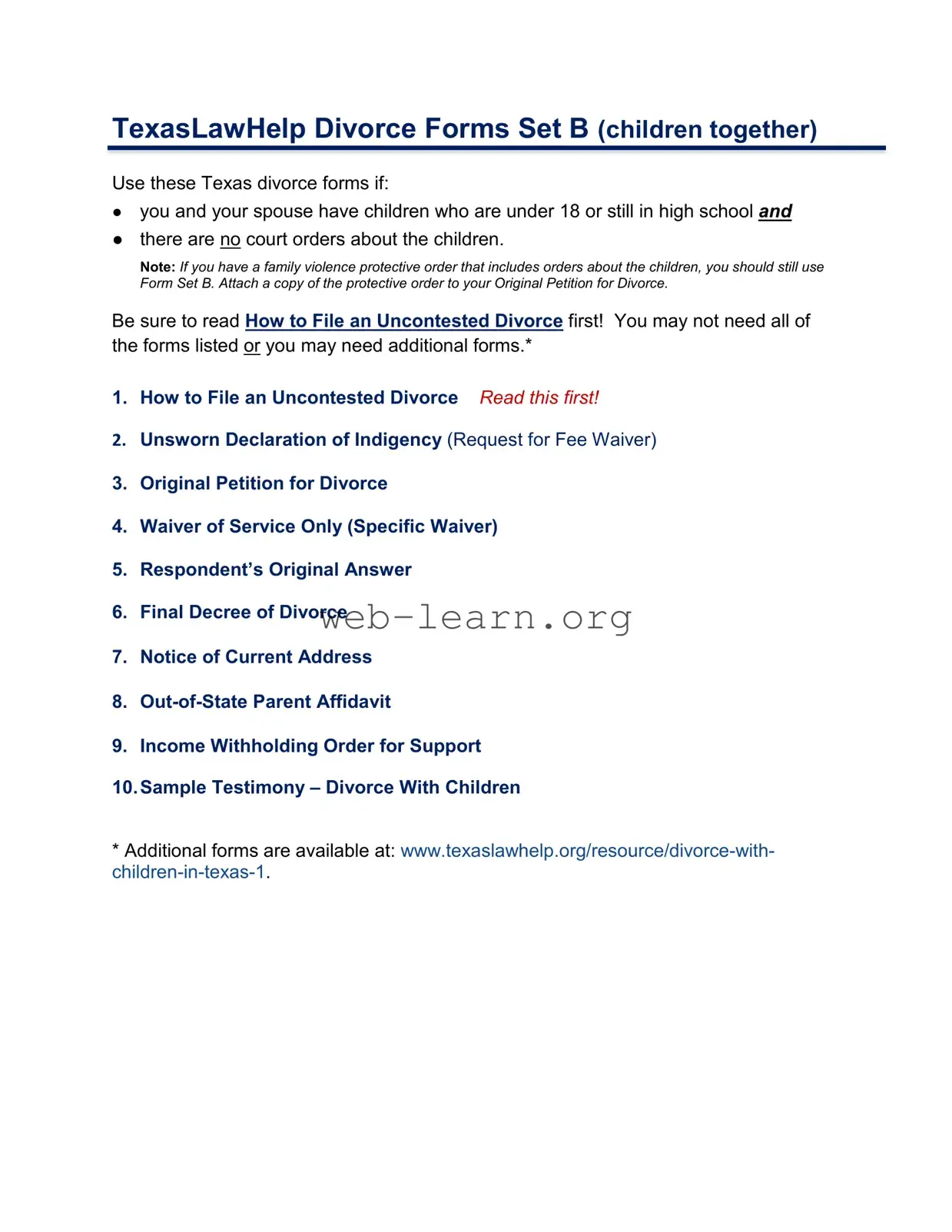
TexasLawHelp Divorce Forms Set B (children together)
Use these Texas divorce forms if:
●you and your spouse have children who are under 18 or still in high school and
●there are no court orders about the children.
Note: If you have a family violence protective order that includes orders about the children, you should still use Form Set B. Attach a copy of the protective order to your Original Petition for Divorce.
Be sure to read How to File an Uncontested Divorce first! You may not need all of the forms listed or you may need additional forms.*
1. How to File an Uncontested Divorce Read this first!
2.Unsworn Declaration of Indigency (Request for Fee Waiver)
3.Original Petition for Divorce
4.Waiver of Service Only (Specific Waiver)
5.Respondent’s Original Answer
6.Final Decree of Divorce
7.Notice of Current Address
8.
9.Income Withholding Order for Support
10.Sample Testimony – Divorce With Children
*Additional forms are available at:

How to File an Uncontested Divorce
These instructions explain the steps in a simple, uncontested Texas divorce. Use them with the FREE
These instructions are written for people who are “pro se.” Pro se means you don’t have a lawyer.
These instructions are not a substitute for the advice and help of a lawyer. It’s a good idea to talk to a lawyer about your particular situation before filing or responding to a divorce.
Is Your Divorce Uncontested?
Your divorce is uncontested when it is:
agreed – you and your spouse agree about all the issues in your case OR
default – your spouse is given legal notice of your divorce by Official Service of Process, Publication or Posting and does not file an Answer or Waiver of Service with the Court or otherwise appear in the case.
If your divorce is contested, it is best to talk to a lawyer before filing any forms with the Court.
Steps for an Uncontested Texas Divorce
A full description of each step follows. Carefully read all the steps before you begin.
Step 1: |
Get help if there has been family violence or you feel unsafe. |
|
Step 2: |
Talk to a lawyer about your particular situation. |
|
Step 3: |
Determine where to file. |
|
Step 4: |
Choose a divorce form set at www.TexasLawHelp.org. |
|
Step 5: |
Fill out the Original Petition for Divorce. |
|
Step 6: |
File (turn in) your Original Petition for Divorce. |
|
Step 7: |
Give “legal notice” to your spouse |
|
Step 8: |
Fill out the Final Decree of Divorce. |
|
Step 9: |
Wait the required waiting periods. |
|
Step 10: Confirm that your case is uncontested and get ready for court. |
|
|
Step 11: Go to court to finish your divorce. |
|
|
© TexasLawHelp.org – How to File an Uncontested Divorce, July 2014 |
Page 1 of 13 |
|

Step 1: Get help if there has been violence or you feel unsafe.
●It’s not a good idea to do your own divorce, without a lawyer, when there has been family violence. Family violence includes physical violence and sexual assault. It can also include threats of violence. You do not need to have called the police or sought medical care to be the victim of family violence.
●If you or your children have been the victim of family violence or if at any time you feel unsafe, get help by calling the:
O National Domestic Violence Hotline at
Step 2: Talk to a lawyer about your particular situation.
●Divorce cases can be complicated and your property, your money and your rights as a parent may be at risk. Even if you decide to represent yourself, you should see a lawyer for legal advice about your particular situation before filing anything,
●It’s really important to talk to a lawyer if:
O you’re afraid for your or your children’s safety, or O your case is contested, or
O your spouse has a lawyer, or
O you or your spouse has a house, retirement, business, other valuable property or a lot of debt. Talking to a lawyer now, can save you time and money in the long run.
●Need help finding a lawyer? For referral to a lawyer, or if you have a low income to a free Legal Aid program, call the Lawyer Referral Information Service at
●Just want advice? You can hire a lawyer just to give you advice, review your forms, draft a document or help you prepare for a hearing. This is called limited scope representation. You may then be able to handle the other parts of your divorce yourself.
Go to
Do Not Use the TexasLawHelp Divorce Forms if:
OYou or your spouse have an ongoing bankruptcy case.
OYou want to file specific grounds for divorce, such as cruelty or adultery.
OYou want spousal maintenance, referred to as “alimony” in some states.
OYou and your spouse have a disabled child.
© TexasLawHelp.org – How to File an Uncontested Divorce, July 2014 |
Page 2 of 13 |

Step 3: Determine where to file.
Residency
Requirements
for Divorce
You can file for divorce in Texas as long as you or your spouse has lived:
●in Texas for at least the last 6 months, and
●in the county where you want to file for divorce
for at least the last 90 days. See Texas Family Code Section 6.301.
●Information for Military Families: If you are serving in the armed forces outside of Texas or other government service outside of Texas or you have accompanied your spouse who is serving in the armed forces or other government service outside of Texas, you may still file for divorce in Texas if Texas has been the home state of either you or spouse for at least 6 months and the county where you plan to file the divorce has been the home county of either spouse for at least 90 days. Time spent away while serving in the armed forces or other government service counts as time spent in Texas and your home county. See Texas Family Code Section 6.303.
●Information for Immigrants: You may file for divorce in Texas even if you do not have legal status in the United States, as long as you or your spouse has lived in Texas for at least the last 6 months and in the county where you want to file for divorce for at least the last 90 days.
Things to consider…
Things to consider…
●ififyyourchildrendon’tliveliveininTexasororhaven’tlivedininTexasverylong. .
AATTexasCourtcancannotmakeinitialcustodyandandvisitationordersaboutaachildunless: : 1)1) thethechildhahaslivedininTexasforforatatleastthethelastlast66months(or(orsincebirth),),oror
2)2) Texaswasthethechild’shomestateandandthethechildhashasbebeengoneforforfewerthan66months. .
SeeSeeTexasTexasFamilyFamilyCodeCodeSectionSection152152.201.201. .
Thereareareaafewfewexceptionstotothisthisrulerule. .TTalkwithwithaalawyerififthisthisisisananisissue. .
●ififyourspouselivelivesoutsideofofTexas. .
AsAslongasasyouyoumeetthetheresidencyrequirementsforfordivorce,youyoucancangetgetdivorcedininTexasevenif yourif yourspousespouseliveslivesin anotherin anotherstatestate. However,. However,thetheCourtCourtmustmusthavehavepersonalpersonaljurisdictictionoverover
SeeSeeTexasTexasFamilyFamilyCodeCodeSections6.6305,.305,6.6308,.308,102102.011.011andand102102.012.012. .
TheTheOriginalPetitionforforDivorceformincludesaalistlistofofsituationsthatthatgivegivethetheCourtpersonal
© TexasLawHelp.org – How to File an Uncontested Divorce, July 2014. |
Page 3 of 13 |

Step 4: Choose a divorce form set.
●Choose one of the following divorce form sets at www.TexasLawHelp.org. Each set includes multiple forms that you or your spouse will need to fill out and file with (turn in to) the Court. The forms are described on the following page.
O Texas Supreme Court Divorce Form SET 1 (no children, no real property)
Use these forms if there are:
●no minor children and
●no real property (house or land).
These forms are approved for use throughout Texas by the Texas Supreme Court.
These forms come with different instructions.
O TexasLawHelp Divorce Form SET A (no children together)
Use these forms if:
●you and your spouse do not have children who are under 18 or still in high school.
OTexasLawHelp Divorce Form SET B (children together)
Use these forms if:
●you and your spouse have children who are under 18 or still in high school and
●there are no court orders regarding the children.
Note: If you have a family violence protective order that includes orders regarding the children, you should still use SET B.
O TexasLawHelp Divorce Form SET C (children together with final court order)
Use these forms if:
●you and your spouse have children together who are under 18 or still in high school and
●there is a final court order for custody and support of your children in place and you do not want to change that order.
Note: Do not use the TexasLawHelp divorce forms if you have a court order but: 1) it does not include all the children you and your spouse have together, 2) the order is a temporary order, or 3) you are asking the court to make changes to the order. If one of these situations applies, ask a lawyer to draft the appropriate forms for your case.
Things to consider…
Things to consider…
if you and your spouse don’t agree on child support.
●if you and your spouse don’t agree on child support.
If you and your spouse don’t agree on child support, the Office of the Attorney General (OAG) mayIf youbeandableyourto helpspouse. Althoughdon’t agreethe OAGon childcannotsupport,representthe Officeeith rofparent,the Attorneythey canGeneralask the court(OAG)to maykebeanableordertoforhelpchild. Althoughsupport,themedicalOAG cannotsupport,representcustody andeithervisitationparent,.they can ask the court to make an order for child support, medical support, custody and visitation.
Once there is a final court order for custody and support of your children, you may use the
Once there is a final court order for custody and support of your children, you may use the TexasLawHelp Divorce SET C for your divorce.
TexasLawHelp Divorce SET C for your divorce.
For information about opening a case with the OAG call
www.oag.state.tx.us/cs.
© TexasLawHelp.org – How to File an Uncontested Divorce, July 2014. |
Page 4 of 13 |

●Each divorce form set includes a version of the following forms. Additional forms are available at www.TexasLawHelp.org.
Name of Form |
What It Is and How to Use It |
|
|
If you have a low income, receive government benefits because you have a |
|
Affidavit of |
low income or you cannot pay court fees, you may fill out this form to ask the |
|
Court if you can file for divorce without paying the court and filing fees. The |
||
Indigency |
||
Court may ask you to present evidence of your income and expenses at a |
||
|
||
|
hearing. The Court may or may not decide to let you file without paying. |
|
|
|
|
|
One spouse (the Petitioner) fills out and files (turns in) this form at the |
|
Original |
courthouse to start the divorce. It tells the Court and your spouse that you |
|
Petition for |
want a divorce and states what you want the Court to order in the Final |
|
Divorce |
Decree of Divorce. Note: This form must be turned in first, before the other |
|
|
spouse signs anything. |
|
|
|
|
|
The other spouse (the Respondent) may fill out this form if she or he does |
|
|
not want to be served by a constable, sheriff, or private process server with a |
|
|
copy of the Original Petition for Divorce. The Waiver must be signed in front |
|
Waiver of |
of a notary at least one day after the Original Petition for Divorce is filed at |
|
Service Only |
the courthouse. This form allows the judge to finish the divorce as long as |
|
(Specific |
both spouses have signed the Final Decree of Divorce. |
|
Waiver) |
Note: The TexasLawHelp Waiver of Service Only (Specific Waiver) form only waives |
|
|
||
|
the right to be formally served with a copy of the Petition. Other Waiver forms may |
|
|
also waive the right to know anything else about the case. If someone asks you to |
|
|
sign a Waiver, read it carefully. You may want to sign an Answer instead. |
This form may be used two ways:
(1)If the divorce is agreed, the other spouse (the Respondent) may fill out and sign this form instead of the Waiver of Service Only form. The
Respondent’s |
Respondent’s Original Answer form also |
allows the judge to finish the |
|
divorce as long as both spouses have signed the Final Decree of |
|||
Original |
|||
Divorce. The Respondent’s Original Answer form does not need to be |
|||
Answer |
|||
signed in front of a notary. |
|
||
|
|
||
(2)If the divorce is not agreed, the other spouse (the Respondent) may fill out and file the Respondent’s Original Answer form to contest the divorce.
Final Decree of |
The Judge signs this form to grant your divorce and make orders regarding |
|
Divorce |
your property, debts and children (if applicable). Fill it out ahead of time and |
|
bring it with you to the final divorce hearing. |
||
|
||
|
|
|
Notice of |
This form must be filed if you or your spouse moves. It tells the Court your |
|
Current of |
||
new address so that the Court can contact you about hearings, etc. |
||
Address |
||
|
●Divorce form Set B (with children together) also includes the following forms.
|
Fill out and file this form if either spouse lives outside of Texas. |
|
|
|
Party Affidavit |
|
|
|
|
|
|
|
|
|
|
|
Income |
The Court signs this form to order an employer to withhold child support from |
|
|
Withholding for |
||
|
an employee’s paycheck. Fill it out and bring it with you to the final divorce |
||
|
Support Order |
hearing if child support will be ordered. |
|
|
|
|
|
© TexasLawHelp.org – How to File an Uncontested Divorce, July 2014. |
Page 5 of 13 |
||

Step 5: Fill out the Original Petition for Divorce.
●After you choose a divorce form set, fill out the Original Petition for Divorce form.
→You are the “Petitioner.” Your spouse is the “Respondent.”
→Fill out all the spaces unless instructed otherwise. Print clearly in blue or black ink.
Note: The Petition asks for your address. Your spouse will get a copy of this form. If you are concerned about your spouse knowing your address, call the Family Violence Legal Line at 1-
●Fill out the Information on Suit Affecting the Family Relationship form.
●Fill out these additional beginning forms only if they apply to your case:
OAffidavit of Indigency – only if you can’t pay the filing fee for your divorce. Call the clerk’s office to learn the fee for your case.
Note: Do not sign this form until you are in front of a notary. Or, if you don’t have the necessary picture identification to get this form notarized attach a completed Unsworn Declaration form. If you receive public benefits (such as foodstamps) attach proof.
OExhibit:
OAffidavit for Service by Posting or Publication – only if you can’t find your spouse after looking really hard. Read Step 7C for more information.
●Make 2 copies of each form you filled out.
Thingstotoconsider……
●ififtthewifeisispregnant..
IfIfthethewifewifeisispregnant,youyouwillwillnotnotbebeabletotofinishyourdivorceuntilafterthethechildchildisisborn..
IfIfthethehusbandisisnotthebiologicalfather,paternity ofof the child must be established before you
cancanfinishyourdivorce.. GetGetinformationaboutestablishingpaternityatatwww.TexasLawHelp. .org.org..
IfIfthethehusbandhusbandis isthethebiologicalbiologicalfather,father,ordersordersfor custodyfor custoandysupportand supportof the childof themustchildbe includedmust be inincludedthe FinalinDecreethe FinalofDecreeDivorceof. Divorce.
●ififtthewifehadhadaachildwithanothermanwhilemarriedied totothethehusbandd..
IfIfthethewifehadaachildwithanothermanwhilemarried toto the husband, paternity ofof the child must bebeestablishedbeforeyouyoucanfinishyourdivorce.. Thisisis true even ifif you have been separated
forforaalongtime.. GetGetinformationaboutestablishingpaternityatatwww.TexasLawHelp. .org.org..
●ififyyouneedordersrightaway..
IfIfyouyouneedordersrightaway,, you mayask the Court toto make temporary orders after notice to yourspouseandandaahearing.. Temporaryorderstypicallyy lastuntilthedivorceisisfinished.. Talk to aa
lawyerififyouyouneedtemporaryt orderso .. Your county law library may also have information about temporaryorders..
IfIfyou need a protectiveorderbecauseofoffamilyviolenceviolencecallcallthetheTexasTexasFamilyFamilyViolencenceLegalLegal
Line at
© TexasLawHelp.org – How to File an Uncontested Divorce, July 2014. |
Page 6 of 13 |

Step 6: File (turn in) your Original Petition for Divorce.
● File (turn in) your completed Original Petition for Divorce and additional beginning forms to the Court either in person or electronically.
OTo file your forms in person, take the original and 2 copies of your
forms to the courthouse and turn them in at the clerk’s office.
You may use the Texas Civil Courts Guide at www.TexasLawHelp.org to find the address and phone number for the clerk’s office in the county where you plan to file your divorce.
OTo file your forms electronically go to http://www.efiletexas.gov.
●Pay the filing fee (or file your Affidavit of Indigency form if you cannot afford the fee).
●Ask the clerk if there are local rules or procedures you need to know about for your divorce.
●The clerk will:
Owrite your “Cause Number” and “Court Number” at the top of the first page of your Petition. (You should write these numbers at the top of any document you file in your divorce.)
O
Oask if you want to have your spouse “served.” Served is when your spouse is given legal notice of your divorce by Official Service of Process or by Posting or Publication.
If your spouse will agree to sign a Waiver of Service or Answer, you do not need to have your spouse served. Follow the instructions set out in Step 7A.
If your spouse will not agree to sign a Waiver of Service or Answer, you must have your spouse served by Official Service of Process. Follow the instructions set out in Step 7B.
If you can’t find your spouse, you must have your spouse served by Posting or Publication. Follow the instructions set out in Step 7C.
Things to consider…
●if your children get Medicaid or TANF or got it in the past.
You MUST send a
1)you and your spouse have children together and
2)the children get Medicaid or TANF or got it in the past. See Texas Family Code Section 6.301.
Get contact information for the Attorney General child support office in your area at www.oag.state.tx.us/cs/fieldoffices.php. Bring proof of delivery when you go to court.
●if you and your spouse don’t agree.
If you and your spouse don’t agree on the terms of your divorce, you may want to consider mediation. In mediation, an independent person (the mediator) will try to help you reach an agreement. The divorce process is usually easier when you have an agreement. Be sure to talk to a lawyer first. A lawyer can help you understand your options and negotiate a fair agreement.
© TexasLawHelp.org – How to File an Uncontested Divorce, July 2014. |
Page 7 of 13 |

Step 7: Give “legal notice” to your spouse.
●Your spouse has the right to know that you have filed for divorce. You cannot simply tell your spouse or send your spouse a letter. You must use a legally acceptable way to give your spouse notice and prove to the Court that you did so.
●Here are 3 ways to give “legal notice” to your spouse:
7A - Waiver of Service or Answer (Use this way if your divorce is AGREED.)
7B - Official Service of Process (Use this way if your divorce is NOT AGREED.)
7C - Posting or Publication (Use this way if you can’t find your spouse.)
●Each way to give legal notice is described below. Choose the way that bests fits your situation.
7A. Waiver of Service or Answer (Use this way if your divorce is AGREED.)
●You may give your spouse legal notice by Waiver of Service or Answer if
your spouse agrees to sign the Waiver of Service Only (Specific Waiver) form or the Respondent’s Original Answer form.
● Follow these steps:
1. Mail or
a)a
b)a blank Waiver of Service Only (Specific Waiver) or Respondent’s Original Answer form.
2.If your spouse plans to sign the Waiver of Service Only (Specific Wavier) form, tell him or her to sign it in front of a notary at least one day after you filed the Petition. Otherwise your spouse will have to redo it.
3.File the completed Waiver of Service form or Answer form at the courthouse.
TIP: If your divorce is agreed, your spouse must also sign a completed Final Decree of Divorce (Decree) form. It may save you time to fill out the Decree now and send it to your spouse with the Waiver of Service Only (Specific Waiver) or Respondent’s Original Answer form. You may also wait until later in the process to
Warning: Do not
© TexasLawHelp.org – How to File an Uncontested Divorce, July 2014. |
Page 8 of 13 |

7B. Official Service of Process (Use this way if your divorce is NOT AGREED.)
●Official Service of Process is when your spouse is formally given legal notice of your divorce by a constable, sheriff, private process server or the clerk.
●Give legal notice by Official Service of Process if your spouse will not sign the Waiver of Service or Answer form or you do not want to have personal contact with your spouse.
●Follow these steps to give legal notice by Official Service of Process:
1.Tell the clerk where you filed your Petition that you want to have your spouse “served.” The clerk will print a form called the “Citation” that tells your spouse you have filed for divorce. The clerk will attach a copy of your Petition to the Citation.
2.Tell the clerk whether you want your spouse served by:
a.personal service (this is the better way), or
b.certified mail return receipt requested.
Each way is described below.
3.If you choose personal service, send the Citation (with a copy of your Petition attached) to a constable, sheriff or private process server in the county where your spouse will be served.
4.The constable, sheriff, private process server or clerk will fill out a Return of Service form. Make sure the Return of Service form is filed at the courthouse.
What is personal service?
Personal service is when a constable, sheriff or private process server gives your spouse the divorce paperwork in person. The constable, sheriff or private process server then completes a Return of Service form stating when your spouse was served. The Return of Service form is proof to the Court that you gave your spouse legal notice. Your spouse does not have to sign anything.
Note: The Return of Service form must be filed at the courthouse at least 12 days before your final hearing.
What if my spouse is in jail or prison?
Use personal service if your spouse is in jail or prison. DO NOT use service by certified mail because your spouse will not be able to sign for the letter.
What is service by certified mail?
Service by certified mail is when the clerk (or constable) sends your spouse the divorce paperwork by certified mail return receipt requested. The return receipt (or “green card”) must be signed by your spouse. Only use this way if you know that your spouse is the only person who will sign for the letter when the post office delivers it. If someone else signs or your spouse does not sign his or her name exactly as it is written on your Petition, you will have to pay another fee and have your spouse served a different way.
The clerk (or constable) will complete a Return of Service form stating when your spouse was served. The Return of Service form must be filed at the courthouse at least 12 days before your final hearing.
7C - Posting or Publication (Use this way if you can’t find your spouse.)
●If you can’t find your spouse, you must give your spouse legal notice by posting or publication depending on your case. Find forms and instructions for service by posting and publication at www.TexasLawHelp.org.
© TexasLawHelp.org – How to File an Uncontested Divorce, July 2014. |
Page 9 of 13 |
| Fact Name | Details |
|---|---|
| Applicable Form Set | TexasLawHelp Divorce Forms Set B is for couples with children under 18 or still in high school. |
| Governing Law | Texas Family Code Section 6.301 governs residency requirements for divorce. |
| Family Violence Consideration | If there is a protective order for family violence, use Form Set B and attach a copy of the order. |
| Initial Steps | Read "How to File an Uncontested Divorce" before proceeding with any forms. |
| Forms Included | Form Set B includes forms like the Original Petition for Divorce and Final Decree of Divorce. |
| Pro Se Representation | These forms are designed for individuals representing themselves, known as "pro se." |
| Residency Requirements | At least one spouse must have lived in Texas for 6 months and in the filing county for 90 days. |
| Legal Advice Recommendation | It's advisable to consult a lawyer before filing, especially in complex situations. |
Filling out the Texas Law Help form is an essential step in initiating your uncontested divorce process. This guide will help you navigate the form efficiently, ensuring that you complete it accurately and understand the necessary steps that follow.
What is the Texas Law Help Divorce Form Set B?
This form set is designed for couples who have children together and are seeking an uncontested divorce. You should use these forms if:
If you have a family violence protective order that includes provisions about the children, you should still use Form Set B. Just remember to attach a copy of that protective order to your Original Petition for Divorce.
What does "uncontested divorce" mean?
An uncontested divorce is one where both spouses agree on all issues related to the divorce. This can happen in two ways:
If your divorce is contested, meaning you and your spouse cannot agree on certain issues, it’s advisable to consult a lawyer.
What steps should I follow for an uncontested divorce?
Here’s a brief outline of the steps to take:
Who should consider speaking with a lawyer?
It’s wise to consult a lawyer if:
A lawyer can provide valuable advice and help protect your rights during the divorce process.
What if I don't need all the forms listed?
You may not need to fill out every form in the Texas Law Help Divorce Form Set B. Depending on your situation, some forms might not apply to you. It’s important to review each form and determine which ones are necessary for your case.
Where can I find additional resources or help?
For more information and resources, visit www.texaslawhelp.org. This website offers a wealth of information about divorce, including additional forms and guidance tailored to your needs. If you need legal help, you can also contact the Lawyer Referral Information Service at 1-800-252-9690.
Filling out the Texas Law Help form can be a straightforward process, but many individuals make common mistakes that can lead to delays or complications in their divorce proceedings. Understanding these mistakes can help ensure a smoother experience. Here are seven frequent errors people often make.
One common mistake is not reading the instructions thoroughly. The Texas Law Help form provides essential guidelines on how to fill out the necessary documents. Skipping this step can lead to incomplete forms or misunderstandings about what is required. It’s crucial to familiarize oneself with the instructions to avoid unnecessary setbacks.
Another frequent error is failing to determine whether the divorce is truly uncontested. An uncontested divorce means both parties agree on all issues. If there is any disagreement, it becomes contested, and different procedures may apply. Misclassifying a contested divorce as uncontested can result in filing the wrong forms and additional legal complications.
People often forget to include necessary documents. For example, if there is a family violence protective order, it must be attached to the Original Petition for Divorce. Neglecting to include such documents can lead to delays in the court process. Always double-check to ensure all required attachments are present.
Additionally, many individuals overlook the residency requirements for filing a divorce in Texas. Both parties must have lived in Texas for at least six months and in the filing county for at least 90 days. Failing to meet these criteria can result in the court dismissing the case. It’s essential to verify that these conditions are satisfied before proceeding.
Another mistake is not seeking legal advice when needed. While the forms are designed for individuals representing themselves, complex situations—such as those involving children or significant assets—can benefit from professional guidance. Consulting a lawyer can help clarify rights and responsibilities, potentially saving time and money in the long run.
Some individuals also make the error of using the wrong form set. Texas Law Help offers different forms depending on the specific circumstances of the divorce, such as whether children are involved. Using an incorrect form can lead to complications and further delays. It’s important to select the appropriate set based on the specific situation.
Lastly, many people forget to keep copies of all submitted forms. After filing, it’s essential to retain copies for personal records. This practice ensures that individuals have access to their documents if questions arise later in the process. Keeping organized records can make the entire process more manageable.
By avoiding these common mistakes, individuals can navigate the Texas Law Help form process more effectively, leading to a smoother divorce experience.
When navigating a divorce in Texas, especially one involving children, several forms and documents often accompany the Texas Law Help form. Each of these documents plays a crucial role in ensuring that the divorce process is handled correctly and fairly. Below is a list of some commonly used forms that can help streamline the process.
Understanding these forms can make the divorce process smoother and less stressful. While it may seem overwhelming at first, taking it step by step can help you navigate through the necessary paperwork effectively.
When filling out the Texas Law Help form, there are several important guidelines to keep in mind. Here’s a list of things you should and shouldn't do:
By following these guidelines, you can navigate the process more smoothly and ensure that your rights and interests are protected.
This is incorrect. The Texas Law Help form Set B is specifically designed for couples who have children under 18 or still in high school. It is important to use the correct form based on your situation.
While it is recommended to consult a lawyer, especially in complicated cases, individuals can represent themselves using these forms. The instructions are tailored for those who choose to file without legal representation.
This is not true. If you have a family violence protective order that includes children, you should still use Form Set B. It is crucial to attach a copy of the protective order to your Original Petition for Divorce.
Not necessarily. You may not need all the forms listed in the instructions, or you may require additional forms. It’s essential to assess your specific circumstances before proceeding.
Each divorce case is unique. Factors such as whether the divorce is contested or uncontested, the presence of children, and any existing court orders can significantly affect the process.
This is a misconception. As long as you meet the residency requirements, you can file for divorce in Texas even if your spouse resides in another state. However, the court must have personal jurisdiction over your spouse for certain orders.
This is misleading. If you have children, it is vital to address custody and child support arrangements. The Texas Law Help forms provide guidance on these issues, and it is advisable to seek legal advice if there are disagreements.
Here are some key takeaways about filling out and using the Texas Law Help form for divorce: