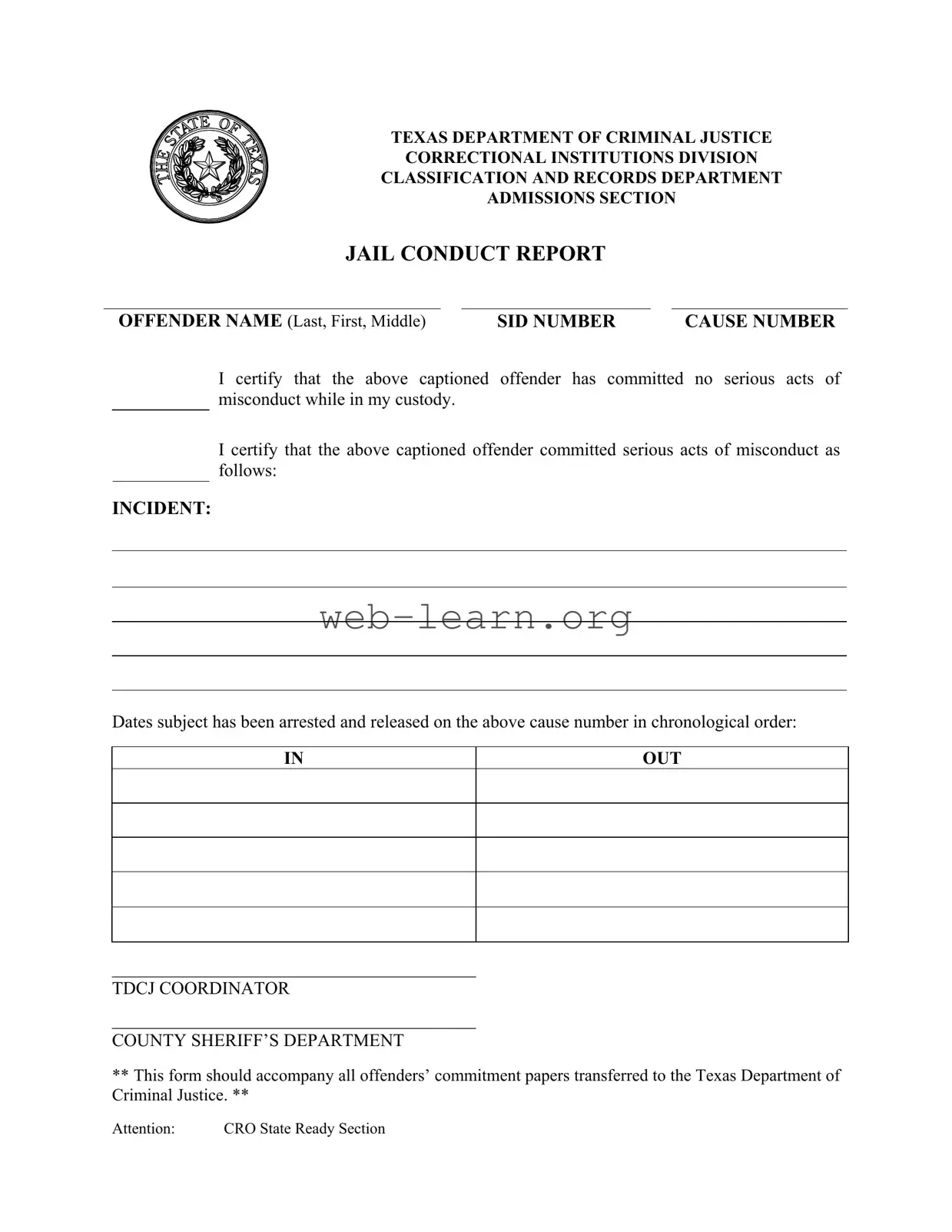
The Texas Jail Conduct Report form plays a crucial role in the assessment and documentation of an offender's behavior while in custody. This form is essential for maintaining accurate records, as it provides a structured way to report any incidents of misconduct. The report includes key information such as the offender's name, SID number, and cause number, ensuring that all relevant details are easily accessible. It allows the responsible authorities to certify whether the offender has committed serious acts of misconduct during their time in custody. Additionally, it requires a chronological listing of the dates when the subject was arrested and released under the specified cause number. This comprehensive documentation is vital for the Texas Department of Criminal Justice, as the form must accompany all offenders' commitment papers during their transfer. The involvement of both the TDCJ Coordinator and the County Sheriff’s Department highlights the collaborative effort in managing offender records and ensuring that proper procedures are followed.

TEXAS DEPARTMENT OF CRIMINAL JUSTICE
CORRECTIONAL INSTITUTIONS DIVISION
CLASSIFICATION AND RECORDS DEPARTMENT
ADMISSIONS SECTION
JAIL CONDUCT REPORT
OFFENDER NAME (Last, First, Middle) |
|
SID NUMBER |
|
CAUSE NUMBER |
I certify that the above captioned offender has committed no serious acts of misconduct while in my custody.
I certify that the above captioned offender committed serious acts of misconduct as follows:
INCIDENT:
Dates subject has been arrested and released on the above cause number in chronological order:
IN
OUT
_______________________________________
TDCJ COORDINATOR
_______________________________________
COUNTY SHERIFF’S DEPARTMENT
**This form should accompany all offenders’ commitment papers transferred to the Texas Department of Criminal Justice. **
Attention: |
CRO State Ready Section |
| Fact Name | Fact Description |
|---|---|
| Purpose | The Texas Jail Conduct Report form is used to document an offender's behavior while in custody. |
| Offender Information | It requires the offender's name, SID number, and cause number for proper identification. |
| Certification of Conduct | The form includes a certification section where the custodian confirms whether the offender committed serious misconduct. |
| Incident Reporting | Details of any serious acts of misconduct must be documented, providing clarity on the offender's behavior. |
| Arrest Dates | Custodians must record the dates the offender was arrested and released, ensuring chronological order. |
| Authority Signature | The form must be signed by the TDCJ coordinator and the county sheriff’s department representative. |
| Mandatory Submission | This report is mandatory and must accompany all offenders' commitment papers sent to the Texas Department of Criminal Justice. |
| Governing Law | The use of this form is governed by Texas law pertaining to the management of offenders in custody. |
| Attention to Detail | Special attention is required to ensure that the form is completed accurately to avoid delays in processing. |
Filling out the Texas Jail Conduct Report form is an important step in documenting an offender's behavior while in custody. This form needs to be filled out carefully to ensure accurate information is provided for the Texas Department of Criminal Justice. Follow these steps to complete the form correctly.
What is the Texas Jail Conduct Report form?
The Texas Jail Conduct Report form is a document used by correctional facilities to record the behavior of offenders while in custody. This form is crucial for maintaining accurate records of an offender's conduct, particularly when they are being transferred to the Texas Department of Criminal Justice (TDCJ). It helps ensure that all relevant information about an offender's behavior is communicated effectively.
Who needs to complete this form?
The form must be completed by the jail staff responsible for overseeing the offender during their time in custody. This includes correctional officers and other personnel who can accurately assess and report on the offender's behavior. The information provided will be crucial for the TDCJ in evaluating the offender's conduct history.
What information is required on the form?
The form requires several key pieces of information:
What does it mean to certify an offender's conduct?
When jail staff certify an offender's conduct, they are attesting to the accuracy of the information provided on the form. This includes confirming whether the offender has committed serious acts of misconduct during their custody. The certification is an important legal statement that can impact the offender's future interactions with the criminal justice system.
Why is this form important for transferring offenders?
The Texas Jail Conduct Report form is essential for transferring offenders to the TDCJ because it provides a comprehensive overview of their behavior while in jail. This information helps the TDCJ assess the offender's risk level and determine appropriate housing and treatment options. It also ensures that any patterns of behavior are taken into account, which can influence rehabilitation efforts.
What happens if the form is not completed correctly?
If the Texas Jail Conduct Report form is not completed accurately, it can lead to misunderstandings regarding the offender's behavior. Inaccuracies may affect the offender's classification, treatment, and even their legal proceedings. Therefore, it is crucial for jail staff to ensure that all information is filled out correctly and thoroughly.
Where should the completed form be sent?
Once completed, the Texas Jail Conduct Report form should accompany all offenders' commitment papers when they are transferred to the Texas Department of Criminal Justice. Specifically, it should be directed to the CRO State Ready Section to ensure that it is included in the offender's official records.
When filling out the Texas Jail Conduct Report form, it’s easy to make mistakes that could lead to complications. One common error is failing to include the complete name of the offender. It's essential to provide the full name as it appears on official documents. Omitting a middle name or using nicknames can cause confusion and delay processing.
Another frequent mistake involves the SID number. This unique identifier is crucial for tracking an offender's record. If the SID number is incorrect or missing, it can lead to significant issues in the system. Double-checking this number before submission can save time and prevent future headaches.
Many people also overlook the importance of the cause number. This number links the report to specific legal proceedings. If it’s not entered accurately, it can create discrepancies in the offender's file. Always ensure that the cause number is correct and matches the associated legal documentation.
In addition, the certification section often sees errors. Some individuals mistakenly check the wrong box, either indicating that no serious misconduct occurred when it did, or vice versa. This can lead to serious implications for the offender's record. Careful consideration is necessary when making this certification.
Dates of arrest and release are another area where mistakes commonly happen. It’s vital to list these dates in chronological order. Failure to do so can confuse the timeline of events and complicate the review process. A simple checklist can help ensure all dates are accurate and properly ordered.
Another pitfall is neglecting to sign the form. A signature is not just a formality; it verifies the accuracy of the information provided. Omitting this step can render the report incomplete and delay the transfer process to the Texas Department of Criminal Justice.
Some individuals forget to include the name of the TDCJ Coordinator. This information is essential for routing the report correctly. Without it, the form may not reach the appropriate department, causing unnecessary delays.
Additionally, people often fail to attach necessary documents. The Jail Conduct Report should accompany all commitment papers. Not including these documents can lead to the rejection of the report, forcing resubmission and wasting valuable time.
Finally, misunderstanding the audience for the report can lead to miscommunication. This report is a formal document intended for legal and correctional professionals. Using informal language or abbreviations can create ambiguity. Clarity and professionalism in language are crucial to ensure the report is taken seriously.
The Texas Jail Conduct Report form is an essential document used in the correctional system. However, it often accompanies several other forms that provide additional context and information about an offender's history and behavior. Here are some of those key documents:
Each of these documents plays a crucial role in maintaining an organized and fair correctional system. Together, they provide a clearer picture of an offender's behavior and legal status, ensuring that all parties involved have the necessary information for making informed decisions.
The Texas Jail Conduct Report form serves a specific purpose within the corrections system, but it shares similarities with several other documents. Each of these documents plays a crucial role in maintaining records and ensuring accountability in various correctional settings. Below is a list of eight documents that are comparable to the Texas Jail Conduct Report form:
When filling out the Texas Jail Conduct Report form, it’s important to ensure accuracy and clarity. Here are some essential dos and don’ts to keep in mind:
By following these guidelines, you can help ensure that the report is processed smoothly and accurately. Taking the time to fill out the form correctly can make a significant difference in how the information is received and utilized.
Here are seven common misconceptions about the Texas Jail Conduct Report form:
This is not true. While the form does document serious acts of misconduct, it also allows for certification that an offender has committed no serious acts while in custody.
Although jail staff usually complete the form, it can also be filled out by authorized personnel who have relevant information about the offender's conduct.
This is incorrect. The Texas Jail Conduct Report must accompany all offenders' commitment papers when transferred to the Texas Department of Criminal Justice.
The form is important for all offenders being transferred, regardless of whether they are new or have been in custody before.
This is a misunderstanding. The report is filled out whenever an offender is transferred, not just at the end of their time in custody.
On the contrary, providing accurate and complete details is crucial. The form includes sections for documenting specific incidents and dates of arrest and release.
This is false. The information in the Texas Jail Conduct Report can influence future decisions regarding an offender's classification, parole, and rehabilitation opportunities.
Filling out the Texas Jail Conduct Report form requires careful attention to detail. Here are some key takeaways to ensure accuracy and compliance:
Adhering to these guidelines will help streamline the process and ensure that all necessary information is accurately captured.