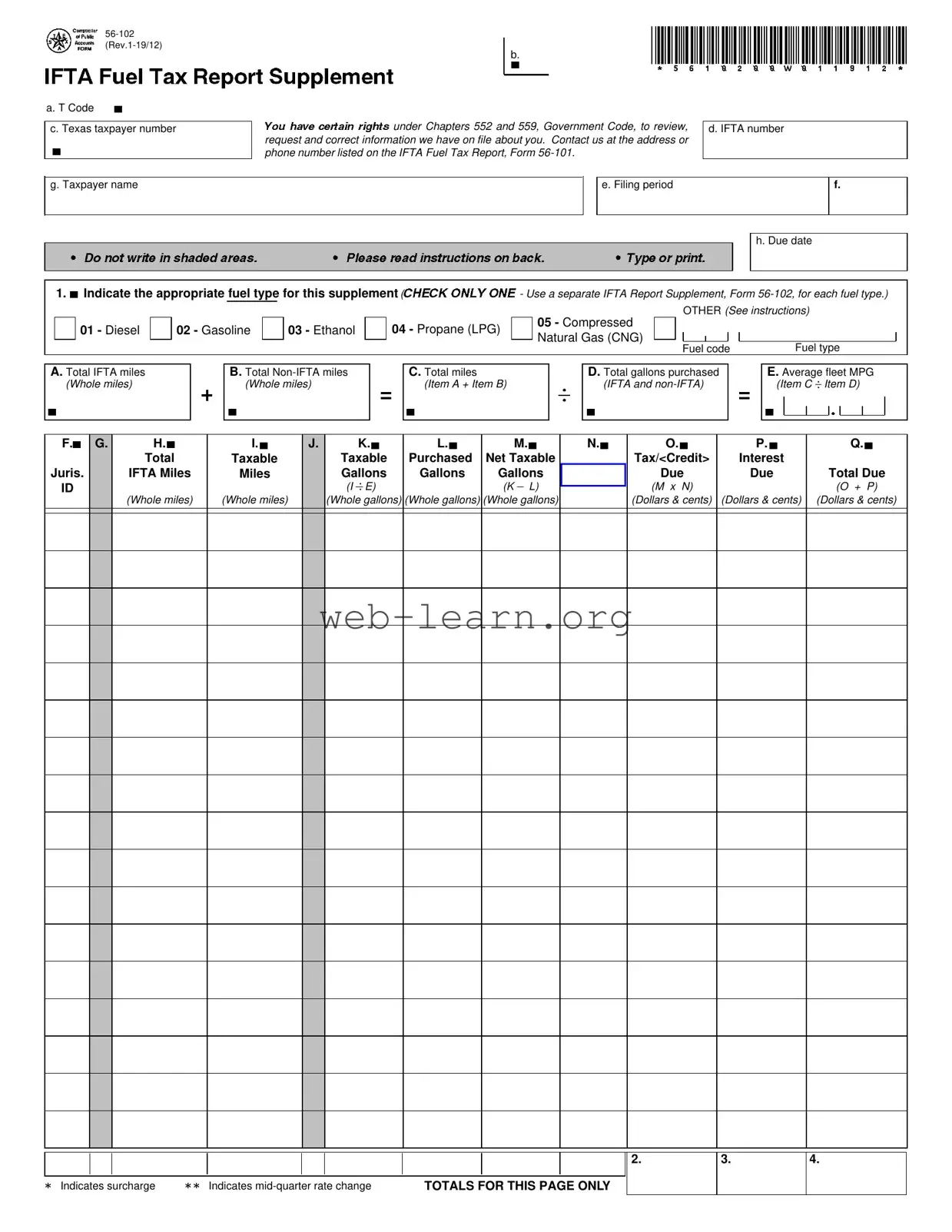
The Texas IFTA form, officially known as Form 56-102, is an essential document for motor carriers operating across state lines and within IFTA jurisdictions. This form facilitates the reporting of fuel usage and mileage, ensuring compliance with the International Fuel Tax Agreement (IFTA). It requires carriers to detail their total IFTA miles, non-IFTA miles, and total gallons of fuel purchased, categorized by fuel type such as diesel, gasoline, and propane. Each fuel type necessitates a separate report supplement, allowing for clear tracking and management of fuel tax liabilities. Additionally, the form includes sections for calculating taxable miles, gallons, and the corresponding tax due or credits owed. Carriers must also account for any surcharges imposed by specific jurisdictions and be mindful of mid-quarter tax rate changes. Accurate completion of this form is crucial, as it impacts the overall fuel tax obligations and ensures that carriers meet their filing deadlines to avoid penalties.
instructions |
ReportSupplement |
|
back. |
|
|
|
|
||||
a. T Code b56100 |
|
Youhavecertainrights |
|
|
|
|
|
|
|
|
b |
|
|
|
|
|
|
|
|||
c. Texas taxpayer number |
|
under Chapters 552 a d 559, Government Code, to review, |
|
d. IFTA num er |
||||||
IDonotwriteinshadedareas. |
request and correct information we have |
file about you Contact us at the address or |
|
|
|
|||||
phone numberIlistedPleaseon thereadIFTA Fuel Tax Report,onForm |
ITypeorprint. |
|
|
|
||||||
|
|
|
|
|
|
|
|
|
|
|
g. Taxpayer name |
|
|
|
|
|
|
e. Filing ri d |
|
f. |
|
|
|
|
|
|
|
|
|
|
|
|
h. Due date
1.bIndicate the appropriate fuel type for this supplement (CHECKONLYONE- Use a separate IFTA Report Supplement, Form
OTHER (See instructions)
01 - Diesel
02 - Gasoline
03 - Ethanol
04 - Propane (LPG)
05 - Compressed
Natural Gas (CNG)
Fuel code |
Fuel type |
A. Total IFTA miles |
|
B. Total |
|
C. Total miles |
|
|
|
D. Total gallons purchased |
|
E. Average fleet MPG |
|
|||||||
|
|
|
|
|
|
|
|
|
|
. |
|
|
|
|
|
|||
b(Whole miles) |
+ |
b(Whole miles) |
= |
b(Item A + Item B) |
. |
|
b(IFTA and |
= |
b(Item C |
. |
Item.D) |
|
||||||
|
|
|
|
|
|
|
|
|
|
|
|
|
|
|
|
|
|
|
|
|
|
|
|
|
|
|
|
|
|
|
|
|
|
|
|
|
|
|
|
|
|
|
|
|
|
|
|
|
|
|
|
|
|
|
|
|
F.b
Juris.
ID
G.
H.b
Total
IFTA Miles
(Whole miles)
I.b
Taxable
Miles
(Whole miles)
J.
|
K. |
bbbbbL.M.N. |
O. |
|||||
Taxable |
Purchased |
Net Taxable |
|
Tax/<Credit> |
||||
Gallons |
Gallons |
Gallons |
Tax Rate |
Due |
||||
. |
|
|
|
|
|
|
|
|
(I |
. |
E) |
|
(K |
|
L) |
|
(M x N) |
(Whole gallons) |
(Whole gallons) (Whole gallons) |
|
(Dollars & cents) |
|||||
|
|
|
|
|
|
|
|
|
P.b
Interest
Due
(Dollars & cents)
Q.b
Total Due
(O + P)
(Dollars & cents)
*
Indicates surcharge |
**Indicates |
TOTALS FOR THIS PAGE ONLY |
2.
3.
4.

Form
Item 1 - |
Indicate the |
ppropriate fuel type if it is not preprinted. Place an |
|||||||||||||||||||
|
"X" in the applicable box for Diesel, Gasoline, Ethanol, Propane |
||||||||||||||||||||
|
or Compressed Na ural Gas. For OTHER fuel typ s, place an |
||||||||||||||||||||
|
"X" in the last box and ent |
|
the fuel code and fuel type as |
||||||||||||||||||
|
listed below: |
|
|
|
|
|
|
|
|
|
|
|
|
|
|
|
|
|
|
||
|
|
|
|
|
|
|
|
|
|
|
|
|
|
|
|
|
|
||||
|
|
|
|
|
|
|
|
|
|
|
|
|
|
|
|
|
|
||||
|
|
06 |
|
|
|
|
|
|
11 |
|
|
|
|
Methanol |
|
|
|||||
|
|
07 |
|
|
|
|
|
|
12 |
|
|
|
|
Biod esel |
|
|
|||||
|
|
08 |
|
|
|
|
|
|
13 |
|
|
|
|
Electricity |
|
|
|||||
|
|
09 |
|
|
Gasohol |
|
|
14 |
|
|
|
|
Hydrogen |
|
|
||||||
|
|
10 |
|
|
|
LNG |
|
|
|
|
|
|
|
|
|
|
|
|
|
|
|
|
Use a sep rate Form |
r |
ch |
|
fu |
|
type. Go |
to |
|||||||||||||
|
www.co |
ptr |
ll |
r.texas.gov/taxes/fu |
s/docs/biodies |
l.pdf |
|
for |
|||||||||||||
|
additional |
information |
repor ing biodies |
l. |
|
|
|
|
|
|
|
|
|||||||||
Item A - |
T |
tal IFTA |
miles |
- |
E ter |
|
ot |
|
|
|
trave |
d |
n |
IFTA |
|||||||
|
jurisdictions by all qual fi |
d motor vehicles in your fleet using |
|||||||||||||||||||
|
the fuel type |
|
icated. Report all mil |
trave |
d whether the |
||||||||||||||||
|
miles are taxable or nont xable. F |
r IFTA jurisdictions with a |
|||||||||||||||||||
|
surcharge, include miles trav led only once f r that juris- |
||||||||||||||||||||
|
diction. The total in C |
lumn H f r all pages must equal item A. |
|||||||||||||||||||
Item B - |
Total |
||||||||||||||||||||
|
traveled in |
dictions of No |
h |
est Territori s and |
|||||||||||||||||
|
Yukon Territory of Canad |
, M xico, Alaska |
nd the D strict of |
||||||||||||||||||
|
Columbia by all qua ifi d |
tor vehi l |
in |
|
|
fle |
t. Report all |
||||||||||||||
|
mileage |
traveled |
whe her |
the |
mileage |
|
is |
taxable |
or |
||||||||||||
|
|
|
|
|
|
|
|
|
|
|
|
|
|
|
|
|
|
|
|||
Item C - |
Total miles - A |
the am unt in Item A and the amount |
n |
||||||||||||||||||
|
Item B to determine the |
tal mil |
trav led |
by |
|
l qualified |
|||||||||||||||
|
motor vehicles in your fleet. |
|
|
|
|
|
|
|
|
|
|
|
|
|
|||||||
Item D - |
Total Gallons Purcha ed |
- Ent |
the |
total |
gallons |
of |
fuel |
||||||||||||||
|
purchased in both IFTA and |
||||||||||||||||||||
|
qualified |
|
tor |
vehic |
in |
your |
fleet |
u |
ing the |
fu |
l |
type |
|||||||||
|
indicated. |
|
|
|
|
|
|
|
|
|
|
|
|
|
|
|
(Note: |
||||
|
Fuel is |
sidered "purchas |
d" when it is pump |
|
into your |
||||||||||||||||
|
qualified vehicle.) |
|
|
|
|
|
|
|
|
|
|
|
|
|
|
|
|
||||
Item E - |
Average Fleet MPG - Divide It m C by Item D. R und to 2 |
||||||||||||||||||||
|
decimal places. |
|
|
|
|
|
|
|
|
|
|
|
|
|
|
|
|
|
|||
Column F - |
Jurisdicti n ID - Preprinted are all IFTA member jurisdic- |
||||||||||||||||||||
|
|
ns in which y have indicated oper tions during t |
|
|
|||||||||||||||||
|
|
previ |
us f |
quart rs. If you did not operate in a jurisdic- |
|||||||||||||||||
|
|
listed, make |
o entri |
s for that jurisdiction. If you op |
- |
|
|||||||||||||||
|
|
ated in any ju isdict on other than tho |
|
listed, enter |
e |
||||||||||||||||
|
|
jurisdiction's two |
etter abbreviation from the t |
ble b |
l |
w. |
|
|
|||||||||||||
Column H - |
T tal IFTA Miles - |
En |
|
the |
total mil |
(taxable |
and |
||||||||||||||
|
|
n ntaxable) trav |
d in |
ach IFTA juri |
diction for this fuel |
||||||||||||||||
|
|
ype |
ly. |
|
|
|
|
|
|
|
|
|
|
|
|
|
|
|
|
|
|
Column I - |
Taxab e Miles - Enter |
|
IFTA tax ble miles for each |
||||||||||||||||||
|
|
jurisdiction. Trip permit miles are not considered taxable in |
|||||||||||||||||||
|
|
any jurisdiction. |
|
|
|
|
|
|
|
|
|
|
|
|
|
|
|
|
|||
Column K - |
Taxab e Gallons |
- Divide the amount in Column I by the |
|||||||||||||||||||
|
|
amount in Item E to d termine the tot |
l taxable gallons of |
||||||||||||||||||
|
|
fuel |
nsumed in each jurisdiction. |
|
|
|
|
|
|
|
|
|
|
||||||||
Column L - |
Pur hased |
Gallons |
- |
Ent |
the |
total |
gallons |
of |
fuel |
||||||||||||
|
|
purchased |
tax paid |
each IFTA jurisdiction. Ke |
|
your |
|||||||||||||||
|
|
receipts for each purchase claimed. When using bulk |
|||||||||||||||||||
|
|
storage, |
report |
|
nly |
gallons removed |
for use in |
your |
|||||||||||||
|
|
qualified motor vehicles. Fuel remaining in sto age cannot |
|||||||||||||||||||
|
|
be claimed until it is used. Column L cannot be greater |
|||||||||||||||||||
|
|
an Item D. |
|
|
|
|
|
|
|
|
|
|
|
|
|
|
|
|
|||
Column M - Net Taxable Gallons - Subtract Column L from Column K for each jurisdiction.
-If Column K is greater than Column L, enter the taxable gallons.
-If Column L is greater than Column K, enter the credit gallons. Use brackets < > to indicate credit gallons.
Column N - Tax Rate - The tax rate is listed for each preprinted IFTA jurisdiction on your report. If the tax rate is not preprinted, enter the tax rate for the appropriate fuel type from the enclosed tax rate chart. Refer to the IFTA, Inc. web page (www.iftach.org) for tax rate footnotes and exchange rate.
FUEL TAX SURCHARGES - Some jurisdictions impose an additional charge on each taxable gallon of fuel used in that jurisdiction. This surcharge is not paid at the pump or upon withdrawal from bulk storage facilities; the surcharge is collected on the quarterly IFTA report. If you have traveled in any of the jurisdictions that impose a surcharge, you must calculate and pay the surcharge on this report. To calculate the amount due for the surcharge, multiply the number of taxable gallons (K) used in that jurisdiction by the surcharge rate. Fuel tax surcharges need to be reported on separate lines of the report supplements.
RATE CHANGES WITHIN A QUARTER - Sometimes jurisdictions change their tax rate during a quarter. When this occurs, it is necessary to separate the miles traveled during each rate period and report them on separate lines of the report supplement. If you traveled in a jurisdiction that had a
Column O - Tax <Credit> Due - Multiply the amount in Column M by the tax rate for that jurisdiction in Column N to determine the tax or credit. Enter credit amount in brackets < >.
Column P - Interest Due - If you file late, compute interest on the tax due for each jurisdiction for each fuel type. Interest is com- puted on tax due from the due date of the report until the date the payment is postmarked. For current interest rate, refer to www.comptroller.texas.gov/taxes/fuels/ifta.php. Reports must be postmarked no later than the last day of the month following the end of the quarter to be timely. If the last day of the month falls on a Saturday, Sunday or national holiday, the due date will be the next business day.
Column Q - Total Due - For each jurisdiction add the amounts in Column O and Column P, and enter the total dollar amount due or credit amount. Enter credit amount in brackets < >.
Item 2 - Enter the total of amounts in Column O for all jurisdictions listed on this page for the fuel type indicated.
Item 3 - Enter the total of amounts in Column P for all jurisdictions listed on this page for the fuel type indicated.
Item 4 - Enter the total of amounts in Column Q for all jurisdictions listed on this page for the fuel type indicated. This total is necessary to calculate the fuel type totals reported on the corresponding line of the International Fuel Tax Agreement (IFTA) Quarterly Fuel Tax Report, Form
JURISDICTION ABBREVIATIONS
AL |
Alabama |
KY |
Kentucky |
NC |
North Carolina |
WI |
Wisconsin |
AK |
Alaska |
LA |
Louisiana |
ND |
North Dakota |
WY |
Wyoming |
AZ |
Arizona |
ME |
Maine |
OH |
Ohio |
CANADIAN PROVINCES |
|
AR |
Arkansas |
MD |
Maryland |
OK |
Oklahoma |
||
CA |
California |
MA |
Massachusetts |
OR |
Oregon |
AB |
Alberta |
CO |
Colorado |
MI |
Michigan |
PA |
Pennsylvania |
BC |
British Columbia |
CT |
Connecticut |
MN |
Minnesota |
RI |
Rhode Island |
MB |
Manitoba |
DE |
Delaware |
MS |
Mississippi |
SC |
South Carolina |
NB |
New Brunswick |
DC |
Dist. of Columbia |
MO |
Missouri |
SD |
South Dakota |
NL |
Newfoundland |
FL |
Florida |
MT |
Montana |
TN |
Tennessee |
NT |
Northwest Territories |
GA |
Georgia |
NE |
Nebraska |
TX |
Texas |
NS |
Nova Scotia |
ID |
Idaho |
NV |
Nevada |
UT |
Utah |
ON |
Ontario |
IL |
Illinois |
NH |
New Hampshire |
VT |
Vermont |
PE |
Prince Edward Island |
IN |
Indiana |
NJ |
New Jersey |
VA |
Virgina |
QC |
Quebec |
IA |
Iowa |
NM |
New Mexico |
WA |
Washington |
SK |
Saskatchewan |
KS |
Kansas |
NY |
New York |
WV |
West Virginia |
YT |
Yukon |
| Fact Name | Details |
|---|---|
| Form Purpose | The Texas IFTA Form 56-102 is used to report fuel usage and mileage for vehicles operating under the International Fuel Tax Agreement (IFTA). |
| Filing Frequency | Reports must be filed quarterly. Ensure your report is postmarked by the last day of the month following the end of each quarter. |
| Fuel Types | Different fuel types can be reported, including Diesel, Gasoline, Ethanol, Propane, and Compressed Natural Gas. Use a separate form for each fuel type. |
| Taxable Miles | Taxable miles are defined as miles traveled within IFTA jurisdictions. Non-taxable miles include travel in jurisdictions not part of IFTA. |
| Interest on Late Filings | If the report is filed late, interest will be charged on the tax due from the due date until the payment date. Check the Texas Comptroller’s website for current rates. |
| Governing Laws | The Texas IFTA Form is governed by Chapters 552 and 559 of the Texas Government Code, which outline taxpayer rights and reporting requirements. |
Filling out the Texas IFTA form can seem daunting at first, but breaking it down into manageable steps makes the process easier. This form is essential for reporting fuel usage and mileage for vehicles operating across state lines. By following these steps carefully, you can ensure that your report is accurate and complete.
Once you have completed the form, double-check all entries for accuracy. Make sure to keep copies of your records and the submitted form for your files. This will help you in case of any inquiries or audits in the future.
What is the Texas IFTA form?
The Texas IFTA form, specifically Form 56-102, is a report used by qualified motor carriers to report fuel use and mileage for vehicles operating in multiple jurisdictions. This form is part of the International Fuel Tax Agreement (IFTA), which simplifies the reporting of fuel taxes for interstate commerce. Carriers must report their total miles driven and fuel purchased for each fuel type used during a specific quarter.
Who needs to file the Texas IFTA form?
Any motor carrier operating qualified vehicles across state lines and using fuel must file the Texas IFTA form. A qualified vehicle typically includes those weighing over 26,000 pounds or having three or more axles, regardless of weight. If your business involves interstate travel with such vehicles, you are required to submit this form.
What information is required on the Texas IFTA form?
When completing the Texas IFTA form, you will need to provide various details including:
Accurate record-keeping is crucial, as you must report all mileage and fuel purchases, even if they are not taxable.
How do I determine taxable miles and gallons?
Taxable miles are those traveled within IFTA jurisdictions, while taxable gallons refer to the fuel consumed in those jurisdictions. To calculate these figures, you will need to keep track of your travel across different states and the amount of fuel purchased in each area. It’s important to remember that trip permit miles are not considered taxable.
What happens if I file late?
If you file the Texas IFTA form after the due date, you may incur interest charges on any tax due. The interest is calculated from the due date until the date your payment is postmarked. To avoid these charges, ensure your report is submitted on time, which is typically by the last day of the month following the end of the quarter.
Are there additional charges I need to be aware of?
Some jurisdictions impose fuel tax surcharges that need to be reported separately on the Texas IFTA form. If you have traveled in any jurisdiction with a surcharge, you must calculate this additional charge based on the taxable gallons used in that area. Be sure to check the current rates for each jurisdiction as they can change.
Where can I find more information about the Texas IFTA form?
For detailed instructions and resources regarding the Texas IFTA form, you can visit the Texas Comptroller’s website. They provide comprehensive guidance on completing the form, understanding tax rates, and other related topics. Additionally, the IFTA, Inc. website offers valuable information regarding the agreement and jurisdiction-specific details.
Filling out the Texas IFTA form can be straightforward, but there are common mistakes that individuals often make. Recognizing these errors can save time and prevent complications down the line. Here are eight frequent pitfalls to avoid.
One of the most common mistakes is neglecting to indicate the correct fuel type. It is essential to place an "X" in the appropriate box for the fuel type being reported. Failing to do this can lead to confusion and delays in processing your report. Always double-check that you have marked the correct fuel type, whether it’s Diesel, Gasoline, Ethanol, or another option.
Another mistake occurs when individuals do not report all miles traveled. Item A requires you to include all IFTA miles, and Item B asks for total non-IFTA miles. Omitting any miles can result in inaccurate calculations, leading to potential penalties. Ensure that every mile, whether taxable or non-taxable, is accounted for.
Additionally, many people forget to keep their receipts for fuel purchases. Item D requires the total gallons purchased, and it’s crucial to retain documentation for these purchases. Without receipts, you may struggle to substantiate your claims, which could lead to discrepancies in your report.
Incorrectly calculating average fleet MPG is another frequent error. This figure is derived from dividing total miles by total gallons purchased. If you miscalculate this, it can affect various aspects of your report, including the taxable gallons and tax due. Take your time with these calculations to ensure accuracy.
Some individuals also fail to recognize the importance of jurisdiction identification. Column F should include the correct jurisdiction ID for each area where you operated. If you operated in a jurisdiction not listed, you must enter its two-letter abbreviation. Missing or incorrect entries can lead to processing delays.
Moreover, people sometimes overlook the need to report fuel tax surcharges. If you traveled in jurisdictions with additional charges, these must be reported separately. Not including this information can lead to underpayment of taxes owed, resulting in penalties.
Another common mistake is misreporting tax rates. The tax rate for each jurisdiction is either preprinted or needs to be entered manually. Double-check the tax rate against the provided chart to ensure you are using the correct figures. Errors in tax rates can significantly affect the total tax due.
Finally, late submissions often result in interest due, which is frequently overlooked. If your report is filed after the due date, interest will accrue from that date until payment is made. Be aware of deadlines and plan accordingly to avoid unnecessary charges.
By being mindful of these common mistakes, you can ensure that your Texas IFTA form is completed accurately and efficiently. A little attention to detail can go a long way in simplifying the reporting process.
The Texas IFTA form, specifically Form 56-101, is crucial for reporting fuel use and mileage for vehicles operating in multiple jurisdictions. Alongside this form, there are several other documents that are commonly utilized to ensure compliance with the International Fuel Tax Agreement (IFTA). Each of these forms serves a specific purpose in the reporting and tax calculation process.
Understanding and utilizing these forms correctly is vital for ensuring compliance with IFTA regulations. Accurate reporting not only helps avoid penalties but also facilitates smoother operations for motor carriers traveling across state and international borders.
The Texas IFTA form shares similarities with several other documents used in transportation and fuel tax reporting. Here’s a breakdown of six documents that are comparable to the Texas IFTA form:
When filling out the Texas IFTA form, it is crucial to follow specific guidelines to ensure accuracy and compliance. Here’s a list of things you should and shouldn’t do:
Understanding the Texas IFTA form can be challenging, and several misconceptions can lead to confusion. Here are four common misconceptions about the Texas IFTA form, along with clarifications to help ensure accurate reporting.
This is incorrect. The IFTA form applies to various fuel types, including gasoline, ethanol, propane, and compressed natural gas. Each fuel type requires a separate report supplement, so it’s essential to indicate the appropriate fuel type on the form.
In reality, both taxable and non-taxable miles must be reported. This includes all miles traveled by qualified motor vehicles in IFTA jurisdictions. Accurate reporting ensures compliance and helps avoid potential penalties.
This is misleading. While the focus is on IFTA jurisdictions, all fuel purchased must be reported on the form. This includes fuel purchased in non-IFTA jurisdictions, as it contributes to the total gallons used by the fleet.
This is not true. Late submissions can incur interest charges on the tax due. It is crucial to postmark reports by the last day of the month following the end of the quarter to avoid these additional costs.
When filling out and using the Texas IFTA form, there are several important points to keep in mind to ensure accuracy and compliance. Here are key takeaways:
By adhering to these guidelines, you can navigate the complexities of the Texas IFTA form more effectively and ensure compliance with state regulations.