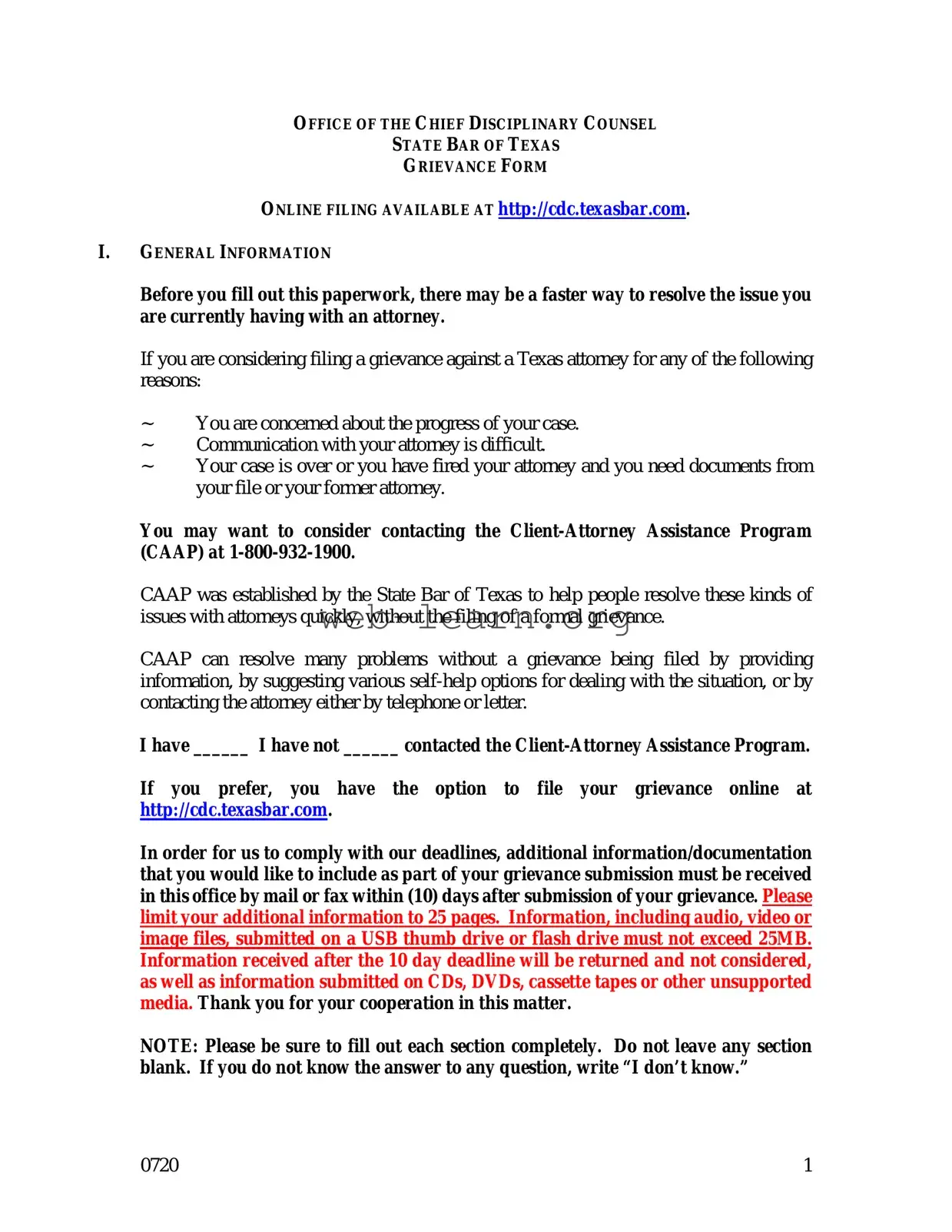
Filing a grievance against an attorney can be a daunting process, but the Texas Grievance Form provides a structured way to voice your concerns. This form is designed for individuals who believe their attorney has acted improperly or failed to fulfill their obligations. Before diving into the details of the grievance process, it's essential to note that there may be quicker resolutions available through the Client-Attorney Assistance Program (CAAP). This program can help address issues like communication difficulties or delays in your case without requiring a formal grievance. If you decide to proceed with the grievance, the form requires you to provide comprehensive information about yourself, the attorney in question, and the nature of your complaint. Key sections include your personal details, the attorney’s information, and a detailed account of the alleged misconduct. Additionally, you must indicate whether you have previously contacted CAAP and clarify your relationship with the attorney. Remember, grievances are specific to individual attorneys, so if you have concerns about multiple lawyers, separate forms will be necessary. Completing the Texas Grievance Form accurately is crucial, as it ensures that your complaint is taken seriously and addressed appropriately.
OFFICE OF THE CHIEF DISCIPLINARY COUNSEL
STATE BAR OF TEXAS
GRIEVANCE FORM
ONLINE FILING AVAILABLE AT http://cdc.texasbar.com.
I.GENERAL INFORMATION
Before you fill out this paperwork, there may be a faster way to resolve the issue you are currently having with an attorney.
If you are considering filing a grievance against a Texas attorney for any of the following reasons:
~You are concerned about the progress of your case.
~Communication with your attorney is difficult.
~Your case is over or you have fired your attorney and you need documents from your file or your former attorney.
You may want to consider contacting the
CAAP was established by the State Bar of Texas to help people resolve these kinds of issues with attorneys quickly, without the filing of a formal grievance.
CAAP can resolve many problems without a grievance being filed by providing information, by suggesting various
I have ______ I have not ______ contacted the
If you prefer, you have the option to file your grievance online at http://cdc.texasbar.com.
In order for us to comply with our deadlines, additional information/documentation that you would like to include as part of your grievance submission must be received in this office by mail or fax within (10) days after submission of your grievance. Please limit your additional information to 25 pages. Information, including audio, video or image files, submitted on a USB thumb drive or flash drive must not exceed 25MB. Information received after the 10 day deadline will be returned and not considered, as well as information submitted on CDs, DVDs, cassette tapes or other unsupported media. Thank you for your cooperation in this matter.
NOTE: Please be sure to fill out each section completely. Do not leave any section blank. If you do not know the answer to any question, write “I don’t know.”
0720 |
1 |

II.INFORMATION ABOUT YOU
Mr.
1. |
TDCJ/SID # |
Ms. |
Name: |
|
_____________________________________ |
|
|
|
Immigration # _______________ |
|
|
|
Address: _____________________________________________________________________ |
||
|
_____________________________________________________________________________ |
||
|
City: ____________________ |
State: _________________ Zip Code: ______________ |
|
2.Employer:___________________________________________________________________
Employer’s Address:__________________________________________________________
___________________________________________________________________________
3.Telephone numbers: Residence: ____________________ Work: _____________________
Cell: _________________
4.Email:______________________________________________________________________
5.Drivers License # _____________________ Date of Birth __________________
6.Name, address, and telephone number of person who can always reach you in the event that the Office of Chief Disciplinary Counsel needs to locate you. *Please note that confidentiality is not waived and this individual does not have the authority to contact the Office of Chief Disciplinary Counsel in order to obtain information about this grievance.
Name _______________________________ Address _______________________________
______________________________ Telephone ___________________________________
7.Do you understand and write in the English language? ______________________
If no, what is your primary language? ___________
Who helped you prepare this form? _____________________________________
Will they be available to translate future correspondence during this process? _________
8.Are you a Judge? _____________________
If yes, please provide Court, County, City, State: ____________________________________
0720 |
2 |
III.INFORMATION ABOUT ATTORNEY
Note: Grievances are not accepted against law firms. You must specifically name the attorney against whom you are complaining. A separate grievance form must be completed for each attorney against whom you are complaining.
1.Attorney name: _____________________________ Address: ____________________
City: ______________________ State:_____________ Zip Code:_________________
2. Telephone number: Work _____________ Home ________________ Other _____________
3.Have you or a member of your family filed a grievance about this attorney previously?
Yes ___ No ___ If “yes”, please state its approximate date and outcome. ____________
______________________________________________________________________________
Have you or a member of your family ever filed an appeal with the Board of Disciplinary Appeals about this attorney?
Yes ____ No ___ If “yes,” please state its approximate date and outcome.
________________________________________________________________________
4.Please check one of the following:
________ |
This attorney was hired to represent me. |
________ |
This attorney was appointed to represent me. |
________ |
This attorney was hired to represent someone else. |
If you hired the attorney, tell us how you met the attorney. Specifically, please provide details about how you came to know and hire this attorney.___________________________________
_____________________________________________________________________________
_____________________________________________________________________________
Please give the date the attorney was hired or appointed. __________________________
Please state what the attorney was hired or appointed to do.________________________
_____________________________________________________________________________
_____________________________________________________________________________
5.What was your fee arrangement with the attorney? ____________________________________
_____________________________________________________________________________
0720 |
3 |

How much did you pay the attorney? ______________________________________________
_____________________________________________________________________________
If you signed a contract and have a copy, please attach.
If you have copies of checks and/or receipts, please attach.
Do not send originals.
6.If you did not hire the attorney, what is your connection with the attorney? Explain briefly
______________________________________________________________________________
______________________________________________________________________________
7.Are you currently represented by an attorney? ____________________
If yes, please provide information about your current attorney: ___________________________
_____________________________________________________________________________
8.Do you claim the attorney has an impairment, such as depression or a substance use disorder? If yes, please provide specifics (your personal observations of the attorney such as slurred speech, odor of alcohol, ingestion of alcohol or drugs in your presence etc., including the date you observed this, the time of day, and location).
________________________________________________________________________
________________________________________________________________________
9.Did the attorney ever make any statements or admissions to you or in your presence that would indicate that the attorney may be experiencing an impairment, such as depression or a substance use disorder? If so, please provide details.
________________________________________________________________________
________________________________________________________________________
IV. INFORMATION ABOUT YOUR GRIEVANCE
1.Where did the activity you are complaining about occur?
County: _________________ City: ________________
2.If your grievance is about a lawsuit, answer the following, if known:
a. Name of court ________________________________________________________
0720 |
4 |
b.Title of the suit ________________________________________________________
c.Case number and date suit was filed _______________________________________
d.If you are not a party to this suit, what is your connection with it? Explain briefly.
______________________________________________________________________
If you have copies of court documents, please attach.
3.Explain in detail why you think this attorney has done something improper or has failed to do something which should have been done. Attach additional sheets of paper if necessary.
Supporting documents, such as copies of a retainer agreement, proof of payment, correspondence between you and your attorney, the case name and number if a specific case is involved, and copies of papers filed in connection with the case, may be useful to our investigation. Do not send originals, as they will not be returned. Additionally, please do not use staples,
Include the names, addresses, and telephone number of all persons who know something about your grievance.
Please be advised that a copy of your grievance will be forwarded to the attorney named in your grievance. To protect your privacy and the privacy of others, please redact personal identifying information (i.e., social security number, date of birth) from any document you provide in support of your grievance and avoid submitting medical records or protected health information belonging to third- parties. Please be advised that in the event that you do provide records that contain your own personal identifying information or protected health information, you are authorizing us to share this information with the attorney named in your grievance. Be advised that documents that contain unredacted third party personal identifying information or that individual’s protected health information will be returned and not considered. By executing the grievance below, you authorize the CDC to disclose your personal identifying information and protected health information as necessary to comply with the law, or as necessary to carry out the function and duties of the CDC.
______________________________________________________________________________
______________________________________________________________________________
0720 |
5 |
______________________________________________________________________________
______________________________________________________________________________
______________________________________________________________________________
______________________________________________________________________________
______________________________________________________________________________
______________________________________________________________________________
______________________________________________________________________________
______________________________________________________________________________
______________________________________________________________________________
______________________________________________________________________________
______________________________________________________________________________
______________________________________________________________________________
______________________________________________________________________________
______________________________________________________________________________
______________________________________________________________________________
______________________________________________________________________________
______________________________________________________________________________
______________________________________________________________________________
______________________________________________________________________________
______________________________________________________________________________
______________________________________________________________________________
______________________________________________________________________________
______________________________________________________________________________
0720 |
6 |
V.HOW DID YOU LEARN ABOUT THE STATE BAR OF TEXAS’ ATTORNEY GRIEVANCE PROCESS?
__ |
Yellow Pages |
__ |
CAAP |
__ |
Internet |
__ |
Attorney |
__ |
Other |
__ |
Website |
VI.
I hereby expressly waive any
Additionally, I understand that the Office of Chief Disciplinary Counsel may exercise its discretion and refer this Grievance to the
I understand that the Office of Chief Disciplinary Counsel maintains as confidential the processing of Grievances.
I hereby swear and affirm that I am the person named in Section II, Question 1 of this form (the Complainant) and that the information provided in this Grievance is true and correct to the best of my knowledge.
Signature: _________________________________ Date: ______________________
TO ENSURE PROMPT ATTENTION, THE GRIEVANCE SHOULD BE MAILED TO:
THE OFFICE OF CHIEF DISCIPLINARY COUNSEL
P.O. Box 13287
Austin, TX 78711
Fax: (512)
0720 |
7 |
| Fact Name | Description |
|---|---|
| Online Filing | The Texas Grievance Form can be filed online at http://cdc.texasbar.com, providing a convenient option for individuals. |
| Client-Attorney Assistance Program | Before filing a grievance, individuals are encouraged to contact the Client-Attorney Assistance Program (CAAP) at 1-800-932-1900 for quicker resolution of issues. |
| Governing Law | The grievance process is governed by the Texas Rules of Disciplinary Procedure, ensuring a structured approach to attorney complaints. |
| Multiple Grievances | A separate grievance form must be completed for each attorney against whom a complaint is made, emphasizing the need for specificity in the filing process. |
Filling out the Texas Grievance form is an important step in addressing your concerns about an attorney's conduct. After completing the form, it will be reviewed by the appropriate authorities. You will receive further communication regarding the status of your grievance.
The Texas Grievance Form is a tool for individuals to formally report concerns about the conduct of a Texas attorney. Common reasons for filing a grievance include issues related to the progress of a case, poor communication, or difficulty obtaining documents after terminating an attorney's services. This form is part of the process to ensure that attorneys adhere to professional standards and ethics.
Before proceeding with a formal grievance, consider reaching out to the Client-Attorney Assistance Program (CAAP) at 1-800-932-1900. This program offers a quicker resolution to common issues. CAAP can provide information, suggest self-help options, or even contact the attorney on your behalf. Many complaints can be resolved through this informal channel, saving time and effort.
When filling out the grievance form, you will need to provide comprehensive information about yourself, the attorney in question, and the specifics of your grievance. This includes:
It is crucial to fill out each section completely. If you are unsure about a question, write “I don’t know” instead of leaving it blank.
Once you submit your grievance, it will be reviewed by the Office of the Chief Disciplinary Counsel. The attorney named in your grievance will receive a copy of your complaint. The review process may involve gathering additional information and conducting interviews. You will be kept informed about the status of your grievance as it progresses through the system.
Filing a grievance against an attorney in Texas can be a daunting process, and many people make mistakes that can hinder their case. One common mistake is leaving sections of the Texas Grievance form blank. Each section is designed to gather specific information that is crucial for the review of your grievance. If you don’t know the answer to a question, it’s important to simply write “I don’t know” instead of skipping it. This ensures that the reviewing body has as much information as possible to make an informed decision.
Another frequent error involves not providing enough detail about the grievance itself. When explaining why you believe the attorney has acted improperly, it’s vital to be thorough and clear. Vague statements may lead to confusion and could result in your grievance being dismissed. Include specific examples, dates, and any relevant documentation to support your claims. The more context you provide, the better the chances of your grievance being taken seriously.
Some individuals also neglect to include the necessary contact information for witnesses or others who may have insight into the situation. This can be a significant oversight. Providing the names, addresses, and phone numbers of people who can corroborate your claims strengthens your case. Without this information, the State Bar may struggle to gather additional evidence or perspectives on your grievance.
Additionally, many people fail to check whether they have previously filed a grievance against the same attorney. This is an important detail that needs to be disclosed. If you or a family member has filed a grievance before, it can impact the current case. Be honest and transparent about any past grievances to avoid complications later on.
Finally, some individuals forget to keep copies of their submitted forms and any attachments. It’s essential to retain a record of what you have sent, as this can be helpful if you need to follow up or if there are any questions about your grievance. Keeping your own copies ensures that you have all the information at your fingertips throughout the process.
When filing a grievance against an attorney in Texas, several other forms and documents may be necessary to support your case. These documents can help clarify the situation and provide additional context. Below is a list of commonly used forms and documents alongside the Texas Grievance form.
Having these documents ready can streamline the grievance process and strengthen your case. Always ensure that you fill out each form completely and accurately to avoid delays.
When filling out the Texas Grievance form, it is important to be thorough and accurate. Here are some guidelines to help you navigate the process effectively:
Following these guidelines can help ensure that your grievance is processed smoothly and efficiently. Take your time to review your form before submission.
Misunderstandings about the Texas Grievance form can lead to confusion and frustration for those seeking to address issues with their attorneys. Here are seven common misconceptions:
Understanding these misconceptions is crucial for anyone considering the grievance process. It can save time, effort, and emotional energy while navigating the complexities of attorney-client relationships.