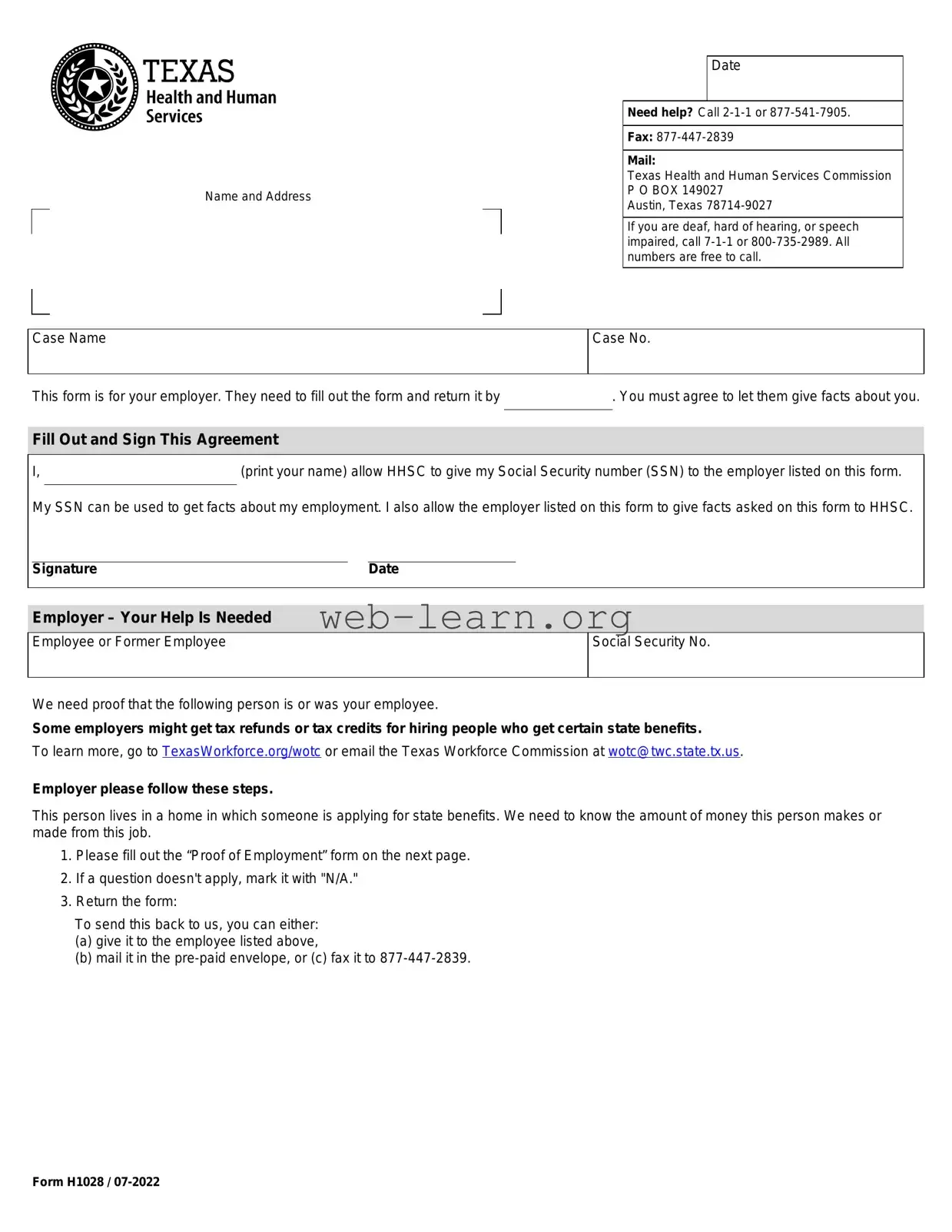
The Texas Employment Verification form serves a crucial role in the process of verifying an individual's employment status for state benefits. This form requires employers to provide essential information about their current or former employees, including the employee's name, Social Security number, and job details. Employers must confirm whether the individual is or was employed, specify the type of job, and indicate the rate of pay. The form also requests information about hours worked, any additional compensation like bonuses or commissions, and health insurance availability. It is vital that the employer fills out the “Proof of Employment” section accurately and returns the completed form by the specified deadline. Employees must consent to share their Social Security number for verification purposes, allowing the Texas Health and Human Services Commission (HHSC) to obtain necessary employment facts. For assistance, individuals can contact various support numbers provided on the form. Overall, this document streamlines the verification process, ensuring that applicants for state benefits receive the necessary support while maintaining compliance with employment verification requirements.
Name and Address
Date
Need help? Call
Fax:
Mail:
Texas Health and Human Services Commission
P O BOX 149027
Austin, Texas
If you are deaf, hard of hearing, or speech impaired, call
Case Name
Case No.
This form is for your employer. They need to fill out the form and return it by. You must agree to let them give facts about you.
Fill Out and Sign This Agreement
I, |
|
(print your name) allow HHSC to give my Social Security number (SSN) to the employer listed on this form. |
|
|
|
My SSN can be used to get facts about my employment. I also allow the employer listed on this form to give facts asked on this form to HHSC.
Signature |
Date |
Employer – Your Help Is Needed
Employee or Former Employee
Social Security No.
We need proof that the following person is or was your employee.
Some employers might get tax refunds or tax credits for hiring people who get certain state benefits.
To learn more, go to TexasWorkforce.org/wotc or email the Texas Workforce Commission at [email protected].
Employer please follow these steps.
This person lives in a home in which someone is applying for state benefits. We need to know the amount of money this person makes or made from this job.
1.Please fill out the “Proof of Employment” form on the next page.
2.If a question doesn't apply, mark it with "N/A."
3.Return the form:
To send this back to us, you can either:
(a)give it to the employee listed above,
(b)mail it in the
Form H1028 /
Employment Verification
Form H1028
Page 2 /
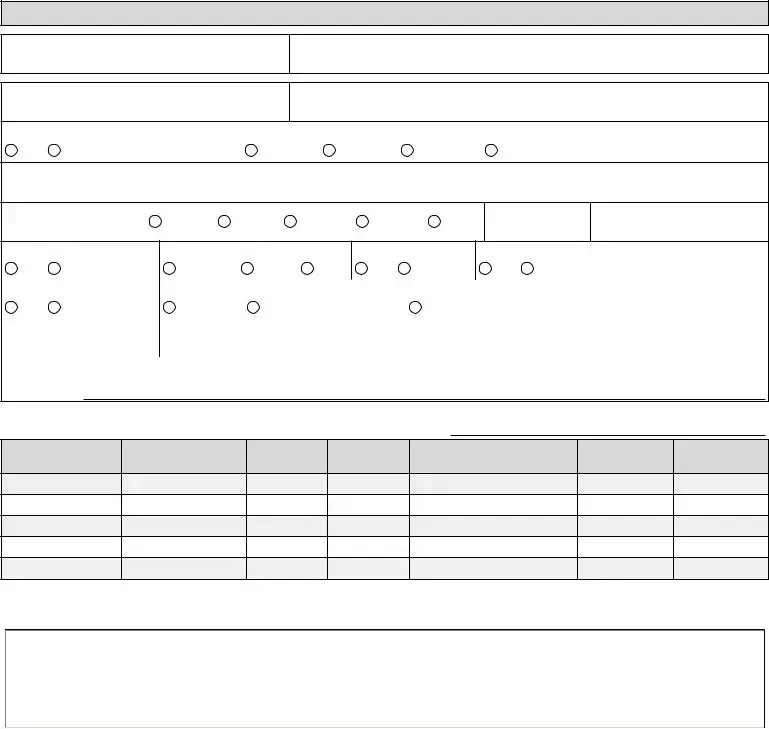
Proof of employment to be filled out by the employer.
Company or Employer
Address (Street, City, State, ZIP code)
Employee Name (as shown on your records)
Employee Address (Street, City, State, ZIP Code – as shown on your records)
Is (or was) this person employed by you? |
If yes, what type of job? |
|
|
||
Yes |
No |
Full Time |
Part Time |
Permanent |
Temporary |
If no: Stop here – sign and date the bottom of this form and return it.
If yes: Answer all the questions below. If a question doesn’t apply, write “N/A".
Rate of Pay |
Per Day |
Per Week |
Per Month |
Per Job |
Per Hour |
How Often Paid?
Average Hours Per Pay Period
Commissions Tips Bonuses |
Overtime Pay |
|
|
FICA or FIT Withheld |
Profit Sharing or Pension Plan |
|||
Yes |
No |
Frequently |
Rarely |
Never |
Yes |
No |
Yes |
No If yes, current value? |
Health insurance available? |
If yes, employee is: |
|
|
|
Name of Insurance Company |
|||
Yes |
No |
Not Enrolled |
Enrolled with Family Member |
Enrolled for Self Only |
|
|
||
|
|
|
|
|
|
|||
Date Hired |
|
Date First Check Received |
Average Hours Per Week |
If Employee |
is or was on Leave Without Pay: |
|||
|
|
|
|
|
|
Start Date: |
End Date: |
|
|
|
|
|
|
|
|
|
|
Do you expect any changes to the above information within the next few months? Yes No
If yes, explain:
On the chart below, list all wages received by this employee during the month(s) of:
Date Pay
Period Ended
Date Employee
Received Paycheck
Actual Hours
Gross
Pay
Other Pay*
(tips, commissions, bonuses)
EITC
Advance
Total Pretax
Contributions
*Please explain (in comments section below) when and how often tips, commissions, or bonuses are received. Comments
If this person is no longer in your employ.
|
Date Separated |
Reason for Separation |
|
|
|
|
Date Final Check Received |
|
|
Gross Amount of Final Check |
|
|
|
|
|
|
|
|
|
|
|
|
|
|
Employer – Read, Sign and Date |
|
|
|
|
|
|
|
|
|
|
|
|
|
|
|
|
|
|
|
|||
|
I confirm that this information is true and correct to the best of my knowledge: |
|
|
|
|
||||||
|
|
|
|
|
|
|
|
|
|
|
|
|
Employer Signature |
|
Date |
Title |
Area Code and Phone No. |
||||||
|
|
|
|
|
|
|
|
|
|
|
|
| Fact Name | Description |
|---|---|
| Purpose | The Texas Employment Verification form is used by employers to confirm the employment status and income details of employees or former employees applying for state benefits. |
| Governing Law | This form operates under the Texas Health and Human Services Commission guidelines, specifically related to the verification of employment for state benefit applications. |
| Submission Process | Employers must fill out the form and return it by mail, fax, or hand delivery to the employee. A pre-paid envelope is provided for mailing. |
| Confidentiality Agreement | Employees must agree to allow their Social Security number to be shared with the employer for the purpose of employment verification. |
Completing the Texas Employment Verification form is an important step in ensuring that the necessary employment information is accurately communicated. After filling out the form, it must be returned to the appropriate agency as specified. Below are the steps to guide you through the process of filling out this form.
After completing these steps, ensure that the form is returned either by giving it to the employee, mailing it in the pre-paid envelope, or faxing it to the specified number. This will ensure that the necessary information is processed without delay.
What is the purpose of the Texas Employment Verification form?
The Texas Employment Verification form is designed to confirm the employment status and income of individuals who are applying for state benefits. This form must be completed by the employer of the individual in question, providing essential details about their employment history and earnings.
Who needs to fill out the form?
Only the employer of the individual applying for state benefits is required to fill out this form. The employee or former employee must give consent for their employer to disclose their employment information.
How should the employer submit the completed form?
The employer has three options for returning the completed form:
What information is required from the employer?
The employer must provide various details, including:
What if a question on the form does not apply?
If a particular question does not apply to the employee, the employer should simply mark it with "N/A." This helps ensure clarity and prevents confusion in the submission.
What happens if the employee is no longer employed?
If the individual is no longer with the company, the employer should still complete the form. They must provide the date of separation and the reason for it, along with the details of the final paycheck received by the employee.
Is there a deadline for submitting the form?
Yes, the form must be returned by a specified date, which is indicated on the form itself. Timely submission is crucial for the employee to receive the benefits they are applying for.
Who can I contact for help with the form?
If assistance is needed, individuals can call 2-1-1 or 877-541-7905. For those who are deaf, hard of hearing, or speech impaired, the number to call is 7-1-1 or 800-735-2989. All these numbers are free to call, ensuring that help is accessible to everyone.
Filling out the Texas Employment Verification form accurately is crucial for both employees and employers. However, there are common mistakes that can lead to complications or delays in processing. Understanding these errors can help ensure a smoother experience.
One frequent mistake is failing to provide complete and accurate information in the employee’s name and address section. This information must match the records held by the employer. If discrepancies arise, it can create confusion and hinder the verification process. It is essential for the employer to double-check that the employee's details are correct before submitting the form.
Another common error involves not marking questions that do not apply with "N/A." When a question is left blank, it can lead to assumptions or misinterpretations. Employers should make it a point to fill out every section of the form, indicating where certain questions do not pertain to the employee's situation. This simple step can prevent unnecessary follow-up inquiries.
Additionally, some individuals overlook the importance of the signature and date at the bottom of the form. Without a signature, the form is incomplete and cannot be processed. Employers must ensure that they sign and date the form, confirming that the information provided is accurate to the best of their knowledge. This adds a layer of accountability and legitimacy to the document.
Another mistake is neglecting to provide detailed information regarding the employee's pay. Employers should accurately fill in the rate of pay, frequency of payment, and any additional earnings such as tips or bonuses. Incomplete financial information can lead to delays in processing state benefits for the employee, so thoroughness is key.
Lastly, failing to communicate any anticipated changes in employment status can create problems down the line. If an employer expects changes in the employee's information, such as a change in hours or pay, this should be clearly noted on the form. Transparency about potential changes helps the Texas Health and Human Services Commission manage expectations and provide accurate benefits.
The Texas Employment Verification form is an essential document for confirming an individual's employment status. Alongside this form, several other documents may be required to provide a complete picture of employment and benefits. Here’s a list of related forms and documents that are often used in conjunction with the Texas Employment Verification form.
Each of these documents plays a significant role in verifying employment and income. They ensure that individuals receive the appropriate benefits and that employers comply with state regulations. Having these documents ready can streamline the verification process.
When filling out the Texas Employment Verification form, it is essential to approach the task with care. Below are some key do's and don'ts to ensure the form is completed accurately and efficiently.
Following these guidelines will help ensure that the employment verification process goes smoothly and that all necessary information is communicated effectively.
Understanding the Texas Employment Verification form is essential for both employers and employees. However, there are several misconceptions that can lead to confusion. Here are ten common misconceptions explained:
Being aware of these misconceptions can help streamline the employment verification process and ensure compliance with regulations. Clarity and accuracy are essential for both employers and employees involved in this procedure.
Understanding the Texas Employment Verification form is crucial for both employees and employers. Here are some key takeaways to help you navigate the process effectively:
By keeping these takeaways in mind, both employees and employers can ensure a smooth verification process that benefits everyone involved.