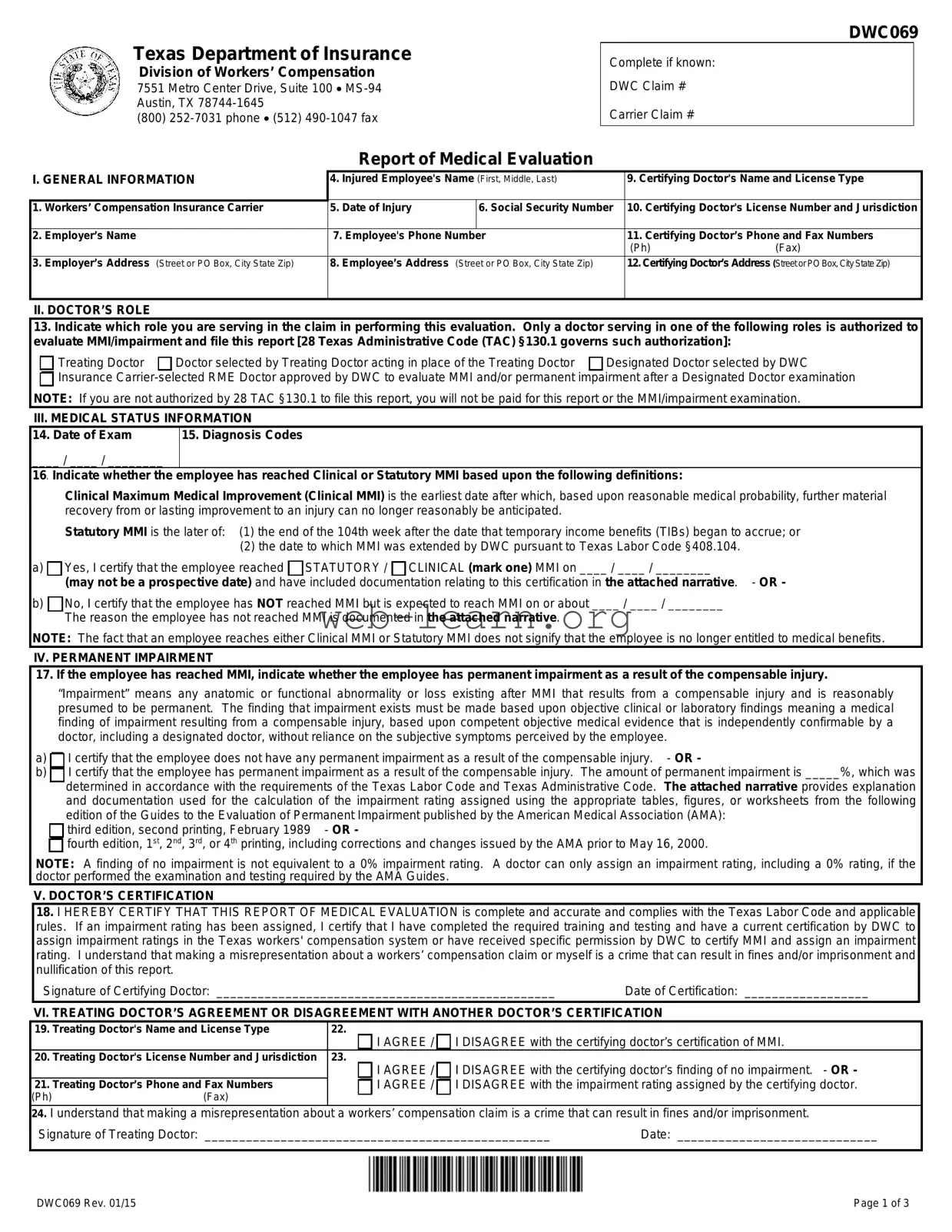
The Texas DWC069 form, officially known as the Report of Medical Evaluation, plays a crucial role in the workers' compensation process in Texas. This form is primarily used to document the medical evaluation of an injured employee, specifically focusing on their Maximum Medical Improvement (MMI) status and any permanent impairment resulting from their injury. It requires detailed information about the injured employee, including their name, date of injury, and social security number, as well as the credentials of the certifying doctor. The form outlines the doctor's role in the evaluation process, specifying whether they are acting as a treating doctor, a designated doctor, or a doctor selected by the treating doctor. Additionally, the DWC069 form mandates the doctor to assess and certify whether the employee has reached either Clinical or Statutory MMI, providing a clear distinction between the two. If the employee has reached MMI, the doctor must also evaluate and document any permanent impairment, including the percentage of impairment, based on objective medical findings. The form emphasizes the importance of accurate and honest reporting, as misrepresentation can have serious legal consequences. Ultimately, the DWC069 form serves as a vital tool for ensuring that injured workers receive the appropriate medical evaluations and benefits they are entitled to under Texas law.
Texas Department of Insurance
Division of Workers’ Compensation
7551 Metro Center Drive, Suite 100
(800)
Report of Medical Evaluation
DWC069
Complete if known:
DWC Claim #
Carrier Claim #
I. GENERAL INFORMATION |
4. Injured Employee's Name (First, Middle, Last) |
|||
|
|
|
|
|
1. |
Workers’ Compensation Insurance Carrier |
5. |
Date of Injury |
6. Social Security Number |
|
|
|
|
|
2. |
Employer’s Name |
7. Employee's Phone Number |
|
|
|
|
|
|
|
3. |
Employer’s Address (Street or PO Box, City State Zip) |
8. |
Employee’s Address (Street or PO Box, City State Zip) |
|
|
|
|
|
|
9.Certifying Doctor's Name and License Type
10.Certifying Doctor's License Number and Jurisdiction
11.Certifying Doctor’s Phone and Fax Numbers
(Ph)(Fax)
12.Certifying Doctor’s Address (Street or PO Box, City State Zip)
II. DOCTOR’S ROLE
13.Indicate which role you are serving in the claim in performing this evaluation. Only a doctor serving in one of the following roles is authorized to evaluate MMI/impairment and file this report [28 Texas Administrative Code (TAC) §130.1 governs such authorization]:
Treating Doctor |
Doctor selected by Treating Doctor acting in place of the Treating Doctor |
Designated Doctor selected by DWC |
Insurance
III. MEDICAL STATUS INFORMATION
14. Date of Exam |
15. Diagnosis Codes |
____ / ____ / ________ |
|
16. Indicate whether the |
employee has reached Clinical or Statutory MMI based upon the following definitions: |
Clinical Maximum Medical Improvement (Clinical MMI) is the earliest date after which, based upon reasonable medical probability, further material recovery from or lasting improvement to an injury can no longer reasonably be anticipated.
Statutory MMI is the later of: (1) the end of the 104th week after the date that temporary income benefits (TIBs) began to accrue; or
(2)the date to which MMI was extended by DWC pursuant to Texas Labor Code §408.104.
a) Yes, I certify that the employee reached STATUTORY / CLINICAL (mark one) MMI on ____ / ____ / ________
(may not be a prospective date) and have included documentation relating to this certification in the attached narrative. - OR -
b) No, I certify that the employee has NOT reached MMI but is expected to reach MMI on or about ____ / ____ / ________
The reason the employee has not reached MMI is documented in the attached narrative.
NOTE: The fact that an employee reaches either Clinical MMI or Statutory MMI does not signify that the employee is no longer entitled to medical benefits.
IV. PERMANENT IMPAIRMENT
17. If the employee has reached MMI, indicate whether the employee has permanent impairment as a result of the compensable injury.
“Impairment” means any anatomic or functional abnormality or loss existing after MMI that results from a compensable injury and is reasonably presumed to be permanent. The finding that impairment exists must be made based upon objective clinical or laboratory findings meaning a medical finding of impairment resulting from a compensable injury, based upon competent objective medical evidence that is independently confirmable by a doctor, including a designated doctor, without reliance on the subjective symptoms perceived by the employee.
a) I certify that the employee does not have any permanent impairment as a result of the compensable injury. - OR -
b) I certify that the employee has permanent impairment as a result of the compensable injury. The amount of permanent impairment is _____%, which was determined in accordance with the requirements of the Texas Labor Code and Texas Administrative Code. The attached narrative provides explanation and documentation used for the calculation of the impairment rating assigned using the appropriate tables, figures, or worksheets from the following
edition of the Guides to the Evaluation of Permanent Impairment published by the American Medical Association (AMA): third edition, second printing, February 1989 - OR -
fourth edition, 1st, 2nd, 3rd, or 4th printing, including corrections and changes issued by the AMA prior to May 16, 2000.
NOTE: A finding of no impairment is not equivalent to a 0% impairment rating. A doctor can only assign an impairment rating, including a 0% rating, if the doctor performed the examination and testing required by the AMA Guides.
V. DOCTOR’S CERTIFICATION
18.I HEREBY CERTIFY THAT THIS REPORT OF MEDICAL EVALUATION is complete and accurate and complies with the Texas Labor Code and applicable rules. If an impairment rating has been assigned, I certify that I have completed the required training and testing and have a current certification by DWC to assign impairment ratings in the Texas workers' compensation system or have received specific permission by DWC to certify MMI and assign an impairment rating. I understand that making a misrepresentation about a workers’ compensation claim or myself is a crime that can result in fines and/or imprisonment and nullification of this report.
|
Signature of Certifying Doctor: _________________________________________________ |
Date of Certification: __________________ |
|||
|
VI. TREATING DOCTOR’S AGREEMENT OR DISAGREEMENT WITH ANOTHER DOCTOR’S CERTIFICATION |
||||
19. |
Treating Doctor's Name and License Type |
22. |
|
||
|
|
|
|
I AGREE / I DISAGREE with the certifying doctor’s certification of MMI. |
|
20. |
Treating Doctor's License Number and Jurisdiction |
|
23. |
|
|
|
|
|
|
I AGREE / I DISAGREE with the certifying doctor’s finding of no impairment. - OR - |
|
21. |
Treating Doctor’s Phone and Fax Numbers |
|
I AGREE / I DISAGREE with the impairment rating assigned by the certifying doctor. |
||
(Ph) |
(Fax) |
|
|
||
24.I understand that making a misrepresentation about a workers’ compensation claim is a crime that can result in fines and/or imprisonment.
Signature of Treating Doctor: __________________________________________________ |
Date: _____________________________ |
DWC069 Rev. 01/15 |
Page 1 of 3 |

DWC069
Frequently Asked Questions
Report of Medical Evaluation (DWC
INSTRUCTIONS FOR DOCTORS:
Who can file the DWC
Treating Doctor: Doctor chosen by the employee who is primarily responsible for employee's
Doctor Selected by Treating Doctor: Doctor selected by the treating doctor to evaluate permanent impairment and Maximum Medical Improvement (MMI). This doctor acts in the place of the treating doctor. Such a doctor must be selected if the treating doctor is not authorized to certify MMI or assign an impairment rating in those cases in which the employee has permanent impairment. An authorized treating doctor may also choose to select another doctor to perform the evaluation/certification.
Designated Doctor: Doctor selected by the Texas Department of Insurance, Division of Workers’ Compensation (DWC) to resolve a question over MMI or permanent impairment.
Insurance
AUTHORIZATION: In addition to the requirement of acting in an eligible role, 28 Texas Administrative Code §130.1 provides the following requirements:
Employee has permanent impairment: Only a doctor certified by DWC to assign impairment ratings or who receives specific
permission by exception granted by DWC is authorized to certify MMI and to assign an impairment rating.
Employee does not have permanent impairment: A doctor not certified or exempted from certification by DWC is only authorized to determine whether an employee has permanent impairment and, in the event that the employee has no impairment, certify MMI.
INVALID CERTIFICATION: Certification by a doctor who is not authorized is invalid.
Under what circumstances and when am I required to file the DWC
If the employee has reached MMI, you must file the DWC
Where do I file the form?
The DWC
the insurance carrier;
the treating doctor (if a doctor other than the treating doctor files the report);
DWC;
injured employee; and
injured employee’s representative (if any).
The report must be filed by facsimile or electronic transmission unless an exception applies. The specific requirements are shown below. To file this form with DWC, fax to (512)
|
|
Insurance Carrier |
|
Treating Doctor |
|
|
|
DWC |
|
|
|
|
|
|
Designated Doctor |
fax or |
fax or |
||
|
|
|
|
|
Treating Doctor |
|
|
|
fax or |
Doctor Selected by Treating Doctor |
|
fax or |
not provided these numbers; then |
|
Insurance |
|
|
|
by other verifiable means |
Injured Employee
Injured Employee’s Representative
fax or
fax or
Do I have to maintain documentation regarding the examination and report?
The certifying doctor must maintain the original copy of the report and narrative and documentation of the following:
date of the examination;
date any medical records necessary to make the certification of MMI were received, and from whom the medical records were received; and
date, addresses, and means of delivery that required reports were transmitted or mailed by the certifying doctor.
Where can I find more information about the Report of Medical Evaluation?
See 28 TAC §130.1 through §130.4 and §130.6 for the complete requirements regarding the filing of this report, including required documentation. The complete text of these rules is available on the Texas Department of Insurance website at www.tdi.texas.gov/wc/rules/index.html. If you have additional questions, call
DWC069 Rev. 01/15 |
Page 2 of 3 |
DWC069
IMPORTANT INFORMATION FOR INJURED EMPLOYEES:
What if I disagree with the doctor's certification of Maximum Medical Improvement (MMI) and/or permanent impairment rating for my workers' compensation claim?
If this is the first evaluation of your MMI and/or permanent impairment, you or your representative may dispute:
the certification of MMI; and/or
the assigned impairment rating.
To file the dispute, contact your local DWC field office or call
the appointment of a designated doctor (DD), if one has not been appointed; or
a Benefit Review Conference (BRC).
Important Note: Your dispute must be filed within 90 days after the written notice is delivered to you or the certification of MMI and/or the assigned impairment rating may become final.
NOTE: With few exceptions, upon your request, you are entitled to be informed about the information DWC collects about you; receive and review the information (Government Code, §§552.021 and 552.023); and have DWC correct information that is incorrect (Government Code, §559.004).
DWC069 Rev. 01/15 |
Page 3 of 3 |
| Fact Name | Details |
|---|---|
| Purpose | The DWC069 form is used to report medical evaluations related to workers' compensation claims in Texas. |
| Governing Laws | This form is governed by the Texas Labor Code, specifically §408.104, and 28 Texas Administrative Code §130.1. |
| Filing Requirements | The form must be filed within seven working days after the examination or receipt of necessary medical information. |
| Authorized Signatories | Only certain medical professionals, such as treating doctors or designated doctors, are authorized to complete and submit this form. |
Completing the Texas DWC069 form is an important step in the workers’ compensation process. This form, known as the Report of Medical Evaluation, requires specific information about the injured employee, the evaluating doctor, and the medical status of the employee. Once filled out, it must be submitted to the appropriate parties, including the insurance carrier and the Division of Workers’ Compensation.
After completing these steps, ensure that all documentation is retained for your records. Proper submission of the DWC069 form is crucial for the continuation of benefits and the management of the workers' compensation claim.
The Texas DWC069 form is the Report of Medical Evaluation used in workers' compensation claims. It is completed by a doctor to certify whether an injured employee has reached Maximum Medical Improvement (MMI) and to assess any permanent impairment resulting from the injury.
Only certain doctors can fill out the DWC069 form. These include:
The form must be filed no later than the seventh working day after the examination if the employee has reached MMI. If the employee has not reached MMI, only a Designated Doctor is required to file the form within that timeframe.
The completed form should be sent to:
Submission can be done via fax or electronic transmission unless otherwise specified.
If you disagree with the MMI certification or the permanent impairment rating, you can dispute it. This must be done within 90 days of receiving the written notice. You can request a designated doctor or a Benefit Review Conference to address your concerns.
The certifying doctor must maintain the original report and any related narratives. They should also document the date of the examination, when medical records were received, and the details of how reports were transmitted.
Yes, misrepresentation on the form is considered a crime and can lead to fines or imprisonment. It can also result in the nullification of the report.
For detailed information, you can refer to the Texas Administrative Code sections 130.1 through 130.4 and 130.6. The full text of these rules is available on the Texas Department of Insurance website at www.tdi.texas.gov/wc/rules/index.html.
Filling out the Texas DWC069 form can be straightforward, but many people make mistakes that can lead to complications. One common error is failing to provide complete information about the injured employee. This includes missing details such as the employee’s full name, social security number, or contact information. Omitting even one piece of information can delay the processing of the claim.
Another frequent mistake is entering incorrect dates. The date of injury and the date of the medical evaluation are critical. If these dates are inaccurate, it can create confusion regarding the timeline of the case. Always double-check the dates before submitting the form.
People often overlook the importance of the certifying doctor's role. It's crucial to ensure that the doctor filling out the form is authorized to evaluate Maximum Medical Improvement (MMI) and impairment ratings. If the doctor is not properly designated, the report may be deemed invalid, causing further delays.
Additionally, many individuals forget to include necessary documentation. When certifying MMI, the doctor must attach a narrative that supports their findings. Without this documentation, the certification may not hold up during reviews or disputes.
Another common pitfall is misinterpreting the definitions of Clinical and Statutory MMI. Misunderstanding these terms can lead to incorrect certifications. It's essential to grasp these definitions clearly to ensure accurate reporting.
Some people also fail to sign the form. A missing signature can render the entire submission invalid. Make sure to check that all required signatures are present before sending the form off.
Finally, many submitters forget to keep a copy of the completed form and any attached documents. Retaining a copy is crucial for future reference, especially if any disputes arise later. Keeping organized records can save a lot of time and hassle down the road.
The Texas DWC069 form, known as the Report of Medical Evaluation, is crucial for documenting an injured employee's medical status in the workers' compensation system. Alongside this form, several other documents may be necessary to ensure a comprehensive evaluation and processing of claims. Below is a list of common forms that often accompany the DWC069.
These forms and documents collectively support the workers' compensation process, ensuring that all necessary information is available for claims review and resolution. Proper completion and timely submission of these documents can significantly impact the outcome of a claim.
The Texas DWC069 form, known as the Report of Medical Evaluation, serves a crucial role in the workers' compensation process. Several other documents share similarities with this form, primarily in their purpose of evaluating medical conditions and determining benefits. Here’s a look at eight documents that are similar to the DWC069 form:
Each of these documents plays a unique role in the workers' compensation process, yet they share the common goal of ensuring that injured employees receive the medical evaluations and benefits they deserve.
When filling out the Texas DWC069 form, attention to detail is crucial. Here are ten essential dos and don’ts to guide you through the process.
By following these guidelines, you can help ensure a smoother process when submitting the DWC069 form. Accuracy and completeness are key to facilitating the workers' compensation process in Texas.
Misconception 1: The DWC069 form can be completed by any doctor.
Only specific doctors are authorized to fill out the DWC069 form. These include the treating doctor, a doctor selected by the treating doctor, a designated doctor chosen by the DWC, and an insurance carrier-selected RME doctor. If a doctor is not in one of these roles, their certification will be invalid.
Misconception 2: Completing the DWC069 form guarantees that the employee will receive benefits.
Filing the DWC069 form does not automatically ensure that an employee will receive medical benefits. The form serves to report the medical evaluation, but the determination of benefits depends on various factors, including the findings of MMI and impairment.
Misconception 3: The DWC069 form can be submitted at any time after the medical evaluation.
There are strict deadlines for submitting the DWC069 form. If an employee has reached Maximum Medical Improvement (MMI), the form must be filed no later than the seventh working day after the examination or after receiving all necessary medical information. Failure to meet this deadline can result in complications for the claim.
Misconception 4: A finding of no impairment means the employee has a 0% impairment rating.
A finding of no impairment does not equate to a 0% impairment rating. A doctor can only assign an impairment rating, including a 0% rating, if they performed the necessary examination and testing as per the AMA Guides. Therefore, a finding of no impairment should be clearly documented and does not imply a numerical rating.
Filling out the Texas DWC069 form accurately is crucial for both injured employees and healthcare providers involved in workers' compensation claims. Here are key takeaways to keep in mind:
These takeaways will help ensure compliance with the requirements of the Texas workers' compensation system and facilitate a smoother process for all parties involved.