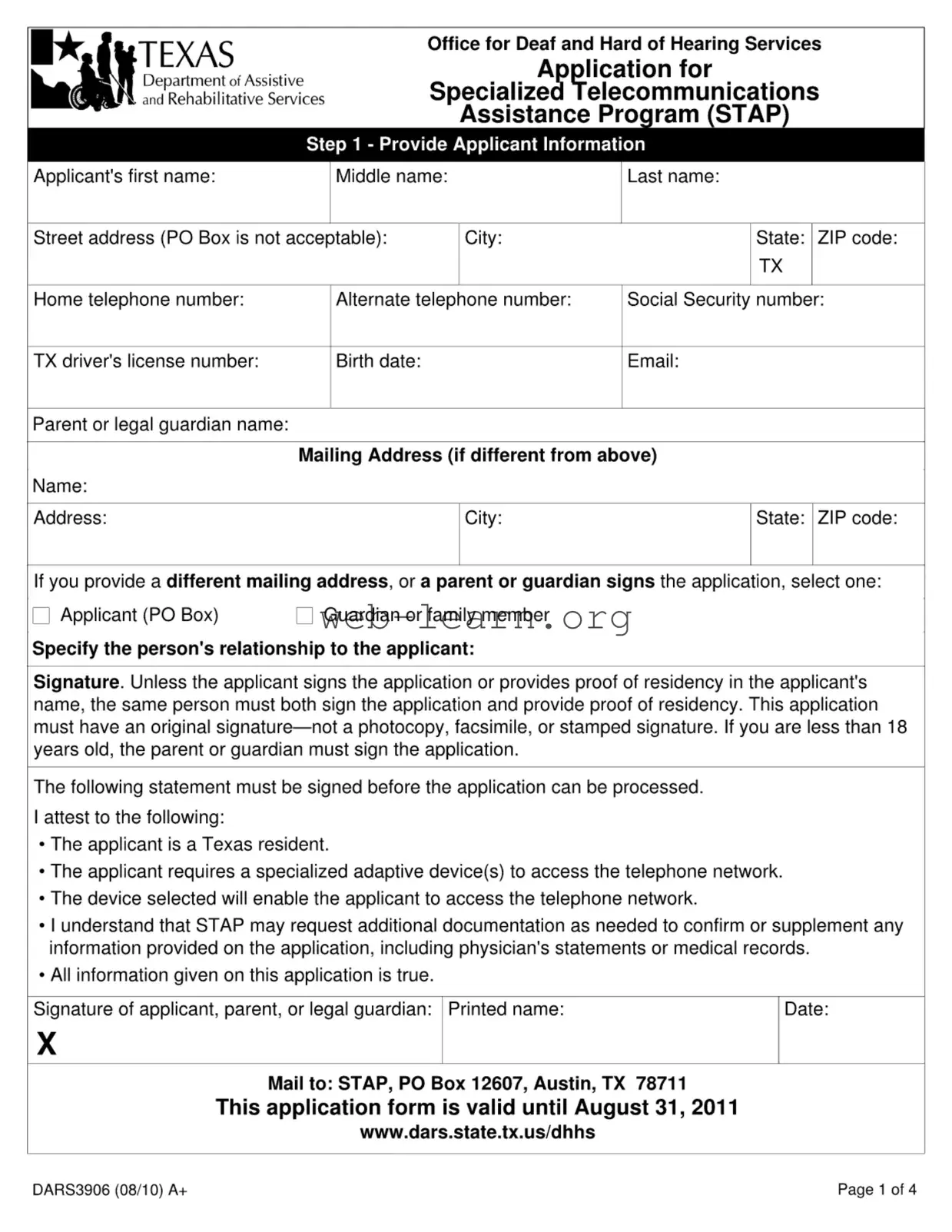
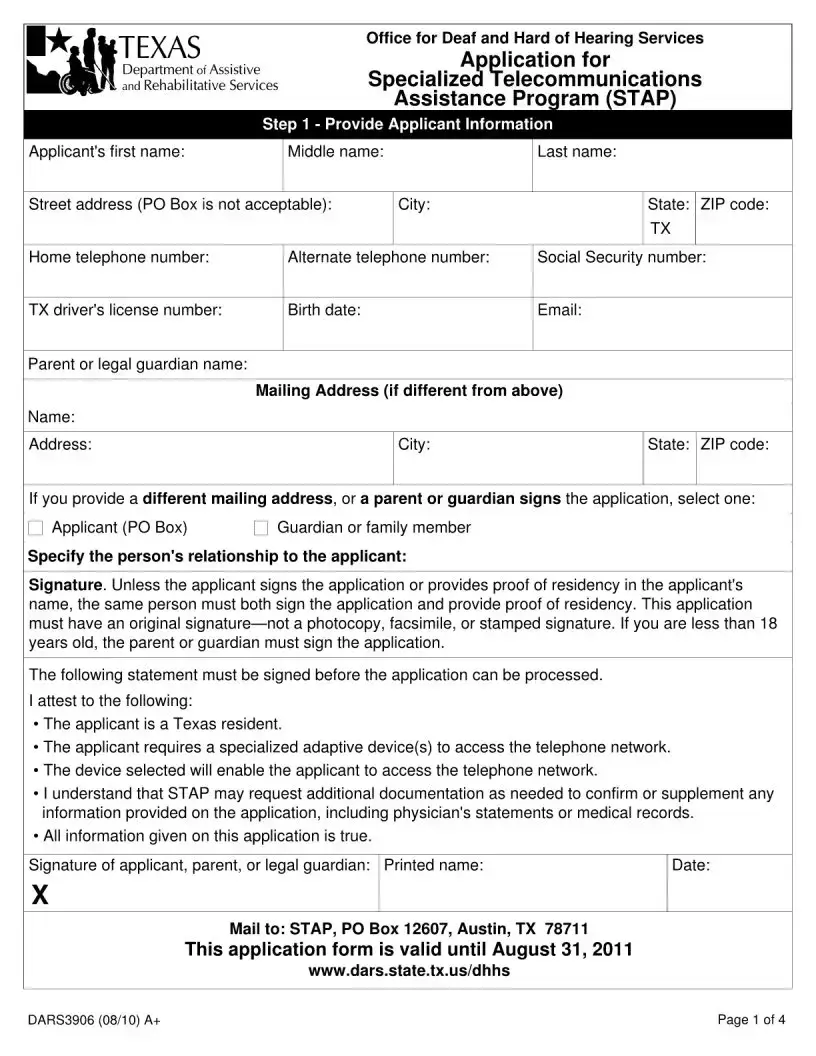
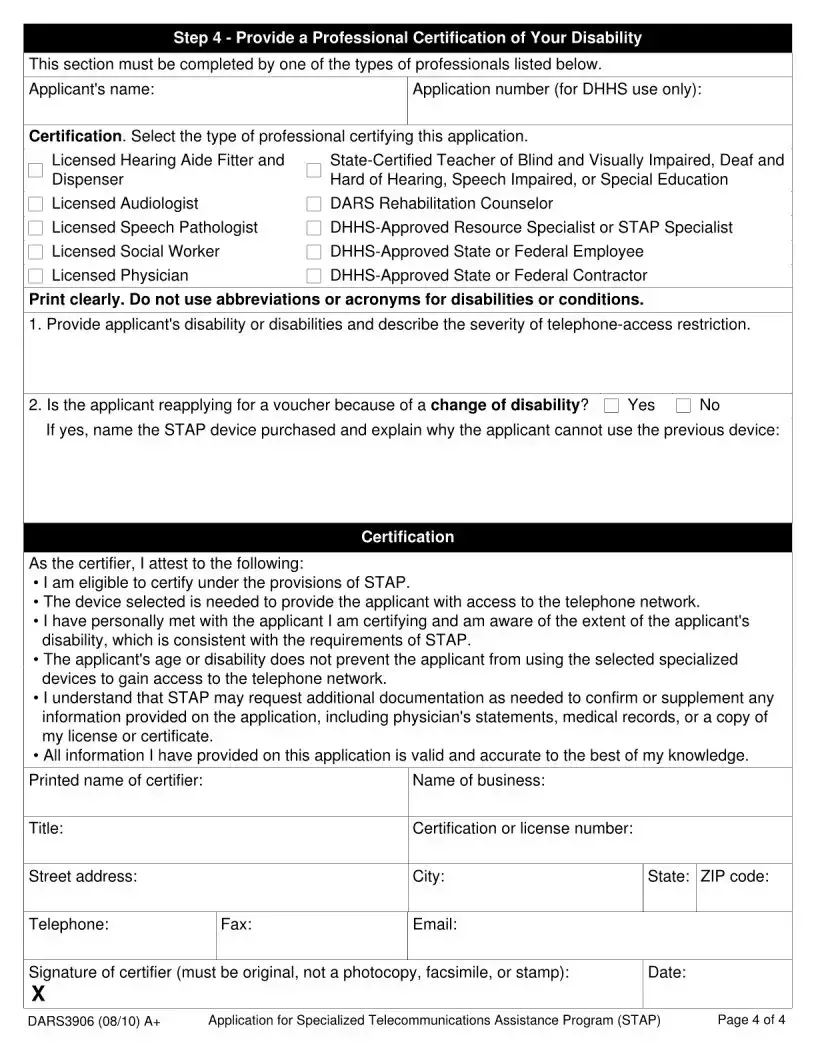
The Texas DARS3906 form is a crucial document for individuals seeking assistance through the Specialized Telecommunications Assistance Program (STAP), which is managed by the Texas Department of Assistive and Rehabilitative Services. This program aims to provide specialized adaptive devices that enhance access to the telephone network for individuals who are deaf, hard of hearing, or have other disabilities. The application process is divided into several steps, beginning with the collection of applicant information, including personal details such as name, address, and contact numbers. Proof of residency is also required, necessitating the submission of a current document that verifies the applicant's Texas residency. Additionally, the form allows applicants to select from a range of telecommunication devices tailored to specific disabilities, ensuring that the selected device meets the established requirements. Importantly, the application must be signed by the applicant or a legal guardian, affirming the truthfulness of the provided information and the need for the requested device. The DARS3906 form serves as a gateway for individuals to access necessary telecommunications resources, ultimately promoting better communication and connectivity within the community.
| Fact Name | Details |
|---|---|
| Governing Law | The Texas DARS3906 form is governed by the Texas Human Resources Code, specifically Title 7, Chapter 117, which pertains to the provision of services for individuals with disabilities. |
| Purpose | This form is used to apply for the Specialized Telecommunications Assistance Program (STAP), which provides adaptive devices to individuals who are deaf, hard of hearing, or have other communication disabilities. |
| Residency Requirement | Applicants must provide proof of Texas residency. Acceptable documents include a Texas driver's license, utility bill, or voter registration card, dated within three months of the application submission. |
| Signature Requirement | An original signature is required on the application. This means no photocopies, facsimiles, or stamped signatures will be accepted. If the applicant is under 18, a parent or legal guardian must sign. |
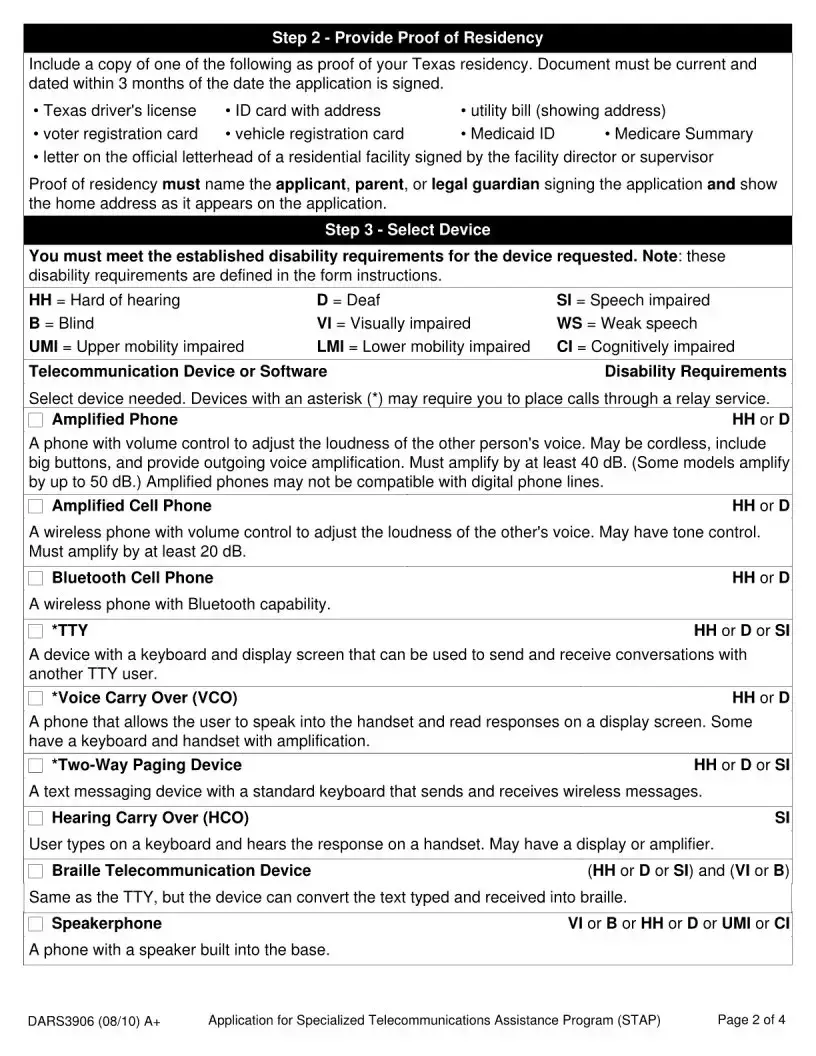
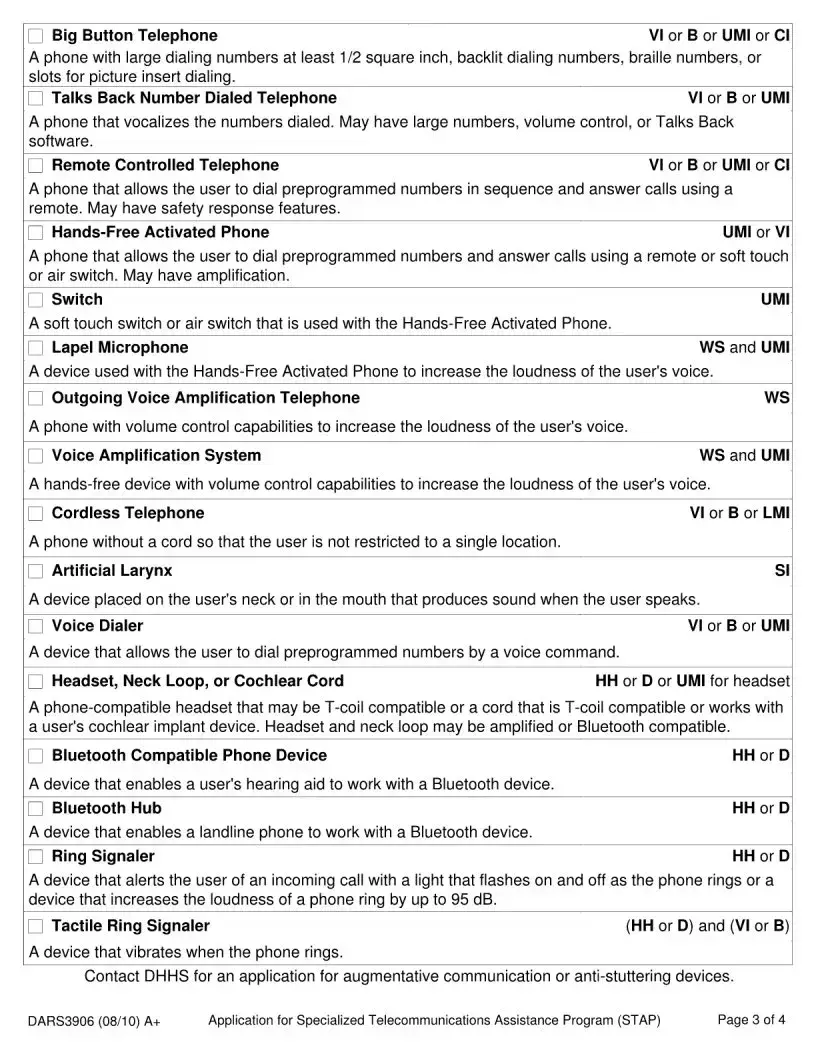
| Device Selection | Applicants must meet specific disability requirements to qualify for certain devices. The form outlines various devices available, such as amplified phones and TTYs, along with their corresponding disability designations. |
Completing the Texas Dars3906 form is a straightforward process that requires you to provide personal information, proof of residency, and select the appropriate telecommunications device based on your needs. Follow these steps carefully to ensure your application is filled out correctly and submitted without delays.
What is the Texas DARS3906 form?
The Texas DARS3906 form is an application for the Specialized Telecommunications Assistance Program (STAP). This program assists individuals who are deaf, hard of hearing, or have other disabilities by providing specialized telecommunications devices to help them communicate effectively.
Who is eligible to apply for STAP?
To be eligible for STAP, the applicant must be a Texas resident and require a specialized adaptive device to access the telephone network. The applicant must also meet specific disability requirements outlined in the form instructions.
What information do I need to provide on the form?
Applicants must provide personal information such as their name, address, phone numbers, Social Security number, and date of birth. If the applicant is under 18, a parent or legal guardian must also provide their information and sign the application.
What proof of residency is required?
You must include a current document as proof of Texas residency. Acceptable documents include a Texas driver's license, utility bill, voter registration card, or any other official document that shows your name and address. This document must be dated within three months of signing the application.
Can I submit a photocopy of my signature?
No, the application must have an original signature. Photocopies, facsimiles, or stamped signatures will not be accepted. If the applicant is under 18, a parent or guardian must sign the application.
What devices can I request through STAP?
STAP offers a variety of devices, including amplified phones, TTY devices, Bluetooth cell phones, and more. Each device has specific eligibility requirements based on the applicant's disability. It is important to review these requirements before selecting a device.
How long is the application valid?
The DARS3906 application form is valid until August 31, 2011. However, it is essential to check for any updates or changes to the program that may affect the application process.
What should I do if additional documentation is requested?
If STAP requests additional documentation, such as physician statements or medical records, it is crucial to provide this information promptly. This will help ensure that your application is processed without unnecessary delays.
Where do I send my completed application?
Completed applications should be mailed to STAP at the following address: PO Box 12607, Austin, TX 78711. Make sure to send the application to the correct address to avoid any processing issues.
What happens after I submit my application?
Once your application is submitted, it will be reviewed by the STAP staff. If everything is in order, you will receive a notification regarding your eligibility and any devices you may be approved to receive. Keep an eye on your mail for updates.
Filling out the Texas DARS3906 form can be straightforward, but several common mistakes can lead to delays or even rejection of the application. Understanding these pitfalls can help ensure a smoother process.
One frequent mistake is providing an incorrect or incomplete applicant's information. This section requires precise details, including the first name, last name, and social security number. Omitting any of this information or making typographical errors can cause complications. It is essential to double-check all entries for accuracy.
Another common error involves the proof of residency. Applicants must submit a document that is current and dated within three months. Acceptable documents include a Texas driver’s license or utility bill. Failing to provide a document that meets these criteria can result in a denial of the application.
Many applicants also overlook the requirement for an original signature. The application must include a handwritten signature from the applicant or their guardian. Photocopies, facsimiles, or stamped signatures are not accepted. This rule is crucial and often leads to confusion among applicants.
Inaccuracies in selecting the appropriate device can hinder the application process. The form lists specific devices that correspond to various disabilities. Applicants must ensure that they select a device that matches their needs and meets the established disability requirements. Misunderstanding these requirements can lead to the selection of an inappropriate device.
Another mistake involves failing to understand the importance of the relationship specification. If a guardian or family member signs the application, it is vital to specify their relationship to the applicant. This detail is necessary for processing and verification purposes.
Some applicants may forget to include their mailing address if it differs from their home address. This section is crucial for ensuring that correspondence regarding the application reaches the correct location. Omitting this information can lead to delays in communication.
Lastly, applicants sometimes neglect to review the attestation statement carefully. This statement confirms that all information provided is true and that the applicant is a Texas resident in need of a specialized device. Misunderstanding or overlooking this statement can result in processing issues.
By avoiding these common mistakes, applicants can improve their chances of a successful application process for the Texas DARS3906 form.
The Texas DARS3906 form is essential for individuals seeking assistance through the Specialized Telecommunications Assistance Program (STAP). Alongside this form, several other documents and forms may be required to ensure a smooth application process. Below is a list of these related documents, each serving a specific purpose in the application journey.
Understanding these documents and their purposes can help streamline the application process for the STAP program. It is essential to ensure that all required forms are completed accurately and submitted in a timely manner to avoid delays in receiving assistance.
The Texas Dars3906 form is essential for individuals seeking assistance through the Specialized Telecommunications Assistance Program (STAP). Several other documents share similarities with this form, particularly in their purpose and structure. Below are four such documents:
When filling out the Texas DARS3906 form, it is crucial to follow specific guidelines to ensure your application is processed smoothly. Here are nine important dos and don'ts to consider:
Following these guidelines can help avoid delays in processing your application. Take your time to review each section carefully, ensuring that all information is correct and complete. This attention to detail can make a significant difference in the outcome of your application.
Understanding the Texas DARS3906 form is essential for those seeking assistance through the Specialized Telecommunications Assistance Program (STAP). However, several misconceptions surround this form. Below is a list of ten common misunderstandings, along with clarifications.
Clearing up these misconceptions can help ensure that applicants navigate the process more effectively and increase their chances of receiving the necessary assistance.
When filling out the Texas DARS3906 form, keep these key takeaways in mind:
Following these guidelines will help streamline the application process and improve your chances of approval.